KNOWLEDGE ORGANIZATION is a forum for all those interested in the organization of knowledge on a universal or a domain-specific scale, using concept-analytical or concept-synthetical approaches, as well as quantitative and qualitative methodologies. KNOWLEDGE ORGANIZATION also addresses the intellectual and automatic compilation and use of classification systems and thesauri in all fields of knowledge, with special attention being given to the problems of terminology. KNOWLEDGE ORGANIZATION publishes original articles, reports on conferences and similar communications, as well as book reviews, letters to the editor, and an extensive annotated bibliography of recent classification and indexing literature. KNOWLEDGE ORGANIZATION should therefore be available at every university and research library of every country, at every information center, at colleges and schools of library and information science, in the hands of everybody interested in the fields mentioned above and thus also at every office for updating information on any topic related to the problems of order in our information-flooded times.
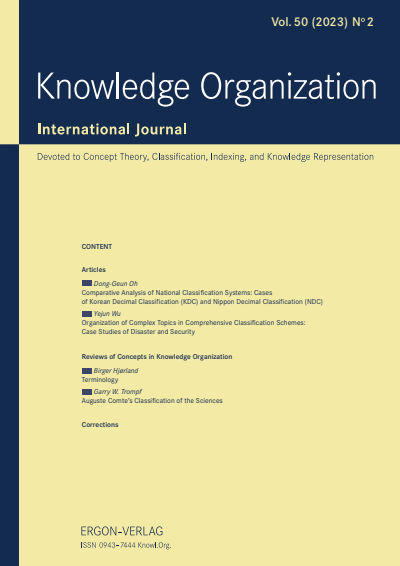
The Korean Decimal Classification (KDC) and Nippon Decimal Classification (NDC) are national classification systems of Korea and Japan. They have been used widely in many libraries of each country and maintained successfully by each national library...
This research investigates how comprehensive classifications and home-grown classifications organize complex topics. Two comprehensive classifications and two home-grown taxonomies are used to examine two complex topics: disaster and security. The...
This article introduces the field of terminology, which often considers the Austrian engineer Eugen Wüster as its founder in the 1930s, although important principles go back in time, in particular to 18th and 19th century botanists, zoologists and...
Auguste Comte is ostensibly the world’s most famous classifier of the sciences in modern history. His whole life was dedicated to establishing a classification that conformed to the ‘positivist’ (non-theological and non-metaphysical)...