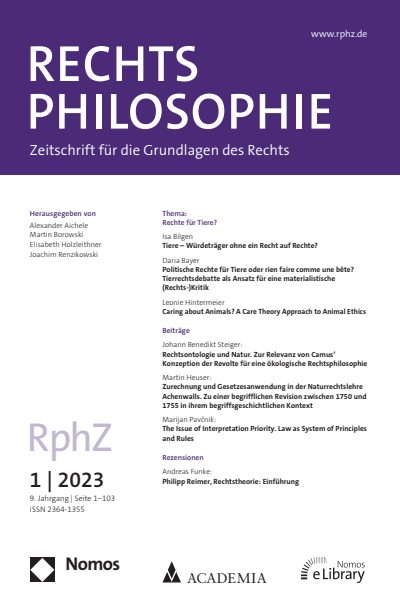
The main reason for human dignity is our capacity for autonomy. By virtue of our gift of reason we can relativize our purposes in the interests of others and set limits for ourselves. This also gives rise to our duty to recognize and respect...
This paper looks at the debate on animal rights since the so-called “political turn”. It argues that the question whether animals should have political rights can show the potential as well as the limits of the prevailing understanding of...
Engster’s care approach provides an interesting change of perspective to well-established approaches to animal ethics, such as utilitarianism and animal rights accounts: it shifts the focus towards justifying moral status based on...
The vast majority of studies concerning the ecological problems of the 21st century and their consequences for legal philosophy is based in legal ethics or moral philosophy. This article on the contrary takes an ontological perspective on the...
This article serves as an overview on Gottfried Achenwall’s principles of moral imputation specifically in their early development. In contrast to Joachim Georg Darjes, he claims that moral imputation consists in an application of the law. That is...
The central contentual characteristic of the legal principle is that it is a value measure directing the definition (creation) of legal rules as to their contents, the understanding of the rules, and the manner of their application. In relation to...