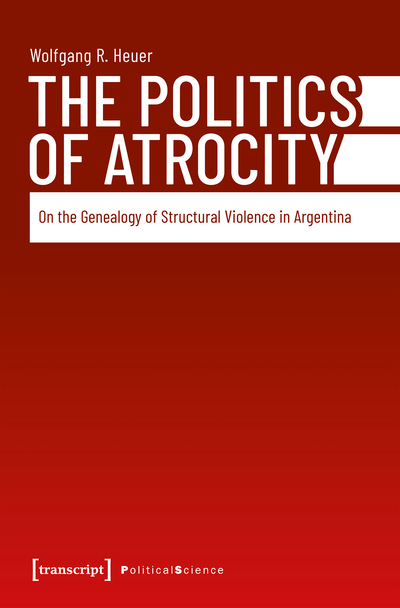
The Politics of Atrocity
On the Genealogy of Structural Violence in Argentina- Authors:
- Series:
- Edition Politik, Volume 198
- Publisher:
- 2026
Summary
The terror of Argentina’s last military dictatorship from 1976 to 1983, with an estimated 30,000 people murdered, is one of a series of violent conflicts that have taken every known form since independence from Spain in 1825: civil wars, dictatorships and genocide of the indigenous population. They are accompanied by a culture of violence and cruelty and reinforce social inequality, weakness and corruption in state institutions. Wolfgang R. Heuer tells the story of political violence in Argentina in short episodes, including early observations of genocide, metaphors of failure in literature, and the reasons for the failure of the Montoneros urban guerrilla movement. This shows that violence and anarchy, in the sense of weak politics, reinforce each other.
Keywords
Search publication
Bibliographic data
- Edition
- 1/2026
- Copyright Year
- 2026
- ISBN-Print
- 978-3-8376-8175-8
- ISBN-Online
- 978-3-8394-7760-1
- Publisher
- transcript, Bielefeld
- Series
- Edition Politik
- Volume
- 198
- Language
- English
- Pages
- 289
- Product Type
- Monograph
Table of contents
- FrontmatterPages 1 - 8 Download chapter (PDF)
- 1 PrefacePages 9 - 14 Download chapter (PDF)
- 2 Arrival in the PresentPages 15 - 21 Download chapter (PDF)
- 3 Crisis and ViolencePages 23 - 33 Download chapter (PDF)
- 4 State and AnarchyPages 35 - 44 Download chapter (PDF)
- 5 Caudillos and GauchosPages 45 - 93 Download chapter (PDF)
- 6 Patagonia, GenocidePages 95 - 131 Download chapter (PDF)
- 7 The Military OrderPages 133 - 165 Download chapter (PDF)
- 8 Perón, Perón, How Great You ArePages 167 - 202 Download chapter (PDF)
- 9 The Escalation of ViolencePages 203 - 227 Download chapter (PDF)
- 10. The Seven Deadly Sins of a GuerrillaPages 229 - 267 Download chapter (PDF)
- 11 LiteraturePages 269 - 284 Download chapter (PDF)