Soziale Arbeit, founded in 1951, is an independent academic journal which addresses developments in the context of social work. It is one of the most important publication media in its field and is read by teachers, students and researchers in social work and social pedagogy as well as by professionals and managers from associations and institutions. The journal’s aim is to promote professional development in social work fields by presenting methods and new concepts, in addition to subject-specific practical reports. In the ‘Rundschau’ (Review) section, information from all social fields is compiled. The ‘Tagungskalender’ (Conference Calendar) refers to important events, and the ‘Zeitschriftenbibliographie’ (Bibliography of Journals) lists current articles from professional journals. Soziale Arbeit is published 11 times a year with an annual focus issue published as a double issue. All scholarly articles submitted for publication in the journal undergo a double-blind peer review process. The editorial board is supported in an advisory capacity by a professional advisory board consisting of individuals from associations, universities, politics and administrative bodies. The journal cooperates with the academic societies of social work from Germany (DGSA) and Austria (OGSA). All social work contributions are indexed in the literature database DZI SoLit.
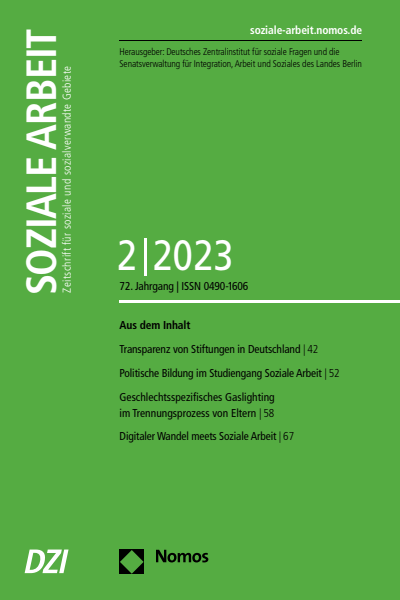
The article first takes a look at the foundation system in Germany and discusses the term "foundation". A quantitative survey of foundations in Germany on the subject of transparency provides insights into topics such as accounting, voluntary...
Politics and social work are closely linked and civic education is a frequent component of professional practice. In order to trace the relevance of the topics in the education of practicioners, module plans of bachelor programs of social work at...
Based on a qualitative study of parents' separation trajectories in different social milieus, risk factors for gender-specific gaslighting are identified. It can be shown that naturalistic ideals of parenthood, non-violent communication,...
Increasing digitization is also leading to far-reaching changes in social work. Many organizations are intensifying their efforts in this area. However, there are often implementation problems that can be avoided using the structured approach...