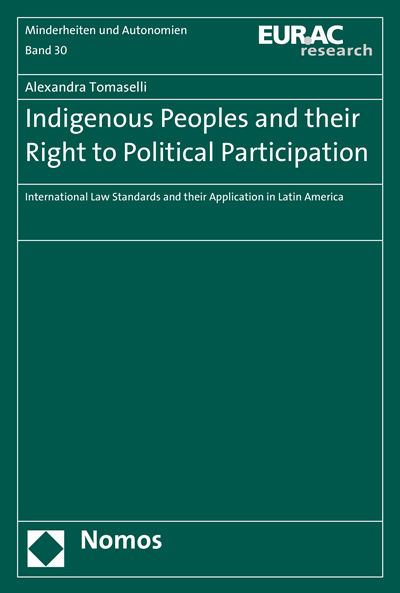
Indigenous Peoples and their Right to Political Participation
International Law Standards and their Application in Latin America- Authors:
- Series:
- Schriftenreihe der Europäischen Akademie Bozen, Bereich »Minderheiten und Autonomien«, Volume 30
- Publisher:
- 2016
Summary
Die UN-Gremien betonen zunehmend die Notwendigkeit, die politische Partizipation von indigenen Völkern zu verbessern. Dieses Buch schlägt ein umfassendes Recht auf politische Partizipation für indigene Völker vor, geht der Frage der Anerkennung im Völkerrecht nach und untersucht seine Anwendung in Bolivien und Chile - zwei Fallstudien in Lateinamerika, die unterschiedlich und dennoch ähnlicher als erwartet sind. Als Hauptquellen für die Anerkennung dieses Recht dienen die wichtigsten Grundlagen des internationalen Rechts, einschließlich der Urteile des Interamerikanischen Gerichtshofs für Menschenrechte. Diese Analyse schließt die nicht (rein) rechtlich verbindlichen Ergebnisse internationaler Organisationen, publizistische Abhandlungen und die wissenschaftliche Literatur anderer Disziplinen (Politikwissenschaften, Soziologie und Anthropologie) mit ein.
Die zwei Fallstudien dieses Buch decken einen Zeitraum von etwa 10 Jahren (2005-2015) ab und beurteilen die nationale Gesetzgebung und Umsetzung sowie die nationale Rechtsprechung.
Search publication
Bibliographic data
- Edition
- 1/2016
- Copyright Year
- 2016
- ISBN-Print
- 978-3-8487-2663-9
- ISBN-Online
- 978-3-8452-6878-1
- Publisher
- Nomos, Baden-Baden
- Series
- Schriftenreihe der Europäischen Akademie Bozen, Bereich »Minderheiten und Autonomien«
- Volume
- 30
- Language
- English
- Pages
- 558
- Product Type
- Monograph
Table of contents
- Titelei/Inhaltsverzeichnis No access Pages 1 - 20
- Introduction No access Pages 21 - 30
- The (Non-)Definition of Indigenous Peoples No access
- The international protection of indigenous rights No access
- Indigenous peoples’ land dispossession and recent evolutionary jurisprudence No access
- Brief overview of developments surrounding selfdetermination No access
- United Nations and Self-Determination No access
- Article 1.1 and the link with the political rights No access
- Article 1.2 and the right of peoples over natural wealth and resources No access
- Article 1.3 and the full exercise of the right to self-determination No access
- Legal conceptualizations of self‐determination No access
- Crucial aspects: Post-colonial self-determination; Selfdetermination as jus cogens; Singularity; and the People referred in Article 1 No access
- Recent developments in international law: The Responsibility to Protect and Remedial Secession No access
- Latest quests for self-determination: Scotland, Catalonia, and New Caledonia No access
- Concluding remarks No access
- Introduction No access
- References to the right of self-determination of indigenous peoples in the “Study of the Problem of Discrimination against Indigenous Populations” No access
- The UN Human Rights Committee, the Committee on Economic, Social and Cultural Rights and the right to self-determination of indigenous peoples No access
- Self-determination of indigenous peoples in the Draft Declaration on the Rights of Indigenous Peoples No access
- The shaping of the right to self-determination of indigenous peoples from the Draft Declaration to the UNDRIP’s formula No access
- The UNDRIP regime of self-determination and the right to autonomy of indigenous peoples No access
- The right to self-determination of indigenous peoples in the two American and African regional human rights systems No access
- The multifaceted right to self-determination of indigenous peoples No access
- The implications of the use of the term “people” No access
- Concluding remarks No access
- Introduction No access
- The “political rights” No access
- Concluding remarks No access
- Political rights of minorities in art.27 of the ICCPR No access
- Ad hoc political rights of minorities No access
- Participation within the State No access
- Participation in the form of autonomy/selfgovernment No access
- Concluding remarks No access
- Introduction No access
- The ad hoc rights of indigenous peoples to participation in domestic decision-making processes No access
- Ways to implement the right participation of indigenous peoples in domestic decision-making processes No access
- The Yatama case before the Inter-American Court of Human Rights and Indigenous peoples’ electoral rights No access
- The recognition of the rights to Consultation and Free, Prior and Informed Consent No access
- The core elements of the right to consultation No access
- Free, Prior and Informed Consent No access
- Consultation and FPIC No access
- Jurisprudence vis-à-vis the right to consultation and FPIC of Indigenous peoples No access
- International provisions recognizing the right to autonomy/self-government of Indigenous peoples and to preserve and/or establish their traditional institutions No access
- The debate on the right to autonomy of indigenous peoples No access
- Forms of indigenous autonomies No access
- Final considerations on indigenous peoples and autonomy No access
- Final considerations on the recognition of the composite right of political participation of indigenous peoples No access
- Concluding remarks No access
- Introduction No access
- An excursus on indigenous peoples’ recognition in the Latin American constitutions and recent developments No access
- The role of the Inter-American human rights bodies in protecting indigenous rights No access
- The increasing negotiating power of indigenous movements in Latin America No access
- Concluding remarks No access
- Socio-economic data No access
- Marginalization of indigenous peoples, the 1990 reforms, and the new Constitution No access
- International human rights law applicable to indigenous peoples in Bolivia No access
- Domestic protection of indigenous peoples’ rights No access
- Indigenous peoples’ representation at national and local level No access
- Legislative framework No access
- Decision No.2003/2010-R of the Constitutional Court No access
- Implementation of indigenous peoples’ right to consultation and the controversial case of TIPNIS No access
- The indigenous autonomy proposed by indigenous peoples in Bolivia No access
- Looking for a Bolivian history of autonomy No access
- The complex Bolivian (autonomous) administrative and territorial system No access
- Overall introduction to the AIOC and its legal framework No access
- The existing AIOCs: Process of creation and rules No access
- The regulation of new/future AIOCs No access
- Common conversion procedure and other norms No access
- The current status of the AIOCs No access
- Final remarks on the AIOCs No access
- Concluding remarks on the Bolivian case No access
- Data on indigenous peoples in Chile No access
- Introduction No access
- Indigenous peoples’ historical land dispossession No access
- The developments after the restoration of democracy No access
- The 2011 students’ mobilization, the 2014 elections and the hope for a change of Chilean institutions No access
- International human rights law applicable to indigenous peoples in Chile No access
- The lack of constitutional recognition No access
- The Indigenous Law and other norms No access
- The restrictive Chilean electoral system and the obstacles to indigenous peoples’ participation No access
- Initiatives to include indigenous peoples in decision-making processes No access
- The Mapuche Wallmapuwen party No access
- Legislative framework No access
- Application of the indigenous peoples’ right to consultation in Chile No access
- The recent Amparo proceedings vis-à-vis the right to consultation No access
- Participation through autonomy/self-government arrangements and the preservation of indigenous institutions – indigenous autonomy claims in Chile No access
- Concluding remarks on the Chilean case No access
- Conclusions No access Pages 507 - 520
- Selected Bibliography No access Pages 521 - 558