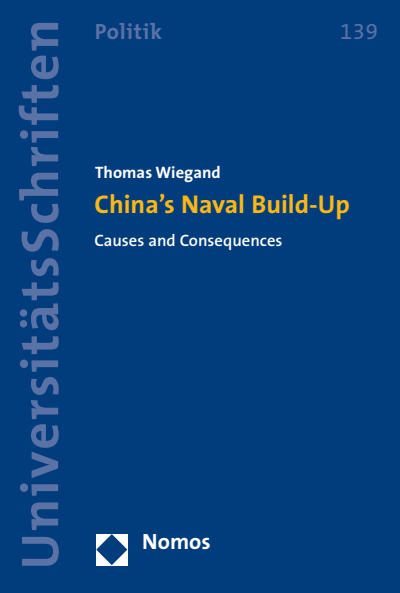
Since the early 1980ies China - the most populated country in the world - is undergoing an economical and social transformation which is without any parallel in history. If this process continues, the country will be the world"s biggest economy in the next two decades thus becoming a real superpower. While China is building up a world class economy, the country also modernizes its armed forces. This military build-up, foremost the creation of a blue water navy capable of operating on the high seas, causes growing concern and suspicion among its neighbors. The study is giving answers to the question why Beijing is building up its armed forces in this comprehensive manner. Which motives are underlying this modernization? Does Beijing try to achieve the hegemony in the Asian Pacific region?
Dr. Thomas Wiegand is a lecturer and researcher specialized in Asian Pacific security affairs. He is working for several academic and research institutions in Germany.
Search publication
Bibliographic data
Edition
1/2007
Copyright Year
2007
ISBN-Print
978-3-8329-2386-0
ISBN-Online
978-3-8452-0066-8
Publisher
Nomos, Baden-Baden
Series
Nomos Universitätsschriften - Politik
Volume
139
Language
English
Pages
144
Product Type
Monograph
Table of contents
ChapterPages
Titelei/Inhaltsverzeichnis No access Pages 2 - 10
Authors:
The motivation for the study No access Pages 11 - 12
Authors:
Structure of this study No access Pages 12 - 15
Authors:
Power as a factor in international politics – Hans J. Morgenthau No access Pages 16 - 19
Authors:
Man's limitations – Reinhold Niebuhr No access Pages 19 - 19
Authors:
Every man against every man – Thomas Hobbes No access Pages 19 - 20
Authors:
Aggression as a means of self-preservation – Konrad Lorenz No access Pages 20 - 21
Authors:
The struggle for survival – Charles Darwin No access Pages 21 - 23
Authors:
The psychological approach – Herbert Kelman No access Pages 23 - 24
Authors:
The political approach – Robert Jervis No access Pages 24 - 30
Authors:
Control of the seas and national power – Alfred T. Mahan No access Pages 30 - 33
Authors:
The functions of naval forces – Dieter Mahncke and Hans-Peter Schwarz No access Pages 33 - 35
Authors:
The elements of naval power – Sergei G. Gorshkov No access Pages 35 - 36
Authors:
The history of the navy of the People's Republic of China No access Pages 37 - 39
Authors:
The command structure and dispositioning of naval forces No access Pages 39 - 41
Authors:
Ships and weapons systems No access Pages 41 - 46
Authors:
Military strategy No access Pages 46 - 49
Authors:
Economic restructuring and its causes No access Pages 50 - 56
Authors:
The effects of the reforms on the national economy No access Pages 56 - 57
Authors:
Coal as a source of energy No access Pages 57 - 58
Authors:
The role of oil and gas in energy supplies No access Pages 58 - 60
Authors:
The political and economic significance of Central Asia No access Pages 60 - 64
Authors:
The development of international maritime law No access Pages 64 - 69
Authors:
The People's Republic of China and its territorial claims No access Pages 69 - 71
Authors:
China's maritime interests No access Pages 71 - 77
Authors:
The People's Republic of China and the international environment No access Pages 78 - 79
Authors:
The confrontation with Washington No access Pages 79 - 84
Authors:
The break with the USSR and cooperation with the USA No access Pages 84 - 95
Authors:
Authors:
The Taiwan question No access
Authors:
The different political systems No access
Authors:
The historical legacy No access Pages 112 - 113
Authors:
Japan as ally of the USA No access Pages 113 - 114
Authors:
The Japanese-Chinese rapprochement No access Pages 114 - 115
Authors:
Difficulties in the relationship between Beijing and Tokyo No access Pages 115 - 120
Authors:
Washington's strategic interests and the oceans No access Pages 121 - 124
Authors:
Japan's existential dependence on sea routes No access Pages 124 - 130
Authors:
The threat to Taiwan No access Pages 130 - 132
Authors:
Conclusion No access Pages 133 - 136
Authors:
Bibliography No access Pages 137 - 144
Authors:
Similar publications
from the series "Nomos Universitätsschriften - Politik"