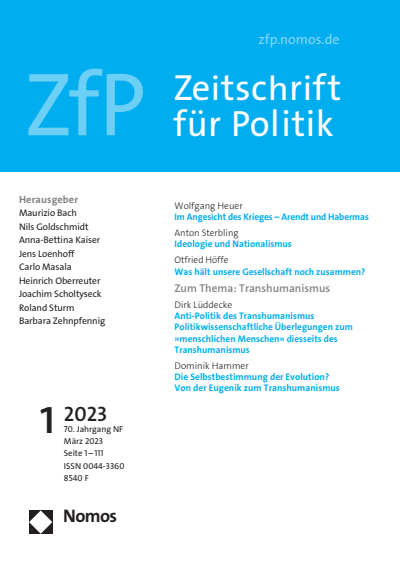
Zeitschrift für Politik sees its main goals in representing political science in its full range; in outlining its development in research and teaching and in serving as a forum for innovative academic discussions. It addresses scholars from various fields of research: political theory and philosophy, comparative political studies and international relations, political sociology, political economy and political law. Website: www.zfp.nomos.de
In their attitude towards war, Arendt and Habermas show great differences. Whereas Arendt publicly advocated the armed self-defense of the Jewish people against Hitler with great emotionality, Habermas warns against such emotionality and too much...
We are currently observing a worrying increase in ideology-led authoritarian states that are characterized by conspicuous nationalism. First of all, the concept of ideology is introduced. Then nationalism is viewed as an »ideology of integration«...
How do modern ("western") societies manage not to break apart, despite immense challenges, but still hold together, even if sometimes only "with groans and moans," and in many areas and respects bring forth impressive flourishing, economic,...
Transhumanism pursues the goal to continue the biological evolution technically controlled beyond the human being and to use all possibilities of the scientific progress to increase the probability of the post-human. These possibilities are imagined...
Modern eugenics, as it developed in the second half of the 19th century, represents a synthesis of revolutionary-utopian, social-reformist and individual approaches, which emerged to help overcome what was seen as the crisis of modernity. The idea...