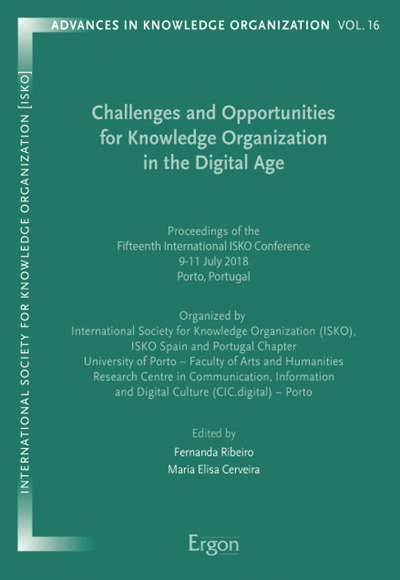
Challenges and Opportunities for Knowledge Organization in the Digital Age
Proceedings of the Fifteenth International ISKO Conference 9-11 July 2018 Porto, Portugal- Editors:
- |
- Series:
- Advances in Knowledge Organization, Volume 16
- Publisher:
- 2018
Summary
The 15th International ISKO Conference has been held in Porto (Portugal) under the topic Challenges and opportunities for KO in the digital age. ISKO has been organizing biennial international conferences since 1990, in order to promote a space for debate among Knowledge Organization (KO) scholars and practitioners all over the world.
The topics under discussion in the 15th International ISKO Conference are intended to cover a wide range of issues that, in a very incisive way, constitute challenges, obstacles and questions in the field of KO, but also highlight ways and open innovative perspectives for this area in a world undergoing constant change, due to the digital revolution that unavoidably moulds our society. Accordingly, the three aggregating themes, chosen to fit the proposals for papers and posters to be submitted, are as follows: 1 – Foundations and methods for KO; 2 – Interoperability towards information access; 3 – Societal challenges in KO. In addition to these themes, the inaugural session includes a keynote speech by Prof. David Bawden of City University London, entitled Supporting truth and promoting understanding: knowledge organization and the curation of the infosphere.
Keywords
Search publication
Bibliographic data
- Edition
- 1/2018
- Copyright Year
- 2018
- ISBN-Print
- 978-3-95650-420-4
- ISBN-Online
- 978-3-95650-421-1
- Publisher
- Ergon, Baden-Baden
- Series
- Advances in Knowledge Organization
- Volume
- 16
- Language
- English
- Pages
- 994
- Product Type
- Edited Book
Table of contents
- Titelei/Inhaltsverzeichnis No access
- Proceedings of the 15th International Conference International Society for Knowledge Organization. Introduction No access Pages 15 - 16
- Supporting truth and promoting understanding: Knowledge Organization and the curation of the infosphere No access Pages 17 - 26Authors:
- Among dictionaries, reference works and concept systems: can the terminology in International Standard ISO 5127: 2017 contribute toKnowledge Organization? No access Pages 27 - 42Authors:
- An Analysis of the theoretical and practical application of Diplomatics to archival description in Knowledge Organization No access Pages 43 - 51Authors: |
- Applied Knowledge Organization and the history of the world No access Pages 52 - 57Authors:
- Approaches to the concepts of exhaustivity and specificity in ISKO International meeting proceedings: 2000-2017 No access Pages 58 - 65Authors: | | | |
- Articulating a cultural research program for Knowledge Organization Systems No access Pages 66 - 73Authors: | |
- Aspects regarding the notion of subject in the context of different theoretical trends: teaching approaches in Brazil No access Pages 74 - 85Authors: |
- Automatic indexing and ontologies: the consistency of research chronology and authoring in the context of Information Science No access Pages 86 - 94Authors: | | | |
- Big data, Knowledge Organization and decision making: opportunities and limits No access Pages 95 - 102Authors: |
- Classification and Knowledge Organization Systems: ontologies and archival classification No access Pages 103 - 111Authors: |
- Classification of photographs: methodological concepts in Archival Science, Library Science and Museum Science No access Pages 112 - 119Authors: |
- Comparing the use of full text search between a conventional IR System and a DBMS No access Pages 120 - 127Authors:
- Computer-assisted checking of conceptual relationships in a large thesaurus No access Pages 128 - 136Authors: | | | |
- The Contribution of Semiotics to Knowledge Organization for music information No access Pages 137 - 143Authors: | |
- Critical questions for big data approach in knowledge representation and organization No access Pages 144 - 151Authors: |
- Developing a field of knowledge through bibliography: art history in the 16th century No access Pages 152 - 159Authors:
- Different parameters for Knowledge Organization in archives No access Pages 160 - 166Authors:
- Document representation with images: an experimental milestone No access Pages 167 - 175Authors: | | | |
- Domain analysis of scientific production in Information and Communication Technology in the context of small farmers No access Pages 176 - 183Authors: | |
- Epistemic communities, domain analysis, and Kuhn: dialogs and intersections in Knowledge Organization No access Pages 184 - 190Authors: | | |
- Epistemic LOCI: linguistic and critical meta-methodology in Knowledge Organization No access Pages 191 - 197Authors: |
- Epistemological challenges in Knowledge Organization in the digital age No access Pages 198 - 203Authors: |
- Facet: itself a multifaceted concept No access Pages 204 - 211Authors: |
- Feasibility of implementing PRESSoo model in organizing Persian serials No access Pages 212 - 223Authors: |
- Foundations and methods for Knowledge Organization in European iSchools courses No access Pages 224 - 230Authors:
- A Framework to represent variables and values in Social Science research data sets to support data curation and reuse No access Pages 231 - 239Authors: |
- The Genesis of Documentation in Brazil: Manoel Cícero Peregrino da Silva and Paul Otlet (1900-1924) No access Pages 240 - 247Authors: |
- Global Knowledge Organization, “super-facets” and music: universal music classification in the digital age No access Pages 248 - 255Authors: | |
- Historical ambiguity: a lens for approaching outdated terms No access Pages 256 - 264Authors:
- How Knowledge Organization helped to shape the emerging field of Terminology in Canada No access Pages 265 - 272Authors:
- Influence of metatheoretical research in Knowledge Organization No access Pages 273 - 281Authors: |
- Information and argument structures in Sociology research abstracts No access Pages 282 - 289Authors: |
- Information and knowledge ecology: a field for research in Knowledge Organization No access Pages 290 - 299Authors:
- Information from jussive processes No access Pages 300 - 307Authors:
- Intellectual history, history of ideas, and subject ontogeny No access Pages 308 - 313Authors:
- Is the massive incorporation of e-books into university libraries devaluing the technical processes related to the assigning of subject headings and classification codes? No access Pages 314 - 320Authors: | | |
- Knowledge Organization in editorial policies for titles, abstracts and keywords in JCR-indexed journals: an exploratory study in the areas of Information and Communication Sciences No access Pages 321 - 329Authors: | |
- Knowledge Organization in the health field: an ontology project to improve the information retrieval process No access Pages 330 - 338Authors: |
- Literary warrant-based approach to organize KO terminology: criteria and method No access Pages 339 - 346Authors: | | |
- Medical ontology: Siddha System of Medicine No access Pages 347 - 355Authors: |
- The Modern and its impact on models of information organization in Brazil: the decline of the National Library and the rise of the National Book Institute (1930-1954) No access Pages 356 - 362Authors: |
- The Onomasiological approach and the function of definitions in the elaboration of domain models in ontologies No access Pages 363 - 370Authors: |
- OntoM4IS: ontology reuse method for Information Science No access Pages 371 - 376Authors: |
- Parsimony in Biological and Colon Classifications No access Pages 377 - 379Authors:
- The Penumbra-line: Ranganathan’s journeys and the genesis of the APUPA pattern No access Pages 380 - 391Authors:
- Photography as a legitimate technique for domain analysis in Knowledge Organization No access Pages 392 - 399Authors:
- Reconstructionism: a comparative method for viewpoint analysis and indexing using the example of Kohlberg’s moral stages No access Pages 400 - 408Authors:
- A Relation typology in Knowledge Organization Systems: case studies in the research data management domain No access Pages 409 - 415Authors:
- Reorganization of knowledge in technical documents for the information system: the extraction of logico-cognitive information from heterogeneous administrative data No access Pages 416 - 425Authors: |
- The Retrieval power added by subject indexing to bibliographic databases No access Pages 426 - 431Authors:
- Risks and requirements of an applied Information Science research framework in healthcare No access Pages 432 - 441Authors: |
- Semantic warrant, cultural hospitality and knowledge representation in multicultural contexts: experiments with the use of the EuroVoc and UNBIS thesauri No access Pages 442 - 449Authors: |
- Solid Foundations and some secondary assumptions in the design of bibliographic metadata: toward a typology of complementary uses of metadata No access Pages 450 - 459Authors: |
- The Spirit of inquiry’s power to influence in 21st-century KO research: Jesse Shera and Margaret Egan No access Pages 460 - 467Authors: | | |
- Truth, relevance, and justice: towards a veritistic turn for KO No access Pages 468 - 474Authors:
- Verbal protocols in Brazilian Information Science: a perspective from indexing studies No access Pages 475 - 482Authors: | |
- Who is Tesauro? The man, words and things No access Pages 483 - 489Authors: | | |
- Wikipedia categories in research: towards a qualitative review of uses and applications No access Pages 490 - 498Authors: | |
- A Comparative analysis and evaluation of bibliographic ontologies No access Pages 499 - 510Authors:
- A Conceptual model for an OWL ontology to represent the knowledge of transmedia storytelling No access Pages 511 - 520Authors: |
- Connecting KOSs and the LOD Cloud No access Pages 521 - 529Authors: | | |
- Converting UDC to BCC: comparative approaches to interdisciplinarity No access Pages 530 - 538Authors: |
- Culturally relevant relationships: publishing and connecting digital objects in collections of archives, libraries, and museums over the Web No access Pages 539 - 548Authors:
- Derivative interpretation of biographical sketches (bios) supporting innovative information No access Pages 549 - 556Authors: |
- Extending the scope of library discovery systems via hashtags No access Pages 557 - 564Authors:
- An FRBR-based approach for transforming MARC records into linked data No access Pages 565 - 570Authors:
- From uniform identifiers to graphs, from individuals to communities: what we talk about when we talk about linked person data No access Pages 571 - 580Authors:
- Identifying semantic characteristics of user interaction datasets through application of a data analysis No access Pages 581 - 587Authors: | |
- Image organization on the Web: an analysis from the perspective of cultural heritage of rural farms in Brazil No access Pages 588 - 596Authors: | | |
- Information access in the digital era: document visualization strategy No access Pages 597 - 605Authors: |
- Integrating libraries, archives, museums and art galleries with Linked Data: initiatives study No access Pages 606 - 612Authors: | |
- Knowledge Organization in a Web collaborative environment No access Pages 613 - 623Authors: |
- Knowledge Organization Systems and cultural interoperability in open humanitarian settings No access Pages 624 - 632Authors:
- Knowledge Organization systems used in European national libraries towards interoperability of the semantic Web No access Pages 633 - 643Authors:
- The Need to interoperate: structural comparison of and methodological guidance on mapping discipline-specific subject authority data to wikidata No access Pages 644 - 652Authors:
- Phenomenon-based vs. disciplinary classification: possibilities for evaluating and for mapping No access Pages 653 - 661Authors: | | |
- Relationship status: libraries and linked data in Europe No access Pages 662 - 665Authors: |
- The Role of Knowledge Organization tools in open innovation platforms No access Pages 666 - 673Authors:
- Subject access of Mexican television news broadcasts on the Web No access Pages 674 - 683Authors: |
- Tags on healthcare information websites No access Pages 684 - 692Authors: |
- Towards integrated systems for KOS management, mapping, and access: Coli-conc and its collaborative computer-assisted KOS mapping tool Cocoda No access Pages 693 - 701Authors: | |
- Towards the semantic annotation and the prevention of the loss of information of second opinion requests from rural Brazilian primary healthcare providers: the Q-codes use case – a work in progress No access Pages 702 - 710Authors: | | | |
- Use of conceptual relations for semantic integration of scientific publications and research data No access Pages 711 - 719Authors: |
- A Value-based approach to modelling interoperability in Knowledge Organization Systems No access Pages 720 - 728Authors: | |
- VIAF and OpenCitations: cooperative work as a strategy for information organization in the linked data era No access Pages 729 - 736Authors: |
- Author information for Knowledge Organization in the digital age No access Pages 737 - 745Authors:
- Challenges of organization and retrieval of photographs on social networks on the Internet No access Pages 746 - 753Authors: | |
- Challenges to Knowledge Organization in the era of social media: the case of social controversies No access Pages 754 - 761Authors: | | |
- Copyright infringement: between ethical use and legal use of information No access Pages 762 - 769Authors: |
- Dealing with the paradoxes of customer opinion for effective decision support in churn management No access Pages 770 - 785Authors: | |
- Design Science as a methodology for the development of Knowledge Organization Systems in museological entities No access Pages 786 - 794Authors: | |
- Digital heritage: challenges and opportunities in the access and organisation of digital knowledge in contemporary societies No access Pages 795 - 803Authors:
- Enhancement of digital heritage through digital social networks No access Pages 804 - 811Authors: |
- Epistemology and Ethics of big data No access Pages 812 - 819Authors: |
- Information Design as knowledge technology in the organization of digital information environments on the Zika Virus and its effects No access Pages 820 - 829Authors:
- Intersectionality and the social construction of Knowledge Organization No access Pages 830 - 838Authors:
- Knowledge Organization in the digital age: the complexity of the global labor market No access Pages 839 - 847Authors: |
- Memories in dispute, and reconfigurations of cultural heritage: for an Ethnography of museums No access Pages 848 - 855Authors: |
- The Mobile phone between challenge and expectations: a potential for information sharing between Algerian breeders and veterinarians No access Pages 856 - 862Authors: | | |
- Negotiating participatory KO in crowdsourcing infrastructures No access Pages 863 - 870Authors:
- New ways to produce shared knowledge to improve cooperation in overcoming societal challenges in healthcare: the lever of innovative interface organizations in France No access Pages 871 - 879Authors:
- The Role of Neuroscience in information and knowledge appropriation No access Pages 880 - 891Authors: | | |
- Testing library catalog analysis as a bibliometric indicator for research evaluation in Social Sciences and Humanities No access Pages 892 - 899Authors: | |
- What do museum website users expect from linked open data? No access Pages 900 - 907Authors: |
- What is happening about KOS in Spain: scientific production analysis, 2000-2017 No access Pages 908 - 918Authors: |
- Challenges in management and Knowledge Organization of documental heritage: key factors in the methodology of diligent search for orphan works No access Pages 919 - 923Authors: | | |
- A Connotative trust-based paradigm to minify societal challenge(s) in Knowledge Organization Systems No access Pages 924 - 926Authors: | | |
- The Contribution of research on information quality to Knowledge Organizatio No access Pages 927 - 930Authors: | | |
- Creation of a domain ontology in CIDOC CRM OWL format using heterogeneous textual data related to industrial heritage No access Pages 931 - 936Authors: | | | |
- Diplomatic forensics: a necessary historical review for the analysis of the born-digital record No access Pages 937 - 939Authors: |
- The French military documentary system to anticipate health risk: content and information classification No access Pages 940 - 944Authors:
- Gamification as a system for developing knowledge in the classroom: a proposal based on an educational innovation project No access Pages 945 - 947Authors: | | | | |
- Interdisciplinary research organization: superimposing linked library data, linked research information and research data with interdisciplinary Knowledge Organization No access Pages 948 - 950Authors:
- Knowledge Organization and information retrieval in institutional repositories No access Pages 951 - 954Authors:
- Knowledge Organization System interoperability: the cogitation of user interfaces for better interactivity No access Pages 955 - 958Authors: | |
- Mapping perspectival ambiguity in Bioethics: revisiting the viewpoint warrant No access Pages 959 - 961Authors: | |
- A Model for decision making (DM) in territory management: social implications No access Pages 962 - 965Authors: |
- State of the art of organization and administration of libraries in Brazil: preliminary results No access Pages 966 - 968Authors: |
- Web archiving of elections and Brazilian possibilities No access Pages 969 - 972Authors: |
- The Politics of classification No access Pages 973 - 978Authors: | | | |
- Thematic representation and metadata of photographic documents No access Pages 979 - 982Authors: |
- List of Contributors and Authors’ Index No access Pages 983 - 992
- Programme Committee No access Pages 993 - 994