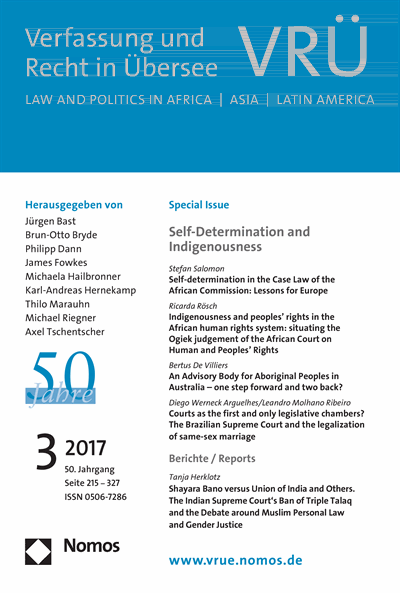
"Law and Politics in Africa, Asia and Latin America" analyses legal and constitutional developments in all states or regions outside of Europe as well as their regional and international integration. Founded in 1968 and inspired by decolonization and the idea of a cooperative new beginning, the Journal also promotes a special interest in contributions on 'Law and development'. The journal aims to provide a forum for a variety of perspectives on these fields of interest, be they focused on one country or comparative, theoretical or methodological in nature. Next to extensive articles, the journal publishes shorter reports about current events or conferences as well as book reviews. As a special service, each issue of "Law and Politics in Africa, Asia and Latin America" contains an international bibliography of relevant publications from around the world. This is compiled in cooperation with the Leibniz-Institute for Global and Regional Studies in Hamburg (GIGA). "Law and Politics" addresses authors and readers on all continents and aims to serve as a forum of mutual exchange. The journal is open for contributions from legal and social sciences as well as for analyses from practitioners. The journal is published quarterly and welcomes contributions in German, English, Spanish and French. Website: www.vrue.nomos.de
Looking at self-determination in contemporary Europe, one finds self-determination lumped together with the question of a possible right to remedial secession, either passionately defended or fervently rejected. Lumping self-determination and...
In May 2017, the African Court on Human and Peoples’ Rights delivered its first indigenous rights case dealing with the expulsion of the Ogiek from their ancestral lands in the Kenyan Mau forest. The article highlights the judgement’s most...
The Aboriginal Peoples of Australia have been demanding a form of constitutional recognition for many years. Whereas some other indigenous peoples in countries such as New Zealand, the USA and Canada have been partners to a ‘treaty’ at the time...
Since 2012, same-sex marriage has been legal in Brazil. This, however, was accomplished without the participation of any political branch: the only lawmaking actor involved was the Supreme Court. In existing studies on the judicialization of...