, to see if you have full access to this publication.
Edited Book No access
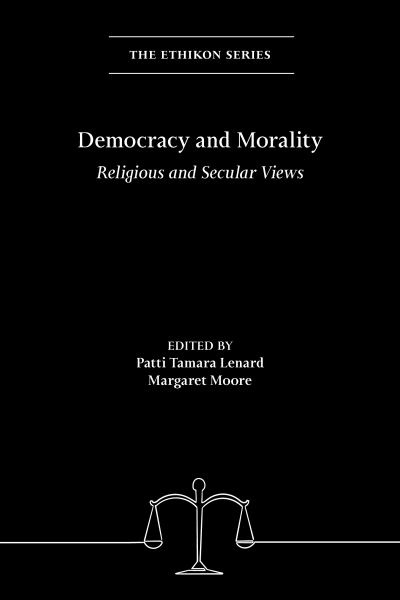
Democracy and Morality
Religious and Secular Views
Editors:
|
Publisher:
2024
Summary
Democracy is a dominant principle and practice to legitimate political power in the modern world, and yet its relationship with other moral traditions is not well understood. some but not all commitments with it (feminism, Classical and Egalitarian variants of Liberalism).
Ethical theories, by their very nature, are universal theories, and tend to be suspicious of democratic legitimacy arguments – since ‘the people’ who are the source of democratic legitimacy might support some things that are contrary to justice, as described in the tradition. Yet, appeal to democracy remains one of the most powerful appeals to legitimize political power in the contemporary world. This volume is interested in the relationship between democracy and moral traditions whose origins either precede the democratic ideal of legitimacy (Buddhism, Christianity, Confucianism, Hinduism, Islam, Judaism, Natural Law) or developed in some sense along side the democratic ideal and share some of its commitments. This volume explores the relationship between these moral traditions and democracy, including the way in which the moral and religious perspectives have adapted in their encounter with democratic ideals, and have themselves modified democratic theory and practice.
This is a work in comparative ethics. The contributors each an expert in one of these traditions, show how that traditions has confronted democracy – and considers different dimensions in which the traditions have engaged with the tradition. To orient the engagement between democratic principles and the moral traditions, the contributors focus on various dimensions in which the two have engaged. The contributors consider their tradition’s views of participation, including eligibility for participation and opportunities to do so, including people with quite different world-views; the scope of democracy, as conceived by the tradition, including how the democratic ‘people’ interact or ought to interact with adherents of other traditions, and whether some of the pillars of moral tradition have themselves helped to inform democratic principles and practices in communities where the ethical tradition is dominant. For example, if there are traditions of consultation and of appropriate authority in a moral tradition, does this operate as a resource for democracy itself, and if so, has it changed the way democracy is practiced in these societies?
What emerges is a rich and nuanced tapestry that testifies to the interaction of moral traditions and democracy, and the various relationships between these traditions and democratic theory and practice.
Keywords
Search publication
Bibliographic data
Edition
1/2024
Copyright Year
2024
ISBN-Print
978-1-5381-8889-7
ISBN-Online
978-1-5381-8891-0
Publisher
Rowman & Littlefield, Lanham
Language
English
Pages
292
Product Type
Edited Book
Table of contents
ChapterPages
Contents No access
Acknowledgments No access
Introduction No access Pages 1 - 4
Buddhism DEMOCRACY AND MORALITY IN BUDDHISM No access Pages 5 - 28
Christianity CHRISTIANITY AND DEMOCRACY No access Pages 29 - 54
Classical Liberalism CLASSICAL LIBERALISM, DEMOCRACY, AND MORALITY No access Pages 55 - 78
Confucianism DEMOCRACY AND MORALITY: A CONFUCIAN PERSPECTIVE No access Pages 79 - 106
Liberal Egalitarianism DEMOCRACY AND MORALITY: A LIBERAL EGALITARIAN PERSPECTIVE No access Pages 107 - 130
Feminism FEMINISM, DEMOCRACY, AND MORALITY No access Pages 131 - 148
Hinduism DEMOCRACY IN THE HINDU TRADITION No access Pages 149 - 174
Islam THE QUESTION OF DEMOCRACY IN MODERN ISLAMIC THOUGHT No access Pages 175 - 204
Judaism BEYOND ANARCHY AND MONARCHY: JEWISH APPROACHES TO DEMOCRACY No access Pages 205 - 220
Natural Law SHOULD POLITICAL SOCIETIES BE DEMOCRATIC? AN APPROACH FROM THE NATURAL LAW TRADITION No access Pages 221 - 244
Comparing the Traditions No access Pages 245 - 262
Selected Annotated Bibliography No access Pages 263 - 272