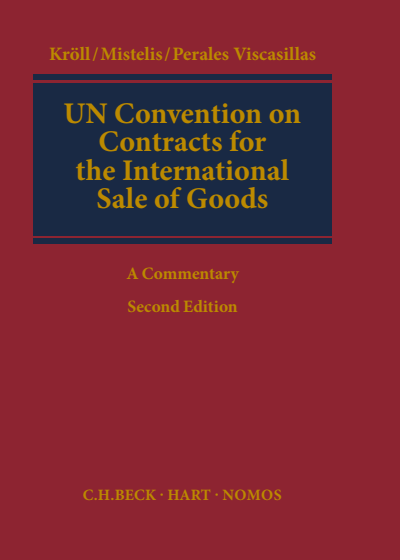
UN Convention on Contracts for the International Sale of Goods (CISG)
A Commentary- Editors:
- | |
- Series:
- Beck International
- Publisher:
- 2020
Summary
About the work
Almost thirty years after its entry into force, the CISG has become the law of international sales. In the meantime, 89 states have ratified the CISG, which make up for more than two thirds of the global trade. Already with its first edition, the commentary, written by leading international scholars and practitioners, has established itself on the market as the first truly international commentary on the CISG, taking into account the various legal settings in which the CISG is applied.
Praises for the 1st edition
‘The Kröll/Mistelis/Perales Commentary is an important contribution to the rich literature on this vital topic – a volume that should be in every library that intends to address the CISG seriously, and a work that deserves to be part of even a basic collection on the Convention.’
Harry M. Flechtner, The Rabel Journal 78/4 (2014) 883
‘No collection, related course materials, or decisionmakers’ cache of indispensible materials could possibly be complete without this scholarly, but quite readable, treatise designed for both novices and seasoned reader- users.’
The American Society of International Law Newsletter, September 2011
About the authors
Dr Stefan Kröll practises law in Cologne and is a professor of law at Bucerius Law School, Hamburg. Dr Loukas Mistelis is Clive M Schmitthoff Professor of Transnational Commercial Law and Arbitration and the director of the School of International Arbitration, London. Dr Pilar Perales Viscasillas holds the Chair of Commercial Law at the University Carlos III, Madrid. The authors are wellknown scholars and practitioners active in the field of CISG.
The international background of its authors and editors assures a broad and unbiased coverage of the CISG. In addition to the editors the following authors contribute to this commentary:
_ Prof. Dr. Yesmin M. Atamer, Turkey _ Prof. Dr. Ivo Bach, Germany _ Professor Gary Bell, Singapore _ Professor Andrea Bjoerklund, Canada _ Prof. Dr. Stavros Brekoulakis, United Kingdom _ Professor Michael Bridge, United Kingdom _ Prof. Dr. Petra Butler, New Zealand _ Prof. Dr. Milena Djordjevic, Serbia _ Professor Johan Erauw, Belgium _ Prof. Dr. Franco Ferrari, U.S. _ Arjun Harindranath, U.S. _ Professor Johnny Herre, Sweden_ Prof. Dr. Peter Huber, Germany _ Prof. Dr. Burghard Piltz, Germany _ Professor Anjanette Raymond, Bloomington, U.S. _ Dr. John Ribeiro, Japan _ Prof. Dr. Djakhongir Saidov, United Kingdom _ Professor Hiroo Sono, Japan _ Dr. Frank Spohnheimer, Germany _ Prof. Dr. Alberto Zuppi, Argentina
Search publication
Bibliographic data
- Edition
- 2/2020
- Copyright Year
- 2020
- ISBN-Print
- 978-3-406-71455-9
- ISBN-Online
- 978-3-406-75911-6
- Publisher
- C.H.BECK Recht - Wirtschaft - Steuern, München
- Series
- Beck International
- Language
- English
- Pages
- 1254
- Product Type
- Edited Book
Table of contents
- Titelei/Inhaltsverzeichnis No access Pages I - LXXXVI
- I. General Remarks No access
- 1. The search for an international sales law: driving forces and objectives No access
- 2. From the UNIDROIT Initiative to the Hague Uniform Laws No access
- 3. The drafting process and the adoption of the CISG No access
- 1. Legal nature of the CISG No access
- 2. Structure and content at a glance No access
- 3. Main Principles No access
- IV. The CISG’s Global Reach and Grounds for Success No access
- V. Impact on International and Regional Harmonization and National Modernization No access
- 1. The original scepticism No access
- 2. Increasing role in practice No access
- 3. Commodity Trade No access
- VII. Advantages of the CISG No access
- VIII. Working with the CISG No access
- IX. Contract Drafting No access
- X. Electronic Commerce No access
- Preamble No access Pages 19 - 20
- 1. General No access
- 2. Drafting history No access
- 3. Importance of provision No access
- 1. Sales contracts No access
- 2. Goods No access
- 3. Internationality No access
- 4. Automatic application if international sales contract No access
- 5. Territorial application – Contracting States No access
- 6. Application by operation of conflict of laws No access
- III. Comparable Rules No access
- I. Importance and Role of the Provision No access
- 1. Consumer sales No access
- 2. Sales by auction No access
- 3. Sales on execution or otherwise by authority of law No access
- 4. Sales of stocks, shares, investment securities, negotiable instruments or money No access
- 5. Sales of ships, vessels, hovercraft or aircraft No access
- 6. Sales of electricity No access
- 7. Burden of proof No access
- III. Comparable Rules No access
- 1. General No access
- 2. Drafting history No access
- 1. Contracts for the sale of goods to be manufactured or produced No access
- 2. Service Contracts No access
- 3. Software No access
- 4. Burden of proof No access
- III. Comparable Rules No access
- 1. General No access
- 2. Drafting history No access
- 1. Matters explicitly governed by the Convention No access
- 2. Matters explicitly excluded from the Convention No access
- 3. Other (non)contentious matters No access
- III. Comparable Rules No access
- 1. General No access
- 2. Drafting History No access
- 1. Death or personal injury caused by the goods No access
- 2. Death or personal injury caused by other means No access
- 3. Death or personal injury of third parties No access
- 4. Liability for property damage No access
- 5. Concurrent remedies No access
- III. Comparable Rules No access
- 1. General No access
- 2. Drafting history No access
- 1. Party autonomy No access
- 2. Methods of opting out No access
- 3. Derogation from or modification or exclusion of the CISG No access
- 4. Opting in – agreements to apply the CISG No access
- III. Comparable Rules No access
- I. Importance and Role of the Provision No access
- 1. Interpretation of the Convention (Art. 7(1)) No access
- 2. Gap-filling within the CISG (Art. 7.2) No access
- III. Comparable Rules No access
- 1. Introduction No access
- 2. Legislative history No access
- 1. First Paragraph No access
- 2. The second paragraph: The reasonable understanding No access
- 3. The third paragraph No access
- III. Comparable Rules No access
- 1. Introduction No access
- 2. Art. 9 in the context of the CISG: Hierarchy of rules No access
- 3. Validity No access
- 1. Practices established between the parties: Art. 9(1) No access
- 2. Agreed usages (Art. 9(1) No access
- 3. International usages of trade: Art. 9(2) No access
- 4. Conflict between usages No access
- 5. Procedural aspects/burden of proof No access
- 6. Extended application of Art. 9 No access
- 7. CISG and other instruments as usages of trade No access
- III. Comparable Rules No access
- I. Importance and Role of the Provision No access
- 1. Autonomous versus domestic meaning of “place of business No access
- 2. Essential elements of the term “place of business No access
- 3. Place of business that has the “closest relationship to the contract and its performance No access
- 4. Crucial factors for the determination of “the place of business that has the closest to the contract relationship No access
- 5. “Having regard to the circumstances known to or contemplated by the parties at any time before or at the conclusion of the contract No access
- 6. Art. 10(b) No access
- III. Comparable Rules No access
- I. Importance and Role of the Provision No access
- 1. Freedom of form No access
- 2. Freedom of evidence No access
- 3. Agreement of the parties requiring writing or evidence in writing No access
- 4. Electronic form and evidence No access
- III. Comparable Rules No access
- 1. Introduction No access
- 2. Drafting history No access
- 1. Scope of Art. 12 No access
- 2. Art. 96 reservation No access
- III. Comparable Rules No access
- I. Importance and Role of the Provision No access
- 1. Scope of Art. 13 No access
- 2. Expansive interpretation of Art. 13: fax and electronic means No access
- 3. Interpretation of Art. 13 in light of other international uniform law instruments No access
- III. Comparable Rules No access
- 1. Possibility of Reservation No access
- 2. Temporal sphere of application No access
- 1. Introduction No access
- 2. Standard Contract Terms No access
- 3. Other modes of contract conclusion No access
- 4. Commercial letter of confirmation No access
- III. Exclusion of Part II No access
- I. Importance and Role of the Provision No access
- 1. Proposal addressed to specific persons; invitation to make an offer No access
- 2. Intention to be bound No access
- 3. The specificity requirement No access
- 4. The requirement of indication of the purchase price and price determination absent such indication No access
- 5. Offer containing a clause excluding Part II No access
- 6. Incorporation of standard contract terms No access
- III. Comparable Rules No access
- I. Importance and Role of the Provision No access
- 1. Withdrawal No access
- 2. Death, insolvency and lack of legal capacity of the offeror No access
- III. Comparable Rules No access
- I. Importance and Role of the Provision No access
- 1. Revocation (para. 1) No access
- 2. The end of the offeror’s right to revoke No access
- 3. The Irrevocability of the offer (para. 2) as per the offer itself No access
- 4. Irrevocability of the offer (para. 2) due to the offeree’s justified reliance and the prohibition of venire contra factum proprium No access
- 5. Damages in case of revocation No access
- III. Comparable Rules No access
- I. Importance and Role of the Provision No access
- 1. Rejection No access
- 2. Legal effects of the rejection No access
- III. Comparable Rules No access
- I. Importance and Role of the Provision No access
- 1. Acceptance by express declaration, acceptance by conduct, silence and inactivity No access
- 2. Effectiveness of the declaration of acceptance No access
- 3. Time for acceptance (para. 2) No access
- 4. Burden of proof No access
- III. Comparable Rules No access
- I. Importance and Role of the Provision No access
- 1. Reply containing additions or different terms No access
- 2. Objection No access
- 3. Burden of proof No access
- III. Comparable Rules No access
- I. Importance and Role of the Provision No access
- 1. Beginning of the period for acceptance (para. 1) No access
- 2. Calculation and expiry of the period of time (para. 2) No access
- 3. The rule in Art. 20(2) as general principle upon which the CISG is based No access
- III. Comparable Rules No access
- I. Importance and Role of the Provision No access
- 1. Late acceptance and approval by the offeror No access
- 2. Lateness due to delays in transmission (Art. 21(2)) No access
- 3. Opportunity for speculation No access
- 4. Burden of proof No access
- III. Comparable Rules No access
- I. Importance and Role of the Provision No access
- 1. Withdrawal No access
- 2. Effects of a withdrawal No access
- III. Comparable Rules No access
- I. Importance and Role of the Provision No access
- 1. Time of contract conclusion No access
- 2. Place of contract conclusion No access
- III. Comparable Rules No access
- I. Importance and Role of the Provision No access
- 1. “Oral” declarations No access
- 2. Declarations by “other means No access
- 3. Preventing declarations from reaching the addressee No access
- 4. Burden of proof No access
- III. Comparable Rules No access
- I. Importance and Role of the Provision No access
- 1. Departure from domestic laws No access
- 2. Requirements for fundamental breach No access
- 3. Examples of fundamental breach No access
- III. Comparable Rules No access
- I. Importance and Role of the Provision No access
- 1. Form of notice No access
- 2. The possibility of implicit notice No access
- 3. Time period for notice to be given No access
- 4. Risk of non-delivery of notice No access
- III. Comparable Rules No access
- I. Importance and Role of the Provision No access
- 1. Dispatch rule and allocation of risk No access
- 2. Effect of dispatch of notice No access
- 3. Proof of dispatch No access
- 4. Applicability to telephonic communications No access
- 5. Applicability to email communications No access
- 6. Derogating from Art. 27 No access
- 7. Appropriateness of the means of communication No access
- III. Comparable Rules No access
- I. Importance and Role of the Provision No access
- 1. Specific performance under municipal law No access
- 2. The provisions of the Convention No access
- 3. Derogation from Art. 28 and party autonomy No access
- 4. Seller’s right to require payment of the price No access
- III. Comparable Rules No access
- I. Importance and Role of the Provision No access
- 1. Contract modification No access
- 2. The “pre-existing duty rule” at common law No access
- 3. No-oral-modification clauses No access
- III. Comparable Rules No access
- 1. Subject matter No access
- 2. Primary obligations of the seller No access
- 3. National laws No access
- 4. Vienna Conference No access
- 1. Seller’s obligation to deliver No access
- 2. Seller’s obligation to transfer property No access
- 3. Seller’s obligation to hand over documents No access
- 4. Party autonomy No access
- 1. Incoterms No access
- 2. PICC and PECL No access
- 3. DCFR No access
- 1. Subject matter No access
- 2. Breach of contract No access
- 3. Further context No access
- 4. National laws No access
- 5. Vienna Conference No access
- 1. Obligation to deliver No access
- 2. Sales involving carriage of the goods No access
- 3. Kinds of acts of delivery No access
- 4. Place of delivery No access
- 5. Further obligations of the seller No access
- 1. Incoterms No access
- 2. PICC and PECL No access
- 3. DCFR No access
- 1. Subject matter No access
- 2. Breach of contract No access
- 3. Further context No access
- 4. National laws No access
- 5. Vienna Conference No access
- 1. Notice of consignment No access
- 2. Carriage of the goods No access
- 3. Information regarding insurance No access
- 1. Incoterms No access
- 2. PICC and PECL No access
- 3. DCFR No access
- 1. Subject matter No access
- 2. Breach of contract No access
- 3. Further context No access
- 4. National laws No access
- 5. Vienna Conference No access
- 1. Party autonomy No access
- 2. Time for delivery No access
- 3. Art. 33(a), (b) and (c) No access
- 4. Part-deliveries No access
- 1. Incoterms No access
- 2. PICC and PECL No access
- 3. DCFR No access
- 1. Subject matter No access
- 2. Breach of contract No access
- 3. Further context No access
- 4. National laws No access
- 5. Vienna Conference No access
- 1. Handing over of documents No access
- 2. Right to cure No access
- 1. Incoterms No access
- 2. PICC and PECL No access
- 3. DCFR No access
- I. Importance of Section II in Practice No access
- II. Structure of Section II No access
- III. Differences Between the Liability Regimes for Non-conformity and Defects in Title No access
- IV. Differences in the Remedial Systems for Other Breaches No access
- V. Relationship to the National Remedies No access
- 1. Overview on the content No access
- 2. History No access
- 3. Terminology No access
- 4. Art. 35 as part of the CISG’s liability regime for non-conformity No access
- 1. The concept of non-conformity No access
- 2. Art. 35(1) No access
- 3. Art. 35(2) No access
- 4. Art. 35(3) No access
- 5. Exclusion of express and implied obligations as to conformity No access
- 6. Burden of proof No access
- 7. Relationship to the non-contractual remedies under national law No access
- III. Comparable Rules No access
- I. Importance and Role of the Provision No access
- 1. Art. 36(1) No access
- 2. Art. 36(2) No access
- 3. Burden of proof No access
- III. Comparable Rules No access
- I. Importance and Role of the Provision No access
- 1. Prerequisites for the right to cure under Art. 37 No access
- 2. Means of cure No access
- 3. Legal consequences No access
- 4. Burden of proof No access
- III. Comparable Rules No access
- 1. Content No access
- 2. Purpose of the duty to examine No access
- 3. Art. 38 as part of the CISG’s notification regime No access
- 4. History of the provision and its character No access
- 1. General remarks No access
- 2. Prevailing contractual agreements, practices and usages No access
- 3. Scope of the examination duty No access
- 4. Extent of the examination duty No access
- 5. Place of examination No access
- 6. Time period for examination No access
- 7. Examination in contract involving carriage: Art. 38(2) No access
- 8. Art. 38(3) No access
- 9. Costs of the examination duty No access
- 10. Sanctions No access
- 11. Waiver of the examination duty No access
- 12. Burden of proof No access
- III. Comparable Provisions No access
- 1. General remarks No access
- 2. Drafting history No access
- 3. Purpose of the notice requirement No access
- 4. Art. 39 as part of the CISG’s examination and notification regime No access
- 1. Introduction No access
- 2. Prevailing contractual agreements, practices and usages No access
- 3. Scope of application No access
- 4. Notice No access
- 5. The two years cut-off date in Art. 39 No access
- 6. Consequence of a failure to give notice No access
- 7. Exceptions No access
- 8. Waiver and exclusions of the right to invoke belated notice No access
- 9. Relationship with statutes of limitation No access
- 10. Acceptance of the goods as conforming No access
- 11. Burden of proof No access
- III. Comparable Rules No access
- I. Importance and Role of the Provision No access
- 1. General remarks No access
- 2. Prevailing contractual agreements, practices and usages No access
- 3. Scope of application No access
- 4. Seller’s actual or constructive knowledge No access
- 5. Disclosure to the buyer No access
- 6. Legal consequences and contractual modifications No access
- 7. Burden of proof No access
- III. Comparable Rules No access
- I. Importance and Role of the Provision No access
- 1. General remarks No access
- 2. Third party rights and claims No access
- 3. Time of the defects in title No access
- 4. Exclusion of liability No access
- 5. Remedies for defects in title No access
- 6. Art. 41 and domestic rules providing for nullity of the contract No access
- 7. Burden of proof No access
- III. Comparable Rules No access
- I. Importance and Role of the Provision No access
- 1. General remarks No access
- 2. Third party rights and claims No access
- 3. Based on industrial property or other intellectual property No access
- 4. Territorial limitations No access
- 5. Relevant time No access
- 6. Seller’s actual or constructive knowledge No access
- 7. Exceptions from liability under Art. 42(2) No access
- 8. Remedies No access
- 9. Burden of proof No access
- III. Comparable Rules No access
- I. Importance and Role of the Provision No access
- 1. General remarks No access
- 2. Notice No access
- 3. Notice period No access
- 4. Legal consequences of a failure to give notice No access
- 5. Exclusion of reliance on a failure to give notice in time: Art. 43(2) No access
- 6. Burden of proof No access
- III. Comparable Rules No access
- I. Importance and Role of the Provision No access
- 1. General remarks No access
- 2. Scope of application No access
- 3. Reasonable excuse No access
- 4. Legal consequences No access
- 5. Burden of proof No access
- III. Comparable Rules No access
- I. Importance and Role of the Provision No access
- 1. System of remedies (para. 1) No access
- 2. Damages and other remedies (para. 2) No access
- 3. No period of grace (para. 3) No access
- III. Comparable Rules No access
- 1. Purpose No access
- 2. Outline No access
- 3. Distinction between Art. 46(1) and Art. 46(2), (3): The concept of non-conformity No access
- 1. General claim for performance (Art. 46(1) No access
- 2. Substitute delivery (Art. 46(2) No access
- 3. Repair (Art. 46(3) No access
- 4. Burden of proof No access
- III. Comparable Rules No access
- I. Importance and Role of the Provision No access
- 1. Requirements No access
- 2. Consequences No access
- 3. Burden of proof No access
- III. Comparable Rules No access
- I. Importance and Role of the Provision No access
- 1. Right to cure under Art. 48(1) No access
- 2. Right to cure under Art. 48(2) No access
- 3. Burden of proof No access
- III. Comparable Rules No access
- I. Importance and Role of the Provision No access
- 1. Outline of the requirements No access
- 2. Avoidance for fundamental breach (Art. 49(1)(a)) No access
- 3. Avoidance using the Nachfrist-procedure (Art. 49(1)(b)) No access
- 4. Declaration of avoidance and time limits No access
- 5. Burden of proof No access
- 6. Effects of avoidance No access
- III. Comparable Rules No access
- 1. History of the provision No access
- 2. Importance of the provision No access
- 3. Nature of the remedy No access
- 4. Position in the system of remedies No access
- 1. Requirements No access
- 2. Legal consequences No access
- 3. Burden of proof No access
- 4. Interaction with other remedies No access
- III. Comparable Rules No access
- 1. The general rule: narrowing the view under Art. 51(1) No access
- 2. The exception: re-expanding the view under Art. 51(2) No access
- 3. Application to instalment contracts No access
- 1. Prerequisites No access
- 2. Legal consequences No access
- 3. Burden of proof No access
- III. Comparable Rules No access
- I. Importance and Role of the Provision No access
- 1. Early delivery No access
- 2. Excessive delivery No access
- 1. Early delivery No access
- 2. Excessive delivery No access
- I. Importance and Role of the Provision No access
- 1. Overview No access
- 2. Purchase price No access
- 3. Payment arrangements No access
- 4. Payment clauses No access
- 5. Duty to take delivery No access
- 6. Further duties No access
- 7. Choice of payment debt No access
- 8. Practical considerations No access
- III. Comparable Rules No access
- I. Importance and Role of the Provision No access
- 1. Scope of the duty No access
- 2. Currency No access
- 3. The buyer’s breach of his obligation(s No access
- 4. Practical questions No access
- III. Comparable Rules No access
- I. Importance and Role of the Provision No access
- 1. When does it apply No access
- 2. How does it apply No access
- 3. Burden of proof No access
- III. Comparable Rules No access
- I. Importance and Role of the Provision No access
- 1. Overview No access
- 2. Practical considerations No access
- IV. Comparable Rules No access
- I. Importance and Role of the Provision No access
- 1. Overview No access
- 2. Party agreement (Art. 57(1) first sentence No access
- 3. Payment at the seller’s place of business (Art 57(1)(a), (2)) No access
- 4. Payment against the handing over of the goods or of documents (Art. 57(1)(b)) No access
- 5. Place of payment of monetary claims other than the purchase price No access
- 6. Practical considerations No access
- III. Comparable Rules No access
- I. Importance and Role of the Provision No access
- 1. Buyer’s right to examine the goods (Art. 58(3)) No access
- 2. Time the purchase price becomes due No access
- 3. Divergent agreements No access
- 4. Documents No access
- 5. Rights of retention (Arts 58(1) second sentence and 58(2)) No access
- 6. Payment ahead of time, part payment No access
- 7. Application to other buyer’s obligations No access
- 8. Practical considerations No access
- III. Comparable Rules No access
- I. Importance and Role of the Provision No access
- II. Detailed Commentary No access
- III. Comparable Rules No access
- I. Importance and Role of the Provision No access
- 1. Content of the duty to take delivery No access
- 2. Refusal to take delivery No access
- 3. Practical considerations No access
- III. Comparable Rules No access
- Introduction to Articles 61–65 No access
- I. Importance and Role of the Provision No access
- 1. Remedies available to the seller (Art. 61(1)) No access
- 2. Damages can be cumulated with other remedies (Art. 61(2)) No access
- 3. Court may not grant a period of grace (Art. 61(3)) No access
- III. Comparable Rules No access
- I. Importance and Role of the Provision No access
- 1. The right to specific performance No access
- 2. Limitations on the right to specific performance No access
- III. Comparable Rules No access
- I. Importance and Role of the Provision No access
- 1. The fixing of an additional period of time of reasonable length (63(1)) No access
- 2. The suspension of other remedies during the additional period of time (63(2)) No access
- III. Comparable Rules No access
- I. Importance and Role of the Provision No access
- 1. The right to declare the contract avoided (64(1)) No access
- 2. Losing the right to declare the contract avoided (Art. 64(2)) No access
- III. Comparable Rules No access
- I. Importance and Role of the Provision No access
- 1. Purpose of Art. 65 and the mechanism it sets in place No access
- 2. Criticism of Art. 65 – a cumbersome process which will not be used most of the time No access
- III. Comparable Rules No access
- I. Importance and Role of the Provision No access
- 1. Price-risk No access
- 2. The risk transferred but reduced through the use of a remedy for the buyer No access
- 3. An act or omission by the seller – posterior alleviation of risk No access
- 4. Determining which risks are transferred to the buyer No access
- 5. Contractual risk No access
- 6. Damage caused by the goods themselves No access
- III. Comparable Rules No access
- I. Importance and Role of the Provision No access
- 1. Handing over the goods No access
- 2. Clearly identifying the goods No access
- 3. Art. 67’s relationship with terms agreed by the parties No access
- III. Comparable rules No access
- I. Importance and Role of the Provision No access
- 1. Terminology No access
- 2. Carrier and documents No access
- 3. Retroactive allocation of risk No access
- 4. Loss or damage to the goods No access
- III. Comparable Rules No access
- I. Importance and Role of the Provision No access
- 1. Goods placed at buyer’s disposal – at the seller’s place of business No access
- 2. Goods placed at buyer’s disposal – other than at the seller’s place of business No access
- 3. Identification No access
- 4. Incoterms No access
- III. Comparable Rules No access
- I. Importance and Role of the Provision No access
- II. Detailed Commentary No access
- III. Comparable Rules No access
- Introduction to Articles 71–73 No access
- I. Importance and Role of the Provision No access
- 1. The exercise of the right of suspension No access
- 2. Stoppage in transit No access
- 3. Suspension and burden of proof No access
- 4. Adequate assurance No access
- 5. Cessation of suspension No access
- 6. Damages No access
- III. Comparable Rules No access
- I. Importance and Role of the Provision No access
- 1. General No access
- 2. The relationship between Art. 72 paras 1 and 3 No access
- 3. The standard of prognosis No access
- 4. The nature of events giving rise to the right to avoid No access
- 5. Burden of proof No access
- 6. Notice under Art. 72(2); burden of proof No access
- 7. Adequate assurance; burden of proof No access
- 8. Refusal to perform (Art. 72(3)); burden of proof No access
- 9. Damages and mitigation of loss No access
- III. Comparable Rules No access
- I. Importance and Role of the Provision No access
- 1. Definition No access
- 2. Art. 73(1) No access
- 3. Art. 73(2) No access
- 4. Art. 73(3) No access
- III. Comparable Rules No access
- 1. General remarks No access
- 2. Drafting history No access
- 1. Specific requirements No access
- 2. Limitations on damages No access
- 3. Calculation of damages No access
- 4. Specific cases No access
- 5. Other matters No access
- III. Comparable Rules No access
- 1. General remarks No access
- 2. Drafting history No access
- 1. Specific requirements No access
- 2. Calculating damages No access
- 3. Special considerations No access
- III. Comparable Rules No access
- 1. General remarks No access
- 2. Drafting history No access
- 1. Specific requirements No access
- 2. Calculating damages No access
- 3. Special consideration; anticipatory breach No access
- III. Comparable Rules No access
- 1. General remarks No access
- 2. Drafting history No access
- 1. Scope of application No access
- 2. Extent of a duty No access
- 3. Legal consequences No access
- III. Comparable Rules No access
- I. Drafting History, Importance and Role of the Provision No access
- 1. Scope and Requirements No access
- 2. Calculation No access
- 3. Modalities of Payment No access
- 4. Cessation of an Interest Claim No access
- III. Comparable Rules No access
- I. Importance and Role of the Provision No access
- 1. Scope of application of the norm No access
- 2. Prerequisites of exemption No access
- 3. Exemption from liability for the conduct of third persons No access
- 4. Risk allocation in specific cases No access
- 5. Contractual risk allocation No access
- 6. Duty to notify No access
- 7. Burden of proof No access
- III. Comparable Rules No access
- I. Importance and Role of the Provision No access
- 1. Prerequisites of exemption for non-performance No access
- 2. Legal consequences No access
- 3. Burden of proof No access
- III. Comparable Rules No access
- 1. Drafting history No access
- 2. Basis of right of avoidance No access
- 3. Release from performance obligations No access
- 4. Surviving provisions No access
- 5. New rights and duties No access
- 6. Related contracts No access
- 7. Agreements to avoid No access
- 8. Property No access
- 1. Restitution of performance No access
- 2. Partial restitution No access
- 3. Concurrency and security No access
- 4. Place of restitution of goods No access
- 5. Place of restitution of price No access
- 6. Costs connected with restitution No access
- 7. Exempted parties No access
- 8. Time of restitution No access
- 9. Risk No access
- III. Comparable Rules No access
- 1. Drafting history No access
- 2. Time available for avoidance No access
- 3. Availability of avoidance No access
- 4. Substitute goods No access
- 5. Loss of avoidance right in other cases No access
- 6. Avoidance and risk No access
- 7. Avoidance by the seller No access
- 1. Comparison with ULIS No access
- 2. The condition of the goods: general No access
- 3. Partial avoidance No access
- 4. Deterioration of the goods No access
- 5. Exceptions to restitutionary requirement for avoidance No access
- III. Comparable Rules No access
- 1. Drafting history No access
- 2. General No access
- II. Detailed Commentary No access
- III. Comparable Rules No access
- 1. Drafting history No access
- 2. General No access
- 1. Concurrency No access
- 2. Set-off No access
- 3. Payment of interest No access
- 4. Currency of interest No access
- 5. Accounting for benefits from the goods No access
- III. Comparable Rules No access
- Introduction to Articles 85–88 No access
- 1. The function of Art. 85 No access
- 2. Legislative history No access
- 1. Conditions No access
- 2. Consequences No access
- III. Comparable Rules No access
- 1. The function of Art. 86 No access
- 2. Legislative history No access
- 1. Buyer’s duty to preserve the goods (Art. 86(1)) No access
- 2. Buyer’s duty to take possession of the goods (Art. 86(2)) No access
- III. Comparable Rules No access
- 1. The function of Art. 87 No access
- 2. Legislative history No access
- 1. Condition No access
- 2. Consequences No access
- III. Comparable Rules No access
- 1. The function of Art. 88 No access
- 2. Legislative history No access
- 1. Right of self-help sale (Art. 88(1)) No access
- 2. Duty of emergency sales (Art. 88(2)) No access
- 3. Use of proceeds of sale (Art. 88(3)) No access
- 1. Self-help and emergency sales No access
- 2. Electronic notice No access
- I. Importance and Role of the Provision No access
- II. Comparable Rules No access
- I. Importance and Role of the Provision No access
- II. Detailed Commentary No access
- III. Comparable Rules No access
- I. Importance and Role of the Provision No access
- II. Comparable Rules No access
- I. Importance and Role of the Provision No access
- Illustration 1 No access
- Illustration 2 No access
- Illustration 3 No access
- I. Importance and Role of the Provision No access
- II. Detailed Commentary No access
- III. Comparable Rules No access
- I. Importance and Role of the Provision No access
- II. Detailed Commentary No access
- III. Comparable Rules No access
- I. Importance and Role of the Provision No access
- Illustration 1 No access
- Illustration 2 No access
- Illustration 3 No access
- Illustration 4 No access
- Illustration 5 No access
- Illustration 6 No access
- Illustration 7 No access
- III. Comparable Rules No access
- I. Importance and Role of the Provision No access
- II. Detailed Commentary No access
- III. Comparable Rules No access
- Importance and Role of the Provision No access
- Importance and Role of the Provision No access
- Importance and Role of the Provision No access
- Importance and Role of the Provision No access
- Importance and Role of the Provision No access
- Importance and Role of the Text No access
- Bibliography No access Pages 1203 - 1234
- Index No access Pages 1235 - 1254