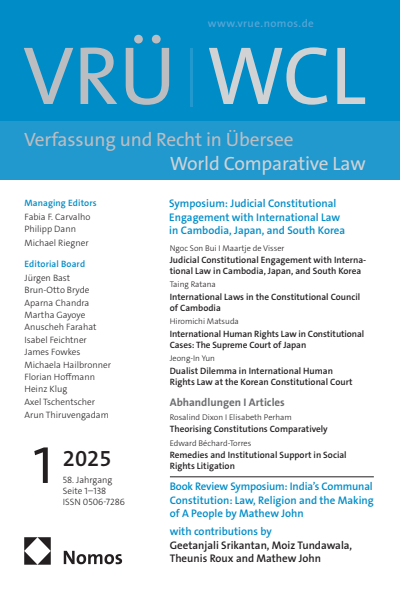
"Law and Politics in Africa, Asia and Latin America" analyses legal and constitutional developments in all states or regions outside of Europe as well as their regional and international integration. Founded in 1968 and inspired by decolonization and the idea of a cooperative new beginning, the Journal also promotes a special interest in contributions on 'Law and development'. The journal aims to provide a forum for a variety of perspectives on these fields of interest, be they focused on one country or comparative, theoretical or methodological in nature. Next to extensive articles, the journal publishes shorter reports about current events or conferences as well as book reviews. As a special service, each issue of "Law and Politics in Africa, Asia and Latin America" contains an international bibliography of relevant publications from around the world. This is compiled in cooperation with the Leibniz-Institute for Global and Regional Studies in Hamburg (GIGA). "Law and Politics" addresses authors and readers on all continents and aims to serve as a forum of mutual exchange. The journal is open for contributions from legal and social sciences as well as for analyses from practitioners. The journal is published quarterly and welcomes contributions in German, English, Spanish and French. Website: www.vrue.nomos.de
Interdisciplinary research in comparative constitutional law and politics is often talked about but rarely theorized or practised. And yet, such research is urgently required to meet the complex problems posed by the rise of populist...
After the end of Liberia’s civil war in 2003, the country embarked upon the reform of its forest and land legislation. This culminated in the adoption of the 2009 Community Rights Law with Respect to Forest Lands and the 2018 Land Rights Act,...
This article discusses the challenges of legislative systematization and inter-institutional coordination that have emerged as a result of the anti-corruption movement in Brazil in recent years. We contextualize the forthcoming discussion by...
In this article, I discuss the need to constitutionalize independent national institutions in Cameroon. Even though a considerable number of these institutions exist in Cameroon, for more practical reasons this study specifically delves into the...
Namibia gained independence and ended the rule of apartheid only in 1990. It is often lauded as a model of human rights-based countries in Africa. Immediately after independence, the country introduced a distinctly rights-based Constitution with a...