Edited Book Open Access Full access
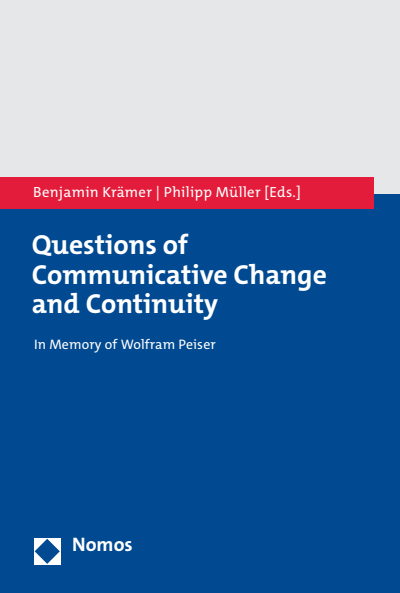
Questions of Communicative Change and Continuity
In Memory of Wolfram Peiser- Editors:
- |
- Publisher:
- 2022
Keywords
Search publication
Bibliographic data
- Copyright Year
- 2022
- ISBN-Print
- 978-3-8487-8402-8
- ISBN-Online
- 978-3-7489-2823-2
- Publisher
- Nomos, Baden-Baden
- Language
- English
- Pages
- 316
- Product Type
- Edited Book
Table of contents
ChapterPages
- Titelei/InhaltsverzeichnisPages 1 - 6 Download chapter (PDF)
- Authors: |Download chapter (PDF)
- Cycles and Continuities
- Competitions and Coexistences
- Crises and Comparisons
- Catastrophes and Choices
- References
- Authors:Download chapter (PDF)
- What Kind of Theory?
- The Problems with Bad Theory
- Some Types of Insufficiently Systematic Theorizing
- Problems with the Validity of Theories and Measurements
- Problems with Critical Reflection of Studies and with Conclusions
- Conclusion
- References
- Authors:Download chapter (PDF)
- Changes in the Media Landscape
- Mediated Communication as a Key Concept?
- Public Communication 2.0 as the Subject of the Field
- Data Specification and Adaptation of Methods
- Conclusion
- References
- Authors:Download chapter (PDF)
- Relations
- Dynamics
- Limitations of Public Sphere Theory
- Limitations of Social Network Analysis
- Modes of Interaction as Constellations of Actors
- Modes of Interaction – A Literature Review
- Dyadic Modes of One-Way Communication
- Dyadic Modes of Two-Way Communication
- Triadic Modes of Indirect Communication
- Systematization
- Modes of Interaction in Subsystems of Society
- The Context of Mass Media
- The Internet as Context
- Conclusion
- References
- Authors:Download chapter (PDF)
- Social Identity
- Small Groups as Information Processors
- Application to Large Groups Online
- Automatic vs. Systematic Processing
- Closed vs. Open Processing
- Participation
- Selectivity
- Interaction
- Interconnectedness
- Automatization
- For Automatic Processing
- For Systematic Processing
- For Closed Processing
- For Open Processing
- Automatic vs. Systematic Processing Online
- Closed vs. Open Processing Online
- Conclusion
- References
- Authors: |Download chapter (PDF)
- Forms and Measurement of Political Mass Polarization
- Political Mass Polarization and Fragmentation
- Origins and Consequences of Political Mass Polarization
- Social Media Use: A Driver of Political Mass Polarization?
- Literature Selection
- Literature Categorization
- Fragmentation or Polarization?
- Group Polarization
- Quantitative Review of Studies
- Qualitative Review of Studies
- Evidence from Dual-Party Systems and Multi-Party Systems
- Specific Social Media Platforms and Method Choices
- Fragmentation vs. Polarization Studies
- Takeaways and Research Desiderata
- References
- Appendices
- Authors:Download chapter (PDF)
- Causes, Relevance, and Consequences of the Problem
- State of Research
- The ‘Journalistic Quality’ Dimension
- The ‘Attention’ Dimension
- The Contingency-Oriented Linguistic Dimension at the Text Level
- The Dimension ‘Persuasion and Ethics in PR’
- Differentiation Dimensions from an Audience Perspective: Recipient Characteristics and Reception Behavior
- Operationalization Concept: Design of a Structural Model
- Selection of Study Design and Stimulus Material for Audience Research
- Content Analyses
- Concluding Remarks
- References
- Authors:Download chapter (PDF)
- Defining Political Advertising
- Framework Conditions
- What Do We Know About the Effects of Political Advertising?
- Conclusion
- References
- Authors:Download chapter (PDF)
- Different Models of Media Systems
- Media Systems and Media Content
- Systematizing Literature Review
- Media Use
- Political Knowledge
- The Relevance of Political Parallelism
- Cross-Cutting Exposure
- Audience Fragmentation
- Online Political Participation
- Media and Social Change
- Synopsis
- Concluding Remarks
- References
- Authors: |Download chapter (PDF)
- Freedom of Speech in the Context of Misogynistic Statements
- Types of (Potentially) Harmful Speech
- Predictors of the Perception of (Potentially) Harmful Speech
- Dependent Variables
- Sociodemographics
- Experiences of Discrimination
- Political Predispositions
- Media Trust
- Descriptive Analyses of Perceptions of (Potentially) Harmful Statements
- Explanatory Analyses of Predictors of the Perceptions of (Potentially) Harmful Statements
- Conclusion
- References
- Authors:Download chapter (PDF)
- Measurement
- Analyses
- Results
- Summary, Conclusions and Discussion
- References
- Authors: | |Download chapter (PDF)
- Conceptions of Media Realism
- Realism Assessments by Users
- Method
- Mainstream Media Audience (MMA, 18.6 %)
- Professional Journalism Objectivists (PJO, 18.6%)
- Citizen Oriented (CO, 17.7 %)
- Mainstream Media Skeptics (MMS, 4.9%)
- Coherence-Seekers (CS, 19.8%)
- Independents (IN, 20.3%)
- Conclusion
- References