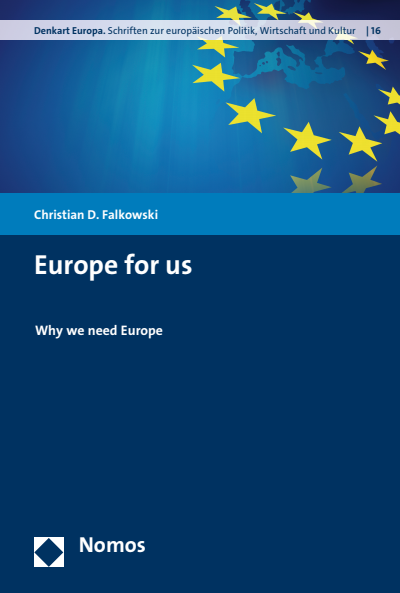
Europe for us
Why we need Europe- Authors:
- Series:
- Denkart Europa | Mindset Europe, Volume 16
- Publisher:
- 2011
Summary
Die friedliche Wiedervereinigung Europas ist ein historischer Erfolg für den Kontinent. Die Begründung für die Europäische Union aus der Überwindung nationalstaatlicher Rivalitäten ist heute, angesichts neuer weltweiter Herausforderungen, nicht mehr ausreichend. Europa bleibt nicht verschont von den globalen Problemen, wie die Verknappung von Ressourcen bei einer weiter wachsenden Weltbevölkerung, die Folgen der globalen Erwärmung, Migration oder dem Verlust an Artenvielfalt. Das Buch analysiert globale Trends, die Bedeutung der aufsteigenden Akteure wie China, Indien, Brasilien und die zukünftige Rolle Europas auch im Verhältnis zu den USA und Russland.
Die einzelnen europäischen Länder verlieren in einer neuen multipolaren Weltordnung an Bedeutung. Die Europäische Union ist mehr als die Summe ihrer Mitgliedstaaten. Sie ist der Garant für Sicherheit, Freiheit und Wohlstand in einer Welt, in der Größe und Macht gelten und sie ist der Motor für nachhaltiges Wachstum und Stabilität auf dem Kontinent. Das Buch erklärt, warum die Union zur Sicherung einer gemeinsamen Zukunft weiter zusammenwachsen muss und wie wichtig dezentrale Strukturen zum Erreichen der europäischen Integration sind.
Search publication
Bibliographic data
- Edition
- 1/2011
- Copyright Year
- 2011
- ISBN-Print
- 978-3-8329-6710-9
- ISBN-Online
- 978-3-8452-3300-0
- Publisher
- Nomos, Baden-Baden
- Series
- Denkart Europa | Mindset Europe
- Volume
- 16
- Language
- English
- Pages
- 225
- Product Type
- Monograph
Table of contents
- Titelei/Inhaltsverzeichnis No access Pages 2 - 10Authors:
- Introduction No access Pages 11 - 18Authors:
- Europe's diversity and limits No access Pages 19 - 27Authors:
- On the way to integration: Europe between individual interests and community No access Pages 27 - 39Authors:
- The Conference on Security and Cooperation in Europe No access Pages 39 - 41Authors:
- Europe between enlargement and deepening No access Pages 41 - 43Authors:
- Authors:
- Europe on the way to increased commonality No accessAuthors:
- The Maastricht Treaty on European Union No accessAuthors:
- The Treaty reforms of Amsterdam and Nice No accessAuthors:
- The unification of the continent No access Pages 50 - 60Authors:
- From a common history to a common present No access Pages 60 - 62Authors:
- Authors:
- Borderless Europe - the European single market No accessAuthors:
- Schengen: a European success No accessAuthors:
- Protection of citizens and their freedoms No accessAuthors:
- Authors:
- A strong Europe through joint action No accessAuthors:
- The significance of the EU in the world economy No accessAuthors:
- International frameworks and European trade policy No accessAuthors:
- The Common Agricultural Policy - success through change No access Pages 77 - 80Authors:
- European Union regional policy No access Pages 80 - 82Authors:
- Demographic development and migration No access Pages 82 - 87Authors:
- The European Economic and Monetary Union No access Pages 87 - 97Authors:
- European energy policy No access Pages 97 - 103Authors:
- Authors:
- The European Union in the world No accessAuthors:
- The European Union and its neighbours No accessAuthors:
- Security and stability in the Western Balkans No accessAuthors:
- Turkey on the path to Europe No accessAuthors:
- The European Neighbourhood Policy No accessAuthors:
- A multilayered new world - the Lisbon Treaty No access Pages 125 - 133Authors:
- From the common present jointly into the future No access Pages 133 - 134Authors:
- Global trends No access Pages 134 - 137Authors:
- The vulnerability of our planet No access Pages 137 - 141Authors:
- Authors:
- China No accessAuthors:
- India No accessAuthors:
- Japan No accessAuthors:
- The United States of America No accessAuthors:
- Brazil No accessAuthors:
- Russia No accessAuthors:
- A changed world - a common Europe No access Pages 167 - 174Authors:
- The European Union- a common space for liberty and democracy No access Pages 175 - 179Authors:
- The Europe 2020 strategy No access Pages 179 - 185Authors:
- Knowledge and innovation - a European knowledge society No access Pages 185 - 188Authors:
- Sustainability - the future is here today No access Pages 188 - 189Authors:
- The EU Sustainable Development Strategy No access Pages 189 - 191Authors:
- Environmentally friendly behaviour No access Pages 191 - 195Authors:
- Think globally - act European No access Pages 195 - 198Authors:
- Security and defence - the European security model No access Pages 198 - 202Authors:
- Institutional balance No access Pages 202 - 208Authors:
- Decentralised structures - the subsidiarity principle No access Pages 208 - 211Authors:
- Joint political decision-making No access Pages 211 - 215Authors:
- Bibliography No access Pages 216 - 222Authors:
- The author No access Pages 223 - 224Authors:
- The publishers No access Pages 225 - 225Authors: