"Law and Politics in Africa, Asia and Latin America" analyses legal and constitutional developments in all states or regions outside of Europe as well as their regional and international integration. Founded in 1968 and inspired by decolonization and the idea of a cooperative new beginning, the Journal also promotes a special interest in contributions on 'Law and development'. The journal aims to provide a forum for a variety of perspectives on these fields of interest, be they focused on one country or comparative, theoretical or methodological in nature. Next to extensive articles, the journal publishes shorter reports about current events or conferences as well as book reviews. As a special service, each issue of "Law and Politics in Africa, Asia and Latin America" contains an international bibliography of relevant publications from around the world. This is compiled in cooperation with the Leibniz-Institute for Global and Regional Studies in Hamburg (GIGA). "Law and Politics" addresses authors and readers on all continents and aims to serve as a forum of mutual exchange. The journal is open for contributions from legal and social sciences as well as for analyses from practitioners. The journal is published quarterly and welcomes contributions in German, English, Spanish and French. Website: www.vrue.nomos.de
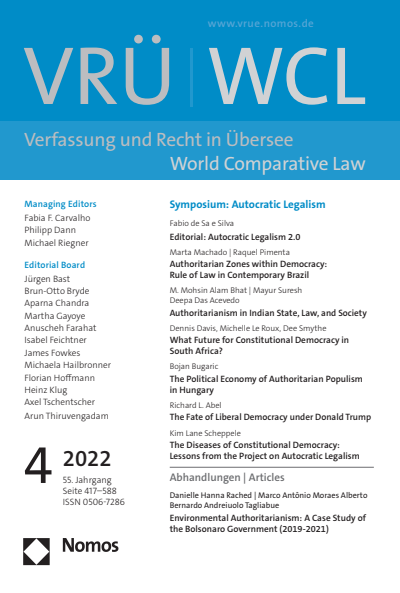
Since the 2000s, scholars have been faced with a new phenomenon, which political scientists eventually labelled democratic backsliding. Law has not been central in studies of democratic backsliding, but it has not been completely absent either. In...
President Jair Bolsonaro’s government (2019-2022) brought unprecedented turmoil to the Brazilian democracy. In this paper, we argue that Bolsonaro’s government builds on and expands pre-existing zones of authoritarianism embedded in the country....
While India possesses features conventionally associated with liberal democracies, it has lately been understood to suffer from “democratic backsliding”. Commentators have used descriptions like “authoritarianism”, “electoral autocracy”,...
South Africa embraced constitutional democracy in 1994 following the collapse of the Apartheid regime. The constitution that was finally passed in 1996 promised the development of a social democratic society. Within two decades, much of the promise...
With all key political institutions firmly in Orban’s hands, and with the electoral rules basically tilted to Orban’s advantage, many observers question whether Orban’s regime can be successfully challenged domestically, from within. As a...
The Trump administration directly attacked and indirectly subverted liberal democracy in many ways. This article describes several pivotal attacks and evaluates the efficacy of efforts to defend liberal democracy. It begins by analyzing how the...
The purpose of this article is to investigate the abuse of presidential and administrative powers with a view to weakening environmental protection. We argue that the concept of “environmental authoritarianism”, designating both a democratic...