, to see if you have full access to this publication.
Monograph No access
Comic Cure for Delusional Democracy
Plato's Republic
Authors:
Publisher:
2014
Summary
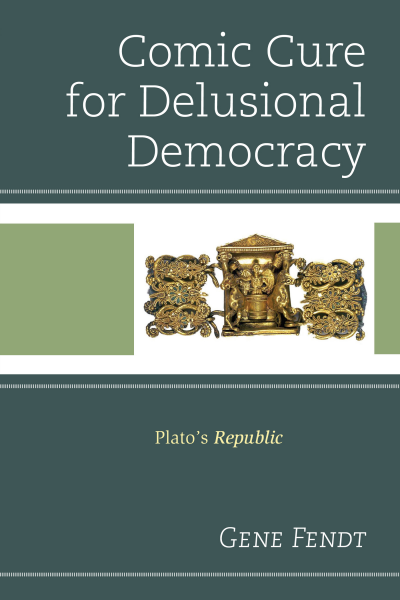
This book shows how the discussion of Platos' Republic is a comic mimetic cure for civic and psychic delusion. Plato creates such pharmaka, or noble lies, for reasons enunciated by Socrates within the discussion, but this indicates Plato must think his readers are in the position of needing the catharses such fictions produce. Socrates' interlocutors must be like us. Since cities are like souls, and souls come to be as they are through mimesis of desires, dreams, actions and thought patterns in the city, we should expect that political theorizing often suffers from madness as well. It does. Gene Fendt shows how contemporary political (and psychological) theory still suffers from the same delusion Socrates' interlocutors reveal in their discussion: a dream of autarchia called possessive individualism. Plato has good reason to think that only a mimetic, rather than a rational and philosophical, cure can work. Against many standard readings, Comic Cure for Delusional Democracy shows that the Republic itself is a defense of poetry; that kallipolis cannot be the best city and is not Socrates' ideal; that there are six forms of regime, not five; and that the true philosopher should not be unhappy to go back down into Plato's cave.
Keywords
Search publication
Bibliographic data
Edition
1/2014
Copyright Year
2014
ISBN-Print
978-0-7391-9390-7
ISBN-Online
978-0-7391-9391-4
Publisher
Lexington, Lanham
Language
English
Pages
289
Product Type
Monograph
Table of contents
ChapterPages
Contents No access
Preface No access
Acknowledgments No access
Introduction: Plato’s Mimetic Art No access Pages 1 - 20
1 The Madman at the Door No access Pages 21 - 58
2 Psyche’s Pharmacy No access Pages 59 - 82
3 Enlarging Homer No access Pages 83 - 108
4 Out of the Cave No access Pages 109 - 150
Interlude No access Pages 151 - 166
5 From Mathematics to Social Science No access Pages 167 - 218
6 Polymorphous Perversity No access Pages 219 - 260