, to see if you have full access to this publication.
Volume No access

Volume 70 (2019), Edition 2

SozW Soziale Welt
Authors:
Journal:
SozW Soziale Welt
Publisher:
 2019


Bibliographic data

ISSN-Print
0038-6073
ISSN-Online
2942-3414
Publisher
Nomos, Baden-Baden
Language
German
Product type
Volume

Articles

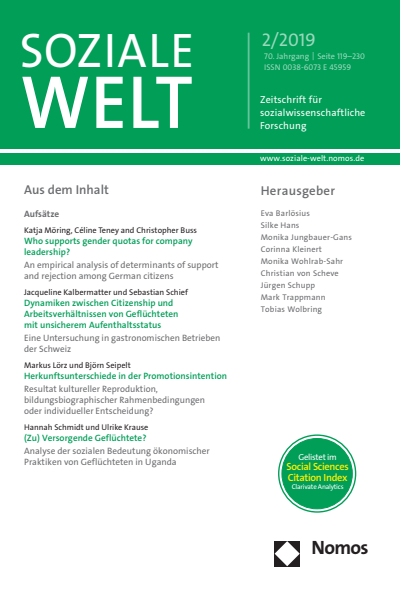
Cover of Volume: SozW Soziale Welt Volume 70 (2019), Edition 2
Article
No access

Page 119 - 120
Nomos Verlagsgesellschaft mbH & Co. KG, Baden-Baden 2019

Cover of Volume: SozW Soziale Welt Volume 70 (2019), Edition 2
Article
No access

Page 121 - 143
After a long and controversial debate, a statutory gender boardroom quota was introduced in Germany in 2016. We examine the determinants of support for this quota among citizens aiming to identify the social groups that approve the most and those...
Nomos Verlagsgesellschaft mbH & Co. KG, Baden-Baden 2019
Authors:

Cover of Volume: SozW Soziale Welt Volume 70 (2019), Edition 2
Article
No access

Page 144 - 171
The article discusses to what extent the arrangement of migration policy, social policy and access to the labor market of Switzerland generates pronounced insecurities in the living and working reality of refugees. We analyze this by way of example...
Nomos Verlagsgesellschaft mbH & Co. KG, Baden-Baden 2019
Authors:

Cover of Volume: SozW Soziale Welt Volume 70 (2019), Edition 2
Article
No access

Page 172 - 199
Nomos Verlagsgesellschaft mbH & Co. KG, Baden-Baden 2019
Authors:

Cover of Volume: SozW Soziale Welt Volume 70 (2019), Edition 2
Article
No access

Page 200 - 230
Nomos Verlagsgesellschaft mbH & Co. KG, Baden-Baden 2019
Authors:

Bibliography (234 entries)

  1. Armstrong, Jo & Walby, Sylvia (2012): Gender Quotas in Management Boards. Brussels: European Parliament’s Committee on Gender Equality. Open Google Scholar doi.org/10.5771/0038-6073-2019-2-121
  2. Barnes, Tiffany D. & Córdova, Abby (2016): Making space for women: Explaining citizen support for legislative gender quotas in Latin America. Journal of Politics 78(3): 670-686. Open Google Scholar doi.org/10.5771/0038-6073-2019-2-121
  3. Blom, Annelies G., Gathmann, Christina & Krieger, Ulrich (2015): Setting up an online panel representative of the general population: The German internet panel. Field Methods 27(4): 391-408. Open Google Scholar doi.org/10.5771/0038-6073-2019-2-121
  4. Bobo, Lawrence (2000): Race and Beliefs About Affirmative Action: Assessing the Effects of Interests, Group Threat, Ideology, and Racism, in David O. Sears (Ed.), Racialized Politics: The Debate About Racism in America. Chicago London: University of Chicago Press. S. 137-164. Open Google Scholar doi.org/10.5771/0038-6073-2019-2-121
  5. Boisjoly, Johanne, Duncan, Greg J., Kremer, Michael, Levy, Dan M. & Eccles, Jacque (2006): Empathy or antipathy? The impact of diversity. American Economic Review 96(5): 1890-1905. Open Google Scholar doi.org/10.5771/0038-6073-2019-2-121
  6. Bolzendahl, Catherine I. & Myers, Daniel J. (2004): Feminist attitudes and support for gender equality: Opinion change in women and men, 1974-1998. Social Forces 83(2): 759-789. Open Google Scholar doi.org/10.5771/0038-6073-2019-2-121
  7. Budig, Michelle J. & England, Paula (2001): The wage penalty for motherhood. American Sociological Review 66(2): 204–225. https://doi.org/10.2307/2657415. Open Google Scholar doi.org/10.5771/0038-6073-2019-2-121
  8. Dirk De Graaf, Nan & Heath, Anthony (1992): Husbands' and wives' voting behaviour in Britain: Class-dependent mutual influence of spouses. Acta Sociologica 35(4): 311-322. Open Google Scholar doi.org/10.5771/0038-6073-2019-2-121
  9. Der Westen (2011): Bundestagsabgeordnete fordern in "Berliner Erklärung" Frauenquote für Aufsichtsräte (15.12.2011). Retrieved from https://www.derwesten.de/wirtschaft/bundestagsabgeordnete-fordern-in-berliner-erklaerung-frauenquote-fuer-aufsichtsraete-id6165492.html (accessed: 01.02.2019). Open Google Scholar doi.org/10.5771/0038-6073-2019-2-121
  10. Edlund, Jonas (2003): The influence of the class situations of husbands and wives on class identity, party preference and attitudes towards redistribution: Sweden, Germany and the United States. Acta Sociologica 46(3): 195-214. Open Google Scholar doi.org/10.5771/0038-6073-2019-2-121
  11. Eicher, Véronique, Settersten, Richard A., Penic, Sandra, Glaeser, Stephanie, Martenot, Aude & Spini, Dario (2015): Normative climates of parenthood across Europe: Judging voluntary childlessness and working parents. European Sociological Review 32(1): 135-150. Open Google Scholar doi.org/10.5771/0038-6073-2019-2-121
  12. Finseraas, Henning, Johnsen, Åshild A., Kotsadam, Andreas & Torsvik, Gaute (2016): Exposure to female colleagues breaks the glass ceiling – Evidence from a combined vignette and field experiment. European Economic Review 90: 363-374. Open Google Scholar doi.org/10.5771/0038-6073-2019-2-121
  13. Gabaldon, Patricia, Mensi-Klarbach, Heike & Seierstad, Cathrine (2017): Gender Diversity in the Boardroom: The Multiple Versions of Quota Laws in Europe, in Cathrine Seierstad, Patricia Gabaldon & Heike Mensi-Klarbach (Hrsg.), Gender Diversity in the Boardroom. Cham: Springer International Publishing. S. 233–254. Open Google Scholar doi.org/10.5771/0038-6073-2019-2-121
  14. Harrison, David A., Kravitz, David A., Mayer, David M., Leslie, Lisa M. and Lev-Arey, Dalit (2006): Understanding attitudes toward affirmative action programs in employment: Summary and meta-analysis of 35 years of research. Journal of Applied Psychology 91(5): 1013-1036. Open Google Scholar doi.org/10.5771/0038-6073-2019-2-121
  15. Himmelweit, Susan, Santos, Cristina, Sevilla, Almudena & Sofer, Catherine (2013): Sharing of resources within the family and the economics of household decision making. Journal of Marriage and Family 75(3): 625-639. Open Google Scholar doi.org/10.5771/0038-6073-2019-2-121
  16. Holst, Elke & Wrohlich, Katharina (2018): Spitzengremien großer Unternehmen: Geschlechterquote für Aufsichtsräte greift, in Vorständen herrscht beinahe Stillstand. DIW-Wochenbericht 5(1/2): 3-17. Open Google Scholar doi.org/10.5771/0038-6073-2019-2-121
  17. Inglehart, Ronald (1977): The Silent Revolution. Changing Values and Political Styles Among Western Publics. Princeton, NJ: Princeton University Press. Open Google Scholar doi.org/10.5771/0038-6073-2019-2-121
  18. Inglehart, Ronald & Norris, Pippa (2000): The developmental theory of the gender gap: Women Open Google Scholar doi.org/10.5771/0038-6073-2019-2-121
  19. ´s and men´s voting behavior in global perspective. International Political Science Review 21(4): 441-463. Open Google Scholar doi.org/10.5771/0038-6073-2019-2-121
  20. Inglehart, Ronald & Norris, Pippa (2003): Rising Tide: Gender Equality and Cultural Change Around the World. Cambridge and others: Cambridge University Press. Open Google Scholar doi.org/10.5771/0038-6073-2019-2-121
  21. Jennings, M. Kent & Stoker, Laura (2001): Political Similarity and Influence Between Husbands and Wives. Working Paper 2001-14. UC Berkeley: Institute of Governmental Studies. Retrieved from https://escholarship.org/uc/item/9s54f2mc (accessed: 01.02.2019). Open Google Scholar doi.org/10.5771/0038-6073-2019-2-121
  22. Kirsch, Anja (2017): Women’s Access to Boards in Germany—Regulation and Symbolic Change, in Cathrine Seierstad, Patricia Gabaldon and Heike Mensi-Klarbach (Ed.), Gender Diversity in the Boardroom. Cham: Springer International Publishing. p. 205–232. Open Google Scholar doi.org/10.5771/0038-6073-2019-2-121
  23. Krysan, Maria (2000): Prejudice, politics, and public opinion: Understanding the sources of racial policy attitudes. Annual Review of Sociology 26: 135-168. Open Google Scholar doi.org/10.5771/0038-6073-2019-2-121
  24. Kunze, Astrid & Miller, Amalia R. (2014): Women helping women? Evidence from private sector data on workplace hierarchies. NBER Working Paper No. 20761. Cambridge, MA: National Bureau of Economic Research. available at http://www.nber.org/papers/w20761 (accessed 1 November 2016). Open Google Scholar doi.org/10.5771/0038-6073-2019-2-121
  25. Longarela, Iñaki R. (2017): Explaining vertical gender segregation: A research agenda. Work, Employment and Society 31(5): 861-871. Open Google Scholar doi.org/10.5771/0038-6073-2019-2-121
  26. Matsa, David A. & Miller, Amalia R. (2011): Chipping away at the glass ceiling: Gender spillovers in corporate leadership. American Economic Review 101(3): 635-39. Open Google Scholar doi.org/10.5771/0038-6073-2019-2-121
  27. Mau, Steffen (2003): The Moral Economy of Welfare States. Britain and Germany Compared. London: Routledge. Open Google Scholar doi.org/10.5771/0038-6073-2019-2-121
  28. Möhring, Katja & Teney, Céline (2019): Equality prescribed? Contextual determinants of citizens’ support for gender boardroom quotas across Europe. Comparative European Politics: 1-30 (online first), https://doi.org/10.1057/s41295-019-00199-w Open Google Scholar doi.org/10.5771/0038-6073-2019-2-121
  29. Noon, Mike (2010): The shackled runner: time to rethink positive discrimination? Work, Employment and Society 24(4): 728-739. Open Google Scholar doi.org/10.5771/0038-6073-2019-2-121
  30. Paxton, Pamela & Kunovich, Sheri (2003): Women’s political representation: The importance of ideology. Social Forces 82(1): 87-114. Open Google Scholar doi.org/10.5771/0038-6073-2019-2-121
  31. Spiegel Online (2014): Union fürchtet wegen Frauenquote um die Wirtschaft (14.10.2014). Retrieved from https://www.spiegel.de/politik/deutschland/frauenquote-cdu-und-spd-streiten-ueber-einfuehrung-a-997079.html (accessed: 18 June 2019). Open Google Scholar doi.org/10.5771/0038-6073-2019-2-121
  32. Staff, Jeremy & Mortimer, Jeylan T. (2011): Explaining the motherhood wage penalty during the early occupational career. Demography 49(1): 1–21. Open Google Scholar doi.org/10.5771/0038-6073-2019-2-121
  33. Trappe, Heike, Pollmann-Schult, Matthias & Schmitt, Cristian (2015): The rise and decline of the male breadwinner model: Institutional underpinnings and future expectations. European Sociological Review 31(2): 230–42. Open Google Scholar doi.org/10.5771/0038-6073-2019-2-121
  34. AsylG, Asylgesetz (1998): 142.31. Stand am 1. Oktober 2016. Open Google Scholar doi.org/10.5771/0038-6073-2019-2-144
  35. AuG, Bundesgesetz über die Ausländerinnen und Ausländer (2005): 142.20. Stand am 1. Januar 2017. Open Google Scholar doi.org/10.5771/0038-6073-2019-2-144
  36. Bauböck, Rainer (2006): Citizenship and migration – concepts and controversies, in: Rainer Bauböck (ed.) Migration and citizenship. Amsterdam: Amsterdam University Press. S. 15-31. Open Google Scholar doi.org/10.5771/0038-6073-2019-2-144
  37. Burawoy, Michael (1985): The politics of production: factory regimes under capitalism and socialism. London: Verso. Open Google Scholar doi.org/10.5771/0038-6073-2019-2-144
  38. Castles, Stephen & Davidson, Alastair (2000): Citizenship and Migration. Globalization and the Politics of Belonging. London: Routledge. Open Google Scholar doi.org/10.5771/0038-6073-2019-2-144
  39. Catron, Peter (2019): The Citizenship Advantage: Immigrant Socioeconomic Attainment in the Age of Mass Migration. American Journal of Sociology 124(4): 999–1042 Open Google Scholar doi.org/10.5771/0038-6073-2019-2-144
  40. Hess, Sabine, Kasparek, Bernd, Kron, Stefanie, Rodatz, Mathias, Schwertl, Maria, & Sontowski, Simon (2017): Der lange Sommer der Migration. Krise, Rekonstitution und ungewisse Zukunft des europäischen Grenzregimes, in: Sabine Hess, Bernd Kasparek, Stefanie Kron, Mathias Rodatz, Maria Schwertl & Simon Sontowski (Hrsg.), Der lange Sommer der Migration. Grenzregime III. Berlin: Assoziation A. S. 6-24. Open Google Scholar doi.org/10.5771/0038-6073-2019-2-144
  41. Hess, Sabine, & Lebuhn, Henrik (2014): Politiken der Bürgerschaft. Zur Forschungsdebatte um Migration, Stadt und citizenship. sub\urban. zeitschrift für kritische stadtforschung 2(3): 11-34. Hess, Sabine, & Tsianos, Vassilis (2007): Europeanizing Transnationalism! Provincializing Open Google Scholar doi.org/10.5771/0038-6073-2019-2-144
  42. Europe! – Konturen eines neuen Grenzregimes, in: Transit Migration Forschungsgruppe Open Google Scholar doi.org/10.5771/0038-6073-2019-2-144
  43. (Hrsg.), Turbulente Ränder. Neue Perspektiven auf Migration an den Grenzen Europas. Bielefeld: transcript Verlag. S. 23-38. Open Google Scholar doi.org/10.5771/0038-6073-2019-2-144
  44. Holzer, Thomas, Schneider, Gerald, & Widmer, Thomas (2000): Discriminating Decentralization: Federalism and the Handling of Asylum Applications in Switzerland, 1988-1996. Journal of Conflict Resolution 44(2): 250-276. Open Google Scholar doi.org/10.5771/0038-6073-2019-2-144
  45. Isin, Engin F. (2008): Theorizing Acts of Citizenship, in: Engin F. Isin & Greg M. Nielsen (Hrsg.), Acts of citizenship. London: Zed Books. S. 15-43. Open Google Scholar doi.org/10.5771/0038-6073-2019-2-144
  46. Isin, Engin F. & Turner, Bryan S. (2002): Citizenship Studies: An Introduction, in: Engin F. Isin & Bryan S. Turner (Hrsg.), Handbook of Citizenship Studies. London: SAGE Publications Ltd. S. 1-10. Open Google Scholar doi.org/10.5771/0038-6073-2019-2-144
  47. Kalbermatter, Jacqueline (im Erscheinen): Bleiberecht in der Gastro-Küche. Migrationspolitische Regulierungen und Arbeitsverhältnisse von Geflüchteten mit unsicherem Aufenthaltsstatus. Zürich: Seismo. Open Google Scholar doi.org/10.5771/0038-6073-2019-2-144
  48. Kirchliche Kontaktstelle für Flüchtlingsfragen (2016 a): Die Asylsozialhilfe. Bern: Kirchliche Kontaktstelle für Flüchtlingsfragen. Open Google Scholar doi.org/10.5771/0038-6073-2019-2-144
  49. Kirchliche Kontaktstelle für Flüchtlingsfragen (2016 b): Nothilfe. Bern: Kirchliche Kontaktstelle für Flüchtlingsfragen. Open Google Scholar doi.org/10.5771/0038-6073-2019-2-144
  50. Koopmans, Ruud, Michalowski, Ines & Waibel, Stine. (2012) Citizenship rights for immigrants: National political processes and cross-national convergence in Western Europe, 1980–2008. American Journal of Sociology 117(4): 1202–1245. Open Google Scholar doi.org/10.5771/0038-6073-2019-2-144
  51. Köster-Eiserfunke, Anna, Reichhold, Clemens, & Schwiertz, Helge (2014): Citizenship zwischen nationalem Status und aktivistischer Praxis – Eine Einführung, in: Lisa-Marie Heimeshoff, Sabine Hess, Stefanie Kron, Helen Schwenken & Miriam Trzeciak (Hrsg.), Grenzregime II. Migration. Kontrolle. Wissen. Transnationale Perspektiven. Berlin: Assoziation A. S. 177-196. Open Google Scholar doi.org/10.5771/0038-6073-2019-2-144
  52. Kruse, Jan (2014): Qualitative Interviewforschung. Ein integrativer Ansatz. Weinheim: Beltz Juventa. Open Google Scholar doi.org/10.5771/0038-6073-2019-2-144
  53. Lofland, John, Snow, David, Anderson, Leon, & Lofland, Lyn H. (2006): Analyzing Social Settings. A Guide to Qualitative Observation and Analysis. Belmont, CA: Wadsworth. Open Google Scholar doi.org/10.5771/0038-6073-2019-2-144
  54. Marshall, Thomas H. (1965)‚ ‘Citizenship and Social Class’, in Thomas H. Marshall, Class, Citizenship, and Social Development. Essays by T. H. Marshall. New York: Anchor Books. Open Google Scholar doi.org/10.5771/0038-6073-2019-2-144
  55. Mezzadra, Sandro (2016): MLC 2015 Keynote: What’s at stake in the Mobility of Labour? Borders, Migration, Contemporary Capitalism. Migration, Mobility, & Displacement 2(1): 30-43. Open Google Scholar doi.org/10.5771/0038-6073-2019-2-144
  56. Mezzadra, Sandro, & Neilson, Brett (2008): Die Grenze als Methode, oder die Vervielfältigung der Arbeit. Transversal. Open Google Scholar doi.org/10.5771/0038-6073-2019-2-144
  57. Mezzadra, Sandro, & Neilson, Brett (2013): Border as method, or, the multiplication of labor. Durham: Duke University Press. Open Google Scholar doi.org/10.5771/0038-6073-2019-2-144
  58. Mezzadra, Sandro, & Neilson, Brett (2014): Grenzen der Gerechtigkeit, differentielle Inklusion und Kämpfe der Grenze, in: Lisa-Marie Heimeshoff, Sabine Hess, Stefanie Kron, Helen Schwenken & Miriam Trzeciak (Hrsg.), Grenzregime II. Migration. Kontrolle. Wissen. Transnationale Perspektiven. Berlin: Assoziation A. S. 232-255. Open Google Scholar doi.org/10.5771/0038-6073-2019-2-144
  59. Migrationsdienst des Kantons Bern (o.J.-a): Stellenantrittsgesuch Asylsuchende (Ausweis N). Bern: Migrationsdienst des Kantons Bern. Open Google Scholar doi.org/10.5771/0038-6073-2019-2-144
  60. Migrationsdienst des Kantons Bern (o.J.-b): Stellenantrittsgesuch Vorläufig Aufgenommene (Ausweis F). Bern: Migrationsdienst des Kantons Bern. Open Google Scholar doi.org/10.5771/0038-6073-2019-2-144
  61. Müller, Jost (2002): Vom Unglück der Integration. Thesen zur aktuellen Veränderung des Migrationsregimes, Subtropen, Jungle World. Zugriff am 13.5.2013 auf http://jungle-world.com/artikel/2002/27/23660.html. Open Google Scholar doi.org/10.5771/0038-6073-2019-2-144
  62. Nyers, Peter, & Rygiel, Kim (2014): Citizenship, migrantischer Aktivismus und Politiken der Bewegung, in: Lisa-Marie Heimeshoff, Sabine Hess, Stefanie Kron, Helen Schwenken & Miriam Trzeciak (Hrsg.), Grenzregime II. Migration. Kontrolle. Wissen. Transnationale Perspektiven. Berlin: Assoziation A. S. 197-216. Open Google Scholar doi.org/10.5771/0038-6073-2019-2-144
  63. O'Reilly, Karen (2009): Key Concepts in Ethnography. London: SAGE Publications Ltd. O'Reilly, Karen (2012): Ethnographic Methods. New York: Routledge. Open Google Scholar doi.org/10.5771/0038-6073-2019-2-144
  64. Ritchie, Jane, Lewis, Jane, Nicholls, Carol McNaughton, & Ormston, Rachel (2014): Qualitative Research Practice. A Guide for Social Science Students and Researchers London: SAGE Publications Ltd. Open Google Scholar doi.org/10.5771/0038-6073-2019-2-144
  65. Scherr, Albert, & Inan, Çiğdem (2017): Flüchtlinge als gesellschaftliche Kategorien und als Konfiktfeld. Ein soziologischer Zugang, in: Cinur Ghaderi & Thomas Eppenstein (Hrsg.), Flüchtlinge. Multiperspektivische Zugänge. Wiesbaden: Springer VS. S. 129-146. Open Google Scholar doi.org/10.5771/0038-6073-2019-2-144
  66. Schneider, Gerald (1998): Der Asylföderalismus wirkt diskriminierend. Höchst ungleiche Anerkennungsquoten für Asylsuchende im Vergleich der Kantone. Asyl 13(3): 62-67. Open Google Scholar doi.org/10.5771/0038-6073-2019-2-144
  67. Schuilenburg, Marc (2008) Citizenship Revisited—Denizens and Margizens, Peace Review, 20:3, 358-365, DOI: 10.1080/10402650802330238 Open Google Scholar doi.org/10.5771/0038-6073-2019-2-144
  68. Standing, Guy (2011): The Precariat. The New Dangerous Class. London: Bloomsbury Academic. Open Google Scholar doi.org/10.5771/0038-6073-2019-2-144
  69. Tsianos, Vassilis, & Hess, Sabine (2012): Ethnographische Grenzregimeanalyse, in: Sabine Hess & Bernd Kasparek (Hrsg.), Grenzregime. Diskurse. Praktiken. Institutionen in Europa. Berlin: Assoziation A.: 243-264. Open Google Scholar doi.org/10.5771/0038-6073-2019-2-144
  70. VZAE, Verordnung über Zulassung, Aufenthalt und Erwerbstätigkeit (2007): 142.201. Stand am 1. Mai 2017. Open Google Scholar doi.org/10.5771/0038-6073-2019-2-144
  71. Wichmann, Nicole, Hermann, Michael, D‘Amato, Gianni, Efionayi-Mäder, Denise, Rosita Fibbi, Menet, Joanna, & Ruedin, Didier (2011): Gestaltungsspielräume im Föderalismus: Die Migrationspolitik in den Kantonen. Bern: Eidgenössische Kommission für Migrationsfragen EKM. Open Google Scholar doi.org/10.5771/0038-6073-2019-2-144
  72. Witzel, Andreas (1989): Das problemzentrierte Interview, in: Gerd Jüttemann (Hrsg.), Qualitative Forschung in der Psychologie. Grundfragen, Verfahrensweisen, Anwendungsfelder. Heidelberg: Asanger. S. 227-256. Open Google Scholar doi.org/10.5771/0038-6073-2019-2-144
  73. Witzel, Andreas (2000): Das problemzentrierte Interview. Forum Qualitative Sozialforschung 1(1). Open Google Scholar doi.org/10.5771/0038-6073-2019-2-144
  74. Ajzen, Icek (1991): The theory of planned behavior. In: Organizational behavior and human decision processes, 50(2), 179-211. Open Google Scholar doi.org/10.5771/0038-6073-2019-2-172
  75. Bachsleitner, Anna, Becker, Michael, Neumann, Marko & Maaz, Kai (2018): Social background effects in the transition to a doctoral degree. In: Research in Social Stratification and Mobility 57: 24-34. Open Google Scholar doi.org/10.5771/0038-6073-2019-2-172
  76. Becker, R. & Hecken, Anna E. (2008): Warum werden Arbeiterkinder vom Studium an Universitäten abgelenkt? Zeitschrift für Soziologie 36(2): 3–29. Open Google Scholar doi.org/10.5771/0038-6073-2019-2-172
  77. Becker, Rolf, Haunberger, Sigrid & Schubert, Frank (2010): Studienfachwahl als Spezialfall der Ausbildungsentscheidung und Berufswahl. In: Zeitschrift für Arbeitsmarktforschung 42: 292-310. Open Google Scholar doi.org/10.5771/0038-6073-2019-2-172
  78. Bornkessel, Philipp & Kuhnen, Sebastian Udo (2011): Zum Einfluss der sozialen Herkunft auf Schulleistung, Studienzuversicht und Studienintention am Ende der Sekundarstufe II. In: Philipp Bornkessel & Jupp Asdonk (Hrsg.): Der Übergang Schule–Hochschule. Wiesbaden: VS, S. 47-104. Open Google Scholar doi.org/10.5771/0038-6073-2019-2-172
  79. Boudon, Raymond (1974): Education, opportunity, and social inequality. New York: Wiley. Bourdieu, Pierre (1982): Die feinen Unterschiede. Kritik der gesellschaftlichen Urteilskraft. 1. Auf- Open Google Scholar doi.org/10.5771/0038-6073-2019-2-172
  80. lage. Frankfurt am Main: Suhrkamp. Open Google Scholar doi.org/10.5771/0038-6073-2019-2-172
  81. Bourdieu, Pierre (1983): Ökonomisches Kapital, soziales Kapital, kulturelles Kapital. In: Soziale Ungleichheiten. Soziale Welt, Sonderband 2, S. 183-198. Open Google Scholar doi.org/10.5771/0038-6073-2019-2-172
  82. Bourdieu, Pierre & Passeron, Jean-Claude (1971): Die Illusion der Chancengleichheit. Stuttgart: Klett. Open Google Scholar doi.org/10.5771/0038-6073-2019-2-172
  83. Breen, Richard & Goldthorpe, John H. (1997): Explaining educational differentials. Towards a formal rational action theory. In: Rationality and Society 9 (3): 275-305. Open Google Scholar doi.org/10.5771/0038-6073-2019-2-172
  84. De Vogel, Susanne (2017): Wie beeinflussen Geschlecht und Bildungsherkunft den Übergang in individuelle und strukturierte Promotionsformen? In: Kölner Zeitschrift für Soziologie und Sozialpsychologie 69 (3): 437–471. Open Google Scholar doi.org/10.5771/0038-6073-2019-2-172
  85. Elder, Glen H., Johnson, Monica K. & Crosnoe, Robert (2003): The emergence and development of life course theory. In: Jeylan T. Mortimer & Michael J. Shanahan (Hrsg.): Handbook of the life course, Boston, MA: Springer US, S. 3-19. Open Google Scholar doi.org/10.5771/0038-6073-2019-2-172
  86. Engelage, Sonja & Schubert, Frank (2009): Promotion und Karriere – Wie adäquat sind promovierte Akademikerinnen und Akademiker in der Schweiz beschäftigt? In: Zeitschrift für Arbeitsmarktforschung 42 (3): 213-233. Open Google Scholar doi.org/10.5771/0038-6073-2019-2-172
  87. Erikson, Robert & Jonsson, Jan O. (1996): Explaining Class Inequality in Education. In: Robert Erikson & Jan O. Jonsson (Hrsg.): Can Education be Equalized? Boulder, CO: Westview, S. 1-63. Open Google Scholar doi.org/10.5771/0038-6073-2019-2-172
  88. Ethington, Corinna A. & Smart, John C. (1986): Persistence to graduate education. In: Research in Higher Education 24 (3): 287-303. Open Google Scholar doi.org/10.5771/0038-6073-2019-2-172
  89. Evans, Mariah D. R., Kelley, Jonathan, Sikora, Joanna & Treiman, Donald J. (2010): Family scholarly culture and educational success. In: Research in Social Stratification and Mobility 28 (2): 171–197. Open Google Scholar doi.org/10.5771/0038-6073-2019-2-172
  90. Fabian, Gregor, Hillmann, Julika, Trennt, Fabian, & Briedis, Kolja (2016): Hochschulabschlüsse nach Bologna. In: Forum Hochschule 2016 (1). Hannover: DZHW. Open Google Scholar doi.org/10.5771/0038-6073-2019-2-172
  91. Falk, Susanne & Küpper, Hans-Ulrich (2013): Verbessert der Doktortitel die Karrierechancen von Hochschulabsolventen. In: Beiträge zur Hochschulforschung 35 (1), S. 58–77. Open Google Scholar doi.org/10.5771/0038-6073-2019-2-172
  92. Gehlke, Anna, Hachmeister, Cort-Denis, Hüning, Lars & de Vries, Lisa (2017): Der Numerus Clausus (NC) im Wintersemester 2017/18. Gütersloh: Centrum für Hochschulentwicklung. Open Google Scholar doi.org/10.5771/0038-6073-2019-2-172
  93. Hansen, Marianne Nordli & Mastekaasa, Arne (2006): Social origins and academic performance at university. In: European Sociological Review 22 (3): 277–291. Open Google Scholar doi.org/10.5771/0038-6073-2019-2-172
  94. Heineck, Guido & Matthes, Britta (2012): Zahlt sich der Doktortitel aus? In: Nathalie Huber, Anna Schelling & Stefan Hornbostel (Hrsg.): Der Doktortitel zwischen Status und Qualifikation. iFQ-Working Paper No. 12, S. 85-100. Open Google Scholar doi.org/10.5771/0038-6073-2019-2-172
  95. Helsper, Werner, Kramer, Rolf-Torsten & Thiersch, Sven (2013): Schülerhabitus: theoretische und empirische Analysen zum Bourdieuschen Theorem der kulturellen Passung. Wiesbaden: VS. Open Google Scholar doi.org/10.5771/0038-6073-2019-2-172
  96. Jacob, Marita & Klein, Markus (2013): Der Einfluss der Bildungsherkunft auf den Berufseinstieg und die ersten Erwerbsjahre von Universitätsabsolventen. In: Beiträge zur Hochschulforschung 35 (1): 8–37. Open Google Scholar doi.org/10.5771/0038-6073-2019-2-172
  97. Jaksztat, Steffen (2014): Bildungsherkunft und Promotionen. Wie beeinflusst das elterliche Bildungsniveau den Übergang in die Promotionsphase? In: Zeitschrift für Soziologie 43 (4): 286-301. Open Google Scholar doi.org/10.5771/0038-6073-2019-2-172
  98. Jaksztat, Steffen & Lörz, Markus (2018): Ausmaß, Entwicklung und Ursachen sozialer Ungleichheit beim Promotionszugang zwischen 1989–2009. In: Zeitschrift für Soziologie 47 (1): 46–64. Karlson, Kristian Bernt, Holm, Anders & Breen, Richard (2012): Comparing regression coeffici- Open Google Scholar doi.org/10.5771/0038-6073-2019-2-172
  99. ents between same-sample nested models using logit and probit. In: Sociological Methodology 42 Open Google Scholar doi.org/10.5771/0038-6073-2019-2-172
  100. (1): 286–313. Open Google Scholar doi.org/10.5771/0038-6073-2019-2-172
  101. Keller, Ansgar (2010): Promotionsführer für Fachhochschulabsolventen. 10. Aufl. 2010/2011. Berlin: Universitätsverlag der TU Berlin. Open Google Scholar doi.org/10.5771/0038-6073-2019-2-172
  102. Keller, Suzanne & Zavalloni, Marisa (1964): Ambition and social class. In: Social Forces 43 (1): 58–70. Open Google Scholar doi.org/10.5771/0038-6073-2019-2-172
  103. Kecskes. Robert (1994): Abwanderung, Widerspruch, Passivität. Oder: Wer zieht wann um? Zeitschrift für Soziologie 23(2): 129–144. Open Google Scholar doi.org/10.5771/0038-6073-2019-2-172
  104. Kohler, Ulrich, Karlson, Kristian B. & Holm, Anders (2011): Comparing coefficients of nested nonlinear probability models using khb. In: Stata Journal 11 (3): 420-438. Open Google Scholar doi.org/10.5771/0038-6073-2019-2-172
  105. Konsortium Bundesbericht Wissenschaftlicher Nachwuchs (2017): Bundesbericht Wissenschaftlicher Nachwuchs 2017. Statistische Daten und Forschungsbefunde zu Promovierenden und Promovierten in Deutschland. Bielefeld: Bertelsmann. Open Google Scholar doi.org/10.5771/0038-6073-2019-2-172
  106. Klein, Daniel (2014): MIMRGNS. Stata module to run margins after mi estimate. Statistical Software Components S457795, Boston College Department of Economics, revised 25 Dec. 2018. Verfügbar unter: https:// ideas. repec. org/ c/ boc/ bocode/ s 457795 . html. Zugriff: 13.2.2019. Open Google Scholar doi.org/10.5771/0038-6073-2019-2-172
  107. Lange-Vester, Andrea & Teiwes-Kügler, Christel (2006): Die symbolische Gewalt der legitimen Kultur: zur Reproduktion ungleicher Bildungschancen in Studierendenmilieus. In: Werner Georg (Hrsg.): Soziale Ungleichheit im Bildungssystem. Konstanz: UVK, S. 55-92. Open Google Scholar doi.org/10.5771/0038-6073-2019-2-172
  108. Leemann, Regula Julia (2002): Chancenungleichheiten beim Übergang in eine wissenschaftliche Laufbahn. In: Schweizerische Zeitschrift für Bildungswissenschaften 24 (2): 197-222. Open Google Scholar doi.org/10.5771/0038-6073-2019-2-172
  109. Little, Roderick J. & Rubin, Donald B. (1987): Statistical Analysis with Missing Data. New York: Wiley. Open Google Scholar doi.org/10.5771/0038-6073-2019-2-172
  110. Lörz, M. (2008). Räumliche Mobilität beim Übergang ins Studium und im Studienverlauf. In: Open Google Scholar doi.org/10.5771/0038-6073-2019-2-172
  111. Bildung und Erziehung 61 (4): 413-436. Open Google Scholar doi.org/10.5771/0038-6073-2019-2-172
  112. Lörz, Markus (2012): Mechanismen sozialer Ungleichheit beim Übergang ins Studium. In: Kölner Zeitschrift für Soziologie und Sozialpsychologie (Sonderheft 52): 302–324. Open Google Scholar doi.org/10.5771/0038-6073-2019-2-172
  113. Lörz, Markus (2013): Differenzierung des Bildungssystems und soziale Ungleichheit. In: Zeitschrift für Soziologie 42 (2): 118–137. Open Google Scholar doi.org/10.5771/0038-6073-2019-2-172
  114. Lörz, Markus (2019): Intersektionalität im Hochschulbereich: In welchen Bildungsphasen bestehen soziale Ungleichheiten nach Migrationshintergrund, Geschlecht und sozialer Herkunft – und inwieweit zeigen sich Interaktionseffekte? In: Zeitschrift für Erziehungswissenschaft (Online First): 1–24. Open Google Scholar doi.org/10.5771/0038-6073-2019-2-172
  115. Lörz, Markus; Quast, Heiko; Woisch, Andreas (2012): Erwartungen, Entscheidungen und Bildungswege. Hannover: HIS. Open Google Scholar doi.org/10.5771/0038-6073-2019-2-172
  116. Lörz, Markus, Netz, Nicolai, & Quast, Heiko (2016): Why do students from underprivileged families less often intend to study abroad? In: Higher Education, 72 (2): 153-174. Open Google Scholar doi.org/10.5771/0038-6073-2019-2-172
  117. Lörz, Markus; Schindler, Steffen (2016): Soziale Ungleichheiten auf dem Weg in die akademische Karriere. In: Beiträge zur Hochschulforschung 38 (4): 14–39. Open Google Scholar doi.org/10.5771/0038-6073-2019-2-172
  118. Hansen, Marianne Nordli, & Mastekaasa, Arne (2006). Social origins and academic performance at university. In: European Sociological Review 22 (3): 277-291. Open Google Scholar doi.org/10.5771/0038-6073-2019-2-172
  119. Mastekaasa, Arne (2006). Educational transitions at graduate level: Social origins and enrolment in PhD programmes in Norway. In: Acta Sociologica 49 (4): 437-453. Open Google Scholar doi.org/10.5771/0038-6073-2019-2-172
  120. Mertens, Anne & Röbken, Heinke (2013): Does a doctoral degree pay off? In: Higher Education Open Google Scholar doi.org/10.5771/0038-6073-2019-2-172
  121. 66 (2): 217-231. Open Google Scholar doi.org/10.5771/0038-6073-2019-2-172
  122. Middendorff, E., Apolinarski, B., Becker, K., Bornkessel, P., Brandt, T., Heißenberg, S. & Poskowsky, J. (2017). Die wirtschaftliche und soziale Lage der Studierenden in Deutschland 2016. Berlin. Open Google Scholar doi.org/10.5771/0038-6073-2019-2-172
  123. Möller, Christina (2013): Wie offen ist die Universitätsprofessur für soziale Aufsteigerinnen und Aufsteiger? In: Soziale Welt 64 (4): 341–360. Open Google Scholar doi.org/10.5771/0038-6073-2019-2-172
  124. Möller, Christina (2017 a): Begrenzte Ermöglichungen. In: Markus Rieger-Ladich & Christian Grabau (Hrsg.): Pierre Bourdieu: Pädagogische Lektüren. Wiesbaden: VS, S. 63-81. Open Google Scholar doi.org/10.5771/0038-6073-2019-2-172
  125. Möller, Christina (2017 b): Der Einfluss der sozialen Herkunft in der Professorenschaft. In Julian Hamann, Jens Maeße, Vincent Gengnagel & Alexander Hirschfeld (Hrsg.): Macht in Wissenschaft und Gesellschaft. Wiesbaden: VS, S. 113-139. Open Google Scholar doi.org/10.5771/0038-6073-2019-2-172
  126. Mood, Carina (2010): Logistic regression. Why we cannot do what we think we can do, and what we can do about it. In: European Sociological Review 26 (1): 67–82. Open Google Scholar doi.org/10.5771/0038-6073-2019-2-172
  127. Mullen, Ann L., Goyette, Kimberly A. & Soares, Joseph A. (2003): Who goes to graduate school? In: Sociology of Education 76 (2): 143-169. Open Google Scholar doi.org/10.5771/0038-6073-2019-2-172
  128. Ochsenfeld, Fabian (2012): Gläserne Decke oder goldener Käfig. In: KZfSS Kölner Zeitschrift für Soziologie und Sozialpsychologie 64 (3): 507-534. Open Google Scholar doi.org/10.5771/0038-6073-2019-2-172
  129. Quast, Heiko, Scheller, Percy & Lörz, Markus (2014): Bildungsentscheidungen im nachschulischen Verlauf. Hannover: HIS. Open Google Scholar doi.org/10.5771/0038-6073-2019-2-172
  130. Reimer, David & Pollak, Reinhard (2010): Educational expansion and its consequences for vertical and horizontal inequalities in access to higher education in West Germany. In: European Sociological Review 26 (4): 415-430. Open Google Scholar doi.org/10.5771/0038-6073-2019-2-172
  131. Schindler, Steffen (2014): Wege zur Studienberechtigung – Wege ins Studium? Wiesbaden: VS. Open Google Scholar doi.org/10.5771/0038-6073-2019-2-172
  132. Schindler, Steffen & Reimer, David (2010): Primäre und sekundäre Effekte der sozialen Herkunft beim Übergang in die Hochschulbildung. In: KZfSS Kölner Zeitschrift für Soziologie und Sozialpsychologie 62 (4): 623-653. Open Google Scholar doi.org/10.5771/0038-6073-2019-2-172
  133. Spangenberg, Heike, & Willich, Janka (2013): Einfluss des Entscheidungs- und Informationsverhaltens auf die Studienaufnahme. In: Jupp Asdonk, Sebastian U. Kuhnen, & Philipp Bornkessel (Hrsg.): Von der Schule zur Hochschule. Münster: Waxmann, S. 167-178. Open Google Scholar doi.org/10.5771/0038-6073-2019-2-172
  134. Spangenberg, Heike & Quast, Heiko (2016): Bildungsentscheidungen und Umorientierungen im nachschulischen Verlauf. In: Forum Hochschule 2016 (5). Hannover: DZHW. Open Google Scholar doi.org/10.5771/0038-6073-2019-2-172
  135. StataCorp (2017): Stata Statistical Software: Release 15. College Station, TX: StataCorp LLC. Statistisches Bundesamt (2016): Fachserie 11 Reihe 4.3.1. Nichtmonetäre hochschulstatistische Open Google Scholar doi.org/10.5771/0038-6073-2019-2-172
  136. Kennzahlen 1980-2012. Wiesbaden: Statistisches Bundesamt. Open Google Scholar doi.org/10.5771/0038-6073-2019-2-172
  137. Stubbe, Tobias C., Bos, Wilfried & Schurig, Michael (2017): Der Übergang von der Primarin die Sekundarschule. In: Hußmann, Anke, Wendt, Heike, Bos, Wilfried, Bremer-V0ß, Albrecht, Kasper, Daniel, Lankes, Eva-Maria, McElvany, Nele, Stubbe, Tobias C. & Valtin, Renate (Hrsg.): IGLU 2016: Lesekompetenz von Grundschulkindern im internationalen Vergleich. Münster: Waxmann, S. 279-296. Open Google Scholar doi.org/10.5771/0038-6073-2019-2-172
  138. Stocké, Volker, Blossfeld, Hans-Peter, Hoenig, Kerstin & Sixt, Michaela (2011): 7 Social inequality and educational decisions in the life course. In: Zeitschrift für Erziehungswissenschaft 14 (2): 103-119. Open Google Scholar doi.org/10.5771/0038-6073-2019-2-172
  139. Trautwein, Ulrich, Maaz, Kai, Lüdtke, Oliver, Nagy, Gabriel, Husemann, Nicole, Watermann, Rainer & Köller, Olaf (2006): Studieren an der Berufsakademie oder an der Universität, Fachhochschule oder Pädagogischen Hochschule? In: Zeitschrift für Erziehungswissenschaft 9 (3): 393-412. Open Google Scholar doi.org/10.5771/0038-6073-2019-2-172
  140. Triventi, Moris (2013): Stratification in Higher Education and its Relationship with Social Inequality. In: European Sociological Review 29 (3): 489-502. Open Google Scholar doi.org/10.5771/0038-6073-2019-2-172
  141. Van Buuren, Stef (2018): Flexible Imputation of Missing Data. New York: Chapman & Hall/ CRC. Open Google Scholar doi.org/10.5771/0038-6073-2019-2-172
  142. Van Buuren, Stef, Brand, Jaap. P. L., Groothuis-Oudshoorn, Catharina. G. M., & Rubin, Donald. B. (2006): Fully conditional specification in multivariate imputation. Journal of Statistical Computation and Simulation, 76(12), 1049–1064. Open Google Scholar doi.org/10.5771/0038-6073-2019-2-172
  143. Wakeling, Paul & Laurison, Daniel (2017): Are postgraduate qualifications the new frontier of social mobility? In: The British Journal of Sociology 68 (3): 533-555. Open Google Scholar doi.org/10.5771/0038-6073-2019-2-172
  144. Watermann, Rainer & Baumert, Jürgen (2006): Entwicklung eines Strukturmodells zum Zusammenhang zwischen sozialer Herkunft und fachlichen und überfachlichen Kompetenzen. In: Jürgen Baumert, Petra Stanat & Rainer Watermann (Hrsg.): Herkunftsbedingte Disparitäten im Bildungswesen, S. 61-94. Open Google Scholar doi.org/10.5771/0038-6073-2019-2-172
  145. Watermann, Rainer, Daniel, Annabell & Maaz, Kai (2014): Primäre und sekundäre Disparitäten des Hochschulzugangs. In: Zeitschrift für Erziehungswissenschaft 17 (2): 233-261. Open Google Scholar doi.org/10.5771/0038-6073-2019-2-172
  146. Wissenschaftsrat (2010): Empfehlungen zur Rolle der Fachhochschulen im Hochschulsystem. Berlin: Wissenschaftsrat. Open Google Scholar doi.org/10.5771/0038-6073-2019-2-172
  147. Weiss, Felix, Schindler, Steffen & Gerth, Maria (2015): Hochschulrankings als Kriterium für neue soziale Ungleichheit im tertiären Bildungssystem? Zeitschrift für Soziologie 44 (5): 366-386. Open Google Scholar doi.org/10.5771/0038-6073-2019-2-172
  148. White, Ian. R., Royston, Patrick & Wood, Angela. M. (2011). Multiple imputation using chained equations. Statistics in Medicine 30 (4): 377-399. Open Google Scholar doi.org/10.5771/0038-6073-2019-2-172
  149. Witte, Johanna, Van der Wende, Marijk & Huisman, Joeren (2008): Blurring boundaries: How the Bologna process changes the relationship between university and non-university higher education in Germany, the Netherlands, and France. In: Studies in Higher Education 33 (3): 217-231. Open Google Scholar doi.org/10.5771/0038-6073-2019-2-172
  150. Acocella, Ivana (2012): The Focus Groups in Social Research: Advantages and Disadvantages. Open Google Scholar doi.org/10.5771/0038-6073-2019-2-200
  151. Quality & Quantity 46(4): 1125-1136. Open Google Scholar doi.org/10.5771/0038-6073-2019-2-200
  152. Agier, Michel (2011): Managing the Undesirables. Refugee Camps and Humanitarian Government. Cambridge: Polity Press. Open Google Scholar doi.org/10.5771/0038-6073-2019-2-200
  153. Alix-Garcia, Jennifer, et al. (2018): Do refugee camps help or hurt hosts? The case of Kakuma, Kenya. Journal of Development Economics 130: 66-83. Open Google Scholar doi.org/10.5771/0038-6073-2019-2-200
  154. Alloush, Mohamad, et al. (2017): Economic Life in Refugee Camps. World Development 95: 334-347. Open Google Scholar doi.org/10.5771/0038-6073-2019-2-200
  155. Barnett, Michael (2011): Humanitarianism, Paternalism, and the UNHCR, in Alexander Betts and Gil Loescher (Hrsg.), Refugees in International Relations. Oxford: Oxford University Press, S. 105-133. Open Google Scholar doi.org/10.5771/0038-6073-2019-2-200
  156. Bergold, Jarg & Thomas, Stefan (2012): Participatory research methods: A methodological approach in motion. Historical Social Research/Historische Sozialforschung 13(1): 191-222. Open Google Scholar doi.org/10.5771/0038-6073-2019-2-200
  157. Betts, Alexander, et al. (2017 a): Thrive or Survive? Explaining Variation in Economic Outcomes for Refugees. Journal on Migration and Human Security 5(4): 716-743. Open Google Scholar doi.org/10.5771/0038-6073-2019-2-200
  158. Betts, Alexander, et al. (2017 b): Refugee Economies: Forced Displacement and Development. Oxford: Oxford University Press. Open Google Scholar doi.org/10.5771/0038-6073-2019-2-200
  159. Betts, Alexander, et al. (2019): Refugee Economies in Uganda: What Difference Does the Self-Reliance Model Make? Oxford: Refugee Studies Centre. Open Google Scholar doi.org/10.5771/0038-6073-2019-2-200
  160. Block, Karen, et al. (Hrsg.) (2013): Values and Vulnerabilities. The Ethics of Research with Refugees and Asylum Seekers. Toowong: Australian Academic Press. Open Google Scholar doi.org/10.5771/0038-6073-2019-2-200
  161. Breidenstein, Georg, et al. (2015): Ethnografie: Die Praxis der Feldforschung. München: UTB. Byaruhanga, Catherine (13.5.2016): Uganda: One of the best places to be a refugee. Quelle: Open Google Scholar doi.org/10.5771/0038-6073-2019-2-200
  162. https://www.bbc.com/news/36286472 [Zugriff am 1.1.2019]. Open Google Scholar doi.org/10.5771/0038-6073-2019-2-200
  163. Buckley-Zistel, Susanne & Krause, Ulrike (Hrsg.) (2017): Gender, Violence, Refugees. Studies in Forced Migration, Nr. 37; New York, Oxford: Berghahn. Open Google Scholar doi.org/10.5771/0038-6073-2019-2-200
  164. Büschel, Hubertus (2014): Hilfe zur Selbsthilfe. Deutsche Entwicklungsarbeit in Afrika 1960-1975. Frankfurt: Campus Verlag. Open Google Scholar doi.org/10.5771/0038-6073-2019-2-200
  165. Campbell, Elizabeth H. (2006): Urban Refugees in Nairobi: Problems of Protection, Mechanisms of Survival, and Possibilities for Integration. Journal of Refugee Studies 19(3): 396-413. Open Google Scholar doi.org/10.5771/0038-6073-2019-2-200
  166. Dellwing, Michael & Prus, Robert (2012): Einführung in die interaktionistische Ethnografie: Soziologie im Außendienst. Wiesbaden: Springer VS. Open Google Scholar doi.org/10.5771/0038-6073-2019-2-200
  167. Diekmann, Andreas (2007): Empirische Sozialforschung: Grundlagen, Methoden, Anwendungen. Hamburg: Rowohlt-Taschenbuch-Verlag. Open Google Scholar doi.org/10.5771/0038-6073-2019-2-200
  168. Doná, Giorgia (2015): Making Homes in Limbo: Embodied Virtual “Homes” in Prolonged Conditions of Displacement. Refuge 31(1): 67-73. Open Google Scholar doi.org/10.5771/0038-6073-2019-2-200
  169. Dryden-Peterson, Sarah (2006): ‘I Find Myself as Someone Who is in the Forest’: Urban Refugees as Agents of Social Change in Kampala, Uganda. Journal of Refugee Studies 19(3): 381-395. Open Google Scholar doi.org/10.5771/0038-6073-2019-2-200
  170. Easton-Calabria, Evan E. (2015): From Bottom-Up to Top-Down: The ‘Pre-History’ of Refugee Livelihoods Assistance from 1919 to 1979. Journal of Refugee Studies 28(3): 412-436. Open Google Scholar doi.org/10.5771/0038-6073-2019-2-200
  171. --- (2016): Refugee-run organisations as partners in development. Forced Migration Review (56): 72-74. Open Google Scholar doi.org/10.5771/0038-6073-2019-2-200
  172. Easton-Calabria, Evan E. & Omata, Naohiko (2018): Panacea for the Refugee Crisis? Rethinking the Promotion of ‘Self-Reliance’ for Refugees, Third World Quarterly 39 (8): 1458-1474 Open Google Scholar doi.org/10.5771/0038-6073-2019-2-200
  173. Ellis, B. Heidi, et al. (2007): Ethical Research in Refugee Communities and the Use of Community Participatory Methods. Transcultural Psychiatry 44(3): 459-481. Open Google Scholar doi.org/10.5771/0038-6073-2019-2-200
  174. Emirbayer, Mustafa & Mische, Ann (1998): What Is Agency?. American Journal of Sociology Open Google Scholar doi.org/10.5771/0038-6073-2019-2-200
  175. 103(4): 962-1023. Open Google Scholar doi.org/10.5771/0038-6073-2019-2-200
  176. Ensor, Marisa O. (2014): Displaced Girlhood: Gendered Dimensions of Coping and Social Change among Conflict-Affected South Sudanese Youth. Refuge 30(1): 15-24. Open Google Scholar doi.org/10.5771/0038-6073-2019-2-200
  177. Fiddian-Qasmiyeh, Elena (2010): “Ideal” Refugee Women and Gender Equality Mainstreaming in the Sahrawi Refugee Camps: “Good Practice” for Whom?. Refugee Survey Quarterly 29(2): 64-84. Open Google Scholar doi.org/10.5771/0038-6073-2019-2-200
  178. Gengo, Rieti G., et al. (2018): Positive effects of refugee presence on host community nutritional status in Turkana County, Kenya. American Journal of Human Biology 30(1): e23060. Open Google Scholar doi.org/10.5771/0038-6073-2019-2-200
  179. Girtler, Roland (2001): Methoden der Feldforschung 4. Auflage. Wien, Köln, Weimar: UTB. Government of Uganda, The World Bank and United Nations (2017): Refugee and Host Popula- Open Google Scholar doi.org/10.5771/0038-6073-2019-2-200
  180. tion Empowerment (ReHoPE) Strategic Framework. Kampala: Government of Uganda. Open Google Scholar doi.org/10.5771/0038-6073-2019-2-200
  181. Grabska, Katarzyna (2006): Marginalization in Urban Spaces of the Global South: Urban Refugees in Cairo. Journal of Refugee Studies 19(3): 287-307. Open Google Scholar doi.org/10.5771/0038-6073-2019-2-200
  182. Harrell-Bond, Barbara E. (1986): Imposing Aid. Emergency Assistance to Refugees. Oxford, New York, Nairobi: Oxford University Press. Open Google Scholar doi.org/10.5771/0038-6073-2019-2-200
  183. --- (2004): Weapons of the Weak. Journal of Refugee Studies 17(1): 27-28. Open Google Scholar doi.org/10.5771/0038-6073-2019-2-200
  184. Hollander, Jocelyn A. (2004): The Social Contexts of Focus Groups. Journal of Contemporary Ethnography 33(5): 602-637. Open Google Scholar doi.org/10.5771/0038-6073-2019-2-200
  185. Horst, Cindy (2006): Transnational Nomads: How Somalis Cope with Refugee Life in the Dadaab Camps of Kenya. Oxford, New York: Berghahn. Open Google Scholar doi.org/10.5771/0038-6073-2019-2-200
  186. Horst, Cindy & Grabska, Katarzyna (2015): Flight and exile: Uncertainty in the context of conflict-induced displacement. Social Analysis 59(1): 1-18. Open Google Scholar doi.org/10.5771/0038-6073-2019-2-200
  187. Hunter, Meredith (2009): The failure of self-reliance in refugee settlements. Polis Journal 2: 1-46. Hutchinson, Mary & Dorsett, Pat (2012): What Does the Literature Say about Resilience in Open Google Scholar doi.org/10.5771/0038-6073-2019-2-200
  188. Refugee People? Implications for Practice. Journal of Social Inclusion 3(2): 55-78. Open Google Scholar doi.org/10.5771/0038-6073-2019-2-200
  189. Inhetveen, Katharina (2010): Die Politische Ordnung des Flüchtlingslagers. Akteure – Macht – Organisation. Eine Ethnographie im Südlichen Afrika. Bielefeld: transcript Verlag. Open Google Scholar doi.org/10.5771/0038-6073-2019-2-200
  190. Jacobsen, Karen (2005): The Economic Life of Refugees. Virginia: Kumarian Press. Open Google Scholar doi.org/10.5771/0038-6073-2019-2-200
  191. Jacobsen, Karen, et al. (2014): Sudanese Refugees in Cairo: Remittances and Livelihoods. Journal of Refugee Studies 27(1): 145-159. Open Google Scholar doi.org/10.5771/0038-6073-2019-2-200
  192. Jaji, Rose (2009): Masculinity on Unstable Ground: Young Refugee Men in Nairobi, Kenya. Journal of Refugee Studies 22(2): 177-194. Open Google Scholar doi.org/10.5771/0038-6073-2019-2-200
  193. Jansen, Bram (2011): The Accidental City: Violence, Economy and Humanitarianism in Kakuma Refugee Camp Kenya, University of Wageningen. Open Google Scholar doi.org/10.5771/0038-6073-2019-2-200
  194. Kaiser, Tania (2006): Between a Camp and a Hard Place: Rights, Livelihood and Experiences of the Local Settlement System for long-term Refugees in Uganda. The Journal of Modern African Studies 44(4): 597–621. Open Google Scholar doi.org/10.5771/0038-6073-2019-2-200
  195. Kibreab, Gaim (1993): The Myth of Dependency Among Camp Refugees in Somalia 1979 – 1989. Journal of Refugee Studies 6(4): 321-349. Open Google Scholar doi.org/10.5771/0038-6073-2019-2-200
  196. Krause, Ulrike (2016): Wie bewältigen Flüchtlinge die Lebensbedingungen in Flüchtlingslagern? Ergebnisse aus einer empirischen Analyse zu kongolesischen Flüchtlingen in Uganda. Zeitschrift für Friedens- und Konfliktforschung 5(2): 189-220. Open Google Scholar doi.org/10.5771/0038-6073-2019-2-200
  197. --- (2017): Researching Forced Migration. Critical Reflections on Research Ethics during Fieldwork, RSC Working Paper Series Nr. 123. Oxford: Refugee Studies Centre. Open Google Scholar doi.org/10.5771/0038-6073-2019-2-200
  198. Krause, Ulrike & Schmidt, Hannah (2018 a): »Being beaten like a drum« Gefahren, Humanitarismus und Resilienz von Frauen in Flüchtlingssituationen. GENDER. Zeitschrift für Geschlecht, Kultur und Gesellschaft 2018(2): 47–62. Open Google Scholar doi.org/10.5771/0038-6073-2019-2-200
  199. --- (2018 b): Vom Opfer zum Akteur? Diskurse über Resilienz von Flüchtlingen und im Flüchtlingsschutz. IMIS-Beiträge 2018(52): 7-32. Open Google Scholar doi.org/10.5771/0038-6073-2019-2-200
  200. --- (2019): Refugees as Actors? Critical Reflections on Global Refugee Policies on Self-Reliance and Resilience. Journal of Refugee Studies: im Erscheinen. Open Google Scholar doi.org/10.5771/0038-6073-2019-2-200
  201. Krause, Ulrike & Gato, Joshua (2019): Escaping Humanitarian Aid in Camps? Rethinking the Links Between Refugees’ Encampment, Urban Self-Settlement, Coping and Peace. Friedenswarte 92(1/2): 76–97. Open Google Scholar doi.org/10.5771/0038-6073-2019-2-200
  202. Kumsa, Martha Kuwee (2006): ‘No! I'm Not a Refugee!’ The Poetics of Be-Longing among Young Oromos in Toronto. Journal of Refugee Studies 19(2): 230-255. Open Google Scholar doi.org/10.5771/0038-6073-2019-2-200
  203. Lecadet, Clara (2016): Refugee Politics: Self-Organized ‘Government’ and Protests in the Agamé Refugee Camp (2005–13). Journal of Refugee Studies 29(2): 187-207. Open Google Scholar doi.org/10.5771/0038-6073-2019-2-200
  204. Lyytinen, Eveliina (2017): Informal places of protection: Congolese refugees’ ‘communities of trust’ in Kampala, Uganda. Journal of Ethnic and Migration Studies 43(6): 991-1008. Open Google Scholar doi.org/10.5771/0038-6073-2019-2-200
  205. Meyer, Sarah (2006): The `refugee aid and development`approach in Uganda: empowerment and self-reliance of refugees in practice. New Issues in Refugee Research Nr. 131 Geneva: UNHCR. Milner, James (2014): Protracted Refugee Situations, in Elena Fiddian-Qasmiyeh, et al. (Hrsg.) Open Google Scholar doi.org/10.5771/0038-6073-2019-2-200
  206. The Oxford Handbook of Refugee and Forced Migration Studies. Oxford: Oxford University Press, Open Google Scholar doi.org/10.5771/0038-6073-2019-2-200
  207. S. 151-162. Open Google Scholar doi.org/10.5771/0038-6073-2019-2-200
  208. Misoch, Sabina (2015): Qualitative interviews. Berlin, München, Bosten: De Gruyter. Open Google Scholar doi.org/10.5771/0038-6073-2019-2-200
  209. Oka, Rahul C. (2011): Unlikely Cities In The Desert: The Informal Economy As Causal Agent For Permanent "Urban" Sustainability In Kakuma Refugee Camp, Kenya. Urban Anthropology and Studies of Cultural Systems and World Economic Development 40(3-4): 223-262. Open Google Scholar doi.org/10.5771/0038-6073-2019-2-200
  210. Olivius, Elisabeth (2014): (Un)Governable Subjects: The Limits of Refugee Participation in the Promotion of Gender Equality in Humanitarian Aid. Journal of Refugee Studies 27(1): 42-61. Open Google Scholar doi.org/10.5771/0038-6073-2019-2-200
  211. Omata, Naohiko (2013): ‘Community resilience or shared destitution?’ Refugees' internal assistance in a deteriorating economic environment. Community Development Journal 48(2): 264-279. Open Google Scholar doi.org/10.5771/0038-6073-2019-2-200
  212. --- (2016): Home-making during protracted exile: Diverse responses of refugee families in the face of remigration. Transnational Social Review 6(1-2): 26-40. Open Google Scholar doi.org/10.5771/0038-6073-2019-2-200
  213. --- (2017): The Myth of Self-Reliance. Economic Lives Inside a Liberian Refugee Camp. Oxford, New York: Berghahn. Open Google Scholar doi.org/10.5771/0038-6073-2019-2-200
  214. Omata, Naohiko & Kaplan, Josiah (2013): Refugee livelihoods in Kampala, Nakivale and Kyangwali Refugee Settlements: Patterns of Engagement with the Private Sector. RSC Working Paper Series Nr. 95. Oxford: Refugee Studies Centre. Open Google Scholar doi.org/10.5771/0038-6073-2019-2-200
  215. Rajaram, Prem Kumar (2002): Humanitarianism and Representations of the Refugee. Journal of Refugee Studies 15(3): 247-364. Open Google Scholar doi.org/10.5771/0038-6073-2019-2-200
  216. Refugee Studies Centre (2007): Ethical Guidelines for Good Research Practice. Refugee Survey Quarterly 26(3): 162-172. Open Google Scholar doi.org/10.5771/0038-6073-2019-2-200
  217. Richmond, Anthony H. (1993): Reactive Migration: Sociological Perspectives On Refugee Movements. Journal of Refugee Studies 6(1): 7-24. Open Google Scholar doi.org/10.5771/0038-6073-2019-2-200
  218. Scheel, Stephan & Squire, Vicki (2014): Forced Migrants as 'Illegal' Migrants, in: Elena FiddianQasmiyeh, et al. (Hrsg.). The Oxford Handbook of Refugee and Forced Migration Studies. Oxford: Oxford University Press, S. 188-202. Open Google Scholar doi.org/10.5771/0038-6073-2019-2-200
  219. Titz, Christoph (14.8.2017): Offene Grenzen in Uganda. In diesem Land können Flüchtlinge bleiben. Für immer. Quelle: http://www.spiegel.de/politik/ausland/uganda-fluechtlinge-erhalten Open Google Scholar doi.org/10.5771/0038-6073-2019-2-200
  220. -land-und-bleiberecht-a-1153730.html [Zugriff am 1.1.2019]. Open Google Scholar doi.org/10.5771/0038-6073-2019-2-200
  221. Turner, Simon (2010): Politics of Innocence. Hutu Identity, Conflict and Camp Life; New York, Oxford: Berghahn. Open Google Scholar doi.org/10.5771/0038-6073-2019-2-200
  222. Uganda (2006): The Refugees Act 2006, Uganda Gazette No.47 Volume XCVIX dated 4 August 2006. Kampala: Government of Uganda. Open Google Scholar doi.org/10.5771/0038-6073-2019-2-200
  223. UNGA (2016): New York Declaration for Refugees and Migrants, A/RES/71/1. New York: United Nations. Open Google Scholar doi.org/10.5771/0038-6073-2019-2-200
  224. UNHCR (1985): Report of the United Nations High Commissioner for Refugees to the General Assembly. Supplement No.12 (A/40/12), A/40/12. New York: United Nations. Open Google Scholar doi.org/10.5771/0038-6073-2019-2-200
  225. --- (2005): Handbook for Self-Reliance. Geneva: UNHCR. Open Google Scholar doi.org/10.5771/0038-6073-2019-2-200
  226. --- (2009): Conclusion on Protracted Refugee Situations, Executive Committee of the High Commissioner's Programme No. 109 (LXI). Geneva: UNHCR. Open Google Scholar doi.org/10.5771/0038-6073-2019-2-200
  227. --- (2014): Global Strategy for Livelihoods: A UNHCR Strategy 2014-2018. Geneva: UNHCR. Open Google Scholar doi.org/10.5771/0038-6073-2019-2-200
  228. --- (2016): Uganda-Monthly Refugee Statistics Update [31 July 2016], (http://reliefweb.int/repo rt/uganda/uganda-monthly-refugee-statistics-update-31-july-2016). Open Google Scholar doi.org/10.5771/0038-6073-2019-2-200
  229. --- (2017): Statistical summary as of 31 May 2017. Refugees and Asylum Seekers in Uganda, (https://reliefweb.int/sites/reliefweb.int/files/resources/Uganda-statistics-package-May-2017. pdf). Open Google Scholar doi.org/10.5771/0038-6073-2019-2-200
  230. --- (2018 a): Global Trends. Forced Displacement in 2017. Geneva: UNHCR. Open Google Scholar doi.org/10.5771/0038-6073-2019-2-200
  231. --- (2018 b): The global compact on refugees. Final Draft (as at 26 June 2018), Quelle: https://w ww.unhcr.org/5b3295167.pdf [Zugriff am 1.1.2019]. Open Google Scholar doi.org/10.5771/0038-6073-2019-2-200
  232. UNHCR & OPM (2004): Self-Reliance Strategy (1999 – 2003) For Refugee Hosting Areas in Moyo, Arua and Adjumani Districts, Uganda. Report of the Mid-term Review, April 2004, RLSS Mission Report 2004/03; Kampala: UNHCR. Open Google Scholar doi.org/10.5771/0038-6073-2019-2-200
  233. Werker, Eric (2007): Refugee Camp Economies. Journal of Refugee Studies 20(3): 461-480. Open Google Scholar doi.org/10.5771/0038-6073-2019-2-200
  234. Zetter, Roger (2007): More Labels, Fewer Refugees: Remaking the Refugee Label in an Era of Globalization. Journal of Refugee Studies 20(2): 172-192. Open Google Scholar doi.org/10.5771/0038-6073-2019-2-200

Latest issues

SozW Soziale Welt
See all issues
Cover der Ausgabe: SozW Soziale Welt Jahrgang 76 (2025), Heft 4
Ausgabe Partial access
Zeitschrift für sozialwissenschaftliche Forschung. The German Sociological Review
Jahrgang 76 (2025), Heft 4
Cover der Ausgabe: SozW Soziale Welt Jahrgang 76 (2025), Heft 3
Ausgabe Partial access
Zeitschrift für sozialwissenschaftliche Forschung. The German Sociological Review
Jahrgang 76 (2025), Heft 3
Cover der Ausgabe: SozW Soziale Welt Jahrgang 76 (2025), Heft 1-2
Ausgabe Partial access
Zeitschrift für sozialwissenschaftliche Forschung. The German Sociological Review
Jahrgang 76 (2025), Heft 1-2
Cover der Ausgabe: SozW Soziale Welt Jahrgang 75 (2024), Heft 4
Ausgabe Partial access
Zeitschrift für sozialwissenschaftliche Forschung. The German Sociological Review
Jahrgang 75 (2024), Heft 4
Cover der Ausgabe: SozW Soziale Welt Jahrgang 75 (2024), Heft 3
Ausgabe No access
Zeitschrift für sozialwissenschaftliche Forschung. The German Sociological Review
Jahrgang 75 (2024), Heft 3