KNOWLEDGE ORGANIZATION is a forum for all those interested in the organization of knowledge on a universal or a domain-specific scale, using concept-analytical or concept-synthetical approaches, as well as quantitative and qualitative methodologies. KNOWLEDGE ORGANIZATION also addresses the intellectual and automatic compilation and use of classification systems and thesauri in all fields of knowledge, with special attention being given to the problems of terminology.KNOWLEDGE ORGANIZATION publishes original articles, reports on conferences and similar communications, as well as book reviews, letters to the editor, and an extensive annotated bibliography of recent classification and indexing literature.KNOWLEDGE ORGANIZATION should therefore be available at every university and research library of every country, at every information center, at colleges and schools of library and information science, in the hands of everybody interested in the fields mentioned above and thus also at every office for updating information on any topic related to the problems of order in our information-flooded times.
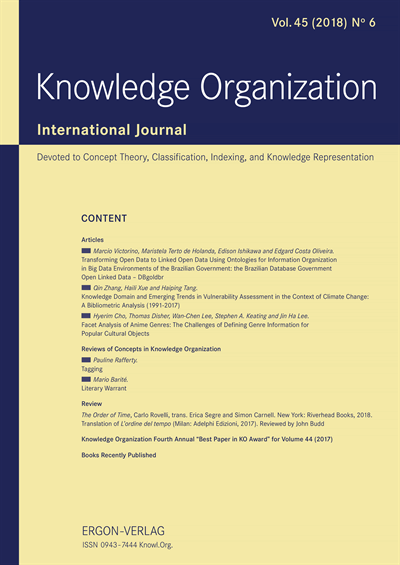
The Brazilian Government has made a massive volume of structured, semi-structured and non-structured public data available on the web to ensure that the administration is as transparent as possible. Subsequently, providing applications with enough...
Analysis of the knowledge structure and the evolution of research topics in specific areas has been the focus of information science (IS). Such analysis helps to enrich interested researchers’ understanding of the functions, activities and...
Anime, as a growing form of multimedia, needs a better and more thorough organization for its myriad unique terminologies. Existing studies show patrons’ desire to search and get recommendations for anime. However, due to inadequate indexing and...
This article examines tagging as knowledge organization. Tagging is a kind of indexing, a process of labelling and categorizing information made to support resource discovery for users. Social tagging generally means the practice whereby internet...
This paper reviews the coining and evolution process of the literary warrant concept from its introduction by Hulme in 1911 until today, its use, applications and adjustment to a digital information environment. Different theoretical and...