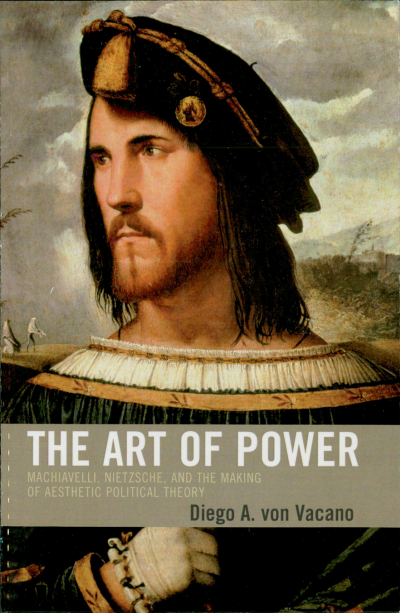
, to see if you have full access to this publication.
Monograph No access
The Art of Power
Machiavelli, Nietzsche, and the Making of Aesthetic Political Theory
Authors:
Publisher:
2006
Summary
The Art of Power is a challenge to traditional political theory. Diego A. von Vacano examines the work of Machiavelli, arguing that he establishes a new, aesthetic perspective on political life. He then proceeds to carry out the most extensive analysis to date of an important relationship in political theory: that between the thought of Machiavelli and Friedrich Nietzsche. Arguing that these two theorists have similar aims and perspectives, this work uncovers the implications of their common way of looking at the human condition and political practice to elucidate the phenomenon of the persistence of aesthetic, sensory cognition as fundamental to the human experience, particularly to the political life. By exploring this relationship, The Art of Power makes a significant contribution to the growing interest in the intersection of aesthetic theory and political philosophy as well as in interdisciplinary and comparative perspectives on political theory.
Search publication
Bibliographic data
Edition
1/2006
Copyright Year
2006
ISBN-Print
978-0-7391-1088-1
ISBN-Online
978-0-7391-5209-6
Publisher
Lexington, Lanham
Language
English
Pages
2
Product Type
Monograph
Table of contents
ChapterPages
Dedication No access
Contents No access
Abbreviations No access
Acknowledgements No access
Introduction: Art, Power, and Knowledge No access Pages 1 - 10
Chapter 1: Machiavelli's Ass and the Poetics of Political Life No access Pages 11 - 42
Chapter 2: Tragic Machiavelli: The Agon of the Heroic Prince No access Pages 43 - 72
Chapter 3: Nietzsche's Machiavellism No access Pages 73 - 110
Chapter 4: A Machiavellian Zarathustra: The Aesthetic Politics of Value Creation No access Pages 111 - 138
Chapter 5: The Form of Aesthetic Political Theory No access Pages 139 - 158
Chapter 6: Aesthetic Political Theory and Modernity No access Pages 159 - 184
Conclusion: Spectacular Politics No access Pages 185 - 196