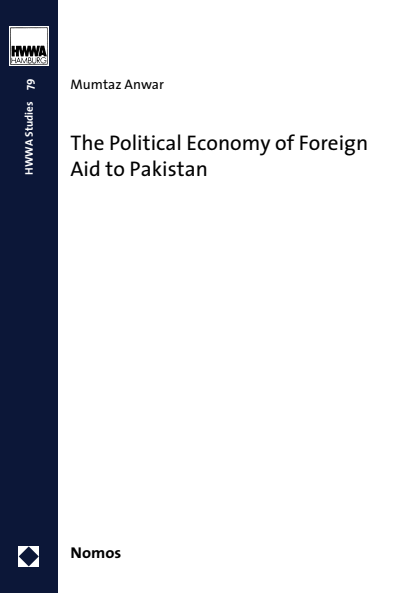
All political decision making processes reflect the interaction of different utility maximising actors: politicians, voters, bureaucrats and interest groups. Theoretical literature on the subject is not conclusive, and thus far, little empirical work exists. This study presents an econometric analysis of the allocation of development aid to Pakistan based on a political economic framework of aid allocation.
Looking at bi- and multilateral aid to Pakistan from 1960 to 2002, results suggest that aid flows to Pakistan are highly motivated by special interests within donor countries and international financial institutions (IFIs). Looking more specifically at bilateral aid, and especially aid by the single largest donor to Pakistan, i.e. the US, analysis suggests that Pakistan and Indian ethnic lobbies could play a role in aid flows, and in the passage of two important amendments, the Pressler and Brown Amendments, in US aid authorisation bills regarding aid to Pakistan. Analysis of multilateral financial flows to Pakistan shows that Pakistan receives a large amount of lending but with considerable variations over time. To some extent personal contacts of Pakistani international civil servants appear to play a role in multilateral lending to Pakistan, along with major shareholders economic interests.
Search publication
Bibliographic data
Edition
1/2007
Copyright Year
2007
ISBN-Print
978-3-8329-2449-2
ISBN-Online
978-3-8452-0002-6
Publisher
Nomos, Baden-Baden
Series
HWWA Studien
Volume
79
Language
English
Pages
141
Product Type
Monograph
Table of contents
ChapterPages
Titelei/Inhaltsverzeichnis No access Pages 2 - 10
Authors:
List of Abbreviations No access Pages 11 - 11
Authors:
List of Figures No access Pages 12 - 12
Authors:
List of Tables No access Pages 13 - 14
Authors:
Background No access Pages 15 - 16
Authors:
Research Questions and Motivation No access Pages 16 - 17
Authors:
Research Outline No access Pages 17 - 20
Authors:
Introduction No access Pages 21 - 22
Authors:
Aid Projections for Pakistan No access Pages 22 - 24
Authors:
Aid to Overcome Gaps in Pakistan No access Pages 24 - 28
Authors:
The Aid and Growth Relation in Pakistan No access Pages 28 - 31
Authors:
Multilateral Aid and Development No access Pages 31 - 34
Authors:
Determinants of Aid to Pakistan No access Pages 34 - 37
Authors:
Conclusions No access Pages 37 - 37
Authors:
Introduction No access Pages 38 - 39
Authors:
Factors Determining Bilateral and Multilateral Aid to Developing Countries No access Pages 39 - 46
Authors:
Politicians’ Interest in Aid Related Decision Making No access Pages 46 - 49
Authors:
The Voters’ Utility Maximising Role in Aid Allocation No access Pages 49 - 50
Authors:
Authors:
Business lobbies No access
Authors:
Ethnic lobbies and former colonial relations No access
Authors:
NGOs utility maximising behaviour No access
Authors:
Bureaucratic Interests in Aid Allocation No access Pages 57 - 59
Authors:
Conclusions No access Pages 59 - 61
Authors:
Introduction No access Pages 62 - 63
Authors:
Foreign Aid Volume and Types No access Pages 63 - 66
Authors:
Sources of bilateral aid to Pakistan No access Pages 66 - 70
Authors:
Sources of multilateral aid to Pakistan No access Pages 70 - 72
Authors:
Conclusions No access Pages 72 - 73
Authors:
Introduction No access Pages 74 - 75
Authors:
Incentives for Decision Making: Theoretical Hypotheses No access Pages 75 - 80
Authors:
Empirical Analysis of US Aid to Pakistan over Time No access Pages 80 - 85
Authors:
Empirical Analysis of Senate Voting on Aid to Pakistan No access Pages 85 - 91
Authors:
Conclusions No access Pages 91 - 92
Authors:
Introduction No access Pages 93 - 94
Authors:
Determinants of IFIs’ Lending Decisions: Theoretical Hypotheses No access Pages 94 - 98
Authors:
Empirical Analysis of IFIs’ Lending to Pakistan over Time No access Pages 98 - 106