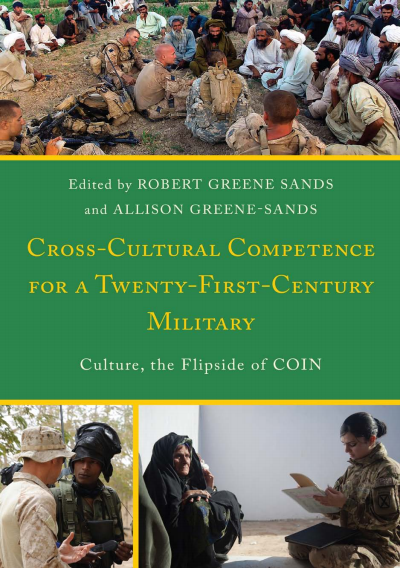
Cross-Cultural Competence for a Twenty-First-Century Military
Culture, the Flipside of COIN- Editors:
- |
- Publisher:
- 2013
Summary
Warfare in the 21st century is far different than warfare throughout the 19th and 20th centuries. Conventional warfare was about kinetic force and bending an adversary by might and strength. Skills valued were those related to mastery of weapons and placing ordnance on target. Courage and valor were defined by conflict, militaries were distinct from the population, and occupation was an enduring stage of war. Contemporary warfare, besides continuing to be an exercise in military strength, is composed of missions that depend on skills to forge interpersonal relationships and build sustainable partnerships with a host of actors that once had no voice or role in conflict’s duration or conclusion. Today, final victory does not conclude directly from conflict, in fact victory may be subsumed into the larger and more consuming equation of international stability. Twenty-first century warfare is about counterinsurgency and counter-terrorism through an array of strategies that foster collusion and collaboration not acquiescence.Cross-cultural competence (3C) is a suite of competencies and enablers that have been identified as critical to instill in expeditionary military and civilian personnel in the Department of Defense (DoD). Defined as a set of knowledge, skills, abilities and attitudes (KSAAs), 3C promotes effective interaction across cultural divides through exchanging ideas and meaning across cultures, facilitating effective cross-cultural interactions to develop and sustain relationships and providing a means to discern meaning from foreign and culturally different behavior. 3C permeates DoD policy, doctrine, strategy and operations and is now being institutionalized in DoD military and civilian education and training.
Cross-Cultural Competence for a Twenty-First-Century Military: Culture, the Flipside of COIN is a volume edited by two acknowledged experts on 3C in military learning, policy and research and explores the value and necessity of 3C to developing 21st Century warfighters. This volume features chapters by the editors and a host of multidisciplinary experts that probes all aspects of 3C, from concept to application. The message carried throughout Cross-Cultural Competence for a 21st Century Military is that contemporary and future security endeavors will be successful because winning wars ultimately rest on developing and sustaining cross-cultural relationships as much as it does on weapons and force.
Search publication
Bibliographic data
- Edition
- 1/2013
- Copyright Year
- 2013
- ISBN-Print
- 978-0-7391-7959-8
- ISBN-Online
- 978-0-7391-7960-4
- Publisher
- Lexington, Lanham
- Language
- English
- Pages
- 388
- Product Type
- Edited Book
Table of contents
- Table of Contents No access
- List of Tables No access
- List of Figures No access
- Foreword No access
- Preface No access
- Acknowledgments No access
- Section Introduction No access
- 1 Why Cross-cultural Competence? No access
- 2 The Historical Development of Cross-cultural Competence No access
- 3 A Developmental Model for Cross-cultural Competence No access
- 4 Institutionalizing Cross-cultural Competence in Department of Defense Policy No access
- Section Introduction No access
- 5 COIN and Beyond No access
- 6 Cross-cultural Competence Is Not Always Intuitive No access
- 7 Why Cross-cultural Competence Is in the Tool Kit for Foreign Area Officers No access
- 8 Cross-cultural Competence and Civil-Military Operations No access
- Section Introduction No access
- 9 Instrumentation Challenges in Developing Cross-cultural Competence Models No access
- 10 Developing Cross-cultural Competence Following Negative Cross-cultural Experiences No access
- 11 Complications in Cross-cultural Communications: Using Interpreters No access
- 12 Cross-cultural Influence and the Advising Mission: Empirical Findings and the Way Ahead No access
- Section Introduction No access
- 13 Cross-cultural Communication Contributions to Professional Military Education: A Distance Learning Case Study No access
- 14 Cross-cultural Competence in the Classroom: Measuring Instructional Effectiveness No access
- 15 Where's the "So What?": Teaching Culture in the Marine Corps No access
- 16 Cross-cultural Competence Plus Language: Capturing the Essence of Intercultural Communication No access
- Section Introduction No access
- 17 Cross-cultural Competence as a Critical Enabler for Security Force Assistance Missions No access
- 18 Raumschach Negotiations No access
- 19 Diversity and Cross-cultural Competence No access
- About the Authors No access Pages 371 - 382
- Index No access Pages 383 - 388