, to see if you have full access to this publication.
Monograph No access
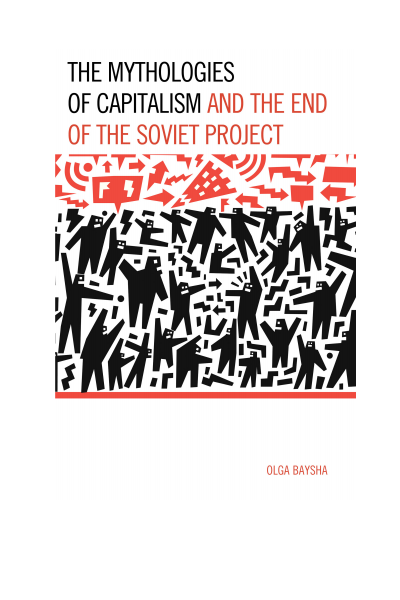
The Mythologies of Capitalism and the End of the Soviet Project
Authors:
Publisher:
2014
Summary
The purpose of The Mythologies of Capitalism and the End of the Soviet Project is to show that in order to understand popular disillusionment with democratization, liberalization, and other transformations associated with the attempts of non-Western societies to appropriate the ideas of Western modernity, one must consider how these ideas are mythologized in the course of such appropriations. Olga Baysha argues that the seeds of popular post-revolutionary frustration should be sought in pre-revolutionary discourses on democracy, liberalism, and other concepts of Western modernity that are produced outside local contexts and introduced through the channels of global communication and the interpretations of politicians, activists, and experts. Analyzing the opinions of working people and intellectuals published in two Ukrainian newspapers of perestroika times, the author shows how the concepts of democracy, the market, and the West acquired schizophrenic mythical significations. The study is situated within the context of Ulrich Beck’s theory of world risk society and Gregory Bateson’s theory of schizophrenia as communicative disorder. The author argues that schizophrenic mythologies constructed through globalized networks can lead to disorientation, frustration, and the sense of uncertainty and insecurity on the part of mass publics.
Keywords
Search publication
Bibliographic data
Edition
1/2014
Copyright Year
2014
ISBN-Print
978-0-7391-8802-6
ISBN-Online
978-0-7391-8803-3
Publisher
Lexington, Lanham
Language
English
Pages
171
Product Type
Monograph
Table of contents
ChapterPages
Contents No access
Acknowledgments No access
Introduction No access
Chapter One: Modernity and Its Projects No access
Chapter Two: Deconstructing Mythologies No access
Chapter Three: The Rise and Fall of an Alternative Project No access
Chapter Four: The Discourses of Perestroika No access
Chapter Five: Mythologizing Democracy No access
Chapter Six: Mythologizing the Market No access
Chapter Seven: Mythologizing the United States: The Horn of Plenty No access
Chapter Eight: The Twilight Zone No access
Chapter Nine: Schizophrenia as a Communicative Disorder No access
Chapter Ten: Personal Reflections No access
Conclusion No access Pages 145 - 146
Appendix A: Research Design No access Pages 147 - 152
Appendix B: Statistical Results No access Pages 153 - 156