, to see if you have full access to this publication.
Monograph No access
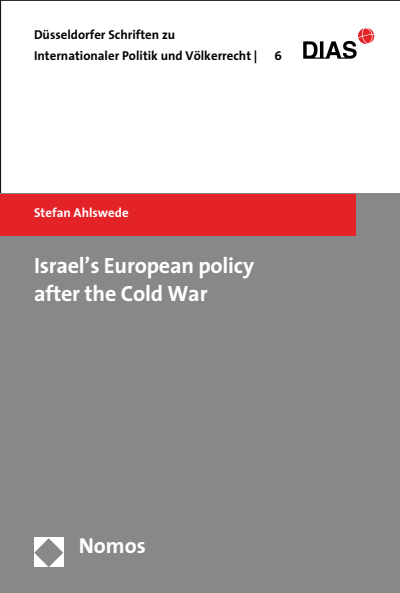
Israel's European policy after the Cold War
- Authors:
- Series:
- Düsseldorfer Schriften zu Internationaler Politik und Völkerrecht, Volume 6
- Publisher:
- 2009
Search publication
Bibliographic data
- Edition
- 1/2009
- Copyright Year
- 2009
- ISBN-Print
- 978-3-8329-4817-7
- ISBN-Online
- 978-3-8452-1918-9
- Publisher
- Nomos, Baden-Baden
- Series
- Düsseldorfer Schriften zu Internationaler Politik und Völkerrecht
- Volume
- 6
- Language
- German
- Pages
- 331
- Product Type
- Monograph
Table of contents
ChapterPages
- Titelei/Inhaltsverzeichnis No access Pages 2 - 10Authors:
- Abbreviations No access Pages 11 - 12Authors:
- Scientific interest No access Pages 13 - 15Authors:
- State of research No access Pages 15 - 16Authors:
- The case studies No access Pages 16 - 18Authors:
- What we need: form follows function No access Pages 18 - 21Authors:
- The research design: structured empiricism No access Pages 21 - 26Authors:
- The data basis No access Pages 26 - 27Authors:
- General outline No access Pages 27 - 28Authors:
- Authors:
- Global system No accessAuthors:
- Authors:
- The Middle Eastern regional system No accessAuthors:
- The greater EU system No accessAuthors:
- The Euro-Mediterranean and Mediterranean systems No accessAuthors:
- The EU No accessAuthors:
- Authors:
- Relations with EU member states No accessAuthors:
- Relations with Israel’s neighbours No accessAuthors:
- Relations with other states No accessAuthors:
- Authors:
- Relations with the United States No accessAuthors:
- Authors:
- EC/EU Middle East policy No accessAuthors:
- EU Mediterranean policy No accessAuthors:
- Israeli-Palestinian relations No accessAuthors:
- Authors:
- Military capability No accessAuthors:
- Economic capability No accessAuthors:
- Political structure No accessAuthors:
- Competing elites No accessAuthors:
- Interest groups No accessAuthors:
- Authors:
- Israel’s European trauma No accessAuthors:
- Authors:
- Being special No accessAuthors:
- Israel’s reaction to being special No accessAuthors:
- The rebellious victim No accessAuthors:
- Primacy of security No access Pages 57 - 57Authors:
- Victims nevermore No accessAuthors:
- Resistance to sanctions/limited compliance No access Pages 58 - 58Authors:
- Motivation of the European Parliament No access Pages 59 - 65Authors:
- Background of Israel’s position No access Pages 65 - 66Authors:
- Background of Israel’s counterproductive behaviour No access Pages 66 - 70Authors:
- Authors:
- Genscher No accessAuthors:
- Rhetoric No accessAuthors:
- Threats No accessAuthors:
- Lobbyism in Brussels No accessAuthors:
- Hibernation No accessAuthors:
- Embassy to the EC No accessAuthors:
- The actors No access Pages 75 - 76Authors:
- Conclusion No access Pages 76 - 77Authors:
- Authors:
- US role No accessAuthors:
- Aid for the region No accessAuthors:
- Tame the EC, have France controlled No accessAuthors:
- Role of the Kuwait crisis No accessAuthors:
- Keep EC amused, safeguard the upgrading of relations No accessAuthors:
- Levy’s perception of what was agreed upon with the EC in June No access Pages 85 - 87Authors:
- The actors No access Pages 87 - 88Authors:
- Conclusion No access Pages 88 - 89Authors:
- Israel’s motivation to agree No access Pages 89 - 97Authors:
- The actors No access Pages 97 - 98Authors:
- The EU’s special envoy to the Middle East No access Pages 98 - 104Authors:
- Nature and aims of the EMP No access Pages 104 - 106Authors:
- An assessment after ten years No access Pages 106 - 108Authors:
- Israel’s perspective No access Pages 108 - 113Authors:
- A third leg – Counterbalance a possible decrease of American commitment No access Pages 113 - 119Authors:
- The ministerial officials No access Pages 119 - 121Authors:
- The politicians No access Pages 121 - 123Authors:
- Administrative units No access Pages 123 - 124Authors:
- Private interest groups No access Pages 124 - 124Authors:
- The 1975 Free Trade and Cooperation Agreement No access Pages 125 - 127Authors:
- The causes and implications of the trade deficit with the EC No access Pages 127 - 130Authors:
- The dynamics of further European integration No access Pages 130 - 132Authors:
- The history of scientific cooperation with the EC No access Pages 132 - 134Authors:
- Excursion: the EC agrees to negotiations – a success of Israeli policy? No access Pages 134 - 144Authors:
- Exploratory talks No access Pages 144 - 146Authors:
- Authors:
- Excursion: implications of EEA status No accessAuthors:
- EFTA or EEA status? No accessAuthors:
- Authors:
- Peace dividend No accessAuthors:
- More favourable rules of origin No accessAuthors:
- Access to the EU’s public procurement markets No accessAuthors:
- Mutual recognition of diplomas and standards No accessAuthors:
- Harmonisation in financial services No accessAuthors:
- Better access for agricultural products No accessAuthors:
- Admission to the EU’s Fourth Framework Programme for Research and Development No accessAuthors:
- Political dialogue No accessAuthors:
- Boost European investments No accessAuthors:
- The dispute on rules of origin No access Pages 160 - 164Authors:
- The dispute on public procurement No access Pages 164 - 166Authors:
- The dispute on agricultural products No access Pages 166 - 167Authors:
- The dispute on financial services No access Pages 167 - 170Authors:
- Authors:
- Further vision: EEA status No accessAuthors:
- The dispute on the EU’s R&D programme No access Pages 174 - 179Authors:
- Sign or keep negotiating? No access Pages 179 - 186Authors:
- Authors:
- The deficit argument No accessAuthors:
- Authors:
- Compensate No accessAuthors:
- Inversion No accessAuthors:
- A policy change? No accessAuthors:
- The moral argument No accessAuthors:
- Sanctions, threats and retaliation No access Pages 193 - 195Authors:
- Authors:
- Marketing tour of Rabin and Peres No accessAuthors:
- The German channel No accessAuthors:
- Authors:
- Israel’s motivation No accessAuthors:
- History of the declaration No accessAuthors:
- Criticism of the Essen Declaration No accessAuthors:
- Nothing has become of the declaration No accessAuthors:
- The name of the agreement No accessAuthors:
- The ministerial officials No access Pages 202 - 205Authors:
- The Inter-Ministerial Director Generals’ Committee for Economic International Affairs No access Pages 205 - 207Authors:
- Authors:
- Authors:
- Peres’ inter-ministerial panel No accessAuthors:
- The Prime Minister No accessAuthors:
- Politicians in implementation No accessAuthors:
- A special case: Avi Primor No access Pages 211 - 212Authors:
- The role of private interest groups No access Pages 212 - 215Authors:
- Has Israel achieved its aims? No access Pages 215 - 218Authors:
- Why has Israel been successful? No access Pages 218 - 220Authors:
- Conflicting visions No access Pages 220 - 221Authors:
- Authors:
- Ill-preparedness No accessAuthors:
- Structural coordination deficit No accessAuthors:
- Peres’ and the Foreign Ministry’s weakness No accessAuthors:
- Israel’s clout No accessAuthors:
- Self-conception of Israel vis-à-vis Europe No access Pages 226 - 228Authors:
- Authors:
- Readiness to explain EU behaviour with anti-Semitism No accessAuthors:
- Misperceptions and policy failure No access Pages 231 - 232Authors:
- Authors:
- The role of the Foreign Minister No accessAuthors:
- The role of the Prime Minister No accessAuthors:
- The role of further cabinet members No accessAuthors:
- Authors:
- The Professionals No accessAuthors:
- Bureaucratic units No access Pages 237 - 237Authors:
- Authors:
- Role of the Knesset No accessAuthors:
- Interest groups No accessAuthors:
- Competing elites No accessAuthors:
- Structures and processes No access Pages 239 - 239Authors:
- Preventing an EU political role No access Pages 239 - 243Authors:
- The EU as the facilitator of peace No access Pages 243 - 247Authors:
- Use the EU’s good services No access Pages 247 - 250Authors:
- EEA status No access Pages 250 - 251Authors:
- Recognition of Europeanness No access Pages 251 - 251Authors:
- Has Israel achieved its aims? No access Pages 251 - 253Authors:
- The role of the US No access Pages 253 - 254Authors:
- The German channel No access Pages 254 - 255Authors:
- Portray behaviour as if caused by EU attitude: the issue of the deportees No access Pages 255 - 257Authors:
- Virtual implementation No access Pages 257 - 258Authors:
- Hibernation No access Pages 258 - 259Authors:
- Token role of the EU No access Pages 259 - 261Authors:
- Bounded slippage and emergencism No access Pages 261 - 262Authors:
- Politics and economics shall not be linked? No access Pages 262 - 262Authors:
- Has Israel’s European Policy changed? No access Pages 263 - 267Authors:
- Conflicting aims: contain Europe or embrace Europe? No access Pages 267 - 268Authors:
- Incompatible visions: European or Middle Eastern? No access Pages 268 - 270Authors:
- Incompatible notions: European or special? No access Pages 270 - 272Authors:
- Incompatible perspectives on appropriate foreign behaviour No access Pages 272 - 274Authors:
- Authors:
- Full EU membership No accessAuthors:
- The future of the EU’s contribution No access Pages 278 - 280Authors:
- Usefulness of our model No access Pages 280 - 280Authors:
- Persons interviewed No access Pages 281 - 284Authors:
- Reference List No access Pages 285 - 322Authors:
- Index No access Pages 323 - 331Authors: