KNOWLEDGE ORGANIZATION is a forum for all those interested in the organization of knowledge on a universal or a domain-specific scale, using concept-analytical or concept-synthetical approaches, as well as quantitative and qualitative methodologies. KNOWLEDGE ORGANIZATION also addresses the intellectual and automatic compilation and use of classification systems and thesauri in all fields of knowledge, with special attention being given to the problems of terminology.KNOWLEDGE ORGANIZATION publishes original articles, reports on conferences and similar communications, as well as book reviews, letters to the editor, and an extensive annotated bibliography of recent classification and indexing literature.KNOWLEDGE ORGANIZATION should therefore be available at every university and research library of every country, at every information center, at colleges and schools of library and information science, in the hands of everybody interested in the fields mentioned above and thus also at every office for updating information on any topic related to the problems of order in our information-flooded times.
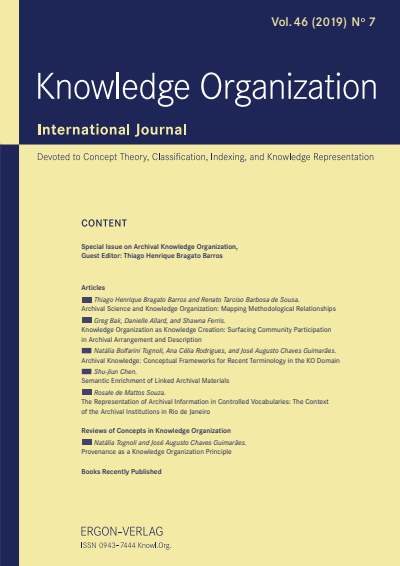
We discuss the aspects and points of contact between knowledge organization and archival science, based on the texts published in the scope of the International Society of Knowledge Organization, especially concerning classification and description,...
Remix or bricolage is recognized as a primary mode of knowledge creation in contemporary digital culture. Archival arrangement represents a form of bricolage that archivists have been practicing for years. By organizing records according to...
Despite having the principle of provenance as its guiding element, the archival knowledge organization still prescinds, for conceptual purposes, of greater clarity of its object-the archival knowledge-a fundamental aspect for the sedimentation of...
By using the metadata for the fonds of “Chen Cheng-po’s Paintings and Documents” (CCP) in the database of the Archives of the Institute of Taiwan History (IHT, Academia Sinica, Taiwan), we develop and enhance a semantic data model for...
We aim to trace the scenario of the use of controlled vocabularies as tools of research and work in the scope of representation and retrieval of information in institutions that have archival collections, in order to highlight the need for greater...
The principle of provenance is one of the most important milestones in archival practice and theory from the time its establishment grounded the scientific dimension of archival discipline in the nineteenth century. Since then, provenance and...