, to see if you have full access to this publication.
Monograph No access
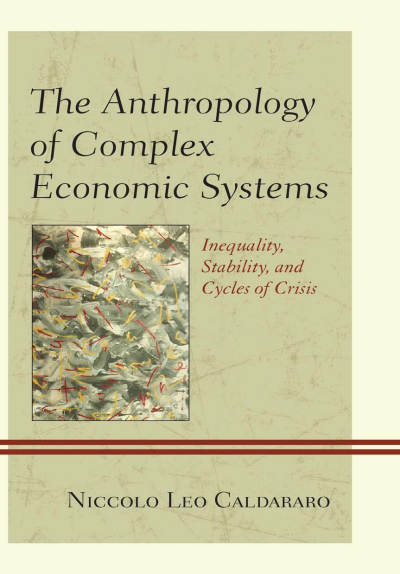
The Anthropology of Complex Economic Systems
Inequality, Stability, and Cycles of Crisis
Authors:
Publisher:
2013
Summary
Today we live in what Ulrich Beck has aptly characterized as a “risk society” shaped by intensifying crises outside of our control and seemingly outside of our comprehension. The master narrative that was supposed to lead us to secular salvation—economics—has proved to be a large part of the problem rather than the much anticipated solution. In The Anthropology of Complex Economic Systems, Niccolo Caldararo offers a much more radical and challenging answer: that the fundamental assumptions on which the modern “science” of economics has been erected are false, and that it is through the medium of anthropology, particularly the relatively neglected field of economic anthropology, that an alternative and sound basis for both the understanding of economic behavior and for the shaping of economic futures can be constructed. Caldararo not only challenges the foundational assumptions of conventional economic theory, but situates economic behavior (something quite different and universal amongst human beings) in both a historical and an ecological context. Contemporary discussions of “sustainability,” especially in the field of development studies, have oddly neglected to look to anthropology. Economic anthropology, is the repository of a vast store of wisdom both about actual alternative and workable economic systems and about their evolution. By drawing on this source, Caldararo builds a model of the evolution of human economies which stir up substantial debate, shows how economic anthropology provides a tool for the interrogation of economic theory, and ties economics to ecology. It has been the rupture of this fundamental relationship that lies at the basis of much of our present crisis and the unsustainable economic patterns that humans have created. By bringing together in a new configuration economic anthropology, ecology, and culture history, Caldararo not only proposes a new model of human social evolution, but equally importantly creates a methodology for speaking to, and against, our present economic and environmental situation.
Keywords
Search publication
Bibliographic data
Edition
1/2013
Copyright Year
2013
ISBN-Print
978-0-7391-6971-1
ISBN-Online
978-0-7391-6972-8
Publisher
Lexington, Lanham
Language
English
Pages
323
Product Type
Monograph
Table of contents
ChapterPages
Contents No access
List of Figures No access
Preface No access
Acknowledgments No access
Introduction No access Pages 1 - 14
Chapter 1: Anthropology and the Cosmology of Modern Economics No access
Chapter 2: Wants, Needs, and the Question of Surplus versus Wealth No access
Chapter 3: Complexity and Stability or Stagnation: Declining Returns and the Business Cycle No access
Chapter 4: Wealth, Consumption, Quality of Life and Standard of Living No access
Chapter 5: The Great Debate: Economists and Anthropologists: The Market and Society, Continued No access
Chapter 6: Introduction No access
Chapter 7: Forest Fires: Origins and Myths No access
Chapter 8: Traditional Peoples and Fire No access
Chapter 9: Climate and Fire, Assessing Time’s Arrow and the Antiquity of Anthropogenic Fire No access
Chapter 10: Forest Management in Modern and Traditional Society No access
Chapter 11: The Degraded Environment and Homo Sapiens No access
Chapter 12: Co-evolutionary Processes and Environmental Exploitation No access
Chapter 13: Makeup and Nature of Forests: Fire-Adapted Species vs “Old Growth” No access
Chapter 14: Determining Fire History: Fire Scars, Fire Histories and Thermal Alteration No access
Chapter 15: Insects, Biomass Reduction and Pesticides No access
Chapter 16: Conclusion: Forests and the Future of Man No access
Chapter 17: Introduction No access
Chapter 18: The Problem of Population and the Nature of Human Society No access
Chapter 19: Consumerism and Sustainability: Japan as an Example No access
Chapter 20: The Evolution of Modern Japan and Its Transformation No access
Chapter 21: The Credit Crisis of 2008 to 20?? No access
Chapter 22: Ideology and Religious Precepts and Motivations: Why People Work No access
Chapter 23: Fundamentalism versus Globalism No access