, to see if you have full access to this publication.
Monograph No access
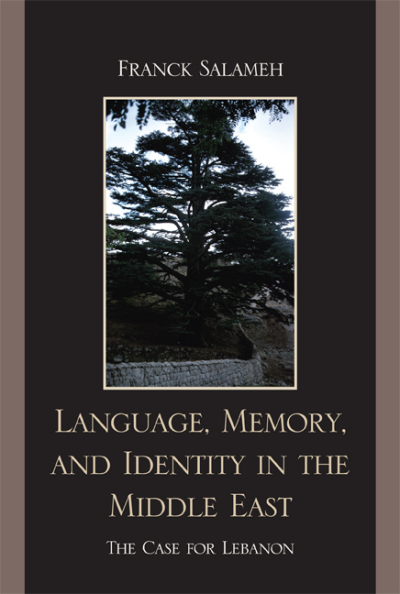
Language, Memory, and Identity in the Middle East
The Case for Lebanon
Authors:
Publisher:
2010
Summary
Since the West's very early flirtations with the modern Near East, and especially in the past 100 years of East-West relations, there has been considerable difficulty in understanding and defining the Middle East, the Arab world, pan-Arabism, Arab nationalism, and Middle Eastern identities in general. The Western impulse of conflating national identity with language, state, and ethnicity—often subsuming Arabic language into Arab ethnicity—has contributed to this misunderstanding and misreading of the region. For, while the Middle East can be accurately referred to by way of the generic "Arab world" label, the appellation itself is a misleading oversimplification that conceals an inherent diversity and multiplicity of Middle Eastern cultures, ethnicities, languages, and nationalities. And while there is certainly a dominant Arab ethnos, there are also significant numbers of Middle Eastern peoples and nationalities with historical memories and ethno-cultural bonds that challenge the dominant Arabist paradigm. Language, Memory, and Identity in the Middle East proposes a new reading of modern Middle Eastern history and suggests alternate solutions to the region's problems. The book is an attempt to rehabilitate and bring back to the fore of Middle East Studies the issue of language as a key factor in shaping (and misshaping) the region, with the hope of rediscovering a broader, more honest, and less ideologically tainted discussion on the Middle East. Language, Memory, and Identity in the Middle East has a special focus on Lebanon, a "Christian homeland," because Lebanon has traditionally acted as the region's template for change and a barometer gauging its problems and charting its progress.
Search publication
Bibliographic data
Edition
1/2010
Copyright Year
2010
ISBN-Print
978-0-7391-3738-3
ISBN-Online
978-0-7391-3740-6
Publisher
Lexington, Lanham
Language
English
Pages
292
Product Type
Monograph
Table of contents
ChapterPages
Contents No access
Acknowledgments No access
Introduction No access
Chapter 01. Arabism and Its Rivals No access Pages 1 - 40
Chapter 02. Swarming Memories, Clashing Identities: The Case for Lebanon No access Pages 41 - 74
Chapter 03. Lebanon’s Myths and Legends No access Pages 75 - 112
Chapter 04. Saïd Akl: The Architect of the Spirit of the Nation No access Pages 113 - 160
Chapter 05. Particularism as Template No access Pages 161 - 190
Chapter 06. Linguistic Lebanonism No access Pages 191 - 214
Chapter07. Toward a Lebanese Alphabet, Toward a New Middle East No access Pages 215 - 258