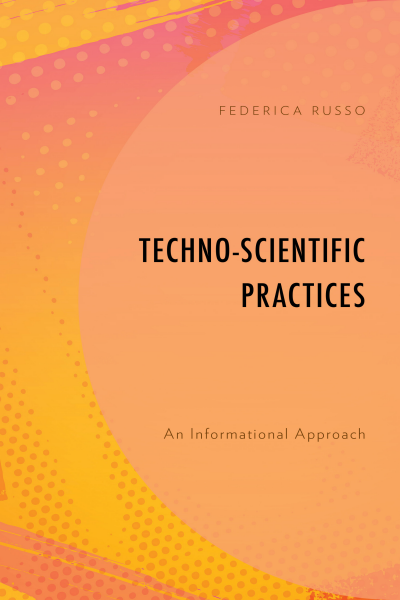
Techno-Scientific Practices
An Informational Approach- Authors:
- Publisher:
- 2022
Summary
In scholarly debates, as well as in everyday parlance, we tend to pull science and technology apart: science gives us theory, and technology applies it. In practice, however, science and technologies are highly intertwined. In Techno-Scientific Practices: An Informational Approach, Federica Russo looks at the practice of science and elucidates the role of technologies and instruments in the process of knowledge production. In this exercise, it becomes evident that technologies cannot be analyzed on their own, but always in relation to epistemic agents. Thus, Techno-Scientific Practices emphasizes the importance of analyzing the process of knowledge production in techno-scientific contexts, in which there is a triad of relations to look at: us, the instruments, and the world. The book thus builds bridges between the philosophy of science, philosophy of technology, and science and technology studies in an unprecedent way.
Keywords
Search publication
Bibliographic data
- Edition
- 1/2022
- Copyright Year
- 2022
- ISBN-Print
- 978-1-78661-232-8
- ISBN-Online
- 978-1-78661-234-2
- Publisher
- Rowman & Littlefield, Lanham
- Language
- English
- Pages
- 316
- Product Type
- Monograph
Table of contents
- Dedication No access
- Contents No access
- List of Abbreviations No access
- Foreword No access
- Acknowledgments No access
- 1.1 The Origin of the Project No access
- 1.2 The Contents of the Book No access
- 1.3 Motivation and Perspective No access
- Summary No access
- 2.1.1 Distinct Institutional Contexts No access
- 2.1.2 Distinct Academic Outputs No access
- 2.1.3 Distinct Objects of Investigation No access
- 2.2 PSP Tries to Bridge the Gap No access
- 2.3 Neglected Traditions: “Techno-Science” in French Epistemology No access
- 2.4 What Do We Need a Concept of “Techno-Science” For? No access
- Notes No access
- Summary No access
- 3.1 The “Practice turn” in Sociology and in Philosophy of Science No access
- 3.2 How to Study “Practices,” in Practice No access
- 3.3.1 What Are These “Episodes Of,” Exactly? No access
- 3.3.2 Episode 1: Molecular Epidemiology and Exposure Research No access
- 3.3.3 Episode 2: Computational History of Ideas and the e-Ideas Project No access
- 3.3.4 Episode 3: The Measurement of Vitamin D No access
- 3.3.5 Episode 4: High Energy Physics and the ATLAS Experiment No access
- 3.4 What Is the Role of Instruments in the Process of Knowledge Production? No access
- Note No access
- Summary No access
- 4.1 Why Go Informational? No access
- 4.2.1 Tool 1: Constructionism No access
- 4.2.2 Tool 2: The Method of the Levels of Abstraction No access
- 4.3 Perspectivism and the Role of Epistemic Agents No access
- Summary No access
- 5.1.1 A Vast Literature to Organize and Systematize No access
- 5.1.2 Models as Representations No access
- 5.1.3 Models as Objects No access
- 5.2.1 Models Mediate between Epistemic Agents and the World No access
- 5.2.2 Models Help Epistemic Agents Isolating Relevant Factors No access
- 5.2.3 Models Guide Epistemic Agents through the Process, Like a Map No access
- 5.3.1 A Plurality of Types of Modeling Practices No access
- 5.3.2 Methodological Pluralism, Styles of Reasoning, and Foliated Pluralism No access
- 5.3.3 The Perils of Methodological Imperialism No access
- 5.4 The Practice of Model Validation No access
- 5.5 The Materiality of Modeling No access
- Summary No access
- 6.1 Models Generate Evidence No access
- 6.2 The Limits of Analytic Approaches and the Materiality of Evidence No access
- 6.3 Evidence as Semantic Information No access
- 6.4.1 Evidential Pluralism No access
- 6.4.2 If Evidence Hierarchies Are Wrong, Then What? No access
- Summary No access
- 7.1.1 Modeling, Language, and Truth No access
- 7.1.2 Examples of Techno-Scientific Claims No access
- 7.2 The Received View in Analytic PhilSci: Truth as Correspondence No access
- 7.3.1 Step 1: Translation No access
- 7.3.2 Step 2: Polarization No access
- 7.3.3 Step 3: Normalization No access
- 7.3.4 Step 4: Verification and Validation No access
- 7.3.5 Step 5: Correctness No access
- 7.4 The Conceptual Design of “Truth”: Correctness, Contextual Correspondence, Procedural Objectivity, and the Role of Epistemic Agents No access
- Note No access
- Summary No access
- 8.1.1 Knowledge and Language No access
- 8.1.2 Knowledge and Situatedness No access
- 8.1.3 Knowledge in Techno-Science Practices No access
- 8.2 Knowledge Is Relational No access
- 8.3 Knowledge Is Distributed No access
- 8.4 Knowledge Is Embodied No access
- 8.5 Knowledge Is Material No access
- 8.6.1 A Constellation of Concepts No access
- 8.6.2 Understanding the Prism: Validity, Evidence, Truth, and Knowledge No access
- 8.7.1 Instruments as Bearers of Knowledge No access
- 8.7.2 Instruments Belong to the Network of Actors No access
- 8.7.3 Instruments Mediate the Human-Technology Relation No access
- 8.7.4 Instruments Respond to “What the World Is Like” No access
- Summary No access
- 9.1 Why “Poiêsis”? No access
- 9.2 Poiêsis, beyond Epistêmê and Technê No access
- 9.3.1 The Maker’s Knowledge Tradition No access
- 9.3.2 The Production of Knowledge No access
- 9.4.1 Technologies That Can Transform the Environment No access
- 9.4.2 The Semi/Quasi-Autonomous Role of (Non-Digital) Instruments No access
- 9.4.3 The Agency of Instruments No access
- 9.5.1 The Concept of “In-Betweenness” No access
- 9.5.2 The Epistemic and Moral Responsibility of Poietic Agents No access
- Note No access
- Summary No access
- 10.1 Ontoepistemology and Constructionism No access
- 10.2 Agency, Structures, and Relations No access
- Summary No access
- 11.1 Entities and the ”Myth of Substance” No access
- 11.2.1 French Philosophy of Techno-Science No access
- 11.2.2 Practice-Oriented Studies of Individuals and Individuality No access
- 11.3 Process Philosophies in (Philosophical) Context No access
- 11.4 Processes and Interactions No access
- Summary No access
- 12.1 Do We Need to “Cement” Things Together? No access
- 12.2 The Mosaic of Causal Theory No access
- 12.3.1 The Classic Process Account No access
- 12.3.2 Complex Systems Mechanisms No access
- 12.3.3 Capacities/Powers/Dispositions No access
- 12.4 Tracing the Transmission of Information No access
- 12.5.1 Tracing Decay Signatures in the LHC No access
- 12.5.2 Tracing Signal from the Noise in Omics Analyses No access
- 12.6 The Ontoepistemological and Constructionist Character of Information Transmission No access
- 13.1 Philosophy of Information and the Ability to Connect Distant Edges No access
- 13.2 The Research Ahead No access
- Bibliography No access Pages 275 - 308
- Index No access Pages 309 - 314
- About the Author No access Pages 315 - 316