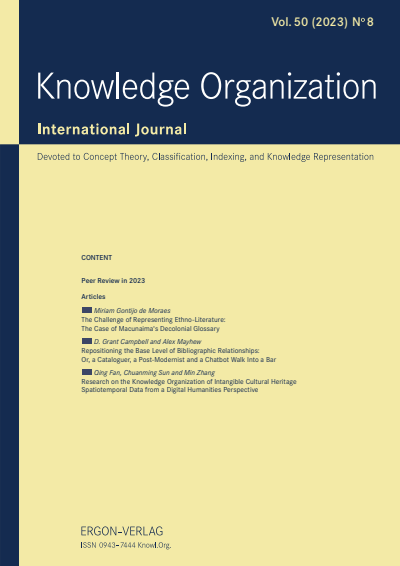
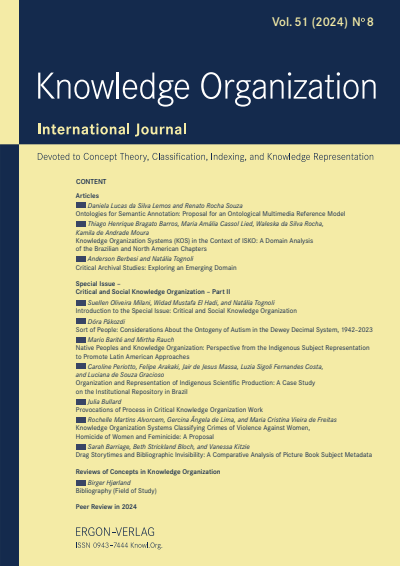
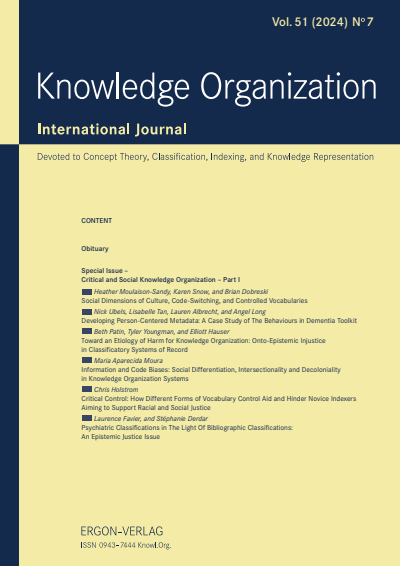
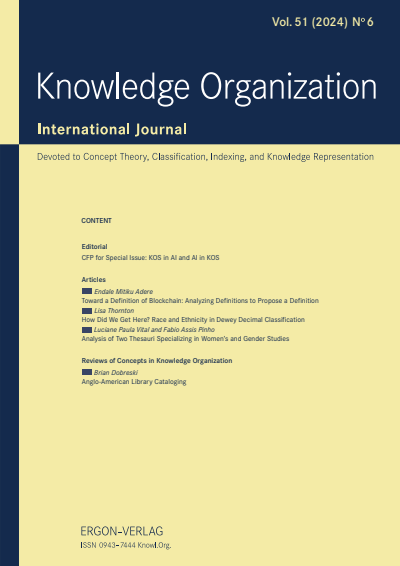
KNOWLEDGE ORGANIZATION is a forum for all those interested in the organization of knowledge on a universal or a domain-specific scale, using concept-analytical or concept-synthetical approaches, as well as quantitative and qualitative methodologies. KNOWLEDGE ORGANIZATION also addresses the intellectual and automatic compilation and use of classification systems and thesauri in all fields of knowledge, with special attention being given to the problems of terminology. KNOWLEDGE ORGANIZATION publishes original articles, reports on conferences and similar communications, as well as book reviews, letters to the editor, and an extensive annotated bibliography of recent classification and indexing literature. KNOWLEDGE ORGANIZATION should therefore be available at every university and research library of every country, at every information center, at colleges and schools of library and information science, in the hands of everybody interested in the fields mentioned above and thus also at every office for updating information on any topic related to the problems of order in our information-flooded times.
Among the challenges in organizing ethnoknowledge is adhering to the theoretical methodological principle of literary warrant. This paper seeks to build a terminological tool that meets both the principle of literary warrant and the decolonial...
Designers and maintainers of library catalogues are facing fresh challenges representing bibliographic relationships, due both to changes in cataloguing standards and to a broader information environment that has grown increasingly diverse,...
Intangible cultural heritage is an important part of China’s excellent traditional culture, and its inheritance and development are attached to a specific time and space. From the digital humanities perspective, the visualization of intangible...