Soziale Arbeit, founded in 1951, is an independent academic journal which addresses developments in the context of social work. It is one of the most important publication media in its field and is read by teachers, students and researchers in social work and social pedagogy as well as by professionals and managers from associations and institutions. The journal’s aim is to promote professional development in social work fields by presenting methods and new concepts, in addition to subject-specific practical reports. In the ‘Rundschau’ (Review) section, information from all social fields is compiled. The ‘Tagungskalender’ (Conference Calendar) refers to important events, and the ‘Zeitschriftenbibliographie’ (Bibliography of Journals) lists current articles from professional journals. Soziale Arbeit is published 11 times a year with an annual focus issue published as a double issue. All scholarly articles submitted for publication in the journal undergo a double-blind peer review process. The editorial board is supported in an advisory capacity by a professional advisory board consisting of individuals from associations, universities, politics and administrative bodies. The journal cooperates with the academic societies of social work from Germany (DGSA) and Austria (OGSA). All social work contributions are indexed in the literature database DZI SoLit.
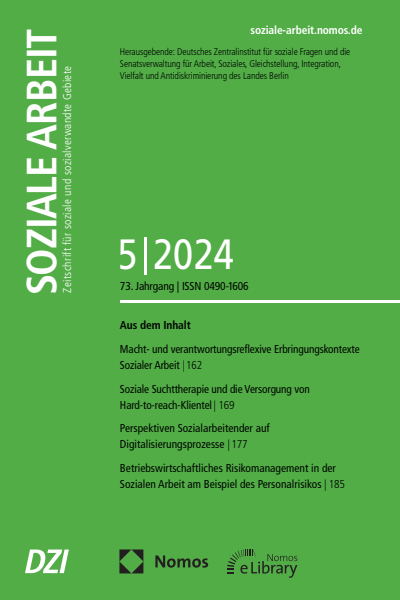
The current socio-political and social challenges, such as the entrenchment of poverty or the rise of populist views, also confront social work with the task of (re)positioning itself and taking a stand. The article is intended as a suggestion for a...
In a qualitative study on the possibilities and limitations of addiction therapy by social workers in counseling centers, five problem-centered expert interviews were conducted and analyzed. Although addiction therapy in the outpatient sector can be...
The DIGITASA survey is presented, which focuses on the perspectives of social workers on digitalization processes. The results are ambivalent: assessments of the improved accessibility and participation of children and young people are mostly...
Social work organisations are increasingly exposed to business risks due to various causes (globalisation, crises). These include, among others, personnel risk. Business management approaches for managing the personnel risks are presented. For...