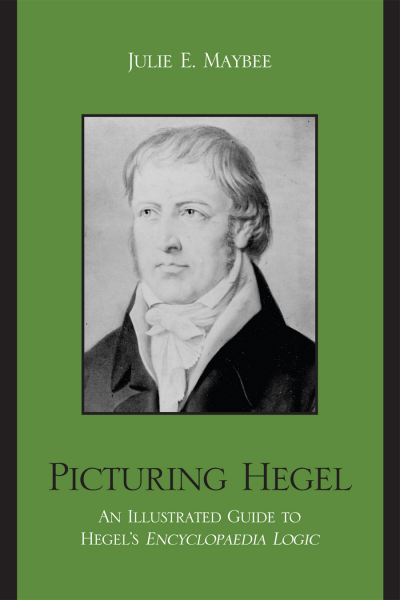
Picturing Hegel
An Illustrated Guide to Hegel's Encyclopaedia Logic- Authors:
- Publisher:
- 2009
Summary
In her innovative take on G.W. F. Hegel's The Encyclopaedia Logic, Julie E. Maybee uses pictures and diagrams to cut through the philosopher's dense, difficult writing. Picturing Hegel: An Illustrated Guide to Hegel's Encyclopaedia Logic utilizes diagrams in order to rehabilitate Hegel's logic for serious consideration by showing how each stage develops step-by-step from earlier stages according to definite, logical patterns. This interpretation makes Hegel's work accessible and understandable for new and experienced readers alike. Because Hegel uses the same logic in all of his works, Maybee's analysis and defense of the logic will capture the attention of those readers interested in Hegel's ethics, politics, history, philosophy of religion, and phenomenology. Through the included diagrams, Maybee is able to define central Hegelian concepts such as 'being-in-itself,' and 'being-in-and-for-itself' with a new level of precision. Maybee argues that Hegel's logic does not include the one logistical pattern most often attributed to him; namely, the pattern 'thesis-antithesis-synthesis.' Rather, Hegel's model of logic was more scientific than formalistic in nature, as the philosopher himself pointed out. Hegel considered himself an encyclopedic culmination of Western philosophy in some ways, and indeed his work summarizes many of the presuppositions of Western philosophy. By picturing Hegel's logic, we can gain a greater understanding of ourselves.
Search publication
Bibliographic data
- Edition
- 1/2009
- Copyright Year
- 2009
- ISBN-Print
- 978-0-7391-1615-9
- ISBN-Online
- 978-0-7391-3979-0
- Publisher
- Lexington, Lanham
- Language
- English
- Pages
- 639
- Product Type
- Monograph
Table of contents
- Contents No access
- Acknowledgments No access
- Introduction No access
- I. The Skepticism of Hume and Kant No access
- II. Reason Overgrasps Reality No access
- III. Essential, Necessary Universals No access
- IV. Reason Drives Itself: Semantics and Syntax No access
- V. Hegel's Argument No access
- VI. Hegel's Overall Project No access
- VII. The Conceptual and Semantic Project of the Logic No access
- VIII. The Syntactic Project of the Logic No access
- I. Introduction No access
- Being No access
- Nothing No access
- Becoming No access
- Being-there No access
- Being-in-itself No access
- Limit No access
- Spurious Infinity No access
- Being-for-itself or Genuine Infinity No access
- Repulsion or Negative Relation No access
- Attraction No access
- Pure Quantity or Quantity in General No access
- Quantum or Quantity as There No access
- Number or Developed Quantum No access
- Extensive and Intensive Magnitude No access
- Degree No access
- Ratio No access
- Immediate Measure No access
- The Measureless No access
- Transition to Essence No access
- V. Wrap Up Being: Comments on Syntax No access
- I. Introduction No access
- Identity No access
- Immediate Distinction No access
- Likeness and Unlikeness No access
- Positive and Negative No access
- Distinction "In Itself' No access
- Transition to Ground No access
- Ground No access
- Transition to Existence No access
- Existence No access
- Thing No access
- Properties No access
- Matters No access
- Thing as Form No access
- One Matter No access
- Thing as One Form No access
- Matter and Form Fall Apart No access
- Transition to Appearance No access
- Appearance No access
- World of Appearance No access
- Content and Form: Law of Appearance No access
- Content and Form: External Form No access
- External Content No access
- Transition to Relationship No access
- Immediate Relationship: Whole and Parts No access
- Force and Utterance No access
- Transition to Inner and Outer No access
- Inner and Outer No access
- Transition to Actuality No access
- Immediate Actuality No access
- Possibility No access
- Contingency and Chance No access
- Transition to Condition No access
- Condition No access
- Real Possibility No access
- The Condition as a Totality No access
- The Matter (Sache) Itself and The Activity of Necessity No access
- External Necessity No access
- The Necessary No access
- Absolute Relationship No access
- Immediate Substance and Substantiality No access
- Substance as Cause No access
- The Effect as a Substance No access
- Transition to Reciprocal Action No access
- Reciprocal Action No access
- Transition to the Concept No access
- V. Wrap Up Essence: Comments on Syntax No access
- I. Introduction No access
- Universality No access
- Particularity No access
- Singularity No access
- The Three Moments Cannot Be Held Apart No access
- Universality as Identity, Particularity as Distinction, Singularity as Ground No access
- The Concept Utters No access
- Transition to the Judgment No access
- The Judgment No access
- Abstract Judgment No access
- Qualitative Judgment: Immediate Judgment or Judgment of Thereness No access
- The (Simply) Negative Qualitative Judgment No access
- Transition to the Empty Qualitative Judgment of Identity and the Negatively Infinite Qualitative Judgment No access
- The Empty Qualitative Judgment of Identity No access
- Negatively Infinite Qualitative Judgment No access
- The Judgment of Reflection: Singular Judgment of Reflection No access
- Particular Judgment of Reflection No access
- Universal Judgment of Reflection No access
- Transition to the Judgment of Necessity No access
- The Judgment of Necessity: Categorical Judgment of Necessity No access
- Hypothetical Judgment of Necessity No access
- Disjunctive Judgment of Necessity No access
- The Judgment of the Concept: Assertoric Judgment or the Immediate Judgment of the Concept No access
- Problematic Judgment of the Concept No access
- Apodictic Judgment of the Concept No access
- Transition to the Syllogism No access
- Immediate Syllogism or Formal Syllogism of the Understanding No access
- The First Figure of Qualitative Syllogism or Syllogism of Thereness No access
- The SL-Development for Qualitative Syllogism No access
- The Second Figure of Qualitative Syllogism (from SL) No access
- The Third Figure of Qualitative Syllogism (from SL) No access
- The EL-Development for Qualitative Syllogism: The Second Figure of Qualitative Syllogism No access
- The Third Figure of Qualitative Syllogism (from EL) No access
- Comparing the EL- and SL-Developments of Qualitative Syllogism No access
- The Quantitative or Mathematical Syllogism No access
- The Syllogism of Reflection No access
- The Syllogism of Allness: The First Figure of the Syllogism of Reflection No access
- The Syllogism of Induction: TheSecond Figure of the Syllogism of Reflection No access
- Syllogism of Analogy: The Third Figure of the Syllogism of Reflection No access
- The Syllogism of Necessity No access
- Categorical Syllogism: The First Figure of the Syllogism of Necessity No access
- Hypothetical Syllogism: The Second Figure of the Syllogism of Necessity No access
- Disjunctive Syllogism: The Third Figure of the Syllogism of Necessity No access
- Transition to the Object No access
- The Object No access
- Transition to Mechanism No access
- Formal Mechanism No access
- Non-indifferent Mechanism No access
- Absolute Mechanism No access
- Transition to Chemism No access
- Chemism No access
- Transition to Purpose No access
- Abstract Purpose No access
- Subjective, Immediate, External or Finite Purpose No access
- First Moment of Purpose Realizing Itself No access
- Second Moment of Purpose Realizing Itself No access
- Third Moment of Purpose Realizing Itself No access
- Realized Purpose No access
- Transition to Idea No access
- Immediate Idea or Life No access
- The First Process of Life: Living-ness Inside Itself No access
- The Second Process: Living-ness Against Inorganic Nature No access
- The Third Process: Living-ness as the Genus-in-itself No access
- The Process of the Genus No access
- Transition to Cognition No access
- Cognition Generally No access
- Theoretical Cognition, Cognition as Such, or Understanding No access
- The Analytic Method of Cognition No access
- The Synthetic Method of Cognition No access
- The Synthetic Moment of Universality: Definition No access
- The Synthetic Moment of Particularity: The Universal Specified and Divided No access
- The Synthetic Moment of Singularity: Theorem, or the Universal in Its Concrete Singularity No access
- Transition to Willing No access
- Finite Willing No access
- Spurious Infinity of Finite Willing No access
- Absolute or Speculative Idea No access
- The Beginning of the Speculative Method: Being, the Immediate No access
- The Progression of the Speculative Method No access
- Immediate Absolute Idea as Nature No access
- V. Wrap up Concept: Comments on Syntax No access
- VI. Epilogue: Hegel's Materialism, Optimism, and Faith No access
- References No access Pages 611 - 612
- Index No access Pages 613 - 639