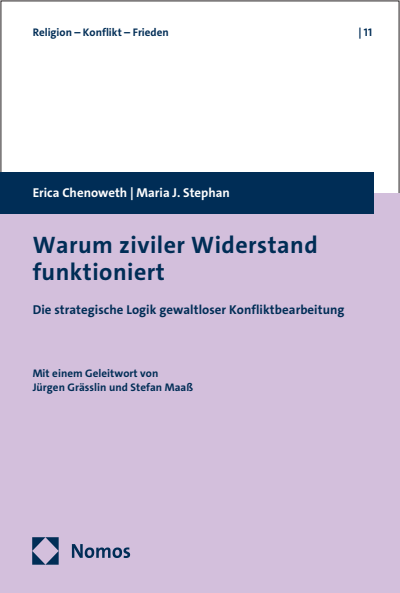
Award-winning book, now for the first time in German translation (winner of the 2013 Grawemeyer Award, winner of the 2012 Woodrow Wilson Foundation Award from the American Political Science Association, 2011 Book of the Year from The Guardian). Campaigns of non-violent resistance were more than twice as successful as violent movements between 1900 and 2006. The authors combine statistical analysis with over 300 case studies from around the world and show in detail the factors that make such campaigns successful - and sometimes cause them to fail. The book systematically compares violent and non-violent developments in different political and geographical conflict contexts. It debunks the myth that violence is caused by structural and situational factors and is necessary to achieve certain political goals. Instead, Chenoweth and Stephan find that violent uprisings can rarely be justified on strategic grounds. And they prove that non-violent resistance movements lead to more stable and peaceful democracies more often, faster, with far fewer victims and at lower cost. Findings that are still highly topical today!
Keywords
Search publication
Bibliographic data
Edition
1/2024
Copyright Year
2024
ISBN-Print
978-3-7560-1817-8
ISBN-Online
978-3-7489-4480-5
Publisher
Nomos, Baden-Baden
Series
Religion - Konflikt - Frieden
Volume
11
Language
German
Pages
372
Product Type
Monograph
Table of contents
ChapterPages
Titelei/Inhaltsverzeichnis No access Pages 1 - 8
Vorwort No access Pages 9 - 10
Authors:
Geleitwort No access Pages 11 - 16
Authors: |
Warum gewaltloser Widerstand funktioniert. Eine Zusammenfassung No access Pages 17 - 30
Authors:
Danksagungen der Autorinnen No access Pages 31 - 36
Das Rätsel No access
Das Argument No access
Der Beweis No access
Warum gewaltfreie und gewaltsame Widerstandskampagnen vergleichen? No access
Implikationen für die Wissenschaft No access
Weiterreichende Auswirkungen No access
Aufbau des Buches No access
Definition von Beteiligung No access
Wie kann man mobilisieren? No access
Beteiligung und Erfolg gehören zusammen No access
Beteiligung und Mechanismen der Einflussnahme No access
Welche Faktoren sind am wichtigsten? Erklärungen zum Erfolg des zivilen Widerstands No access
Wenn Gewaltkampagnen erfolgreich sind: einige wichtige Ausreißer No access
Schlussfolgerung No access
Prüfung struktureller Erklärungen für den Erfolg No access
Schwierige Gegner? No access
Schwierige Ziele? No access
Schwierige Zeiten und Orte? No access
Entstehen gewaltfreie Kampagnen nur dort, wo ein Sieg wahrscheinlich ist? No access
Schlussfolgerung No access
Der Vorlauf zu einer Revolution No access
Eine neue Form des Protests No access
Analyse No access
Schlussfolgerung No access
Die Ursprünge des Widerstands gegen die israelische Besatzung (1967–1987) No access
Analyse No access
Schlussfolgerung No access
Die Herrschaft und der Untergang von Ferdinand Marcos No access
Analyse No access
Schlussfolgerung No access
Von der jungen Demokratie zur Diktatur No access
Die Nationale Demokratische Front No access
Analyse No access
Schlussfolgerung No access
Gewaltfreie und gewaltsame Kampagnen im Vergleich No access
Erfolgreiche und gescheiterte gewaltfreie Kampagnen im Vergleich No access