, to see if you have full access to this publication.
Monograph No access
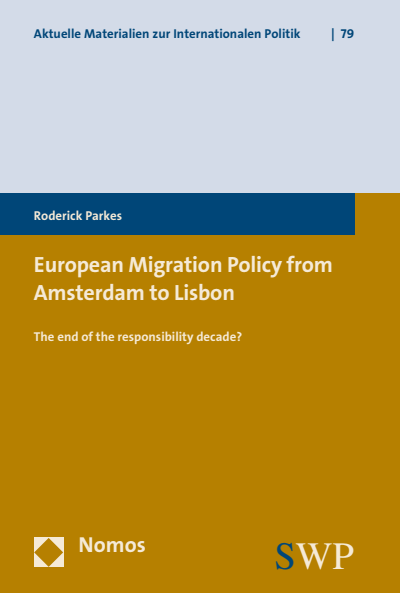
European Migration Policy from Amsterdam to Lisbon
The end of the responsibility decade?- Authors:
- Series:
- Aktuelle Materialien zur Internationalen Politik, Volume 79
- Publisher:
- 2010
Summary
Die EU Asyl- und Migrationspolitik hat seit 1999 eine enorme Weiterentwicklung erfahren. Nichtsdestotrotz ist sie nach wie vor in weiten Teilen restriktiv, illiberal und zeugt nicht von internationaler Solidarität. Mit Beispielen aus der politischen Praxis des letzten Jahrzehnts führt der Autor die Merkmale dieser Politik auf eine Kultur des „responsible policymaking“ der Innenminister zurück – die gerade denjenigen am meisten schadet, für die die Minister sich verantwortlich fühlen: den Bürgern der Europäischen Union.
Search publication
Bibliographic data
- Edition
- 1/2010
- Copyright Year
- 2010
- ISBN-Print
- 978-3-8329-5859-6
- ISBN-Online
- 978-3-8452-2608-8
- Publisher
- Nomos, Baden-Baden
- Series
- Aktuelle Materialien zur Internationalen Politik
- Volume
- 79
- Language
- English
- Pages
- 199
- Product Type
- Monograph
Table of contents
ChapterPages
- Titelei/Inhaltsverzeichnis No access Pages 2 - 8Authors:
- Acknowledgements No access Pages 9 - 10Authors:
- Summary: A decade of responsibility No access Pages 11 - 12Authors:
- The starting point–a question waiting for an answer No access Pages 12 - 14Authors:
- Characterising migration policy No access Pages 15 - 17Authors:
- The policy prescriptions of the Amsterdam Treaty No access Pages 17 - 19Authors:
- The characteristics of the Amsterdam years No access Pages 19 - 24Authors:
- Policymaking under Amsterdam: Rules and reality No access Pages 25 - 31Authors:
- Political dominance and the skewing of policy No access Pages 31 - 32Authors:
- The venue-shopping thesis No access Pages 33 - 34Authors:
- European integration in the venue-shopping thesis No access Pages 34 - 38Authors:
- Lessons from new institutionalism No access Pages 38 - 41Authors:
- Venue-shoppers as arch-rationalists No access Pages 41 - 42Authors:
- Core hypotheses: Interior ministers as ‘arch-rationalists’ No access Pages 42 - 43Authors:
- A new conception of the Amsterdam rules No access Pages 43 - 46Authors:
- The soft side of venue-shopping No access Pages 47 - 49Authors:
- The weight of history: The importance of the ‘complete’ policy image No access Pages 49 - 51Authors:
- Venue shifts in the 1970s: The joys of a complete policy-image No access Pages 51 - 53Authors:
- Institutional changes at Amsterdam: The missing substantive dimension No access Pages 53 - 59Authors:
- After the institutional change at Amsterdam No access Pages 59 - 69Authors:
- Conclusions No access Pages 69 - 70Authors:
- Venue-shopping: Expanding on the basics No access Pages 71 - 72Authors:
- The returns directive: Interior ministries exploit their EU powers No access Pages 72 - 76Authors:
- The PNR agreement: Interior ministries exploit international pressure No access Pages 76 - 80Authors:
- Framework Decision on Data Protection: Interior ministries exploit satellite cooperation No access Pages 80 - 83Authors:
- Conclusions No access Pages 83 - 84Authors:
- Bringing back in the domestic level No access Pages 85 - 86Authors:
- Identifying international loops: An analytical framework No access Pages 86 - 90Authors:
- The closure of the ‘EU loop’ No access Pages 90 - 95Authors:
- Alternative loops: The specifics of the G6 and Heathrow meetings No access Pages 95 - 100Authors:
- Matching supply and demand at G6 and Heathrow No access Pages 100 - 108Authors:
- Conclusions No access Pages 108 - 108Authors:
- Policy interaction No access Pages 109 - 110Authors:
- Conceptual perspectives on policy interaction and coordination No access Pages 110 - 112Authors:
- The distribution of political resources in EU migration policy No access Pages 112 - 115Authors:
- Approaches to migration: External development vs. internal stability? No access Pages 115 - 116Authors:
- EU migration policy outcomes: What evidence of interaction? No access Pages 116 - 121Authors:
- Tracing the sources of interaction: The European Council No access Pages 121 - 125Authors:
- Horizontal pressures: DG Development and the interior ministries No access Pages 125 - 129Authors:
- Conclusions: Explaining the development turn No access Pages 129 - 130Authors:
- The mistakes of responsible policies No access Pages 131 - 131Authors:
- The responsible approach to migration No access Pages 131 - 133Authors:
- The rights-effectiveness nexus No access Pages 133 - 137Authors:
- The legitimacy deficit No access Pages 137 - 138Authors:
- A typology of legitimacy at the European level No access Pages 138 - 140Authors:
- Characteristics of EU migration policymaking No access Pages 140 - 141Authors:
- A taller order: Regulating an invisible phenomenon No access Pages 141 - 142Authors:
- The symbolic politics of border management: Frontex No access Pages 142 - 144Authors:
- Conclusions No access Pages 144 - 144Authors:
- The British litmus test No access Pages 145 - 145Authors:
- British exceptionalism No access Pages 145 - 147Authors:
- The Club of Ministers No access Pages 147 - 148Authors:
- A new Treaty and a new setup No access Pages 148 - 150Authors:
- The British position No access Pages 150 - 152Authors:
- Two scenarios No access Pages 152 - 155Authors:
- The creation of a new hybrid No access Pages 155 - 156Authors:
- The strategic deficit No access Pages 157 - 158Authors:
- The new Treaty and the need for strategic thinking No access Pages 158 - 162Authors:
- The Stockholm Programme evaluated: Programming as inter-institutional mud-wrestling No access Pages 162 - 166Authors:
- Future perspectives: The communitarian vocation of the European Council No access Pages 166 - 170Authors:
- A liberal future? No access Pages 171 - 171Authors:
- The control paradigm No access Pages 171 - 173Authors:
- Restricting migration by liberalising migration channels? No access Pages 173 - 174Authors:
- Paradigm change: The liberalisation of responsibility No access Pages 174 - 176Authors:
- Perspectives for the future No access Pages 176 - 178Authors:
- Bibliography No access Pages 179 - 179Authors:
- Official documents No access Pages 179 - 181Authors:
- Further documents No access Pages 182 - 182Authors:
- Secondary sources No access Pages 183 - 194Authors:
- Media No access Pages 195 - 197Authors:
- Abbreviations No access Pages 198 - 199Authors: