, to see if you have full access to this publication.
Monograph No access
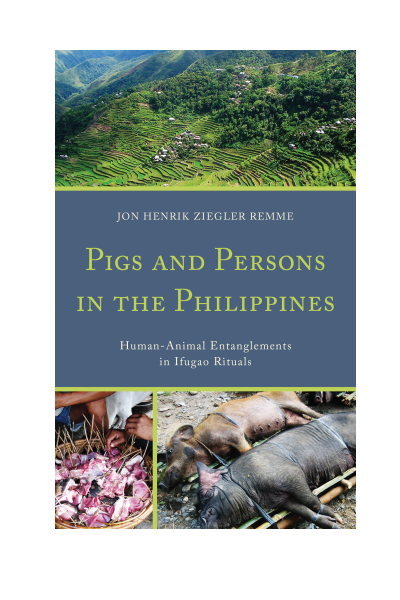
Pigs and Persons in the Philippines
Human-Animal Entanglements in Ifugao Rituals
Authors:
Publisher:
2014
Summary
The Ifugao of Northern Luzon, the Philippines, are famous for their extensive system of irrigated rice terraces, and previous anthropological accounts of the Ifugao have stressed their immense importance for social life. This book attempts to "go against the grain" and approach Ifugao society through an often overlooked element, namely their pigs. By a detailed ethnographic description of Ifugao cultural practices related to kinship, animism, prestige, and death, Pigs and Persons in the Philippines shows how pigs are involved in the constitution and re-constitution of relations between humans and between humans and spirits.
Remme draws upon theories of relationality, performativity, and assemblages to argue that the exchange and consumption of pig meat have the ontological effect of enacting persons. He also shows how pigs are the prime means of engaging in relations with spirits and argues further that prestige can be understood as a heterogeneous assemblage of relations of which pigs play a central role. While pigs are thus constitutively involved in the enactment of persons, Remme also shows how they are operative in the re-constitution of relations that occurs at death.
In documenting these practices, Remme argues for a relational understanding of personhood that goes beyond inter-human relations and includes relations with nonhuman beings, including spirits, and animals.
Keywords
Search publication
Bibliographic data
Edition
1/2014
Copyright Year
2014
ISBN-Print
978-0-7391-9041-8
ISBN-Online
978-0-7391-9042-5
Publisher
Lexington, Lanham
Language
English
Pages
161
Product Type
Monograph
Table of contents
ChapterPages
Contents No access
List of Figures No access
List of Tables No access
Acknowledgements No access
1 Introduction No access Pages 1 - 26
2 Pigs Make Kin No access Pages 27 - 54
3 Pigs and Human–Bā’i Relations No access Pages 55 - 78
4 Pigs and Social Differentiation No access Pages 79 - 106
5 Unmaking a Person No access Pages 107 - 134
6 Conclusion No access Pages 135 - 142
Notes No access Pages 143 - 146
Bibliography No access Pages 147 - 152
Index No access Pages 153 - 160
About the Author No access Pages 161 - 161
Similar publications
from the topics "Soziologie allgemein"
Edited Book Full access
Karen Kastenhofer, Marius Albiez, Pauline Riousset, Constanze Scherz, Michael Decker