, to see if you have full access to this publication.
Edited Book No access
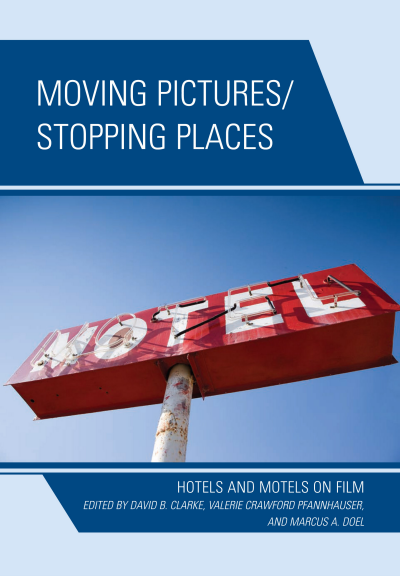
Moving Pictures/Stopping Places
Hotels and Motels on Film
Editors:
| |
Publisher:
2009
Summary
Mobility has long been a defining feature of modern societies, yet remarkably little attention has been paid to the various 'stopping places'_hotels, motels, and the like_that this mobility presupposes. If the paradoxical qualities of fixed places dedicated to facilitating movement have been overlooked by a variety of commentators, film-makers have shown remarkable prescience and consistency in engaging with these 'still points' around which the world is made to turn. Hotels and motels play a central role in a multitude of films, ranging across an immensely wide variety of genres, eras, and national cinemas. Whereas previous film theorists have focused on the movement implied by road movies and similar genres, the outstanding contributions to this volume extend the recent engagement with space and place in film studies, providing a series of fascinating explorations of the cultural significance of stopping places, both on screen and off. Ranging from the mythical elegance of the Grand Hotel, through the uncanny spaces of the Bates motel, to Korean 'love motels,' the wealth of insights, from a variety of theoretical perspectives, that this volume delivers is set to change our understanding of the role played by stopping places in an increasingly fluid world.
Search publication
Bibliographic data
Edition
1/2009
Copyright Year
2009
ISBN-Print
978-0-7391-2855-8
ISBN-Online
978-0-7391-3227-2
Publisher
Lexington, Lanham
Language
English
Pages
394
Product Type
Edited Book
Table of contents
ChapterPages
Contents No access
Checking In No access Pages 1 - 12
Chapter 01. Revisiting the Grand Hotel (and Its Place within the Cultural Economy of Fascist Italy) No access Pages 13 - 48
Chapter 02. Floating Hotels: Cruise Holidays and Amateur Film-making in the Inter-war Period No access Pages 49 - 72
Chapter 03. Vacancies: Hotels, Reception Desks, and Identity in American Cinema, 1929–1964 No access Pages 73 - 142
Chapter 04. The Swiss Hotel Film No access Pages 143 - 182
Chapter 05. Cinematic Topographies in Time–Space: Wim Wenders’ Hotels No access Pages 183 - 208
Chapter 06. The Decay of Fiction and the Poetics of Pastness No access Pages 209 - 218
Chapter 07. ‘Now, where was I?’—Memories, Motels, and Male Hysteria No access Pages 219 - 234
Chapter 08. ‘Just an Anonymous Room:’ Cinematic Hotels and Motels as Mnemonic Purgatories No access Pages 235 - 254
Chapter 09. No Sympathy for the Devil, or, Lobby Music: Spaces of Disjunction in Barton Fink, The Shining, and Muzak No access Pages 255 - 276
Chapter 10. Parallel Hotel Worlds No access Pages 277 - 296
Chapter 11. No Quarter(s), No Camel(s), No Exit(s): Motel Cactus and the Low Heterotopias of Seoul No access Pages 297 - 324
Chapter 12. Off the Highway: Some Notes on Stopping Places in Cinema No access Pages 325 - 352
Chapter T13. The Real of the Screen: Atom Egoyan’s Speaking Parts No access Pages 353 - 370
Departures: The 21st Century Hotel—Your Media/Home Away from Home No access Pages 371 - 380
Index No access Pages 381 - 390
Contributors No access Pages 391 - 394
Similar publications
from the topics "Medienwissenschaft, Kommunikationsforschung"