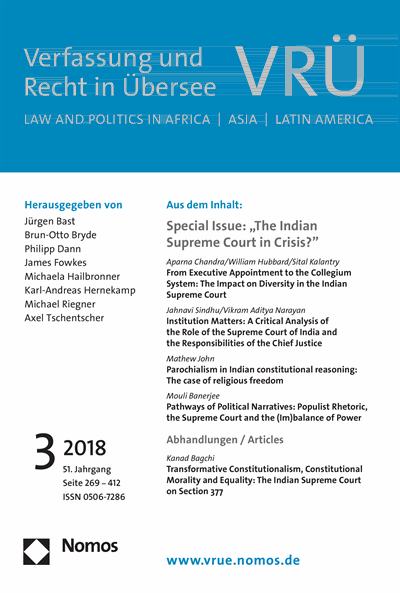
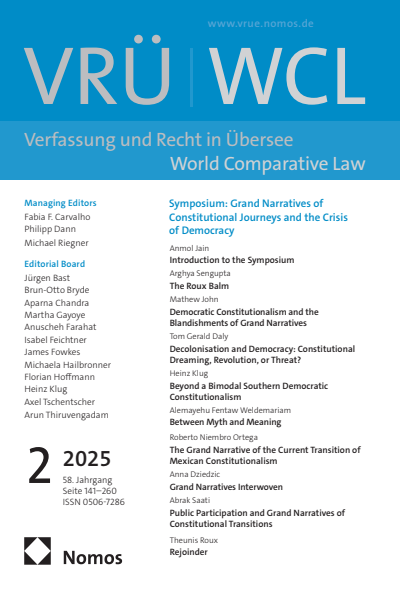
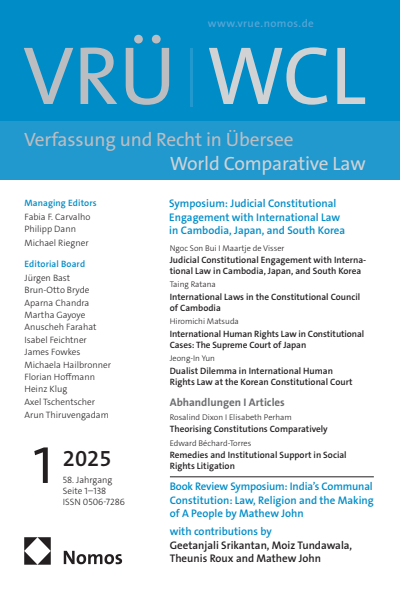
"Law and Politics in Africa, Asia and Latin America" analyses legal and constitutional developments in all states or regions outside of Europe as well as their regional and international integration. Founded in 1968 and inspired by decolonization and the idea of a cooperative new beginning, the Journal also promotes a special interest in contributions on 'Law and development'. The journal aims to provide a forum for a variety of perspectives on these fields of interest, be they focused on one country or comparative, theoretical or methodological in nature. Next to extensive articles, the journal publishes shorter reports about current events or conferences as well as book reviews. As a special service, each issue of "Law and Politics in Africa, Asia and Latin America" contains an international bibliography of relevant publications from around the world. This is compiled in cooperation with the Leibniz-Institute for Global and Regional Studies in Hamburg (GIGA). "Law and Politics" addresses authors and readers on all continents and aims to serve as a forum of mutual exchange. The journal is open for contributions from legal and social sciences as well as for analyses from practitioners. The journal is published quarterly and welcomes contributions in German, English, Spanish and French. Website: www.vrue.nomos.de
There has been a national debate raging in India about the system of appointments for Supreme Court and High Court judges. At the founding of the Indian Supreme Court, the executive had primary authority over judicial appointments. In 1993, the...
Today, the Indian Supreme Court serves as a constitutional court, a regular appeals court and as an equal partner in governance of the country. This year, questions over the administration of the Court repeatedly arose in public discourse,...
The legitimate source of governmental power in modern constitutional democracies is traced to a people. Drawing on this tradition of founding political power, the Indian Constitution is a radical attempt to secure the consent of the Indian people to...
Using the January 2018 Press Conference by the four Supreme Court Justices as an entry point, the paper proposes that Parliamentary discourse, an oft-ignored pulse of the political narrative, is a relevant window into studying how the legislature...
What role does the Indian Constitution play towards the emancipation of the society’s most marginalized and excluded? What vision does the Constitution espouse with respect to basic fundamental rights and freedoms? And what conception of inclusion...
The Scheduled Castes and Scheduled Tribes (Prevention of Atrocities) Act, 1989 Act was enacted to safeguard the Scheduled Castes (SCs) and Scheduled Tribes (STs) from atrocities and violence. Recently the Supreme Court pronounced a verdict in order...
The developments in India since the new millennium have shown that gender equality is a topic in constant flux and dynamic change. In recent years, the Indian Parliament has passed key legislations on maternity benefits, surrogacy, HIV/Aids...