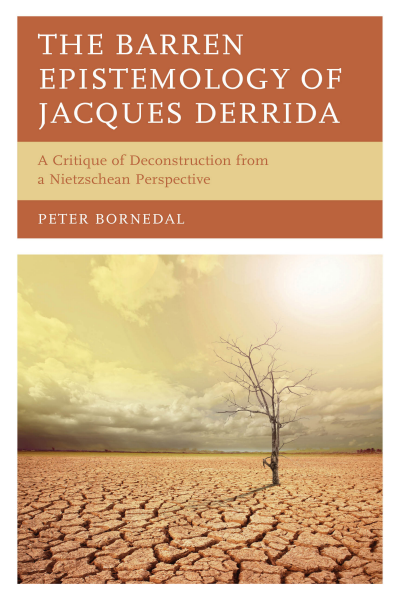
The Barren Epistemology of Jacques Derrida
A Critique of Deconstruction from a Nietzschean Perspective- Authors:
- Publisher:
- 2024
Summary
This book presents a critique of Derrida from a Nietzschean perspective. Questioning the often-advertised association between Nietzsche and Derrida, it focuses instead on important differences and incompatibilities between Nietzsche’s naturalistic paradigm and Derrida’s textual paradigm. Peter Bornedal argues that Nietzsche’s position points us toward a pragmatic and constructionist epistemology based on a naturalist world-view, which was cutting-edge in his days, while Derrida’s epistemology reduces theories of knowledge to a general textualism. In short, Nietzsche is not the predecessor of deconstruction—or, generally, postmodernism—that he is often portrayed to be. His thinking does not advocate postmodernism’s suspension of truth, reason, logic, and understanding, but rather replicates the paradigms of emerging disciplines of his day, such as biology, psychology, cognitive science, and linguistics. His thinking is not playfulness for its own sake and does not defend formal transcendentalist principles such as ‘différance.’ The Barren Epistemology of Jacques Derrida: A Critique of Deconstruction from a Nietzschean Perspective argues instead that Derrida’s introduction of the supposedly novel différance-logic may be analyzed as a transcendentalist validation of logical errors often addressed in earlier Western thinking in order to be avoided, such as the contradiction in Aristotle, or the paralogism in Kant. With this critical view, the work re-examines différance-thinking and questions whether inconsistencies are manufactured rather than discovered in deconstructionist interpretation.
Keywords
Search publication
Bibliographic data
- Edition
- 1/2024
- Copyright Year
- 2024
- ISBN-Print
- 978-1-66692-717-7
- ISBN-Online
- 978-1-6669-2718-4
- Publisher
- Lexington, Lanham
- Language
- English
- Pages
- 190
- Product Type
- Monograph
Table of contents
- Contents No access
- Acknowledgments No access
- Project No access
- Chapter 1: Paralogism of Writing No access
- Chapter 2: The Anti-Logic of Différance No access
- Chapter 3: Signified, Signifier, and the Continuum No access
- Chapter 4: Intentional Forms in Speaker and Speech No access
- Chapter 5: The “Gay Science” of Derrida No access
- Chapter 6: Nietzsche versus Derrida No access
- Notes No access
- The Proposal, “Writing has been Repressed!” No access
- The Hierarchical Relationship between Speech and Writing No access
- The Retreat: “Writing is Not the Same as Writing”! No access
- Kant’s Notion of Paralogical Reasoning No access
- Derrida’s Paralogism of “Writing” No access
- Derrida’s Paralogism of “Institution” No access
- Derrida’s Paralogism of “Parasitism” No access
- Grammatology’s Insistence of Generalizing Concepts No access
- Para-logy as Paralysis of Discussion No access
- Notes No access
- On the Appearances of Différance No access
- Différance as an Indeterminable Agent No access
- Radicalizing Causality-Thinking: Différance Is Nothing Causing Something No access
- Defenses and Criticisms of Grammatological Transcendentalism No access
- Derrida’s Self-Immunizing Responses to Critics No access
- Notes No access
- The Grammatological Master-Narrative No access
- How to Illustrate the Communication of Meaning No access
- Saussure’s “Signified” as a Continuum, Not a Form No access
- Saussure’s “Signified” and Nietzsche’s “Chaotic Subject” No access
- Merging the Language Theories of Nietzsche and Saussure No access
- A New Take on the Simplification- and Arbitrariness-Theses in Nietzsche and Saussure No access
- A Theoretical Synthesis No access
- An Illustration No access
- Notes No access
- A Voice without Words No access
- The Cartesian Theater Setting the Stage for the Rational Subject No access
- The Necessary Possibility of Failure No access
- The Necessary Possibility of Absence No access
- Ordinary Language and Metaphysical Discourse No access
- The Surface and the Abyss No access
- The Paralogism of Intention No access
- Introducing Alternative Unconscious Intentions No access
- Classifying Three Forms of Intention: sai, si, and ui No access
- Formalizing Derrida’s Essential Argument No access
- The Différance of Iterability No access
- Remembering and Forgetting a Shopping List No access
- Reiteration and Repetition No access
- “Truth” in Speech-Act Theory No access
- “True Speech” versus “False Analysis” No access
- Reading for the Labyrinth in a Letter by Freud No access
- Reviving Psycho-Biographical Analysis No access
- Probability Is Not Always Truth No access
- The Fake Mourning of a Workaholic No access
- Deconstruction and Number Mysticism No access
- Freud’s Oedipal Rivalry with His Son-in-Law No access
- Freud’s Fake Protestations of Love for His Son-in-Law No access
- Freud’s Jealous Protection of His Daughter’s Remains No access
- Notes No access
- Deconstruction’s Nietzsche No access
- Derrida’s Nietzsche No access
- Reducing Nietzsche’s Thinking to Ordinary Speech No access
- Différance-Logic in the Umbrella-Example No access
- Serious Playfulness No access
- Différance as Indecisive Decisiveness No access
- Notes No access
- The Concept of Truth No access
- Absence and Presence No access
- What is Metaphysics? No access
- Woman as Another Word for Différance No access
- The “Ewig Weibliche” No access
- Woman as the Superior Sex No access
- When You Go to a Woman, Don’t Forget the Whip No access
- The Logic of Seduction No access
- Différance or Self-Preservation No access
- Nietzsche’s Nihilisms: Complete/Incomplete, Active/Reactive, Christian No access
- Nietzsche’s Epistemology as Nihilism No access
- Deconstruction as Epistemological Annihilism No access
- Notes No access
- Note No access
- Bibliography No access Pages 167 - 180
- Index No access Pages 181 - 188
- About the Author No access Pages 189 - 190