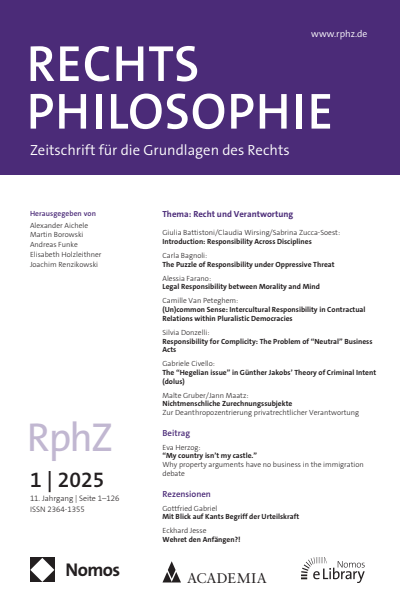
As Aristotle stated in Book IV of the Metaphysics – that being is said in many ways – the same can be said of responsibility, a multifaceted concept that takes on different meanings depending on the context in which it is examined, evolving...
Does the issue of responsibility arise in cases of “oppressive coercion”, where the coercive threat builds on an oppressive normative practice or social schema? In contrast to widespread views, I argue (i) that oppression is not an exculpatory...
The challenge that legal responsibility currently faces in the face of neuroscientific findings has often been framed in the context of the free will debate. Free will has been seen as the philosophical basis of both moral and legal responsibility....
This paper challenges the assumption that contract law operates as a neutral framework for determining contractual meaning in a context of cultural diversity, arguing instead that it systematically reflects and reinforces dominant cultural...
Carrying out professional activities, individuals and companies can – typically without the purpose to – contribute to crimes and human rights violations. Originating in German Criminal Law, the term “neutral acts” emphasizes the normal...
The essay concerns the theory of penal functionalism and in particular the Hegelian roots of the theory of intention developed by Günther Jakobs and recently analyzed in Kritik des Vorsatzbegriffs (2020). In particular, the author highlights the...
The article challenges the traditional private law doctrine that exclusively attributes responsibility to human actors and advocates for a deanthropocentric framework of attribution and responsibility. It argues that private law constructs – such...
Recent immigration debates bring to the surface a peculiar argument about regulating immigration: Sovereign states may prevent immigrants from entering the country, because they have a right to exclude foreigners from their territory, much like...