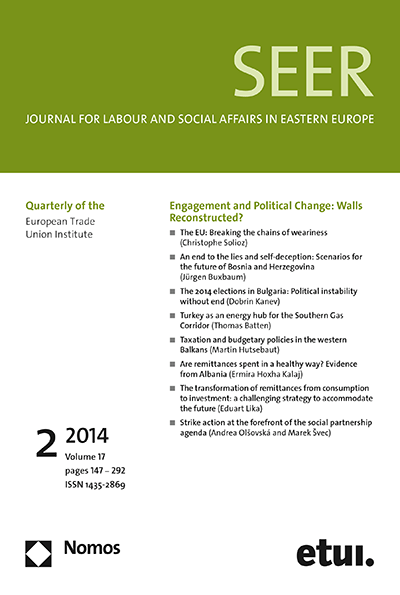
SEER tries to stimulate the exchange of information among researchers, trade unionists and people who have a special interest in the political, social and economic development of the region of south-east Europe. The journal tries to draw attention to new research results and the latest analyses about the ongoing process of political and social changes in the south-east of Europe. It tries to create more understanding for the importance of the elaboration of democratic structures in industrial relations. The SEER combines contributions from different disciplines and »political schools« into an information package of interest for policy makers, researchers, academics and trade unionists from various backgrounds. Website: www.seer.nomos.de
The post-1945 system has today been overcome and a new world order is about to emerge. This new, quite explosive, background does not signal the end of the EU, but provides evidence that its core features must be redesigned to receive broad popular...
This article takes a provocative look at the future of the state of Bosnia i Herzegovina. The author, who is a friend to Bosnia i Herzegovina, describes the sclerosis inhibiting the country’s decision-making structures and the problems this has...
This article reviews the outcome of the 2014 general election in Bulgaria, which was held under complicated political, social and geo-political conditions which had led to the defection of one coalition partner and a premature end to the previous...
The EU has responded to Moscow’s use of energy as a geopolitical force by creating a strategic priority to diversify its energy supply, particularly natural gas. The Trans-Anatolian Natural Gas Pipeline (TANAP) within the Southern Gas Corridor...
Today, the governments of the western Balkan countries are confronted with huge financing problems due to very low employment rates, high levels of undeclared work, low financial discipline and a lack of equity and efficiency in tax matters. The...
This article investigates the effect of remittances on health capital accumulation. Total expenditure is divided into expenditure on medicines; and expenditure on visits and laboratory services. An estimation is presented for rural and urban...
Remittances can contribute to the economic development of a country also by going directly into productive investment, thereby increasing bank liquidity and making it possible to extend loans to entrepreneurs with competing interests, creating an...
In the post-crisis world, employee organisations are not only finding it difficult to gain sufficient traction to engender the improvements in working conditions which might be associated with the upturn in a country’s economic fortunes; they are...