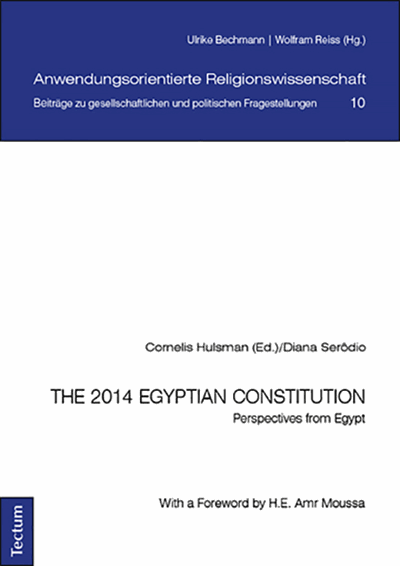
The 2014 Egyptian Constitution
Perspectives from Egypt- Editors:
- |
- Series:
- Anwendungsorientierte Religionswissenschaft, Volume 10
- Publisher:
- 2017
Summary
After President Hosni Mubarak was toppled in 2011, discussions followed immediately regarding the revision of the Egyptian Constitution. Islamist political groups insisted that Parliamentary and Presidential elections should precede the formation of a new Constitution, aiming to use their momentum to gain the upper hand in the Constitutional Assembly. Non-Islamists believed that representatives from all layers of society must first formulate a new Constitution before elections should be held. Out of this struggle emerged the 2012 Constitution, a document deeply influenced by Islamist political ideas and goals. Dissatisfied with the proceedings, the non-Islamists walked out of the Constitutional Assembly before the Constitution was finalized. In attempts to reconcile the alienated non-Islamist factions, and heal a divided Egyptian society, the Egyptian Constitution of 2014 was created. All efforts were made to avoid a similar walk-out from Islamist factions. Various political actors were interviewed during, and shortly after the 2014 constitutional formation process. This book is essential reading for anyone wishing to understand the discussions and debates surrounding the formation of the 2014 Constitution. This book follows and complements the previous books in the series on recent religious and political developments in Egypt, in particular Vol. 3 The Sharia as the Main Source of Legislation? (2012), Vol. 8 Rise and Fall of the Muslim Brotherhood 2011-2013 (2016), Vol. 9 From Ruling to Opposition 2011-2013 (2017).
Search publication
Bibliographic data
- Edition
- 1/2017
- Copyright Year
- 2017
- ISBN-Print
- 978-3-8288-3838-3
- ISBN-Online
- 978-3-8288-6933-2
- Publisher
- Tectum, Baden-Baden
- Series
- Anwendungsorientierte Religionswissenschaft
- Volume
- 10
- Language
- German
- Pages
- 218
- Product Type
- Edited Book
Table of contents
- Titelei/Inhaltsverzeichnis Partial access Pages 1 - 16
- 1 Introduction No access Pages 17 - 20Authors:
- Authors:
- 2.1 Two Roadmaps No accessAuthors:
- 2.2 Inclusion vs. Exclusion No accessAuthors:
- 2.3 The Islamists Win the Elections No accessAuthors:
- 2.4 The Clashes in Winter 2012 No accessAuthors:
- 2.5 Mursi's Deposal No accessAuthors:
- 2.6 Formation of a New Constitution No accessAuthors:
- Authors: |
- 3.1 The Formation of the 2012 Constituent Assembly No accessAuthors: |
- Authors: |
- 3.2.1 On the Committee of Ten No accessAuthors: |
- 3.2.2 On the Committee of Fifty No accessAuthors: |
- 3.2.3 The Membership of the 2014 Constituent Assembly No accessAuthors: |
- 3.2.4 Regulations Within the 2014 Constituent Assembly No accessAuthors: |
- 3.3 General Assessment on the Committee of Fifty No accessAuthors: |
- Authors:
- Authors:
- 4.1.1 Defining a Civil State No accessAuthors:
- 4.1.2 Shari'a in Egypt's 2014 Constitution No accessAuthors:
- Authors:
- 4.2.1 Shari 'a and the State: Defining the Role of Religion and Religious Institutions in the 2014 Constitution No accessAuthors:
- 4.2.2 The Role of the Drafting Committee No accessAuthors:
- 4.2.3 On 'Appropriate Representation': Women, Christians, Youth, Children and Other Vulnerable Groups in the 2014 Constitution No accessAuthors:
- Authors:
- 4.3.1 Clauses Pertaining to Bedouin and Nubian Minority Rights No accessAuthors:
- 4.3.2 Negotiations on Economic and Social Rights No accessAuthors:
- Authors:
- 4.4.1 Defining Legislative and Executive Power No accessAuthors:
- 4.4.2 The Legislature, the Judiciary and the Armed Forces No accessAuthors:
- Authors:
- Authors:
- 5.1.1 Basic Components of the Society - Family Articles No accessAuthors:
- 5.1.2 Religious Rights, Freedoms & Duties No accessAuthors:
- 5.1.3 The Role of the Azhar No accessAuthors:
- 5.1.4 Reflections on the Fundamentals of the State's Articles No accessAuthors:
- Authors:
- 5.2.1 Women's Rights and Gender Equality No accessAuthors:
- 5.2.2 Minority Rights No accessAuthors:
- 5.2.3 Political Rights No accessAuthors:
- 5.2.4 General Personal Rights and Freedoms No accessAuthors:
- 5.2.5 Labour Rights No accessAuthors:
- 5.2.6 Media Rights No accessAuthors:
- 5.2.7 Social Security and Economic Rights No accessAuthors:
- 5.2.8 Social, Cultural and Environmental Responsibility No accessAuthors:
- 5.2.9 Reflections on the Rights and Freedoms Articles No accessAuthors:
- Authors:
- 5.3.1 House of Representatives, President, Government and Autonomous Agencies No accessAuthors:
- 5.3.2 The Legislative Branch No accessAuthors:
- 5.3.3 The President No accessAuthors:
- 5.3.4 The Cabinet No accessAuthors:
- 5.3.5 Local Administration No accessAuthors:
- 5.3.6 Autonomous Organizations and Control Agencies No accessAuthors:
- 5.3.7 Reflections on the System of Government and its Checks and Balances No accessAuthors:
- Authors:
- 5.4.1 General Provisions No accessAuthors:
- 5.4.2 The Prosecutor General No accessAuthors:
- 5.4.3 The Supreme Constitutional Court No accessAuthors:
- 5.4.4 Administrative Prosecution No accessAuthors:
- 5.4.5 National Elections Committee No accessAuthors:
- 5.4.6 Reflections on the Judiciary's Clauses No accessAuthors:
- Authors:
- 5.5.1 The Armed Forces No accessAuthors:
- 5.5.2 The National Defence Council No accessAuthors:
- 5.5.3 Military Courts No accessAuthors:
- 5.5.4 National Security Council No accessAuthors:
- 5.5.5 The Police No accessAuthors:
- 5.5.6 Reflections on Military Clauses No accessAuthors:
- 6 Conclusion No access Pages 123 - 128Authors: |
- Postscript: 'Constitution or Political Covenant?' No access Pages 129 - 130
- Appendix I: Index of Names of People and Locations No access Pages 131 - 140Authors: |
- Appendix II: Chronology of Events No access Pages 141 - 144Authors:
- Appendix III: Membership of the Committee of Experts No access Pages 145 - 146
- Appendix IV: Members of the Committee of Fifty No access Pages 147 - 152
- Appendix V: Organizational Flowchart of Drafting Process No access Pages 153 - 154Authors:
- Appendix VI: Full Text of Articles from the 2014 Constitution Referred to in this Study No access Pages 155 - 196
- Consultations, Emails and Interviews No access
- Acknowledgements No access Pages 211 - 213
- Complementary books in the Tectum Series Anwendungsorientierte Religonswissenschaften No access Pages 214 - 214
- About the Contributors No access Pages 215 - 216
- About the Center for Arab-West Understanding No access Pages 217 - 218