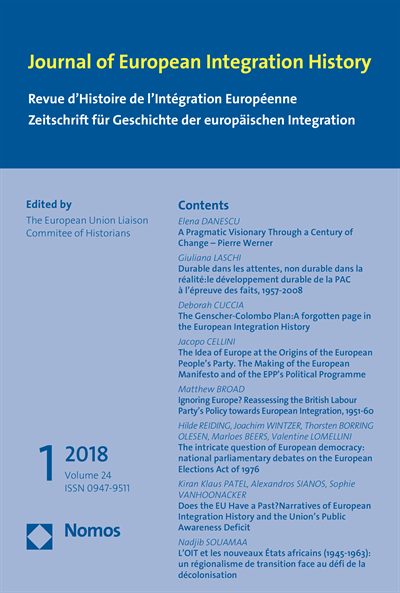
As Prime Minister and Finance Minister of Luxembourg over several decades, Pierre Werner shaped the future of his country and was one of the rare statesmen to play a part in the progress of European integration until the mid-1980s. He played a major...
The CAP has developed in a different direction from sustainable development, which has become an important objective of the EU. After its first great successes, the CAP has turned into a surplus machine, not sustainable either economically or...
In the early 1980s, against the backdrop of a protracted global economic downturn, Europe seemed to be at the crossroads between more integration and political inertia. In this context, the present essay analyses the "Genscher-Colombo Plan", i.e....
This article aims at reconstructing the theoretical framework, which supported the idea of Europe of the European Christian Democracy during the 1970s. I examined the works of the Ideological Commission of the European Union of Christian Democrats...
The 1950s were a turning point in British European policy during which the country moved from passive bystander to prospective member of the European Economic Community (EEC). Existing scholarship, though, depicts the opposition Labour Party as...
On 20 September 1976, the member states of the European Community signed the ‘Act concerning the Election of the Representatives of the Assembly by Direct Universal Elections’, which was to introduce direct elections for the European Parliament...
This article examines the public visibility and media salience of European integration history since the 1960s. More specifically, it analyzes the narratives of four key moments in the history of today’s European Union (i.e. the Schuman...
The decolonization in Africa led industrialized Europe and ILO, which have an universalist vocation, to wonder about the assertion of their world role in front of the Big two and in front of the new States. They defended with the Western camp a...