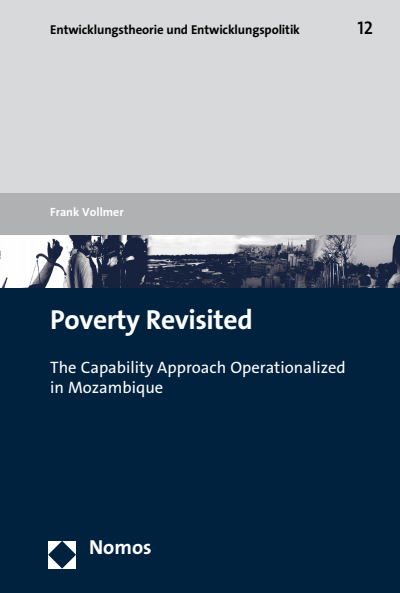
Poverty Revisited
The Capability Approach Operationalized in Mozambique- Authors:
- Series:
- Entwicklungstheorie und Entwicklungspolitik, Volume 12
- Publisher:
- 2013
Summary
Was ist Armut? Dieser Frage widmet sich dieses Buch und diskutiert eingehend Amartya Sen’s Theorie. Seinem „Befähigungsansatz“ (Capability Approach) folgend, wird Armut in Mosambik empirisch re-evaluiert und multidimensional berechnet. Die Studie kommt zu dem Ergebnis, dass Mosambikaner/innen „Befähigungen“ in den vier Kerndimensionen von Armut fehlen (in den politischen, humanen, sozialen und ökonomischen Domänen). Folglich leben weit mehr Menschen in multidimensionaler „Befähigungs-Armut“ als die offizielle verbrauchbasierte Armutsmessung in Mosambik suggeriert.
Der Autor zeigt auf, wie Sen’s normativer Armutsansatz am Beispiel Mosambiks empirisch operationalisiert werden kann, um eine grundlegendere Erkenntnis über die Wesensmerkmale der Armut zu erreichen.
Search publication
Bibliographic data
- Edition
- 1/2013
- Copyright Year
- 2013
- ISBN-Print
- 978-3-8487-0060-8
- ISBN-Online
- 978-3-8452-4495-2
- Publisher
- Nomos, Baden-Baden
- Series
- Entwicklungstheorie und Entwicklungspolitik
- Volume
- 12
- Language
- English
- Pages
- 366
- Product Type
- Monograph
Table of contents
- Titelei No access Pages 2 - 6Authors:
- Acknowledgments No access Pages 7 - 8Authors:
- Contents No access Pages 9 - 14Authors:
- Abbreviations No access Pages 15 - 18Authors:
- Research Rationale: Poverty and Philosophy No access Pages 19 - 23Authors:
- Methodology No access Pages 23 - 24Authors:
- Motivation No access Pages 24 - 24Authors:
- Personal background No access Pages 24 - 26Authors:
- Personal preference formation and Amartya Sen’s CA: meeting in the “grey zone” No access Pages 26 - 27Authors:
- Objectives No access Pages 27 - 29Authors:
- Findings, Advocacy and Outputs No access Pages 29 - 31Authors:
- State of the Arts/ Literature Review No access Pages 31 - 31Authors:
- Structure No access Pages 31 - 33Authors:
- Sources No access Pages 33 - 34Authors:
- Ethics of Poverty Research No access Pages 34 - 34Authors:
- Conceptualising Multidimensional Poverty – Amartya Sen’s Capability Approach Examined No access Pages 35 - 36Authors:
- The linear interlinkage between poverty definition, conceptualisation and categorisation No access Pages 37 - 41Authors:
- Looking for an inter-subjective common ground No access Pages 41 - 43Authors:
- Leaving the common ground No access Pages 43 - 44Authors:
- Recapitulation and outlook No access Pages 44 - 45Authors:
- The concept of poverty and the consequences for its understanding: a narrative No access Pages 46 - 50Authors:
- Categorisations No access Pages 50 - 51Authors:
- Further concept: Adverse incorporation No access Pages 51 - 52Authors:
- Distinguishing evaluative criteria No access Pages 52 - 53Authors:
- Recapitulation and outlook No access Pages 53 - 55Authors:
- Human Development No access Pages 56 - 60Authors:
- The CA – Just about development? No access Pages 60 - 63Authors:
- Traditional evaluative frameworks of poverty and social arrangements – a critique No access Pages 63 - 64Authors:
- CA – tracing the roots No access Pages 64 - 67Authors:
- Locating the CA into a school of thought No access Pages 67 - 68Authors:
- In a nutshell No access Pages 68 - 69Authors:
- Functioning No access Pages 69 - 70Authors:
- Capability No access Pages 70 - 70Authors:
- Agency No access Pages 70 - 71Authors:
- Freedom No access Pages 71 - 71Authors:
- Real opportunities – Commodities and beyond No access Pages 71 - 74Authors:
- A closer look at functionings and capabilities No access Pages 74 - 75Authors:
- An illustrative example No access Pages 75 - 76Authors:
- Freedom – negative vis-à-vis positive liberty No access Pages 76 - 77Authors:
- Freedom as a universal human right No access Pages 77 - 78Authors:
- Freedom – Constitutive and Instrumental Roles No access Pages 78 - 82Authors:
- Interconnections and complementarity of instrumental freedoms No access Pages 82 - 84Authors:
- What kind of Capabilities? No access Pages 84 - 87Authors:
- A closer look at agency and well-being, freedom and achievements No access Pages 87 - 90Authors:
- A closer look at evaluations, measurements and policy focus No access Pages 90 - 92Authors:
- Policy focus: process freedom or agency freedom? No access Pages 92 - 94Authors:
- Deliberate Breadth No access Pages 94 - 95Authors:
- Individual Diversity and Heterogeneity No access Pages 95 - 96Authors:
- The core principles No access Pages 96 - 97Authors:
- The CA – Misunderstandings I No access Pages 97 - 99Authors:
- Misunderstandings II No access Pages 99 - 101Authors:
- Who are the actors involved in enhancing opportunity freedom? No access Pages 101 - 101Authors:
- Authors:
- Outlook No accessAuthors:
- A question of responsibility – is the CA an opportunity or an outcome-based theory? No access Pages 105 - 107Authors:
- Welfare, preferences, respect, social status, fairness: an ethical relevant discussion? An introspective account No access Pages 107 - 110Authors:
- Sen’s CA: A Theory of Justice? No access Pages 110 - 111Authors:
- Preference formation and choices being made: a need for analysis? No access Pages 111 - 113Authors:
- Individualism No access Pages 113 - 115Authors:
- The adaptation discourse No access Pages 115 - 116Authors:
- Old wine in new bottles? No access Pages 116 - 118Authors:
- One size fits all? No access Pages 118 - 118Authors:
- Liberalism and agency freedom No access Pages 118 - 123Authors:
- Looking at Sen and Nussbaum: tracing the roots No access Pages 123 - 125Authors:
- Human nature No access Pages 125 - 127Authors:
- Control, Nussbaum’s list as an entity, benevolence, one-size-fits-all – critique continued No access Pages 127 - 129Authors:
- Authors:
- Nussbaum’s ontology – internalist (Aristotelian) essentialism and internal realism No accessAuthors:
- Nussbaum’s epistemology – introspection and field work No accessAuthors:
- Proposing an epistemological alternative – Clark’s empirical philosophy No accessAuthors:
- To the contrary – Sen’s ontology and epistemology No accessAuthors:
- Sen’s notion of objectivity – walking on a thin line No accessAuthors:
- Recapitulation and outlook No access Pages 139 - 140Authors:
- The epistemological and ontological Q-squared debate No access Pages 141 - 145Authors:
- Q-squared research and a growing epistemic community No access Pages 145 - 146Authors:
- Quantitative economic reductionism: A retrospective (narrative) analysis No access Pages 146 - 149Authors:
- Understanding qualitative poverty research: A retrospective (narrative) analysis No access Pages 149 - 151Authors:
- Qual/ Quant: A Continuum with strengths and weaknesses No access Pages 151 - 154Authors:
- Last comment on “why”: multidimensionality and its place in the modern/ postmodern debate No access Pages 154 - 158Authors:
- Self-contained or opportunistic study design No access Pages 158 - 160Authors:
- Which mix? No access Pages 160 - 161Authors:
- Timing of the mixed method No access Pages 161 - 162Authors:
- Mixing possibilities No access Pages 162 - 163Authors:
- Recapitulation No access Pages 163 - 164Authors:
- Authors:
- Recapitulation and Last remark No accessAuthors:
- Recapitulation Part I No access Pages 172 - 176Authors:
- ‘Capabilitizing’ the Poverty Challenge – The Case of Mozambique No access Pages 177 - 178Authors:
- Socio-environmental particularities No access Pages 179 - 188Authors:
- Ethnicity, religion, and languages No access Pages 188 - 189Authors:
- Geography No access Pages 189 - 189Authors:
- Recapitulation and outlook No access Pages 189 - 189Authors:
- Introduction: Discrepancy unravelled No access Pages 190 - 192Authors:
- Poverty as a lack of consumption: Measuring around the problem No access Pages 192 - 193Authors:
- Applying the “Basic Needs Approach” to set poverty lines: Confusing caloric intake with nutrition No access Pages 193 - 196Authors:
- Main limitations of PARPA’s unidimensional measure: Disclosure vis-à-vis concealment No access Pages 196 - 198Authors:
- Recapitulation: Matching measurement with definition – A call for revision No access Pages 198 - 199Authors:
- Employment and Income: sufficient to ensure a livelihood? No access Pages 200 - 207Authors:
- Feminisation of ill-being No access Pages 207 - 208Authors:
- Authors:
- Mozambique’s governmental structure No accessAuthors:
- No market no demand? No accessAuthors:
- Value-Chain Support Needed No accessAuthors:
- A (neo-) Keynesian proposal No accessAuthors:
- The provision of credit: funding for investment needed No accessAuthors:
- Guarantees: Land tenure No accessAuthors:
- Visions from Europe – Plan España No accessAuthors:
- Authors:
- Fiscal policies No accessAuthors:
- Rising tax/GDP ratios No accessAuthors:
- Trade and external indebtedness: balancing the capital with the current account No accessAuthors:
- Trade regime No accessAuthors:
- Exchange rate regime No accessAuthors:
- Monetary policy and inflation targeting No accessAuthors:
- Protective security – stabilization funds, international and domestic social safety nets No accessAuthors:
- Relatório de Avaliação do Impacto (RAI): PARPA II Impact evaluation No accessAuthors:
- Economic Poverty: a summary No accessAuthors:
- One party rule in a multi-party state No access Pages 257 - 261Authors:
- Decentralisation No access Pages 261 - 262Authors:
- Lack of transparency guarantees No access Pages 262 - 265Authors:
- Social relations and networks No access Pages 265 - 266Authors:
- Human Poverty No access Pages 266 - 270Authors:
- The four functionings of value and their capabilities denial: some anecdotal evidence from interviews conducted No access Pages 270 - 277Authors:
- Recapitulation and outlook No access Pages 277 - 280Authors:
- Selection of dimensions, variables, poverty cutoffs and weights No access Pages 281 - 283Authors:
- Selection Process No access Pages 283 - 285Authors:
- Methodological Limitations No access Pages 285 - 288Authors:
- Ideal List of Mozambique’s poverty domains No access Pages 288 - 292Authors:
- Feasible List of Mozambique’s poverty domains No access Pages 292 - 298Authors:
- Recapitulation No access Pages 298 - 298Authors:
- Notation No access Pages 299 - 305Authors:
- Results No access Pages 305 - 311Authors:
- Recapitulation No access Pages 311 - 312Authors:
- General Conclusion No access Pages 313 - 316Authors:
- Internet Sources No access Pages 317 - 337Authors:
- Amartya Sen’s Capability Approach No access Pages 337 - 338Authors:
- Operationalization examples No access Pages 338 - 340Authors:
- Appendices No access Pages 341 - 366Authors: