, to see if you have full access to this publication.
Monograph No access
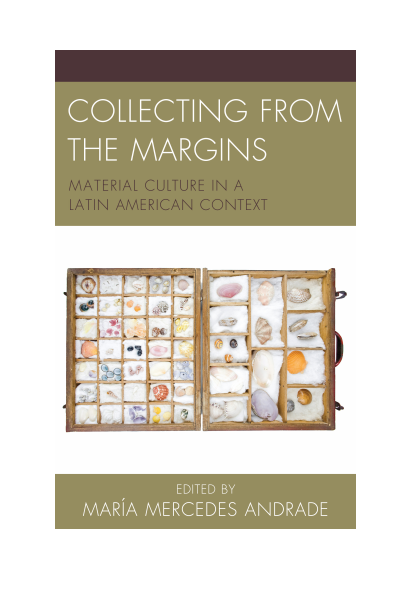
Collecting from the Margins
Material Culture in a Latin American Context
Authors:
Publisher:
2016
Summary
From the cabinets of wonderof the Renaissance to the souvenir collections of today, selecting, accumulating, and organizing objects are practices that are central to our notions of who we are and what we value. Collecting, both private and institutional, has been instrumental in the consolidation of modern notions of the individual and of the nation, and numerous studies have discussed its complex political, social, economic, anthropological, and psychological implications. However, studies of collecting as practiced in colonized cultures are few, since the role of these cultures has usually been understood as that of purveyors of objects for the metropolitan collector.
Collecting from the Margins: Material Culture in a Latin American Context seeks to counter the historical understanding of collecting that posits the metropolis as collecting subject and the colonial or postcolonial society as supplier of collectible objects by asking instead how collecting has been practiced and understood in Latin America. Has collecting been viewed or portrayed differently in a Latin American context? Does the act of collecting, when viewed from a Latin American perspective, unsettle the way we have become accustomed to think about it? What differences, if any, arise in the activity of collecting in colonized or previously colonial societies?
Spanning the period after the independence wars until the 1980s, this collection of ten essays addresses a broad range of examples of collecting practices in Latin America. Collecting during the nineteenth century is addressed in discussions of the creation of the first national museums of Argentina and Colombia in the post-independence period, as well as in analyses of the private collections of modernistas such as Enrique Gómez Carrillo, Rubén Darío, José Asunción Silva, and Delmira Agustini at the end of the nineteenth century and the beginning of the twentieth. The practice of collecting in the twentieth century is discussed in analyses of the self-described revolutionary practices of Oswald de Andrade, Augusto de Campos and the films of Ruy Guerra, as well as the polemical collections of Pablo Neruda, and the unsettling collections portrayed in Gabriel García Márquez’s One Hundred Years of Solitude.
Keywords
Search publication
Bibliographic data
Edition
1/2016
Copyright Year
2016
ISBN-Print
978-1-61148-733-6
ISBN-Online
978-1-61148-734-3
Publisher
University Press Copublishing, Lanham
Language
English
Pages
227
Product Type
Monograph
Table of contents
ChapterPages
Contents No access
List of Figures No access
Acknowledgments No access
Introduction No access Pages 1 - 12
A Note on Translations No access Pages 13 - 14
1 Sacking the Botanical Expedition No access Pages 15 - 34
2 An “Immense Museum” or an “Immense Tomb”? No access Pages 35 - 48
3 Of bayaderas, congaïs, and fumerías No access Pages 49 - 74
4 “That heteroclite assembly” No access Pages 75 - 92
5 Postcards, Autographs, and Modernismo No access Pages 93 - 114
6 Delmira Agustini, Gender, and the Poetics of Collecting No access Pages 115 - 140
7 “I have put all I possess at the disposal of the people’s struggle” No access Pages 141 - 164
8 Antropofagia, Bricolage, Collage No access Pages 165 - 182
9 From the Space of the Wunderkammer to Macondo’s Wonder Rooms No access Pages 183 - 202
10 Collecting Revisited (and Left Behind) No access Pages 203 - 218