Soziale Arbeit, founded in 1951, is an independent academic journal which addresses developments in the context of social work. It is one of the most important publication media in its field and is read by teachers, students and researchers in social work and social pedagogy as well as by professionals and managers from associations and institutions. The journal’s aim is to promote professional development in social work fields by presenting methods and new concepts, in addition to subject-specific practical reports. In the ‘Rundschau’ (Review) section, information from all social fields is compiled. The ‘Tagungskalender’ (Conference Calendar) refers to important events, and the ‘Zeitschriftenbibliographie’ (Bibliography of Journals) lists current articles from professional journals. Soziale Arbeit is published 11 times a year with an annual focus issue published as a double issue. All scholarly articles submitted for publication in the journal undergo a double-blind peer review process. The editorial board is supported in an advisory capacity by a professional advisory board consisting of individuals from associations, universities, politics and administrative bodies. The journal cooperates with the academic societies of social work from Germany (DGSA) and Austria (OGSA). All social work contributions are indexed in the literature database DZI SoLit.
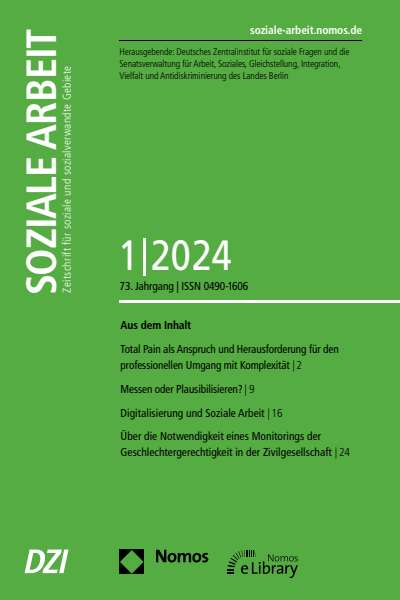
Based on the Total Pain concept, which is firmly anchored in palliative care, the resulting challenges with regard to the realization of the holistic claim are first presented on the basis of the setting “palliative care unit” and it is shown...
The discussion about the impacts and effectiveness of services in social work is strongly influenced by a debate about the possibilities of measuring impacts. For example, it is questioned whether effects in the practice of social work can be...
In view of the need to integrate digitalization thematically into social work degree programs, this paper attempts to design a guiding competency model. The framework for this is provided by the ecological systems theory according to Bronfenbrenner,...
What is the current state of gender equity in the leadership ranks of German civil society? Thanks to the annual monitoring of FAIR SHARE of Women Leaders, data on the structural underrepresentation of women in leadership in civil society...