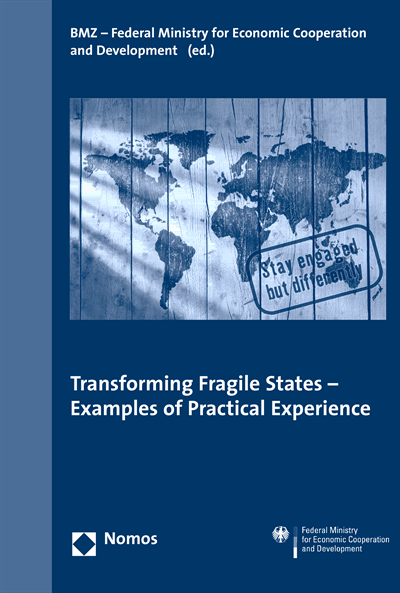
Transforming Fragile States - Examples of Practical Experience
- Editors:
- Publisher:
- 2007
Summary
The problems of fragile statehood and poor government performance rank high on the international agenda for action. In many affected countries the population receives not even the most basic of social services and human rights are violated in many ways. The government is generally unable to perform its core duties. The capacities required are not in place or there is no genuine political will to undertake the necessary reforms. The consequences of poor governance hit poor and disadvantaged sections of the population disproportionately hard. The United Nations sees these states as the single most serious risk to peace and security at global and regional level. The OECD states and international organisations have undertaken to step up their commitment in fragile states. Now the international community faces the major challenge of helping to shape transition processes by means of suitable development strategies and instruments.
In the compilation Transforming Fragile States - Examples of Practical Experience experienced experts express their views. Their analyses highlight the potentials of and limitations to development-policy engagement in fragile states. Above all, however, they demonstrate how development cooperation can help support transition processes even in exceptionally unfavourable environments.
Search publication
Bibliographic data
- Edition
- 1/2007
- Copyright Year
- 2007
- ISBN-Print
- 978-3-8329-2529-1
- ISBN-Online
- 978-3-8452-0414-7
- Publisher
- Nomos, Baden-Baden
- Language
- English
- Pages
- 356
- Product Type
- Edited Book
Table of contents
- Titelei/Inhaltsverzeichnis No access Pages 1 - 4
- Foreword No access Pages 5 - 10Authors:
- Development Cooperation in Fragile States No access Pages 11 - 19Authors:
- Taking on Responsibility in Situations of Fragile Statehood and Poor Government Performance No access Pages 20 - 32Authors: |
- Promoting Effective Governance: The Challenge Facing Technical Cooperation in Afghanistan No access Pages 33 - 46Authors:
- Transformation of Financial Cooperation in a Recovering State: Support for Peace Consolidation and Pro-Poor Growth in Sierra Leone No access Pages 47 - 58Authors:
- Cameroon’s Political Fragility and Contributions to Crisis Prevention by German Technical Cooperation No access Pages 59 - 70Authors:
- Fostering the State’s Capacity to Act: Observations and Experiences from South Somalia No access Pages 71 - 79Authors: | |
- Promoting Democracy in a Fragile Political Environment: The Case of Madagascar No access Pages 80 - 90Authors:
- Coordinated Instruments to Respond to Situations of Risk in a Fragile State: Nepal No access Pages 91 - 103Authors: | |
- Supporting a Constitutional Reform Process in Bolivia No access Pages 104 - 116Authors:
- Small Weapons Control and Peacebuilding in Cambodia No access Pages 117 - 124Authors:
- Promoting Collaboration between the State and Civil Society in Colombia No access Pages 125 - 139Authors: | |
- Bridging Some of the Gaps: Inter-Religious and Inter-Ethnic Dialogues in Nigeria No access Pages 140 - 151Authors:
- Development Cooperation in a Pre-State: Experiences from South Sudan No access Pages 152 - 161Authors: | |
- Supporting Equal Chances for Women in a Fragile State: Yemen No access Pages 162 - 175Authors:
- Promoting Marginalised Children and Youth in Fragile States – Lessons Learnt from Sierra Leone No access Pages 176 - 198Authors:
- Promoting Regional Organisations as a Contribution to Stabilising Fragile States No access Pages 199 - 221Authors:
- Regional Approaches to Stabilisation: The International Conference on the Great Lakes No access Pages 222 - 241Authors:
- Regional Approaches to Stabilisation: Stabilising the Neighbourhood – Europe’s Stability Pact for South Eastern Europe No access Pages 242 - 260Authors: |
- The OECD’s Work on Fragile States and Situations No access Pages 261 - 272Authors: |
- The World Bank’s Approach to Fragile States: Overview and Challenges No access Pages 273 - 286Authors:
- Challenges of Supporting Democratic Governance in Fragile Contexts – UNDP No access Pages 287 - 302Authors: |
- Capacity Development in Fragile States No access Pages 303 - 318Authors: | | |
- Academic Assessment: The Case Studies in the Light of the International Conceptual Debate No access Pages 319 - 330Authors:
- Fragile States: Policy Commitment and Principles for Good International Engagement in Fragile States and Situations (OECD DAC) Version: DCD/DAC (2007) 29, 20 March 2007 No access Pages 331 - 333
- List of Fragile and Poorly Governed States No access Pages 334 - 342
- Contributors No access Pages 343 - 350
- Index No access Pages 351 - 356