, um zu prüfen, ob Sie einen Vollzugriff auf diese Publikation haben.
Ausgabe Teilzugriff

Jahrgang 37 (2019), Heft 3

S&F Sicherheit und Frieden
Autor:innen:
Zeitschrift:
S&F Sicherheit und Frieden
Verlag:
 2019

Über die Zeitschrift

Die Zeitschrift versteht sich als Diskussionsforum für neuere Forschungsergebnisse und politische Entwicklungen auf dem Gebiet der Friedens- und Sicherheitspolitik. Durch Analysen, Stellungnahmen, Dokumente und Informationen sollen kontroverse Auffassungen und brisante Themen einer sachlichen Diskussion zugeführt werden. Homepage: www.sicherheit-und-frieden.nomos.de 

Publikation durchsuchen


Bibliographische Angaben

ISSN-Print
0175-274X
ISSN-Online
0175-274x
Verlag
Nomos, Baden-Baden
Sprache
Deutsch
Produkttyp
Ausgabe

Artikel

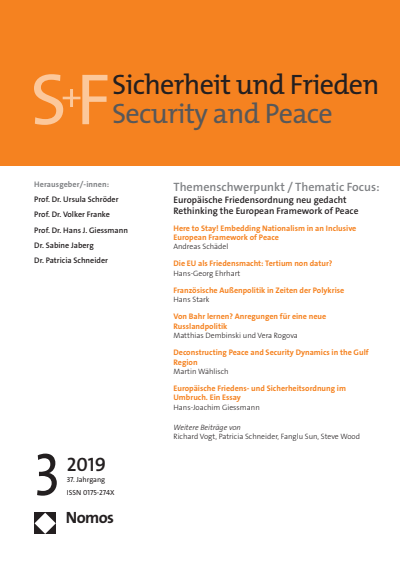
Cover der Ausgabe: S&F Sicherheit und Frieden Jahrgang 37 (2019), Heft 3
Artikel
Kein Zugriff

Seite I - IV
Nomos Verlagsgesellschaft mbH & Co. KG, Baden-Baden 2019

Cover der Ausgabe: S&F Sicherheit und Frieden Jahrgang 37 (2019), Heft 3
Artikel
Vollzugriff

Seite 105 - 112
Nomos Verlagsgesellschaft mbH & Co. KG, Baden-Baden 2019
Autor:innen:

Cover der Ausgabe: S&F Sicherheit und Frieden Jahrgang 37 (2019), Heft 3
Artikel
Kein Zugriff

Seite 113 - 117
Nomos Verlagsgesellschaft mbH & Co. KG, Baden-Baden 2019
Autor:innen:

Cover der Ausgabe: S&F Sicherheit und Frieden Jahrgang 37 (2019), Heft 3
Artikel
Kein Zugriff

Seite 118 - 123
Under the presidency of Emmanuel Macron, France has set itself the goal of strengthening its international presence, being more proactive and defining the European reform agenda. However, the French room for manoeuver is limited. The increasingly...
Nomos Verlagsgesellschaft mbH & Co. KG, Baden-Baden 2019
Autor:innen:

Cover der Ausgabe: S&F Sicherheit und Frieden Jahrgang 37 (2019), Heft 3
Artikel
Kein Zugriff

Seite 124 - 128
Egon Bahr’s 1963 speech outlined ways to achieve rapprochement with the Soviet Union through mutual recognition. The article asks in how far this approach can be useful for the current crisis in Russian-Western relations. It demonstrates that the...
Nomos Verlagsgesellschaft mbH & Co. KG, Baden-Baden 2019
Autor:innen:

Cover der Ausgabe: S&F Sicherheit und Frieden Jahrgang 37 (2019), Heft 3
Artikel
Kein Zugriff

Seite 129 - 134
Nomos Verlagsgesellschaft mbH & Co. KG, Baden-Baden 2019
Autor:innen:

Cover der Ausgabe: S&F Sicherheit und Frieden Jahrgang 37 (2019), Heft 3
Artikel
Kein Zugriff

Seite 135 - 139
The European peace and security order is facing an existential crisis. Its value anchors - democracy, collaboration and integration - are at stake and may seriously weaken due to increasing tendencies of fragmentation and re-nationalization. Such...
Nomos Verlagsgesellschaft mbH & Co. KG, Baden-Baden 2019
Autor:innen:

Cover der Ausgabe: S&F Sicherheit und Frieden Jahrgang 37 (2019), Heft 3
Artikel
Kein Zugriff

Seite 140 - 148
Nomos Verlagsgesellschaft mbH & Co. KG, Baden-Baden 2019
Autor:innen:

Cover der Ausgabe: S&F Sicherheit und Frieden Jahrgang 37 (2019), Heft 3
Artikel
Kein Zugriff

Seite 149 - 158
Nomos Verlagsgesellschaft mbH & Co. KG, Baden-Baden 2019
Autor:innen:

Cover der Ausgabe: S&F Sicherheit und Frieden Jahrgang 37 (2019), Heft 3
Artikel
Kein Zugriff

Seite 159 - 160
Nomos Verlagsgesellschaft mbH & Co. KG, Baden-Baden 2019

Cover der Ausgabe: S&F Sicherheit und Frieden Jahrgang 37 (2019), Heft 3
Artikel
Kein Zugriff

Seite 160 - 165
Nomos Verlagsgesellschaft mbH & Co. KG, Baden-Baden 2019

Literaturverzeichnis (97 Einträge)

  1. Ehrhart, Hans-Georg (2002a): Leitbild Friedensmacht? Die Europäische Sicherheits- und Verteidigungspolitik und die Herausforderung der Konfliktbearbeitung. In: Ehrhart, Hans-Georg (Hrsg.) (2002): Die Europäische Sicherheits- und Verteidigungspolitik. Positionen, Perzeptionen, Probleme, Perspektiven. Baden-Baden: Nomos, S. 243-257. Google Scholar öffnen doi.org/10.5771/0175-274X-2019-3-113
  2. Howorth, Jolyon (2017): EU-NATO Cooperation: the key to Europe’s security future, in: European Security, Jg. 26, Nr. 3, S. 454-459. Google Scholar öffnen doi.org/10.5771/0175-274X-2019-3-113
  3. FDP (2019): Das Programm der Freien Demokraten zur Europawahl 2019, https://www.fdp.de/sites/default/files/uploads/2019/02/26/2019-01-27-bpt-europas-chancen-nutzen-das-programm-der-freien-demokraten-zur-europawahl-2019.pdf. Google Scholar öffnen doi.org/10.5771/0175-274X-2019-3-113
  4. European Parliament (2016): Report on the European Defence Union, http://www.europarl.europa.eu/doceo/document/A-8-2016-0316_EN.html. Google Scholar öffnen doi.org/10.5771/0175-274X-2019-3-113
  5. European Commission (2017b): Reflexion Paper on the Future of European Defence, https://ec.europa.eu/commission/sites/beta-political/files/reflection-paper-defence_en.pdf Google Scholar öffnen doi.org/10.5771/0175-274X-2019-3-113
  6. European Commission (2017a): A European Defence Fund, http://europa.eu/rapid/press-release_IP-17-1508_en.htm. Google Scholar öffnen doi.org/10.5771/0175-274X-2019-3-113
  7. European Commission (2016): European Defence Action Plan: Towards a European Defence Fund, http://ec.europa.eu/smart-regulation/roadmaps/docs/2016_grow_006_cwp_european_defence_action_plan_en.pdf. Google Scholar öffnen doi.org/10.5771/0175-274X-2019-3-113
  8. Europäischer Rat (2018): Schlussfolgerungen des Europäischen Rates vom 28.6.2018, https://www.consilium.europa.eu/media/35938/28-euco-final-conclusions-de.pdf. Google Scholar öffnen doi.org/10.5771/0175-274X-2019-3-113
  9. Europäischer Rat (2017): EU-Zusammenarbeit im Verteidigungsbereich: Rat beschließt militärischen Planungs- und Durchführungsstab (MPCC), https://www.consilium.europa.eu/de/press/press-releases/2017/06/08/military-mpcc-planning-conduct-capability/. Google Scholar öffnen doi.org/10.5771/0175-274X-2019-3-113
  10. Ehrhart, Hans-Georg (2018): European Army: Realities and Chimeras, in: Ethics and Armed Forces, Nr. 2, S. 21-26, http://www.ethikundmilitaer.de/en/full-issues/20182-european-army/ehrhart-european-army-realities-and-chimeras/. Google Scholar öffnen doi.org/10.5771/0175-274X-2019-3-113
  11. Ehrhart, Hans-Georg (Hrsg.) (2017): Krieg im 21. Jahrhundert. Konzepte, Akteure, Herausforderungen, Baden-Baden: Nomos). Google Scholar öffnen doi.org/10.5771/0175-274X-2019-3-113
  12. Ehrhart, Hans-Georg (2005): Die EU und das Leitbild „Friedenmacht“: Außen- und sicherheitspolitische Konzepte nach dem Irak-Krieg. In: Jäger, Thomas/Höse, Alexander/Oppermann, Kai (Hrsg.) (2005): Transatlantische Beziehungen. Sicherheit – Wirtschaft – Öffentlichkeit. Wiesbaden: VS Verlag für Sozialwissenschaften, S. 87-99. Google Scholar öffnen doi.org/10.5771/0175-274X-2019-3-113
  13. Ehrhart, Hans-Georg (2002b): What model for CFSP? Chaillot Papers, Nr. 55, Paris: EU Institute for Security Studies, https://www.iss.europa.eu/content/what-model-cfsp. Google Scholar öffnen doi.org/10.5771/0175-274X-2019-3-113
  14. Hyde-Price, Adrian (2006): ‚Normative’ Power Europe: a realist critique. In: Journal of European Public Policy. 13. Jg., Nr. 2, S. 217-234. Google Scholar öffnen doi.org/10.5771/0175-274X-2019-3-113
  15. Ehrhart, Hans-Georg (2001): Friedensmacht Europa? Die EU auf der Suche nach einem außen- und sicherheitspolitischen Leitbild. In: Reinhard Mutz, Bruno Schoch und Ulrich Ratsch (Hrsg.): Friedensgutachten 2001. Münster: LIT, S. 186-196. Google Scholar öffnen doi.org/10.5771/0175-274X-2019-3-113
  16. Duchêne, François (1973): Die Rolle Europas im Weltsystem: Von der regionalen zur planetarischen Interdependenz. In: Kohnstamm, Max/Hager, Wolfgang (Hrsg.) (1973): Zivilmacht Europa – Supermacht oder Partner? Frankfurt am Main: Suhrkamp, S. 11-35. Google Scholar öffnen doi.org/10.5771/0175-274X-2019-3-113
  17. Council Decision (2017): Council Decision 2017/2315 of 11 December establishing permanent structured coopertion (PESCO) and determining the list of participating Member States, https://eur-lex.europa.eu/legal-content/EN/TXT/PDF/?uri=CELEX:32017D2315&from=EN. Google Scholar öffnen doi.org/10.5771/0175-274X-2019-3-113
  18. Colgan, Jeff D./Keohane, Robert O. (2017): The Liberal World Order is Rigged. Fix it Now or Watch it Wither, Foreign Affairs, Mai/Juni, Nr. 3. Google Scholar öffnen doi.org/10.5771/0175-274X-2019-3-113
  19. CDU/CSU (2019): Gemeinsames Wahlprogramm von CDU und CSU, https://www.csu.de/common/csu/content/csu/hauptnavigation/politik/beschluesse/CDU_20CSU_Europawahlprogramm_final_20mit_20deckblatt.pdf. Google Scholar öffnen doi.org/10.5771/0175-274X-2019-3-113
  20. Bundesministerium der Verteidigung (2016): Weißbuch zur Sicherheitspolitik und zur Zukunft der Bundeswehr, Berlin. Google Scholar öffnen doi.org/10.5771/0175-274X-2019-3-113
  21. Bull, Hedley (1982/83): Civilian Power Europe: A Contradiction in Terms? In: Journal of Common Market Studies. Nr. 1-2, S. 149-170. Google Scholar öffnen doi.org/10.5771/0175-274X-2019-3-113
  22. Bündnis 90/Die Grünen (2019): Europawahlprogramm 2019, https://www.gruene.de/fileadmin/user_upload/Dokumente/B90GRUENE_Europawahlprogramm_2019.pdf. Google Scholar öffnen doi.org/10.5771/0175-274X-2019-3-113
  23. Biscop, Sven (2019): European Strategy in the 21st Century, London: Routledge. Google Scholar öffnen doi.org/10.5771/0175-274X-2019-3-113
  24. Beck, Ulrich (2004): Der kosmopolitische Blick oder: Krieg ist Frieden. Frankfurt am Main: Suhrkamp. Google Scholar öffnen doi.org/10.5771/0175-274X-2019-3-113
  25. Bacevitch, Andrew G. (2019): A World without the West, Commonwealmagazine, https://www.commonwealmagazine.org/world-without-west. Google Scholar öffnen doi.org/10.5771/0175-274X-2019-3-113
  26. Merkel, Angela (2018): zitiert in: Merkel und Maas kritisieren USA, Reuters, 11. Mai, https://de.reuters.com/article/iran-us-eu-merkel-idDEKBN1IC177. Google Scholar öffnen doi.org/10.5771/0175-274X-2019-3-113
  27. Weidenfeld, Werner (1995): Europa – Weltmacht im Werden? In: Internationale Politik. 50. Jg., Nr. 5, S. 17-22. Google Scholar öffnen doi.org/10.5771/0175-274X-2019-3-113
  28. Steinmeier, Frank-Walter (2015): Rede auf dem Deutschen Evangelischen Kirchentag am 7.6.2015, https://www.auswaertiges-amt.de/de/newsroom/150607-rede-bm-kirchentag-kofi-annan/272218. Google Scholar öffnen doi.org/10.5771/0175-274X-2019-3-113
  29. Stavridis, Stelios (2001): Why the ‚Militarising’ of the European Union is strengthening the concept of a ‘Civilian power Europe’. European University Institute, Robert Schuman Centre for Advanced Studies. RSC No. 17. San Domenico 2001. Google Scholar öffnen doi.org/10.5771/0175-274X-2019-3-113
  30. SPD (2019): Wahlprogramm für die Europawahl am 26. Mai 2019, S. 59, https://www.spd.de/fileadmin/Dokumente/Europa_ist_die_Antwort/SPD_Europaprogramm_2019.pdf. Google Scholar öffnen doi.org/10.5771/0175-274X-2019-3-113
  31. Smith, Karen (2000): The End of Civilian Power EU: A Welcome Demise or Cause for Concern? In: International Spectator. Vol. 35, No. 2, S. 11-28. Google Scholar öffnen doi.org/10.5771/0175-274X-2019-3-113
  32. Rinke, Bernhard (2006): Die beiden großen deutschen Volksparteien und das „Friedensprojekt Europa“: Weltmacht, Zivilmacht, Friedensmacht? Baden-Baden: Nomos. Google Scholar öffnen doi.org/10.5771/0175-274X-2019-3-113
  33. Naumann, Klaus (2002): Der Begriff der Sicherheit im Wandel. In: Hoyer, Werner/Kaldrack, Gerd F. (Hrsg.) (2002): Europäische Sicherheits- und Verteidigungspolitik (ESVP). Der Weg zu integrierten europäischen Streitkräften? Baden-Baden: Nomos, S. 27-33. Google Scholar öffnen doi.org/10.5771/0175-274X-2019-3-113
  34. NATO (2018): Joint declaration on EU-NATO Cooperation, https://www.nato.int/cps/en/natohq/official_texts_156626.htm. Google Scholar öffnen doi.org/10.5771/0175-274X-2019-3-113
  35. NATO (2014): Wales Summit Declaration, https://www.nato.int/cps/en/natohq/official_texts_112964.htm#def-exp. Google Scholar öffnen doi.org/10.5771/0175-274X-2019-3-113
  36. Müller, Erwin (2007): Friedensmächte. Unveröffentlichtes Manuskript. Hamburg: Institut für Friedensforschung und Sicherheitspolitik an der Universität Hamburg (IFSH). Google Scholar öffnen doi.org/10.5771/0175-274X-2019-3-113
  37. Mogherini, Federica (2016): Shared Vision, Common Action: A Stronger Europe. A Global Strategy for the European Unions’s Foreign and Security Policy, June. Google Scholar öffnen doi.org/10.5771/0175-274X-2019-3-113
  38. Wucherpfennig, Julian, Nils B. Weidmann, Luc Girardin, Lars-Erik Cederman, and Andreas Wimmer. 2011. “Politically Relevant Ethnic Groups across Space and Time: Introducing the GeoEPR Dataset.” Conflict Management and Peace Science 28(5): 423–37. Google Scholar öffnen doi.org/10.5771/0175-274X-2019-3-105
  39. Maull, Hanns W. (1993): Zivilmacht Bundesrepublik? Das neue Deutschland in der internationalen Politik. Ein „Blätter“-Gespräch mit Hanns W. Maull. In: Blätter für deutsche und internationale Politik. 38. Jg., Heft 8, S. 934-948. Google Scholar öffnen doi.org/10.5771/0175-274X-2019-3-113
  40. Manners, Ian (2002): Normative Power Europe. A Contradiction in Terms? Journal of Common Market Studies, Vol. 40, Nr. 2, S. 235-258. Google Scholar öffnen doi.org/10.5771/0175-274X-2019-3-113
  41. Macron, Emmanuel (2019): Für einen Neubeginn in Europa, Handelsblatt, 14.3., https://www.handelsblatt.com/politik/international/dokumentation-fuer-einen-neubeginn-in-europa-macrons-brief-an-die-eu-buerger-im-wortlaut/24065214.html?ticket=ST-80188-OkLj9504iMAfy954BebD-ap1. Google Scholar öffnen doi.org/10.5771/0175-274X-2019-3-113
  42. Macron, Emmanuel (2017): Rede an der Sorbonne am 26. September, Frankreich-Info, S. 3, https://de.ambafrance.org/Initiative-fur-Europa-Die-Rede-von-Staatsprasident-Macron-im-Wortlaut. Google Scholar öffnen doi.org/10.5771/0175-274X-2019-3-113
  43. Lippert, Barbara/von Ondarza, Nicolai/Perthes, Volker (Hrsg.): Strategische Autonomie Europas. Akteure, Handlungsfelder, Zielkonflikte, SWP-Studie 2, Februar 2019. Google Scholar öffnen doi.org/10.5771/0175-274X-2019-3-113
  44. Kirste, Knut/Maull, Hanns W. (1996): Zivilmacht und Rollentheorie. In: Zeitschrift für Internationale Beziehungen. 3. Jg., Nr. 2, S. 283-312. Google Scholar öffnen doi.org/10.5771/0175-274X-2019-3-113
  45. Kagan, Robert (2019): The New German Question. What happens when Europe comes appart? Foreign Affairs, 2. April, https://www.foreignaffairs.com/articles/germany/2019-04-02/new-german-question. Google Scholar öffnen doi.org/10.5771/0175-274X-2019-3-113
  46. Kagan, Robert (2003): Of paradise and power. America and Europe in the new world order. New York: Random House. Google Scholar öffnen doi.org/10.5771/0175-274X-2019-3-113
  47. Jandl, Gerhard (2018): Die gemeinsame Europäische Verteidigung – was ist sie, und wenn ja, wie viele? In: Sicherheit und Frieden, Nr. 4, S. 171-179. Google Scholar öffnen doi.org/10.5771/0175-274X-2019-3-113
  48. Janning, Josef (2002): Frieden in Europa. In: Weidenfeld, Werner (Hrsg.) (2002): Europa-Handbuch. Bonn: Bundeszentrale für politische Bildung, S. 827-853. Google Scholar öffnen doi.org/10.5771/0175-274X-2019-3-113
  49. IISS (2019): Military Balance Blog, 15th February, https://www.iiss.org/blogs/military-balance/2019/02/european-nato-defence-spending-up. Google Scholar öffnen doi.org/10.5771/0175-274X-2019-3-113
  50. Gellner, Ernest. 1983. Nations and Nationalism. Oxford: Blackwell. Google Scholar öffnen doi.org/10.5771/0175-274X-2019-3-105
  51. Lijphart, Arend. 1977. Democracy in Plural Societies. New Haven: Yale University Press. Google Scholar öffnen doi.org/10.5771/0175-274X-2019-3-105
  52. Lijphart, Arend. 1975. The Politics of Accommodation: Pluralism and Democracy in the Netherlands. Berkeley: University of California Press. Google Scholar öffnen doi.org/10.5771/0175-274X-2019-3-105
  53. Lijphart, Arend. 1969. “Consociational Democracy.” World Politics 21(2): 207–225. Google Scholar öffnen doi.org/10.5771/0175-274X-2019-3-105
  54. Kivirähk, Juhan. 2014. Integrating Estonia’s Russian Speaking Population: Findings of National Defense Opinion Surveys. Tallinn, Estonia: International Center for Defence and Security. Google Scholar öffnen doi.org/10.5771/0175-274X-2019-3-105
  55. International Crisis Group. 2014. “Bosnia’s Future.” Europe Report No. 232. Brussels: International Crisis Group. Google Scholar öffnen doi.org/10.5771/0175-274X-2019-3-105
  56. Inglehart, Ronald F. & Pippa Norris. 2016. Trump, Brexit, and the Rise of Populism: Economic Have-Nots and Cultural Backlash. Harvard Kennedy School Working Paper No. RWP16-026. Google Scholar öffnen doi.org/10.5771/0175-274X-2019-3-105
  57. Hoddie, Matthew and Caroline Hartzell. 2005. “Power Sharing in Peace Settlements: Initiating the Transition from Civil War.” In: Roeder, Philip G. and Donald Rothchild (eds.), Sustainable Peace: Power and Democracy After Civil Wars, pp. 83–106. Ithaca: Cornell University Press. Google Scholar öffnen doi.org/10.5771/0175-274X-2019-3-105
  58. Hechter, Michael. 2000. Containing nationalism. Oxford: Oxford University Press. Google Scholar öffnen doi.org/10.5771/0175-274X-2019-3-105
  59. Halpin, John, Michael Werz, Alan Makovsky, and Max Hoffman. 2018. “Is Turkey Experiencing a New Nationalism? An Examination of Public Attitudes on Turkish Self-Perception.” Washington/Istanbul: Center for American Progress and Istanbul Policy Center. Google Scholar öffnen doi.org/10.5771/0175-274X-2019-3-105
  60. Gurr, Ted Robert. 2000. “Ethnic warfare on the wane.” Foreign Affairs 79: 52–64. Google Scholar öffnen doi.org/10.5771/0175-274X-2019-3-105
  61. Gurr, Ted Robert. 1970. Why Men Rebel. Princeton: Princeton University Press. Google Scholar öffnen doi.org/10.5771/0175-274X-2019-3-105
  62. McGarry, John & Brendan O’Leary. 2004. The Northern Ireland Conflict: Consociational Engagements. Oxford: Oxford University Press. Google Scholar öffnen doi.org/10.5771/0175-274X-2019-3-105
  63. Fukuyama, Francis. 1989. “The End of History?” The National Interest (16): 3-18. Google Scholar öffnen doi.org/10.5771/0175-274X-2019-3-105
  64. European Court of Human Rights. 2017. Judgement in the Case of Kiraly and Dömötör v. Hungary. Application no. 10851/13. Google Scholar öffnen doi.org/10.5771/0175-274X-2019-3-105
  65. Collier, Paul and Anke Hoeffler. 2004. “Greed and Grievance in Civil War.” Oxford Economic Papers 56(4):563–595. Google Scholar öffnen doi.org/10.5771/0175-274X-2019-3-105
  66. Center for Constitutional Change. 2018. “May’s ‘Precious Union’ has Little Support in Brexit Britain.” Press Release, 8 October. Google Scholar öffnen doi.org/10.5771/0175-274X-2019-3-105
  67. Cederman, Lars-Erik. 2019. “Blood for Soil: The Fatal Temptations of Ethnic Politics.” Foreign Affairs 98(2): 61–68. Google Scholar öffnen doi.org/10.5771/0175-274X-2019-3-105
  68. Cederman, Lars-Erik, Kristian Skrede Gleditsch, and Halvard Buhaug. 2013. Inequality, Grievances and Civil War. New York: Cambridge University Press. Google Scholar öffnen doi.org/10.5771/0175-274X-2019-3-105
  69. Cederman, Lars-Erik, Andreas Wimmer and Brian Min. 2010. “Why Do Ethnic Groups Rebel? New Data and Analysis.” World Politics 62(1):87–119. Google Scholar öffnen doi.org/10.5771/0175-274X-2019-3-105
  70. Brubaker, Rogers. 1992. Citizenship and Nationhood in France and Germany. Cambridge, MA: Harvard University Press. Google Scholar öffnen doi.org/10.5771/0175-274X-2019-3-105
  71. Brubaker, Rogers, and David D. Laitin. 1998. “Ethnic and Nationalist Violence.” Annual Review of Sociology 24: 423–52. Google Scholar öffnen doi.org/10.5771/0175-274X-2019-3-105
  72. Bieber, Florian. 2005. “Partial Implementation, Partial Success: The Case of Macedonia.” In: Ian O’Flynn, and David Russel (eds), New Challenges for Power-Sharing: Institutional and Social Reform in Divided Societies, pp. 107-122. London: Pluto Press. Google Scholar öffnen doi.org/10.5771/0175-274X-2019-3-105
  73. BBC. 2019. “Greece’s invisible minority – The Macedonian Slavs.” 24 February. https://www.bbc.com/news/stories-47258809 [May 8, 2019]. Google Scholar öffnen doi.org/10.5771/0175-274X-2019-3-105
  74. Söderlund, Peter. 2006. The Dynamics of Federalism in Russia. Turku: Abo Akademi University Press. Google Scholar öffnen doi.org/10.5771/0175-274X-2019-3-105
  75. Wood, John R. 1981. “Secession: A Comparative Analytical Framework.” Canadian Journal of Political Science 14(1): 107-134. Google Scholar öffnen doi.org/10.5771/0175-274X-2019-3-105
  76. Wimmer, Andreas. 2019. “Why Nationalism Works. And Why It Isn’t Going Away.” Foreign Affairs 98(2): 27-34. Google Scholar öffnen doi.org/10.5771/0175-274X-2019-3-105
  77. Weber, Max. (1922) 1985. Wirtschaft und Gesellschaft: Grundriss der verstehenden Soziologie. Tübingen: Mohr. Google Scholar öffnen doi.org/10.5771/0175-274X-2019-3-105
  78. Weaver, Michael T. 2002. Protest, Radicalism and Militancy in Spain’s Basque Country: The Basque Nationalist Movement and the Persistent Struggle of ETA. New York, NY: St. John’s University. Honor Thesis College of Saint Benedict/Saint John’s University. Google Scholar öffnen doi.org/10.5771/0175-274X-2019-3-105
  79. Walter, Barbara F. 2009. Reputation and Civil War: Why Separatist Conflicts Are So Violent. Cambridge: Cambridge University Press. Google Scholar öffnen doi.org/10.5771/0175-274X-2019-3-105
  80. Vogt, Manuel, Nils-Christian Bormann, Seraina Rüegger, Lars-Erik Cederman, Philipp Hunziker, and Luc Girardin. 2015. “Integrating Data on Ethnicity, Geography, and Conflict: The Ethnic Power Relations Data Set Family.” Journal of Conflict Resolution 59 (7): 1327-1342. Google Scholar öffnen doi.org/10.5771/0175-274X-2019-3-105
  81. Vogt, Manuel, Nils-Christian Bormann and Lars-Erik Cederman. 2016. “Democracy, Ethnic Exclusion, and Civil Conflict: The Arab Spring Revolutions from a Global Comparative Perspective”. In: David A. Backer, Ravi Bhavnani, and Paul Huth (eds.): Peace and Conflict 2016. London, UK: Routledge. Google Scholar öffnen doi.org/10.5771/0175-274X-2019-3-105
  82. Tilly, Charles. 1999. Durable Inequality. Berkeley: University of California Press. Google Scholar öffnen doi.org/10.5771/0175-274X-2019-3-105
  83. Tamir, Yael. 2019. “Building a Better Nationalism. The Nation’s Place in a Globalized World.” Foreign Affairs 98(2): 48-52. Google Scholar öffnen doi.org/10.5771/0175-274X-2019-3-105
  84. Tajfel, Henri and John Turner. 1979. „An Integrative Theory of Intergroup Conflict.” In: Austin, Wiliam G. and Stephen Worchel (eds.), The Social Psychology of Intergroup Relations. Monterey: Brooks Cole. Google Scholar öffnen doi.org/10.5771/0175-274X-2019-3-105
  85. Sözen, Ahmet, and Kudret Özersay (2007). “The Annan Plan: State Succession or Continuity.” Middle Eastern Studies 43(1): 125-141. Google Scholar öffnen doi.org/10.5771/0175-274X-2019-3-105
  86. Amnesty International. 2006. “Estonia: Linguistic minorities in Estonia: Discrimination must end.” https://www.amnesty.org/download/Documents/76000/eur510022006en.pdf [April 2, 2019]. Google Scholar öffnen doi.org/10.5771/0175-274X-2019-3-105
  87. Schlegel, Simon. 2018. “How Could the Gagauz Achieve Autonomy and What Has It Achieved for Them: A Comparison among Neighbors on the Moldova-Ukrainian Border.” Journal on Ethnopolitics and Minority Issues in Europe, 17(1): 1-23. Google Scholar öffnen doi.org/10.5771/0175-274X-2019-3-105
  88. Sapolsky, Robert. 2019. “This Is Your Brain on Nationalism. The Biology of Us and Them.” Foreign Affairs 98(2): 42-47. Google Scholar öffnen doi.org/10.5771/0175-274X-2019-3-105
  89. Sambanis, Nicholas, Micha Germann, and Andreas Schädel. 2018. “SDM: a new data set on self-determination movements with an application to the reputational theory of conflict.” Journal of Conflict Resolution 62(3): 656-686. Google Scholar öffnen doi.org/10.5771/0175-274X-2019-3-105
  90. Roeder, Philip G. and Donald Rothchild. 2005. Sustainable Peace: Power and Democracy After Civil Wars. Ithaca: Cornell University Press. Google Scholar öffnen doi.org/10.5771/0175-274X-2019-3-105
  91. Regan, Patrick M. and Daniel Norton. 2005. “Greed, grievance, and mobilization in civil wars. ” Journal of Conflict Resolution 49(3): 319-336. Google Scholar öffnen doi.org/10.5771/0175-274X-2019-3-105
  92. Protsyk, Oleh. 2011. “Gagauz autonomy in Moldova: the real and the virtual in post-Soviet state design.” In: Weller, Marc, and Katherine Nobbs (eds.), Asymmetric Autonomy and the Settlement of Ethnic Conflicts. Pittsburgh: University of Pittsburgh Press. Google Scholar öffnen doi.org/10.5771/0175-274X-2019-3-105
  93. Petsinis, Vassilis. 2008. ”Serbs and ethnic Hungarians in Vojvodina. Ethnic conflict placed within a framework beyond groupism.” Slovak Sociological Review. 40(3): 258-277. Google Scholar öffnen doi.org/10.5771/0175-274X-2019-3-105
  94. Orttung, Robert W., Danielle N. Lussier, and Anna Paretskaya (eds.). 2000. The Republics and Regions of the Russian Federation. A Guide to Politics, Policies, and Leaders. Armonk, NY: M.E. Sharpe. Google Scholar öffnen doi.org/10.5771/0175-274X-2019-3-105
  95. Ognjenovic, Gorana & Jasna Jozelic. 2016. Titoism, Self-Determination, Nationalism,Cultural Memory. New York: Springer. Google Scholar öffnen doi.org/10.5771/0175-274X-2019-3-105
  96. Oberschall, Anthony. 1993. Social Movements: Ideologies, Interests and Identities. New Brunswick: Transaction. Google Scholar öffnen doi.org/10.5771/0175-274X-2019-3-105
  97. New York Times. 2018. “Milorad Dodik Wants to Carve Up Bosnia. Peacefully, if Possible.” February 16. https://www.nytimes.com/2018/02/16/world/europe/dodik-republika-srpska-bosnia.html [April 2, 2019]. Google Scholar öffnen doi.org/10.5771/0175-274X-2019-3-105
Neuesten Ausgaben

S&F Sicherheit und Frieden
Alle Ausgaben anzeigen
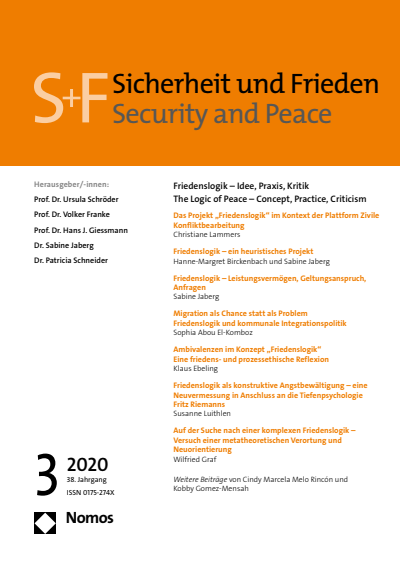
Cover der Ausgabe: S&F Sicherheit und Frieden Jahrgang 38 (2020), Heft 4
Ausgabe Teilzugriff
Security and Peace
Jahrgang 38 (2020), Heft 4
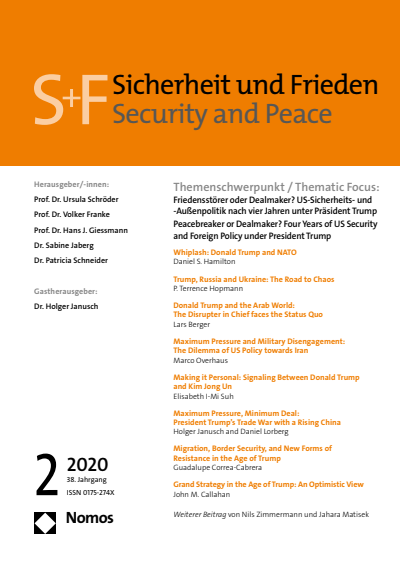
Cover der Ausgabe: S&F Sicherheit und Frieden Jahrgang 38 (2020), Heft 3
Ausgabe Teilzugriff
Security and Peace
Jahrgang 38 (2020), Heft 3
Cover der Ausgabe: S&F Sicherheit und Frieden Jahrgang 38 (2020), Heft 2
Ausgabe Teilzugriff
Security and Peace
Jahrgang 38 (2020), Heft 2
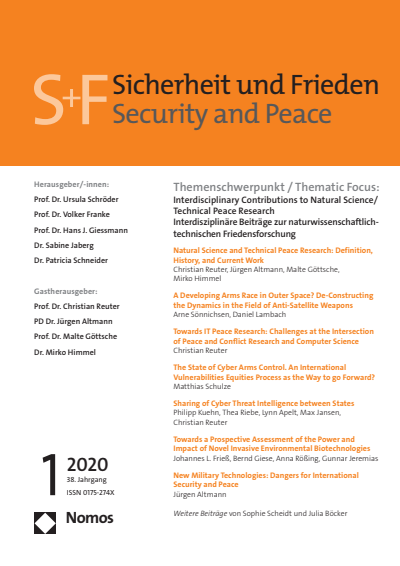
Cover der Ausgabe: S&F Sicherheit und Frieden Jahrgang 38 (2020), Heft 1
Ausgabe Teilzugriff
Security and Peace
Jahrgang 38 (2020), Heft 1
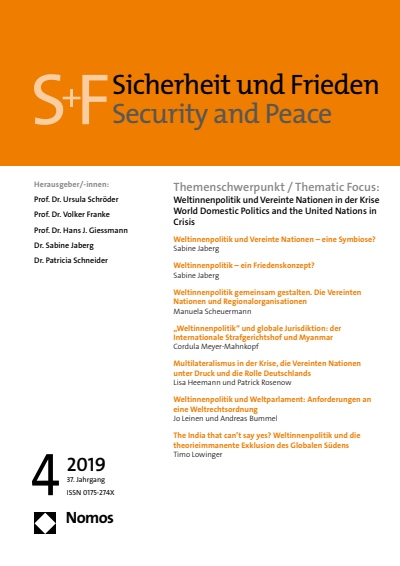
Cover der Ausgabe: S&F Sicherheit und Frieden Jahrgang 37 (2019), Heft 4
Ausgabe Teilzugriff
Security and Peace
Jahrgang 37 (2019), Heft 4