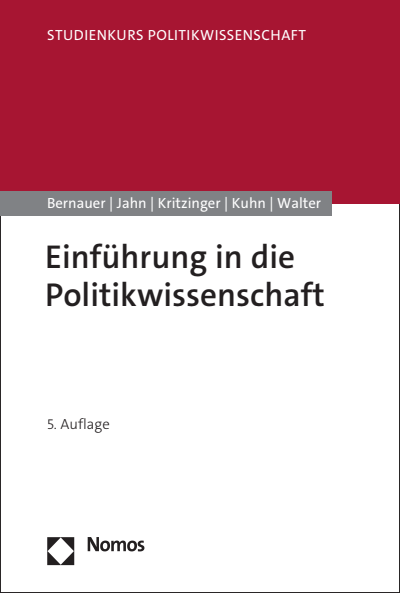
Einführung in die Politikwissenschaft
- Autor:innen:
- | | | |
- Verlag:
- 2022
Zusammenfassung
Diese Einführung in die Politikwissenschaft vermittelt die wichtigsten Konzepte, Methoden und Forschungsinhalte des Faches. Der erste Teil beleuchtet den wissenschaftlichen Prozess von der Theoriebildung bis zur empirischen Analyse. Anschließend vermittelt das Buch Grundlagen und Forschungserkenntnisse aus zentralen Teilbereichen und behandelt dabei Themen wie Wahlen, Medien, Interessengruppen, Parlament, Regierung und internationale Politik. Um die wissenschaftlichen Grundlagen verständlicher zu machen, wird den politischen Systemen Deutschlands, Österreichs, der Schweiz und der Europäischen Union besondere Aufmerksamkeit geschenkt.
Dank guter Lesbarkeit und zahlreichen Beispielen ist das Buch auch für Leserinnen und Leser geeignet, die keine oder nur geringe Vorkenntnisse besitzen.
Schlagworte
Publikation durchsuchen
Bibliographische Angaben
- Copyrightjahr
- 2022
- ISBN-Print
- 978-3-8487-7938-3
- ISBN-Online
- 978-3-7489-2323-7
- Verlag
- Nomos, Baden-Baden
- Reihe
- Studienkurs Politikwissenschaft
- Sprache
- Deutsch
- Seiten
- 598
- Produkttyp
- Lehrbuch
Inhaltsverzeichnis
- Titelei/Inhaltsverzeichnis Kein Zugriff Seiten 1 - 22
- 1.1.1 Soziales Handeln Kein Zugriff
- 1.1.2 Politisches Handeln Kein Zugriff
- 1.1.3 Breites Verständnis des Politischen Kein Zugriff
- 1.2.1 Ein Blick in die Geschichte Kein Zugriff
- 1.2.2 Struktur des internationalen Systems Kein Zugriff
- 1.2.3 Expansion staatlicher Funktionen Kein Zugriff
- 1.3.1 Politik als Studienobjekt Kein Zugriff
- 1.3.2 Instrumentarium Kein Zugriff
- 1.4.1 Empirisch-analytische Forschung Kein Zugriff
- 1.4.2 Hermeneutische Forschung Kein Zugriff
- 1.4.3 Normative, präskriptive und prognostische Elemente Kein Zugriff
- 1.5.1 Vorboten der modernen Politikwissenschaft Kein Zugriff
- 1.5.2 Politikwissenschaft in Deutschland Kein Zugriff
- 1.5.3 Politikwissenschaft in der Schweiz Kein Zugriff
- 1.5.4 Politikwissenschaft in Österreich Kein Zugriff
- 1.5.5 Fortschreitende Ausdifferenzierung Kein Zugriff
- 1.6 Verbindung zu anderen Wissenschaftsgebieten Kein Zugriff
- 1.7 Fazit Kein Zugriff
- 2.1.1 Kernelemente empirisch-analytischer Forschung Kein Zugriff
- 2.1.2 Spielregeln der Wissenschaft Kein Zugriff
- 2.2.1 Formulierung einer Fragestellung Kein Zugriff
- 2.2.2 Entwicklung eines theoretischen Arguments Kein Zugriff
- 2.2.3 Ableitung von Hypothesen Kein Zugriff
- 2.2.4 Konzeptdefinitionen Kein Zugriff
- 2.2.5 Operationalisierung Kein Zugriff
- Experimente Kein Zugriff
- Nicht-experimentelle Untersuchungsformen Kein Zugriff
- Quantitative Untersuchungsformen Kein Zugriff
- Qualitative Untersuchungsformen Kein Zugriff
- Die Qual der Wahl: Untersuchungsformen wählen Kein Zugriff
- Studien mit großer Fallzahl: repräsentative Stichproben und Vollerhebungen Kein Zugriff
- Studien mit kleiner Fallzahl Kein Zugriff
- (Vergleichende) Fallstudien Kein Zugriff
- Verzerrte Fallauswahl (selection bias) Kein Zugriff
- Befragung Kein Zugriff
- Beobachtung Kein Zugriff
- Dokumenten- und Inhaltsanalyse Kein Zugriff
- Verwendung von Sekundärdaten Kein Zugriff
- Analyse Kein Zugriff
- 2.2.9 Publikation Kein Zugriff
- 2.3 Fazit Kein Zugriff
- 3.1 Politische Systeme Kein Zugriff
- 3.2.1 Was ist Demokratie? Kein Zugriff
- 3.2.2 Merkmale demokratischer Systeme Kein Zugriff
- 3.2.3 Deutschland, Österreich, Schweiz und die Europäische Union Kein Zugriff
- 3.3.1 Monarchien Kein Zugriff
- 3.3.2 Militärregime Kein Zugriff
- 3.3.3 Autokratische Zivilregime Kein Zugriff
- 3.3.4 Globale Verteilungen autokratischer Systemtypen seit 1946 Kein Zugriff
- Das Ausmaß der Personalisierung Kein Zugriff
- Das Ausmaß an Freiheitsbeschränkungen der Bürger:innen Kein Zugriff
- 3.4 Empirische Maße für politische Systemtypen Kein Zugriff
- 3.5.1 Beispiel 1: Auswirkungen des politischen Systemtyps auf die Bildungspolitik Kein Zugriff
- 3.5.2 Beispiel 2: Demokratie und wirtschaftliche Entwicklung Kein Zugriff
- 3.6.1 Drei Demokratisierungswellen Kein Zugriff
- Wirtschaftliche Entwicklung Kein Zugriff
- Gesellschaftliche und kulturelle Voraussetzungen Kein Zugriff
- 3.7 Fazit Kein Zugriff
- 4.1 Gewaltenteilung als Fundament demokratischer Systeme Kein Zugriff
- Rolle der Parteien Kein Zugriff
- Machtverteilung zwischen Exekutive und Legislative Kein Zugriff
- Rolle der Parteien Kein Zugriff
- Machtverteilung zwischen Exekutive und Legislative Kein Zugriff
- Struktur des politischen Entscheidungsprozesses Kein Zugriff
- 4.2.3 Semi-präsidentielle Systeme Kein Zugriff
- Deutschland Kein Zugriff
- Österreich Kein Zugriff
- Schweiz Kein Zugriff
- Europäische Union Kein Zugriff
- Politischer Stil und demokratische Stabilität Kein Zugriff
- Regierungssysteme und Wirtschaftspolitik Kein Zugriff
- Bikameralismus Kein Zugriff
- Geschriebene Verfassung Kein Zugriff
- Verfassungsgerichtsbarkeit Kein Zugriff
- Deutschland Kein Zugriff
- Österreich Kein Zugriff
- Schweiz Kein Zugriff
- Europäische Union Kein Zugriff
- 4.3.3 Auswirkungen der vertikalen Gewaltenteilung Kein Zugriff
- 4.4 Gesamtschau auf die Gewaltenteilung Kein Zugriff
- 4.5 Fazit Kein Zugriff
- 5.1.1 Funktionen von Wahlen Kein Zugriff
- Wahlkreiseinteilung Kein Zugriff
- Wahlangebot und Stimmabgabe Kein Zugriff
- Stimmenverrechnung Kein Zugriff
- Wahl- und Meldepflicht Kein Zugriff
- Auswirkungen auf das Verhalten der Politiker:innen Kein Zugriff
- Auswirkungen auf die Regierungsarbeit Kein Zugriff
- Auswirkungen auf Parteien und Parteiensysteme Kein Zugriff
- Auswirkungen auf politische Repräsentation Kein Zugriff
- Direktdemokratische Instrumente, Ursachen und Auswirkungen Kein Zugriff
- Das obligatorische und das fakultative Referendum Kein Zugriff
- Das Regierungsreferendum Kein Zugriff
- Die Volksinitiative Kein Zugriff
- 5.2.2 Entstehung, Verbreitung und Funktion direktdemokratischer Instrumente Kein Zugriff
- 5.3 Fazit Kein Zugriff
- 6.1.1 Begrifflichkeiten im Bereich der öffentlichen Meinung Kein Zugriff
- 6.1.2 Die Wichtigkeit von öffentlicher Meinung in liberal-demokratischen Systemen Kein Zugriff
- 6.1.3 Arten und Objekte öffentlicher Meinung Kein Zugriff
- 6.2.1 Konfliktlinie Zentrum-Peripherie Kein Zugriff
- 6.2.2 Konfliktlinie Kirche-Staat Kein Zugriff
- 6.2.3 Konfliktlinie Stadt-Land Kein Zugriff
- 6.2.4 Konfliktlinie Soziale Klasse: Kapital-Arbeit Kein Zugriff
- 6.2.5 Konfliktlinie Materialismus-Post-Materialismus Kein Zugriff
- 6.2.6 Konfliktlinie Integration-Demarkation/Abgrenzung Kein Zugriff
- 6.3 Konfliktlinien und Politischer Raum Kein Zugriff
- 6.4.1 Faktenwissen, Verständniswissen und Fehlinformation Kein Zugriff
- 6.4.2 Informationsaneignung und -verarbeitung Kein Zugriff
- 6.5.1 Wahlbeteiligung Kein Zugriff
- 6.5.2 Wahlentscheidungen Kein Zugriff
- 6.5.3 Themensalienz und Themenkompetenz Kein Zugriff
- 6.5.4 Räumliches Wählen Kein Zugriff
- 6.6.1 Retrospektives und prospektives Wählen Kein Zugriff
- 6.6.2 Strategisches und aufrichtiges Wählen Kein Zugriff
- 6.7 Fazit Kein Zugriff
- 7.1.1 Definition Kein Zugriff
- 7.1.2 Funktionen politischer Parteien Kein Zugriff
- 7.1.3 Klassifikationen von Parteien Kein Zugriff
- Repräsentative Umfragen (Demoskopie) Kein Zugriff
- Elitenbefragungen Kein Zugriff
- Expert:innenbefragungen Kein Zugriff
- Inhaltsanalysen von Parteiprogrammen Kein Zugriff
- Parlamentarische Abstimmungen Kein Zugriff
- 7.1.5 Der politische Markt und das Medianwählertheorem Kein Zugriff
- Deutschland Kein Zugriff
- Österreich Kein Zugriff
- Schweiz Kein Zugriff
- Positionierung der Parteien im Vergleich Kein Zugriff
- Parteien in der Europäischen Union Kein Zugriff
- 7.2.1 Klassifikationen von Parteiensystemen Kein Zugriff
- 7.2.2 Struktur und Dynamik unterschiedlicher Parteiensysteme Kein Zugriff
- 7.2.3 Entstehung von Parteiensystemen Kein Zugriff
- 7.3.1. Auswirkungen auf die politische Leistungsfähigkeit Kein Zugriff
- 7.3.2 Auswirkungen auf die wirtschaftliche Leistungsfähigkeit Kein Zugriff
- 7.4 Die Parteiensysteme Deutschlands, Österreichs und der Schweiz Kein Zugriff
- 7.4.1 Das Parteiensystem Deutschlands Kein Zugriff
- 7.4.2 Das Parteiensystem Österreichs Kein Zugriff
- 7.4.3 Das Parteiensystem der Schweiz Kein Zugriff
- 7.5 Fazit Kein Zugriff
- 8.1.1 Was ist eine Interessengruppe? Kein Zugriff
- 8.1.2 Interessengruppen in Deutschland, Österreich und der Schweiz Kein Zugriff
- Organisationsfähigkeit Kein Zugriff
- Konfliktfähigkeit Kein Zugriff
- 8.1.4 Gewerkschaften Kein Zugriff
- 8.1.5 Die Stellung von Interessengruppen im politischen System Kein Zugriff
- Input Kein Zugriff
- Output Kein Zugriff
- 8.2.1 Was ist eine soziale Bewegung? Kein Zugriff
- 8.2.2 Soziale Bewegungen im deutschsprachigen Raum Kein Zugriff
- 8.2.3 Welche Faktoren begünstigen die Entstehung und den Erfolg sozialer Bewegungen? Kein Zugriff
- Einfluss relativer Deprivation/Diskriminierung Kein Zugriff
- Einfluss gruppeninhärenter Organisations- und Konfliktfähigkeit Kein Zugriff
- Einfluss politischer Opportunitätsstrukturen Kein Zugriff
- Auswirkungen der Internationalisierung und Digitalisierung Kein Zugriff
- Zusammenwirken von sozialen Bewegungen und Parteien Kein Zugriff
- 8.3 Fazit Kein Zugriff
- 1. Phase: Hypothese der Medienallmacht (bis etwa 1940) Kein Zugriff
- 2. Phase: Hypothese der Medienohnmacht (ca. 1940–1970) Kein Zugriff
- 3. Phase: Hypothese der selektiven Medienwirkung (ab etwa 1970) Kein Zugriff
- Die Agenda-Setting-Theorie Kein Zugriff
- Framing-Theorie Kein Zugriff
- Priming-Theorie Kein Zugriff
- Das Receive-Acceptance-Sample-Modell (RAS-Modell) Kein Zugriff
- Die Wissenskluft-Hypothese (knowledge gap hypothesis) Kein Zugriff
- Theorie der Selektiven Zuwendung (selective exposure): Echokammern Kein Zugriff
- Theorie des motivated reasoning Kein Zugriff
- 9.1.3 Politische Funktionen von Kommunikationsplattformen in der Demokratie Kein Zugriff
- Die rechtliche Grundstruktur europäischer Mediensysteme Kein Zugriff
- Arten von Mediensystemen Kein Zugriff
- Das deutsche Mediensystem Kein Zugriff
- Das österreichische Mediensystem Kein Zugriff
- Das schweizerische Mediensystem Kein Zugriff
- 9.2.1 Logik des Mediensystems Kein Zugriff
- 9.2.2 Folgen für die Politik Kein Zugriff
- 9.3 Kommunikation im Wahlkampf Kein Zugriff
- 9.4 Fazit Kein Zugriff
- 10.1.1 Entstehung der Legislativen Kein Zugriff
- Repräsentation Kein Zugriff
- Kontrolle Kein Zugriff
- Gesetzgebung Kein Zugriff
- Wahlfunktion Kein Zugriff
- 10.1.3 Arbeitsweisen von Legislativen Kein Zugriff
- 10.2.1 Historische Wurzeln von zweiten Kammern Kein Zugriff
- Machtsymmetrie zwischen den beiden Kammern Kein Zugriff
- Politische Kongruenz zwischen den beiden Kammern Kein Zugriff
- 10.3.1 Deutschland: Bundestag und Bundesrat Kein Zugriff
- 10.3.2 Österreich: Nationalrat und Bundesrat Kein Zugriff
- 10.3.3 Schweiz: Nationalrat und Ständerat Kein Zugriff
- 10.4 Das Europäische Parlament (EP) Kein Zugriff
- 10.5.1 Statisches Modell Kein Zugriff
- 10.5.2 Dynamisches Modell Kein Zugriff
- 10.6.1 Der Gesetzgebungsprozess in parlamentarischen Systemen Kein Zugriff
- 10.6.2 Der Gesetzgebungsprozess in präsidentiellen Systemen Kein Zugriff
- 10.6.3 Die Rolle des Agenda-Setters im Gesetzgebungsprozess Kein Zugriff
- 10.7 Fazit Kein Zugriff
- Entstehung demokratischer Regierungen Kein Zugriff
- Formen der Regierungsorganisation Kein Zugriff
- Stellung und Funktion der Regierung im demokratischen System Kein Zugriff
- Entstehung der Verwaltung Kein Zugriff
- Das französische Verwaltungsmodell Kein Zugriff
- Das deutsche Verwaltungsmodell Kein Zugriff
- Das US-amerikanische Verwaltungsmodell Kein Zugriff
- Funktionen der öffentlichen Verwaltung Kein Zugriff
- Verwaltung Kein Zugriff
- Dienstleistung Kein Zugriff
- Regulierung und Lizenzierung Kein Zugriff
- Informationsbeschaffung und -analyse Kein Zugriff
- Normative Fragen zur Verwaltungsorganisation Kein Zugriff
- Stellung der Verwaltung im demokratischen System Kein Zugriff
- Deutschland Kein Zugriff
- Österreich Kein Zugriff
- Schweiz Kein Zugriff
- Der Europäische Rat Kein Zugriff
- Rat der EU Kein Zugriff
- Die Europäische Kommission Kein Zugriff
- Minimale Gewinnkoalition Kein Zugriff
- Koalition der minimalen Größe Kein Zugriff
- Koalition der geringsten Parteienzahl Kein Zugriff
- Koalition der minimalen ideologischen Spannweite Kein Zugriff
- Minimal verbundene Gewinnkoalition Kein Zugriff
- Policy-mögliche Koalition Kein Zugriff
- Minderheitsregierungen Kein Zugriff
- Übergroße Koalitionsregierungen Kein Zugriff
- 11.2.2 Politische Handlungskapazität von Regierungen Kein Zugriff
- 11.3.1 Bürokratietheorie Kein Zugriff
- 11.3.2 Empirische Evidenz zur Bürokratietheorie Kein Zugriff
- 11.3.3 Qualität der Verwaltung Kein Zugriff
- 11.4 Fazit Kein Zugriff
- 12.1.1 Rechtsstaat und Demokratie Kein Zugriff
- Deutschland Kein Zugriff
- Österreich Kein Zugriff
- Schweiz Kein Zugriff
- Europäische Union Kein Zugriff
- 12.2.1 Zwei Grundmodelle der Verfassungsgerichtsbarkeit Kein Zugriff
- Das deutsche Bundesverfassungsgericht Kein Zugriff
- Der österreichische Verfassungsgerichtshof Kein Zugriff
- Das Schweizer Bundesgericht Kein Zugriff
- Der Europäische Gerichtshof (EuGH) Kein Zugriff
- 12.3.1 Konzeptuelle Überlegungen zum Einfluss des Verfassungsgerichts auf die Politik Kein Zugriff
- 12.3.2 Wie lässt sich der Einfluss des Verfassungsgerichts messen? Kein Zugriff
- Fallstudien zu einzelnen Staaten Kein Zugriff
- Vergleichende Studien Kein Zugriff
- Politischer Einfluss des Europäischen Gerichtshofes (EuGH) Kein Zugriff
- Rechtlicher Formalismus und Kultur Kein Zugriff
- Strategisches Verhalten des EuGH Kein Zugriff
- Strategisches Verhalten nationaler Gerichte Kein Zugriff
- Transnationales Interesse privater Akteure Kein Zugriff
- Strategisches Verhalten nationaler Regierungen Kein Zugriff
- 12.4 Fazit Kein Zugriff
- 13.1.1 Staatliche Souveränität und Anarchie Kein Zugriff
- 13.1.2 Relativierung des Souveränitätsprinzips und der Anarchie Kein Zugriff
- Sicherheit Kein Zugriff
- Wohlstand Kein Zugriff
- Selbstbestimmung und Kooperation Kein Zugriff
- 13.2.1 Liberalismus Kein Zugriff
- 13.2.2 Realismus Kein Zugriff
- 13.2.3 Marxismus Kein Zugriff
- 13.2.4 Konstruktivismus Kein Zugriff
- 13.3.1 Häufigkeit und Ausmaß von Kriegen Kein Zugriff
- Krieg aus Sicht des Realismus: Anarchie, Polarität und Macht Kein Zugriff
- Krieg aus Sicht des Liberalismus: Die friedensstiftende Wirkung von Freihandel und Demokratie Kein Zugriff
- Konstruktivistischer Erklärungsansatz Kein Zugriff
- Institutioneller Erklärungsansatz Kein Zugriff
- Transparenz und Vermeidung von Fehlwahrnehmungen und Fehlkalkülen Kein Zugriff
- 13.4.1 Möglichkeiten und Grenzen wirksamer internationaler Kooperation Kein Zugriff
- 13.4.2 Erfolgsbedingungen internationaler Kooperation Kein Zugriff
- Intergouvernementalismus Kein Zugriff
- Realistischer Intergouvernementalismus Kein Zugriff
- Liberaler (institutionalistischer) Intergouvernementalismus Kein Zugriff
- Supranationalismus Kein Zugriff
- Realistischer Intergouvernementalismus Kein Zugriff
- Liberaler Intergouvernementalismus Kein Zugriff
- Supranationalismus, Transaktionalismus, Funktionalismus Kein Zugriff
- Supranationalismus, Konstruktivismus Kein Zugriff
- 13.6 Fazit Kein Zugriff
- Literaturliste Kein Zugriff Seiten 533 - 584
- Autor:innenverzeichnis Kein Zugriff Seiten 585 - 586
- Stichwortverzeichnis Kein Zugriff Seiten 587 - 596
- Bereits erschienen in der Reihe STUDIENKURS POLITIKWISSENSCHAFT (ab 2017) Kein Zugriff Seiten 597 - 598
Literaturverzeichnis (1196 Einträge)
Es wurden keine Treffer gefunden. Versuchen Sie einen anderen Begriff.
- Woolcock, Michael (2010): The Rise and Routinization of Social Capital, 1988-2008. Annual Review of Political Science, 13, 469−87. Google Scholar öffnen doi.org/10.5771/9783748923237
- Wessels, Wolfgang (2020): Das politische System der Europäischen Union. Wiesbaden: Springer VS. Google Scholar öffnen doi.org/10.5771/9783748923237
- Wibbels, Erik (2000): Federalism and the Politics of Macroeconomic Policy and Performance. American Journal of Political Science, 44(4), 687−702. Google Scholar öffnen doi.org/10.5771/9783748923237
- Wibbels, Erik (2006): Madison in Baghdad? Decentralization and Federalism in Comparative Politics. Annual Review of Political Science, 9(1), 165−88. Google Scholar öffnen doi.org/10.5771/9783748923237
- Wiener, Antje (1998): The Embedded Acquis Communitaire. Transmission Belt and Prism of New Governance. European Law Journal, 4, 294–315. Google Scholar öffnen doi.org/10.5771/9783748923237
- Wilensky, Harold L. (2006): Trade-offs in public spending finance: comparing the well-being of big spenders and lean spenders. International Political Science Review, 27, 333−58. Google Scholar öffnen doi.org/10.5771/9783748923237
- Willison, Charley E./Singer, Phillip M./Grazier, Kyle L. (2021): Double-edged sword of federalism: variation in essential health benefits for mental health and substance use disorder coverage in states. Health Economics, Policy and Law, 16(2), 170−82. Google Scholar öffnen doi.org/10.5771/9783748923237
- Wilson, James Q. (1974): Political Organizations. New York: Basic Books. Google Scholar öffnen doi.org/10.5771/9783748923237
- Woldendorp, Jaap/Delsen, Lei (2008): Dutch Corporatism: Does It Still Work? Policy Formation and Macroeconomic Performance 1980–2005. Acta Politica, 43, 308−32. Google Scholar öffnen doi.org/10.5771/9783748923237
- Wonka, Arndt/Baumgartner, Frank R./Mahoney, Christine/Berkhout, Joost (2010): Measuring the size and scope of the EU interest group population. European Union Politics, 11, 463−76. Google Scholar öffnen doi.org/10.5771/9783748923237
- Woodward, Susan L. (2017): The Ideology of Failed States. Cambridge: Cambridge University Press. Google Scholar öffnen doi.org/10.5771/9783748923237
- Werz, Nikolaus (2005): Lateinamerika. Eine Einführung. Baden-Baden: Nomos. Google Scholar öffnen doi.org/10.5771/9783748923237
- Woyke, Wichard (2007): Handwörterbuch Internationale Politik. Stuttgart: UTB. Google Scholar öffnen doi.org/10.5771/9783748923237
- Wright, Joseph (2008): Do Authoritarian Institutions Constrain? How Legislatures Affect Economic Growth and Investment. American Journal of Political Science, 52(2), 322−43. Google Scholar öffnen doi.org/10.5771/9783748923237
- WVS, World Value Survey (2020): World Value Survey. https://www.worldvaluessurvey.org/wvs.jsp Google Scholar öffnen doi.org/10.5771/9783748923237
- Wyss, Vinzenz/Keel, Guido (2010): Journalismusforschung. In: Bonfadelli, Heinz/Jarren, Otfried/Siegert, Gabriele: Einführung in die Publizistikwissenschaft. Bern: Haupt. Google Scholar öffnen doi.org/10.5771/9783748923237
- Zaller, John (1992): The Nature and Origins of Mass Opinion. Cambridge: Cambridge University Press. Google Scholar öffnen doi.org/10.5771/9783748923237
- Zeglovits, Eva/Aichholzer, Julia (2014): Are people more inclined to vote at 16 than at 18? Evidence for the first-time voting boost among 16-to 25-year-olds in Austria. Journal of Elections, Public Opinion and Parties, 24(3), 351−61. Google Scholar öffnen doi.org/10.5771/9783748923237
- Zittel, Thomas (2018): Electoral Systems in Context: Germany. In: Herron, Erik S./Pekkanen, Robert/Søberg Shugar, Matthew: The Oxford Handbook of Electoral Systems: Google Scholar öffnen doi.org/10.5771/9783748923237
- Zreik, Mohamad (2021): The westphalia peace and its impact on the modern European state. Quantum Journal of Social Sciences and Humanities, 2(1), 1–16. Google Scholar öffnen doi.org/10.5771/9783748923237
- Zürn, Michael (1992): Interessen und Institutionen in der internationalen Politik. Grundlegung und Anwendungen des situationsstrukturellen Ansatzes. Opladen: Leske & Budrich. Google Scholar öffnen doi.org/10.5771/9783748923237
- Wehner, Joachim (2010): Cabinet Structure and Fiscal Policy Outcomes. European Journal of Political Research, 49(5), 631−53. Google Scholar öffnen doi.org/10.5771/9783748923237
- Ware, Alan (2006): Political Parties and Party Systems. Oxford: Oxford University Press. Google Scholar öffnen doi.org/10.5771/9783748923237
- Warwick, Paul V. (2006): Policy Horizons and Parliamentary Government. Basingstoke: Palgrave Macmillan. Google Scholar öffnen doi.org/10.5771/9783748923237
- Wasmer, Martina/Blohm, Michael/Walter, Jessica/Jutz, Regina/Scholz, Evi (2017): Konzeption und Durchführung der „Allgemeinen Bevölkerungsumfrage der Sozialwissenschaften“ (ALLBUS) 2014. 10.11.2021. Google Scholar öffnen doi.org/10.5771/9783748923237
- Watts, Ronald (1998): Federalism, Federal Political Systems, and Federations. Annual Review of Political Science, 1, 117−37. Google Scholar öffnen doi.org/10.5771/9783748923237
- Weber, Max (1922): Wirtschaft und Gesellschaft. Grundriss der verstehenden Soziologie. Tübingen: Mohr. Google Scholar öffnen doi.org/10.5771/9783748923237
- Weber, Max (1976) [1922]: Wirtschaft und Gesellschaft. Grundriss der verstehenden Soziologie. 5. Aufl. Tübingen: Mohr. Google Scholar öffnen doi.org/10.5771/9783748923237
- Weber, Max (2000) [1905]: Die protestantische Ethik und der Geist des Kapitalismus. Erftstadt: Area. Google Scholar öffnen doi.org/10.5771/9783748923237
- Weber, Max (2000) [1920]: Die protestantische Ethik und der «Geist» des Kapitalismus. 3. Aufl. Weinheim: Beltz Athenäum. Google Scholar öffnen doi.org/10.5771/9783748923237
- Weber, Till (2007): Campaign Effects and Second-Order Cycles: A Top-Down Approach to European Parliament Elections. European Union Politics, 8(4), 509−36. Google Scholar öffnen doi.org/10.5771/9783748923237
- Wegrich, Kai (2021): Varieties of Executive Styles. In: Howlett, Michael/Tosun, Jale (Hrsg.): The Routledge Handbook of Policy Styles. New York: Routledge, 328−39. Google Scholar öffnen doi.org/10.5771/9783748923237
- Wang, Zhaohua/Danish, Kahn/Zhang, Bin/Wang, Bo (2018): The moderating role of corruption between economic growth and CO2 emissions: Evidence from BRICS economies. Energy, 148, 506−13. Google Scholar öffnen doi.org/10.5771/9783748923237
- Weiler, Joseph (1994): A Quiet Revolution. The European Court of Justice and Its Interlocutors. Comparative Political Studies, 26, 510–34. Google Scholar öffnen doi.org/10.5771/9783748923237
- Weingast, Barry R. (1998): Political Institutions. Rational Choice Perspectives. In: Goodin, Robert E./Klingemann, Hans-Dieter: A New Handbook of Political Science. Oxford: Oxford University Press. Google Scholar öffnen doi.org/10.5771/9783748923237
- Welan, M. (1975): Vom Proporz zum Konkurrenzmodell. Wandlungen der Opposition in Österreich. In: Oberreuter, Heinrich (Hrsg.): Parlamentarische Opposition: Ein Internationaler Vergleich. Hamburg: Hoffmann und Campe. Google Scholar öffnen doi.org/10.5771/9783748923237
- Weldon, S. Laurel (2011): When Protest Makes Policy Ann Arbor: The University of Michigan Press Google Scholar öffnen doi.org/10.5771/9783748923237
- Welzel, Christian/Ingelhart, Ronald (2010): Agency, values, and well-being: a human development model. Social Indicators Research, 97(1), 43−63. Google Scholar öffnen doi.org/10.5771/9783748923237
- Wendt, Alexander (1992): Anarchy is What States Make of It. The Social Construction of Power Politics. International Organization, 46, 391–425. Google Scholar öffnen doi.org/10.5771/9783748923237
- Wendt, Alexander (1999): Social Theory of International Politics. Cambridge: Cambridge University Press. Google Scholar öffnen doi.org/10.5771/9783748923237
- Wenzelburger, Georg (2019): Institutionelle Theorie. In: Obinger, Herbert/Schmidt, Manfred G. (Hrsg.): Handbuch Sozialpolitik. Wiesbaden: Springer VS, 159−79. Google Scholar öffnen doi.org/10.5771/9783748923237
- Wernet, Andreas (2006): Einführung in die Interpretationstechnik der objektiven Hermeneutik. Wiesbaden: Springer VS. Google Scholar öffnen doi.org/10.5771/9783748923237
- Katz, Richard S./Crotty, William (Hrsg.) (2006): Handbook of Party Politics. London: Sage. Google Scholar öffnen doi.org/10.5771/9783748923237
- Katz, Richard S./Mair, Peter (1995): Changing Models of Party Organization and Party Democracy. The Emergence of the Cartel Party. Party Politics, 1(1), 5−28. Google Scholar öffnen doi.org/10.5771/9783748923237
- Kaufmann, Daniel/Kraay, Aart/Mastruzzi, Massimo (2010): The Worldwide Governance Indicators. Methodology and Analytical Issues (World Bank Policy Research Working Paper, Issue. Google Scholar öffnen doi.org/10.5771/9783748923237
- Kayser, Mark Andreas/Wlezien, Christopher (2011): Performance pressure: Patterns of Partisanship and the Economic Vote. European Journal of Political Research, 50(3), 365−394. Google Scholar öffnen doi.org/10.5771/9783748923237
- Keck, Margaret E./Sikkink, Kathryn (1998): Activists Beyond Borders: Advocacy Networks in International Politics. Ithaca: Cornell University Press. Google Scholar öffnen doi.org/10.5771/9783748923237
- Kedar, Orit (2009): Voting for Policy, Not Parties: How Voters Compensate for Power Sharing. Cambridge: Cambridge University Press. Google Scholar öffnen doi.org/10.5771/9783748923237
- Kedourie, Elie (1994): Democracy and the Arab Political Culture. London: Frank Cass. Google Scholar öffnen doi.org/10.5771/9783748923237
- Kelemen, R. Daniel (2012): Eurolegalism and Democracy. Journal of Common Market Studies, 50(1), 55−71. Google Scholar öffnen doi.org/10.5771/9783748923237
- Kellam, Marisa (2013): Parties for hire: How particularistic parties influence presidents’ governing strategies. Party Politics, 21(4), 515−26. Google Scholar öffnen doi.org/10.5771/9783748923237
- Keman, Hans (Hrsg.) (2002): Comparative Democratic Politics. A Guide to Contemporary Theory and Research. London: Sage. Google Scholar öffnen doi.org/10.5771/9783748923237
- Keman, Hans/Müller-Rommel, Ferdinand (2012): Party Government in the New Europe. Routledge. Google Scholar öffnen doi.org/10.5771/9783748923237
- Kenworthy, Lane (2002): Corporatism and Unemployment in the 1980s and 1990s. American Sociological Review, 67, 367−88. Google Scholar öffnen doi.org/10.5771/9783748923237
- Kenworthy, Lane (2003): Quantitative Indicators of Corporatism. International Journal of Sociology, 33(3), 10−44. Google Scholar öffnen doi.org/10.5771/9783748923237
- Keohane, Robert O./Nye, Joseph (1977): Power and Interdependence. Boston: Little, Brown and Company. Google Scholar öffnen doi.org/10.5771/9783748923237
- Keohane, Robert O. (1984): After Hegemony. Cooperation and Discord in the World Political Economy. Princeton: Princeton University Press. Google Scholar öffnen doi.org/10.5771/9783748923237
- Keohane, Robert O. (2015): After Hegemony Cooperation is Still Possible. The International Spectator, 50(4), 92−94. Google Scholar öffnen doi.org/10.5771/9783748923237
- Kerchner, Brigitte (2006): Diskursanalyse in der Politikwissenschaft. Ein Forschungsüberblick. In: Kerchner, Brigitte/Schneider, Silke: Foucault. Diskursanalyse der Politik. Wiesbaden: Springer VS. Google Scholar öffnen doi.org/10.5771/9783748923237
- Kersbergen, Kees van/Manow, Philip (2020): The Welfare State. In: Caramani, Daniele (Hrsg.): Comparative Politics. Oxford: Oxford University Press. Google Scholar öffnen doi.org/10.5771/9783748923237
- Kersting, Norbert (2016): Kommunalforschung in der Vergleichenden Politikwissenschaft. In: Lauth, Hans-Joachim/Kneuer, Marianne/Pickel, Gert (Hrsg.): Handbuch Vergleichende Politikwissenschaft. Wiesbaden: Springer VS, 399−411. Google Scholar öffnen doi.org/10.5771/9783748923237
- Kim, Yonghwan (2015): Does disagreement mitigate polarization? how selective exposure and disagreement affect political polarization. Journalism and Mass Communication Quarterly, 92(4/12), 915−37. Google Scholar öffnen doi.org/10.5771/9783748923237
- Kimminich, Otto (2013): Einführung in das Völkerrecht. Berlin, Boston: K. G. Saur. Google Scholar öffnen doi.org/10.5771/9783748923237
- Kindleberger, Charles P. (2013): An Explanation of the 1929 Depression. In: Kindleberger, Charles P.: The World in Depression, 1929–39. Berkeley: University of California Press. Google Scholar öffnen doi.org/10.5771/9783748923237
- King, Gary/Keohane, Robert O./Verba, Sidney (1994): Designing Social Inquiry: Scientific Inference in Qualitative Research. Princeton: Princeton University Press. Google Scholar öffnen doi.org/10.5771/9783748923237
- King, Gary/Zeng, Langche (2001): Improving Forecast of State Failure. World Politics, 53(4), 623−58. Google Scholar öffnen doi.org/10.5771/9783748923237
- Kinsella, David/Russett, Bruce/Starr, Harvey (2012): World Politics. The Menu for Choice. Boston: Wadsworth. Google Scholar öffnen doi.org/10.5771/9783748923237
- Kirchheimer, Otto (1965): Der Wandel des westeuropäischen Parteisystems. Politische Vierteljahresschrift, 6(1), 20−41. Google Scholar öffnen doi.org/10.5771/9783748923237
- Kirkland, Patricia A./Phillips, Justin H. (2020): A Regression Discontinuity Design for Studying Divided Government. State Politics & Policy Quarterly, 20(3), 356−89. Google Scholar öffnen doi.org/10.5771/9783748923237
- Kitchens, Brent/Johnson, Steven L./Gray, Peter (2020): Understanding Echo Chambers and Filter Bubbles: The Impact of Social Media on Diversification and Partisan Shifts in News Consumption. MIS Quarterly, 44(4). Google Scholar öffnen doi.org/10.5771/9783748923237
- Kitschelt, Herbert (1986): Political Opportunity Structures and Political Protest: Anti-Nuclear Movements in Four Democracies. British Journal of Political Science, 1(16), 57−85. Google Scholar öffnen doi.org/10.5771/9783748923237
- Kitschelt, Herbert (1994): The Transformation of European Social Democracy. Cambridge: Cambridge University Press. Google Scholar öffnen doi.org/10.5771/9783748923237
- Kitschelt, Herbert/McGann, Anthony J. (1997): The Radical Right in Western Europe. A Comparative Analysis. Ann Arbor: University of Michigan Press. Google Scholar öffnen doi.org/10.5771/9783748923237
- Klingemann, Hans-Dieter (1979): Measuring Ideological Conceptualizations. In: Barnes, Samuel H./Kaase, Max: Political Action. Participation in Five Western Democracies. Beverly Hills, CA: Sage Google Scholar öffnen doi.org/10.5771/9783748923237
- Klingemann, Hans-Dieter(2009): The Comparative Study of Electoral Systems. Oxford: Oxford University Press. Google Scholar öffnen doi.org/10.5771/9783748923237
- Klingemann, Hans-Dieter/Volkens, Andrea/Bara, Judith L./Budge, Ian/McDonald, Michael D. (2006): Mapping Policy Preferences II. Estimates for Parties, Electors and Governments in Central and Eastern Europe, European Union, and OECD 1990−2003. Oxford: Oxford University Press. Google Scholar öffnen doi.org/10.5771/9783748923237
- Klüver, Heike (2020a): Setting the party agenda: Interest groups, voters and issue attention. British Journal of Political Science, 50, 979−1000. Google Scholar öffnen doi.org/10.5771/9783748923237
- Klüver, Heike (2020b): The survival of interest groups: Evidence from Germany. West European Politics, 43(7), 1436−54. Google Scholar öffnen doi.org/10.5771/9783748923237
- Klüver, Heike/Zeidler, Elisabeth (2018): Explaining Interest Group Density Across Economic Sectors: Evidence from Germany. Political Studies, 67, 459−78. Google Scholar öffnen doi.org/10.5771/9783748923237
- Kneip, Sascha (2016): Verfassungsgerichte in der Vergleichenden Politikwissenschaft. In: Lauth, Hans-Joachim/Kneuer, Marianne/Pickel, Gert (Hrsg.): Handbuch Vergleichende Politikwissenschaft. Wiesbaden: Springer VS, 361−72. Google Scholar öffnen doi.org/10.5771/9783748923237
- Kölz, Alfred (1992): Neuere schweizerische Verfassungsgeschichte. Ihre Grundlinien vom Ende der Alten Eidgenossenschaft bis 1848. Bern: Stämpfli. Google Scholar öffnen doi.org/10.5771/9783748923237
- Kölz, Alfred (2004): Neuere schweizerische Verfassungsgeschichte. Ihre Grundlinien in Bund und Kantonen seit 1848. Bern: Stämpfli. Google Scholar öffnen doi.org/10.5771/9783748923237
- Kornhauser, William (2008) [1959]: The Politics of Mass Society. Glencoe: The Free Press. Google Scholar öffnen doi.org/10.5771/9783748923237
- Kraft, Partick W./Lodge, Milton/Taber, Charles S. (2015): Why People ‘Don’t Trust the Evidence’: Motivated Reasoning and Scientific Beliefs. The Annals of the American Academy of Political and Social Science, 658, 121−33. Google Scholar öffnen doi.org/10.5771/9783748923237
- Krämer, Jürgen/Rattinger, Hans (1997): The proximity and the directional theories of issue voting: Comparative results for the USA and Germany. European Journal of Political Research, 32(1), 1−29. Google Scholar öffnen doi.org/10.5771/9783748923237
- Krasner, Stephen D. (1982): Regimes and the Limits of Realism. Regimes as Autonomous Variables. International Organization, 36, 497–510. Google Scholar öffnen doi.org/10.5771/9783748923237
- Krauss, Svenja (2018): Stability through control? The influence of coalition agreements on the stability of coalition cabinets. West European Politics, 41(6), 1282−304. Google Scholar öffnen doi.org/10.5771/9783748923237
- Krehbiel, Keith (1998): Pivotal Politics: A Theory of U.S. Lawmaking. Chicago: University of Chicago Press. Google Scholar öffnen doi.org/10.5771/9783748923237
- Kreppel, Amie (2018): Bicameralism and the balance of power in EU legislative politics. The Journal of Legislative Studies, 24(1), 11−33. Google Scholar öffnen doi.org/10.5771/9783748923237
- Kreppel, Amie (2020): Legislatures. In: Caramani, Daniele (Hrsg.): Comparative politics. Oxford: Oxford University Press. Google Scholar öffnen doi.org/10.5771/9783748923237
- Kriesi, Hanspeter (1995): Bewegungen auf der Linken, Bewegungen auf der Rechten: Die Mobilisierung von Zwei Neuen Typen von Sozialen Bewegungen in ihrem Politischen Kontext. Schweizerische Zeitschrift für Politikwissenschaft, 1(1), 1−46. Google Scholar öffnen doi.org/10.5771/9783748923237
- Kriesi, Hanspeter/Grade, Edgar/Lachat, Romain/Dolezal, Martin/Bornschier, Simon/Frey, Timotheos (2006): Globalization and the Transformation of the National Political Space: Six European Countries Compared. European Journal of Political Research, 45(6), 921−56. Google Scholar öffnen doi.org/10.5771/9783748923237
- Kriesi, Hanspeter/Grande, Edgar/Dolezal, Martin/Helbling, Marc/Höglinger, Dominic/Hutter, Swen/Wüest, Bruno (2012): Political Conflict in Western Europe. Cambridge: Cambridge University Press. Google Scholar öffnen doi.org/10.5771/9783748923237
- Kriesi, Hanspeter/Grande, Edgar/Lachat, Romain/Dolezal, Martin/Bornschier, Simon/Frey, Timotheos (2008): West European Politics in the Age of Globalization. Cambridge: Cambridge University Press. Google Scholar öffnen doi.org/10.5771/9783748923237
- Kriesi, Hanspeter/Koopmans, Ruud/Duyvendak, Jan Willem/Giugni, Marco G. (1995): New Social Movements in Western Europe: A Comparative Analysis. University of Minnesota Press. Google Scholar öffnen doi.org/10.5771/9783748923237
- Kriesi, Hanspeter/Lachat, Romain (2004): Globalization and the Transformation of the National Political Space: Switzerland and France Compared. SSRN Journal, DOI: 10.2139/ssrn.1514444. Google Scholar öffnen doi.org/10.5771/9783748923237
- Kriesi, Hanspeter/Lorenzini, Jasmine/Wüest, Bruno/Häusermann, Silja (2020): Contention in Times of Crisis: Recession and Political Protest in Thirty European Countries. Cambridge: Cambridge University Press. Google Scholar öffnen doi.org/10.5771/9783748923237
- Kriesi, Hanspeter/Trechsel, Alexander H. (2008): The Politics of Switzerland. New York: Cambridge University Press. Google Scholar öffnen doi.org/10.5771/9783748923237
- Kriesi, Hanspeter/Wüest, Bruno/Lorenzini, Jasmine/Makarov, Peter/Enggist, Matthias/Rothenhäusler, Klaus/Kurer, Thomas/Häusermann, Silja/Wangen, Patrice /Altiparmakis, Argyrios/Borbáth, Endre/Bremer, Björn/Gessler, Theresa/Hunger, Sophia/Hutter, Swen/Schulte-Cloos, Julia/Wang, Chendi. (2019): PolDem-Protest Dataset 30 European countries, Version 1. Google Scholar öffnen doi.org/10.5771/9783748923237
- Krippendorff, Klaus (2018): Content analysis. An Introduction to its Methodology. 4. Aufl. Los Angeles: Sage. Google Scholar öffnen doi.org/10.5771/9783748923237
- Kritzinger, Sylvia/Plescia, Carolina/Raube, Kolja/Wilhelm, James/Wouters, Jan (2020): Assessing the 2019 European Parliament Elections. London: Routledge. Google Scholar öffnen doi.org/10.5771/9783748923237
- Kritzinger, Sylvia/Zeglovits, Eva/Lewis-Beck, Michael S./Nadeau, Richard (2013): The Austrian Voter. Wien: Vienna University Press. Google Scholar öffnen doi.org/10.5771/9783748923237
- Kubbe, Ina (2016): Experimente in der Politikwissenschaft. Eine methodische Einführung. Wiesbaden: Springer VS. Google Scholar öffnen doi.org/10.5771/9783748923237
- Kuckartz, Udo (2018): Qualitative Inhaltsanalyse. Methoden, Praxis, Computerunterstützung. 4. Aufl. Weinheim: Beltz Juventa. Google Scholar öffnen doi.org/10.5771/9783748923237
- Kuhn, Sebastian (2020): Aggregatdatenanalyse. In: Tausendpfund, Markus (Hrsg.): Fortgeschrittene Analysemethoden in den Sozialwissenschaften. Wiesbaden: Springer VS, 75−118. Google Scholar öffnen doi.org/10.5771/9783748923237
- Kuhn, Thomas S. (1996): The Structure of Scientific Revolutions. 3. Aufl. Chicago: University of Chicago Press. Google Scholar öffnen doi.org/10.5771/9783748923237
- Kuitto, Kati (2016): Post-Communist Welfare States in European Context: Patterns of Welfare Policies in Central and Eastern Europe. Cheltenham: Edward Elgar. Google Scholar öffnen doi.org/10.5771/9783748923237
- Kuklinski, James H./Peyton, Buddy (2007): Belief Systems and Political Decision Making. In: Dalton Russell J./Klingemann, Hans-Dieter: The Oxford Handbook of Political Behavior: Google Scholar öffnen doi.org/10.5771/9783748923237
- Kunda, Ziva (1990): The Case for Motivated Reasoning. Psychological Bulletin, 108(3), 480−89. Google Scholar öffnen doi.org/10.5771/9783748923237
- Künzler, Matthias (2005): Das schweizerische Mediensystem im Wandel. Herausforderungen, Chancen, Zukunftsperspektiven. Bern: Haupt. Google Scholar öffnen doi.org/10.5771/9783748923237
- Kurian, George T. (1998): World Encyclopedia of Parliaments and Legislatures. Congressional Quarterly Press. Google Scholar öffnen doi.org/10.5771/9783748923237
- Kurt, Roland (2004): Hermeneutik. Eine sozialwissenschaftliche Einführung. UTB. Google Scholar öffnen doi.org/10.5771/9783748923237
- Laakso, Markku/Taagepera, Rein (1979): “Effective” Number of Parties: A Measurement with Application to West Europe. Comparative Political Studies, 12(1), 3−27. Google Scholar öffnen doi.org/10.5771/9783748923237
- Lake, David A./Baum, Matthew A. (2001): The Invisible Hand of Democracy: Political Control and the Provision of Public Services. Comparative Political Studies, 34(6), 587−621. Google Scholar öffnen doi.org/10.5771/9783748923237
- Lambin, Eric F./Thorlakson, Tannis (2018): Sustainability Standards: Interactions Between Private Actors, Civil Society, and Governments. Annual Review of Environment and Resources, 43(1), 369−93. Google Scholar öffnen doi.org/10.5771/9783748923237
- Larson, Jennifer M. (2021): Networks of Conflict and Cooperation. Annual Review of Political Science, 24(1), 89−107. Google Scholar öffnen doi.org/10.5771/9783748923237
- Larson, Paul D. (2019): Corruption, gender inequality and logistics performance. The International Journal of Logistics Management, 31, 381−97. Google Scholar öffnen doi.org/10.5771/9783748923237
- Lasswell, Harold D. (1948): The Structure and Function of Communication in Society. In: Bryson, Lyman: The Communication of Ideas. A Series of Addresses. New York: Harper & Brs. Google Scholar öffnen doi.org/10.5771/9783748923237
- Lau, Richard R./Redlawsk, David P. (2001): Advantages and Disadvantages of Cognitive Heuristics in Political Decision Making. American Journal of Political Science, 45(4), 951−71. Google Scholar öffnen doi.org/10.5771/9783748923237
- Laufer, Heinz/Münch, Ursula (2000): Bundesrat. In: Andersen, Uwe/Woyke, Wichard: Handwörterbuch des politischen Systems der Bundesrepublik Deutschland. Opladen: Leske & Budrich Google Scholar öffnen doi.org/10.5771/9783748923237
- Lauth, Hans-Joachim/Lemm, Lukas (2021): Demokratiematrix, Universität Würzburg. In: https://www.demokratiematrix.de/ (10.09.2021). Google Scholar öffnen doi.org/10.5771/9783748923237
- Lauth, Hans-Joachim/Schlenkrich, Oliver/Lemm, Lukas (2021): Different Types of Deficient Democracies: Reassessing the Relevance of Diminished Subtypes. International Political Science Review, DOI: 10.1177/0192512121995686. Google Scholar öffnen doi.org/10.5771/9783748923237
- Laver, Michael (1998): Models of Government Formation. Annual Review of Political Science, 1, 1–25. Google Scholar öffnen doi.org/10.5771/9783748923237
- Laver, Michael (2020): Agent-Based Models of Social Life: Fundamentals. Cambridge: Cambridge University Press. Google Scholar öffnen doi.org/10.5771/9783748923237
- Laver, Michael/Budge, Ian (1992): Measuring Policy Distances and Modelling Coalition Formation. In: Laver, Michael/ Budge, Ian (Hrsg.): Party Policy and Government Coalitions. Houndmills: MacMillan Press, 15−40. Google Scholar öffnen doi.org/10.5771/9783748923237
- Laver, Michael/Hunt, W. Ben (1992): Policy and Party Competition. New York: Routledge. Google Scholar öffnen doi.org/10.5771/9783748923237
- Laver, Michael/Schofield, Norman (1990): Multiparty Government: The Politics of Coalition in Europe. Oxford: Oxford University Press. Google Scholar öffnen doi.org/10.5771/9783748923237
- Laver, Michael/Shepsle, Kenneth A. (1996): Making and Breaking Governments. Cabinets and Legislatures in Parliamentary Democracies. Cambridge: Cambridge University Press. Google Scholar öffnen doi.org/10.5771/9783748923237
- Lawson, Chappell/Lenz, Gabriel S./Baker, Andy/Myers, Michael (2010): Looking Like a Winner. Candidate Appearance and Electoral Success in New Democracies. World Politics, 62, 561–93. Google Scholar öffnen doi.org/10.5771/9783748923237
- Lazarsfeld, Paul F./Berelson, Bernard/Gaudet, Hazel (1944): The People’s Choice. How the Voter Makes Up his Mind in a Presidential Campaign. New York. Google Scholar öffnen doi.org/10.5771/9783748923237
- Lazarsfled, Paul F./Berelson, Bernard/Gaudet, Hazel (1969): Wahlen und Wähler. Soziologie des Wahlverhaltens. Neuwied: Luchterhand. Google Scholar öffnen doi.org/10.5771/9783748923237
- LeDuc, Lawrence (2002): Referendums and Initiatives: The Politics of Direct Democracy. In: LeDuc, Lawrence/Niemi, Richard G./Norris, Pippa: Comparing Democracies 2: New Challenges in the Study of Elections and Voting. London: Sage. Google Scholar öffnen doi.org/10.5771/9783748923237
- Lehmbruch, Gerhard (1977): Liberal Corporatism and Party Government. Comparative Political Studies, 10, 91–126. Google Scholar öffnen doi.org/10.5771/9783748923237
- Lehndorff, Steffen/Dribbusch, Heiner/Schulten, Thorsten (2018): European trade unions in a time of crises — an overview. In: Lehndorff, Steffen/Dribbusch, Heiner/Schulten, Thorsten: Rough waters. European trade unions in a time of crises. Brüssel: European Trade Union Institute (ETUI). Google Scholar öffnen doi.org/10.5771/9783748923237
- Lehner, Franz/Widmaier, Ulrich (2005): Vergleichende Regierungslehre. Opladen: Leske & Budrich. Google Scholar öffnen doi.org/10.5771/9783748923237
- Leiras, Marcelo/Tuñón, Guadalupe/Giraudy, Agustina (2015): Who Wants an Independent Court? Political Competition and Supreme Court Autonomy in the Argentine Provinces (1984–2008). The Journal of Politics, 77(1), 175−87. Google Scholar öffnen doi.org/10.5771/9783748923237
- Lepszy, Norbert (2003): Das politische System der Niederlande. In: Ismayr, Wolfgang (Hrsg.): Die politischen Systeme Westeuropas. 3. Aufl. Opladen: Leske & Budrich, 349−87. Google Scholar öffnen doi.org/10.5771/9783748923237
- Levitsky, Steven/Way, Lucan A. (2010): Competitive Authoritarianism. Hybrid Regimes after the Cold War. Cambridge: Cambridge University Press. Google Scholar öffnen doi.org/10.5771/9783748923237
- Lewin, Leif (1994): The rise and decline of corporatism: The case of Sweden. European Journal of Political Research, 26(1), 59−79. Google Scholar öffnen doi.org/10.5771/9783748923237
- Lewis-Beck, Michael S. (1991): Introduction. In: Norpoth, Helmut/Lewis-Beck, Michael S./Lafay, Jean-Dominique: Economics and Politics: The Calculus of Support. Ann Arbor: University of Michigan Press. Google Scholar öffnen doi.org/10.5771/9783748923237
- Liberman, Peter (1996): Trading with the Enemy: Security and Relative Economic Gains. International Security, 21(1), 147−75. Google Scholar öffnen doi.org/10.5771/9783748923237
- Lichbach, Mark I. (1997): Social Theory and Comparative Politics. In: Lichbach, Mark I./Zuckerman, Alan S. (Hrsg.): Comparative Politics: Rationality, Culture, and Structure. Cambridge: Cambridge University Press, 239−76. Google Scholar öffnen doi.org/10.5771/9783748923237
- Lieberman, Evan S. (2005): Nested Analysis as a Mixed-Method Strategy for Comparative Research. American Political Science Review, 99(3), 435−52. Google Scholar öffnen doi.org/10.5771/9783748923237
- Lijphart, Arend (1975): The Comparable-Cases Strategy in Comparative Research. Comparative Political Studies, 8(2), 158−77. Google Scholar öffnen doi.org/10.5771/9783748923237
- Lijphart, Arend (1977): Democracy in Plural Societies. New Haven: Yale University Press. Google Scholar öffnen doi.org/10.5771/9783748923237
- Lijphart, Arend (1994): Electoral Systems and Party Systems: A Study of Twenty-seven Democracies, 1945−1990. Oxford: Oxford University Press. Google Scholar öffnen doi.org/10.5771/9783748923237
- Lijphart, Arend (1999): Patterns of Democracy: Government Forms and Performance in Thirty-Six Countries. New Haven: Yale University Press. Google Scholar öffnen doi.org/10.5771/9783748923237
- Lijphart, Arend (2012): Patterns of Democracy. Government Forms and Performance in Thirty-Six Countries. New Haven: Yale University Press. Google Scholar öffnen doi.org/10.5771/9783748923237
- Lijphart, Arend/Crepaz, Markus M. L. (1991): Corporatism and Consensus Democracy in Eighteen Countries: Conceptual and Empirical Linkages. British Journal of Political Science, 21, 232−46. Google Scholar öffnen doi.org/10.5771/9783748923237
- Lindberg, Björn/Rasmussen, Anne/Warntjen, Andreas (2013): The Role of Political Parties in the European Union. London: Routledge. Google Scholar öffnen doi.org/10.5771/9783748923237
- Lindbloom, Charles E. (1977): Politics and Markets. The World's Political-Economic Systems. New York: Basic Books. Google Scholar öffnen doi.org/10.5771/9783748923237
- Linder, Wolf (2005): Schweizerische Demokratie: Institutionen, Prozesse, Perspektiven. Bern: Haupt. Google Scholar öffnen doi.org/10.5771/9783748923237
- Linder, Wolf/Müller, Sean (2017): Schweizerische Demokratie: Institutionen, Prozesse, Perspektiven. Bern: Haupt. Google Scholar öffnen doi.org/10.5771/9783748923237
- Linz, Juan J. (1990): The Perils of Presidentialism. Journal of Democracy, 1(1), 51−69. Google Scholar öffnen doi.org/10.5771/9783748923237
- Linz, Juan J./Valenzuela, Arturo (Hrsg.) (1994): The Failure of Presidential Democracy. Baltimore: Johns Hopkins University Press. Google Scholar öffnen doi.org/10.5771/9783748923237
- Linzer, Drewa/Staton, Jeffrey K. (2015): A Global Measure of Judicial Independence, 1948–2012. Journal of Law and Courts. Google Scholar öffnen doi.org/10.5771/9783748923237
- Lipset, Seymour M. (1959): Some Social Requisites of Democracy: Economic Development and Political Legitimacy. American Political Science Review, 53(1), 69–105. Google Scholar öffnen doi.org/10.5771/9783748923237
- Lipset, Seymour M./Rokkan, Stein (1967): Cleavage Structures, Party Systems, and Voter Alignments: An Introduction. In: Lipset, Seymour M./Rokkan, Stein (Hrsg.): Party Systems and Voter Alignments: Cross-National Perspectives. New York: Free Press, 1−64. Google Scholar öffnen doi.org/10.5771/9783748923237
- Lipset, Seymour Martin (1960): Political Man. The Social Bases of Politics. In. London, Melbourne, Toronto: Heinemann. Google Scholar öffnen doi.org/10.5771/9783748923237
- Lipset, Seymour Martin/Rokkan, Stein (1967): Party Systems and Voter Alignments. Cross-National Perspectives. New York: Free Press. Google Scholar öffnen doi.org/10.5771/9783748923237
- Lodge, Milton/Taber, Charles S. (2000): Three Steps toward a Theory of Motivated Political Reasoning. In: Arthur Lupia, Arthur/McCubbins, Mathew D./Popkin, Samuel L.: Elements of Reason: Cognition, Choice, and the Bounds of Rationality. Cambridge: Cambridge University Press. Google Scholar öffnen doi.org/10.5771/9783748923237
- Lohmann, Susanne (1993): A Signaling Model of Informative and Manipulative Political Action. American Political Science Review, 87, 319–33. Google Scholar öffnen doi.org/10.5771/9783748923237
- Lorenz, Astrid (2016): Verfassungen in der Vergleichenden Politikwissenschaft. In: Lauth, Hans-Joachim/Kneuer, Marianne/Pickel, Gert (Hrsg.): Handbuch Vergleichende Politikwissenschaft. Wiesbaden: Springer VS, 373−83. Google Scholar öffnen doi.org/10.5771/9783748923237
- Lösche, Perter (1993): Kleine Geschichte der deutschen Parteien. Stuttgart: Kohlhammer. Google Scholar öffnen doi.org/10.5771/9783748923237
- Lucardie, P. (2000): Prophets, Purifiers and Prolocutors. Towards a Theory on the Emergence of New Parties. Party Politics, 6(2), 175−185. Google Scholar öffnen doi.org/10.5771/9783748923237
- Lüchinger, Simon/Meier, Stephan/Stutzer, Alois (2006): Bureaucratic rents and life satisfaction. In IZA Discussion Papers, No. 1964. Bonn: Institute for the Study of Labor (IZA). Google Scholar öffnen doi.org/10.5771/9783748923237
- Lucht, Jens (2011): Publizistische Versorgung. Jahrbuch Qualität der Medien. Zürich: Zürich Forschungsbereich Öffentlichkeit und Gesellschaft, Universität Zürich. Google Scholar öffnen doi.org/10.5771/9783748923237
- Luther, Kurt Richard (2006): Die Freiheitliche Partei Österreichs (FPÖ) und das Bündnis Zukunft Österreich (BZÖ). In: Dachs, Herbert/Gerlich, Peter (Hrsg.): Politik in Österreich. Das Handbuch. Wien: Manzsche Verlags- und Universitätsbuchhandlung. Google Scholar öffnen doi.org/10.5771/9783748923237
- Lutz, Georg (2010): The Electoral Success of Beauties and Beasts. Swiss Political Science Review, 16, 457–80. Google Scholar öffnen doi.org/10.5771/9783748923237
- Maggetti, Martino (2009): The role of independent regulatory agencies in policy-making: a comparative analysis. Journal of European Public Policy, 16(3), 450−70. Google Scholar öffnen doi.org/10.5771/9783748923237
- Mahoney, Christine/Baumgartner, Frank R. (2008): Converging Perspectives on Interest-Group Research in Europe and America. West European Politics, 31(6), 1251−71. Google Scholar öffnen doi.org/10.5771/9783748923237
- Maier, Michaela/Stengel, Karin/Marschall, Joachim (2010): Nachrichtenwerttheorie. In: Konzepte: Ansätze der Medien- und Kommunikationswissenschaft, Band 2. Baden-Baden: Nomos Google Scholar öffnen doi.org/10.5771/9783748923237
- Mainwaring, Scott (1993): Presidentialism, Multipartism, and Democracy. Comparative Political Studies, 26(2), 198−228. Google Scholar öffnen doi.org/10.5771/9783748923237
- Mainwaring, Scott/Scully, Timothy R. (Hrsg.) (1995): Building Democratic Institutions: Party Systems in Latin America. Stanford: Stanford University Press. Google Scholar öffnen doi.org/10.5771/9783748923237
- Mainwaring, Scott/Shugart, Matthew (1997): Juan Linz, Presidentialism, and Democracy. A Critical Appraisal. Comparative Politics, 29(4), 449−71. Google Scholar öffnen doi.org/10.5771/9783748923237
- Mair, Peter (2001): Searching for the positions of political actors: a review of approaches and a critical evaluation of expert surveys. In: Laver, Michael (Hrsg.): Estimating Policy Positions of Political Actors. London: Routledge, 10−30. Google Scholar öffnen doi.org/10.5771/9783748923237
- Malang, Thomas/Brandenberger, Laurence/Leifeld, Philip (2019): Networks and Social Influence in European Legislative Politics. British Journal of Political Science, 49(4), 1475−98. Google Scholar öffnen doi.org/10.5771/9783748923237
- Manow, Philip/Palier, Bruno/Schwander, Hanna (Hrsg.) (2018): Welfare Democracies and Party Politics. Explaining Electoral Dynamics in Times of Changing Welfare Capitalism. Oxford: Oxford University Press. Google Scholar öffnen doi.org/10.5771/9783748923237
- Mansbridge, Jane (1999): Should Blacks Represent Blacks and Women Represent Women? A Contingent `Yes`. Journal of Politics, 61, 628−57. Google Scholar öffnen doi.org/10.5771/9783748923237
- Marcinkowski, Frank (2005): Die Medialisierbarkeit politischer Institutionen. In: Rössler, Patrick/ Krotz, Friedrich: Mythen der Mediengesellschaft. Konstanz: UVK Verlag Google Scholar öffnen doi.org/10.5771/9783748923237
- Marcus, George E./Neuman, W. Russell/MacKuen, Michael (2000): Affective Intelligence and Political Judgement. Chicago: University of Chicago Press. Google Scholar öffnen doi.org/10.5771/9783748923237
- Marien, Sofie/Hooghe, Marc/Quintelier, Ellen (2010): Inequalities in Non-institutionalised Forms of Political Participation: A Multi-level Analysis of 25 countries [https://doi.org/10.1111/j.1467-9248.2009.00801.x]. Political Studies, 58(1), 187-213. Google Scholar öffnen doi.org/10.5771/9783748923237
- Marshall, Monty G./Gurr, Ted Robert (2020): Political Regime Characteristics and Transitions, 1800−2018. https://www.systemicpeace.org/polityproject.html (13.2.2022). Google Scholar öffnen doi.org/10.5771/9783748923237
- Martin, Lanny W./Vanberg, George (2004): Policing the Bargain: Coalition Governments and Parliamentary Scrutiny. American Journal of Political Science, 48(1), 13–27. Google Scholar öffnen doi.org/10.5771/9783748923237
- Martin, Shane/Saalfeld, Thomas/Strøm, Kaare W. (2014): The Oxford Handbook of Legislative Studies. Oxford Oxford University Press. Google Scholar öffnen doi.org/10.5771/9783748923237
- Matiaske, Wenzel/Grözinger, Gerd (2012): Editorial: The future of trade unions in Europe. Part I. Management Revue, 23, 5−6. Google Scholar öffnen doi.org/10.5771/9783748923237
- Matich, Philip/Kiszka, Jeremy J./Heithaus, Michael R./Bourg, Baptiste Le/Mourier, Johann (2019): Inter‑individual differences in ontogenetic trophic shifts among three marine predators. Oecologia, 189, 621−36. Google Scholar öffnen doi.org/10.5771/9783748923237
- Matthes, Jörg (2014): Framing. Baden-Baden: Nomos. Google Scholar öffnen doi.org/10.5771/9783748923237
- Matthews, Mary M. (2005): Cleaning Up Their Acts: Shifts of Environment and Energy Policies in Pluralist and Corporatist States. Policy Studies Journal, 29, 478−98. Google Scholar öffnen doi.org/10.5771/9783748923237
- Matthews, Steven A. (1979): A simple direction model of electoral competition. Public Choice, 34(2), 141−56. Google Scholar öffnen doi.org/10.5771/9783748923237
- Mattli, Walter/Slaughter, Anne-Marie (1995): Law and Politics in the European Union. A Reply to Garrett. International Organization (49), 183–90. Google Scholar öffnen doi.org/10.5771/9783748923237
- Mattli, Walter/Slaughter, Anne-Marie (1998): Revisiting the European Court of Justice. International Organization, 52, 177–209. Google Scholar öffnen doi.org/10.5771/9783748923237
- Mattli, Walter/Slaughter, Anne-Marie (1998): The Role of National Courts in the Process of European Integration. Accounting for Judicial Preferences and Constraints. In: Slaughter, Anne-Marie/Stone Sweet, Alec/Weiler, Joseph: The European Court and National Courts – Doctrine and Jurisprudence. Legal Change in Its Social Context. Oxford: Hart Google Scholar öffnen doi.org/10.5771/9783748923237
- Mattson, Ingvar/Strøm, Kaare (1995): Parliamentary Committees. In: Herbert Döring, Herbert: Parliaments and Majority Rule in Western Europe. Frankfurt a. M.: Campus Google Scholar öffnen doi.org/10.5771/9783748923237
- Mattson, Ingvar/Strøm, Kaare (2004): Committee Effects on Legislation. In: Döring, Herbert/Hallerberg, Mark: Patterns of Parliamentary Behavior. Aldershot: Ashgate Google Scholar öffnen doi.org/10.5771/9783748923237
- Mavčič, Arne (2010): A Tabular Presentation of Constitutional/Judicial Review Around the World. http://www.concourts.net/tab/tab1.php?lng=en&stat=1&prt=0&srt=0. Google Scholar öffnen doi.org/10.5771/9783748923237
- Mayntz, Renate (1985): Soziologie der öffentlichen Verwaltung. Heidelberg: UTB. Google Scholar öffnen doi.org/10.5771/9783748923237
- Mayring, Philipp (2015): Qualitative Inhaltsanalyse. Grundlagen und Techniken. 12. Aufl. Weinheim: Beltz. Google Scholar öffnen doi.org/10.5771/9783748923237
- McAdam, Doug (1982): Political Process and the Development of Black Insurgency 1930−1970. Chicago: University of Chicago Press. Google Scholar öffnen doi.org/10.5771/9783748923237
- McCabe, Riley (2021): Global Political Protests and the Future of Democracy. Center for Strategic and International Studies. Google Scholar öffnen doi.org/10.5771/9783748923237
- McCombs, Maxwell/Shaw, Donald L. (1972): The Agenda-Setting Function of Mass Media. Public Opinion Quarterly, 36, 176−87. Google Scholar öffnen doi.org/10.5771/9783748923237
- McDonald, Michael D./Budge, Ian (2005): Elections, Parties, Democracy. Conferring the Median Mandate. Oxford: Oxford University Press. Google Scholar öffnen doi.org/10.5771/9783748923237
- McKinnon, Ronald (2000): Mundell, the euro, and optimum currency areas. Money, markets, and mobility: Celebrating the ideas of Robert A. Mundell, Nobel Laureate in economic sciences. Google Scholar öffnen doi.org/10.5771/9783748923237
- McNamara, Kathleen R (1999): Consensus and constraint: ideas and capital mobility in European monetary integration. JCMS: Journal of Common Market Studies, 37(3), 455−76. Google Scholar öffnen doi.org/10.5771/9783748923237
- Mearsheimer, John J. (1990): Back to the Future. Instability in Europe after the Cold War. International Security, 15, 5–56. Google Scholar öffnen doi.org/10.5771/9783748923237
- Mearsheimer, John J. (1994): The False Promise of International Institutions. International Security, 19, 5–49. Google Scholar öffnen doi.org/10.5771/9783748923237
- Mearsheimer, John J. (2001): The Tragedy of Great Power Politics. New York: W.W. Norton. Google Scholar öffnen doi.org/10.5771/9783748923237
- Meguid, Bonnie M. (2005): Competition Between Unequals. The Role of Mainstream Party Strategy in Niche Party Success. American Political Science Review, 99(3), 347−359. Google Scholar öffnen doi.org/10.5771/9783748923237
- Meguid, Bonnie M. (2008): Party Competition between Unequals. Strategies and Electoral Fortunes in Western Europe. Cambridge: Cambridge University Press. Google Scholar öffnen doi.org/10.5771/9783748923237
- Meier, Werner A. (2009): Schweiz. In: Hans-Bredow-Institut: Internationales Handbuch Medien. Baden-Baden: Nomos. Google Scholar öffnen doi.org/10.5771/9783748923237
- Melischek, Gabriele/Seethaler, Josef/Skodacsek, Katja (2005): Der österreichische Zeitungsmarkt 2004. Hochkonzentriert Strukturen, Marktpotenziale, Anbieterkonzentration. Media Perspektiven, 243−52. Google Scholar öffnen doi.org/10.5771/9783748923237
- Melton, James/Ginsburg, Tom (2014): Does De Jure Judicial Independence Really Matter? Journal of Law and Courts(2), 187−217. Google Scholar öffnen doi.org/10.5771/9783748923237
- Meltzer, Allan H./Richard, Scott F. (1981): A Rational Theory of the Size of Government. Journal of Political Economy, 89(5), 914−27. Google Scholar öffnen doi.org/10.5771/9783748923237
- Merkel, Anna/Vanberg, Christoph (2020): Legislative bargaining with costly communication. Public Choice, 183(1), 3−27. Google Scholar öffnen doi.org/10.5771/9783748923237
- Merkel, Wolfgang (2010): Systemtransformation. Eine Einführung in die Theorie und Empirie der Transformationsforschung. 2. Aufl. Wiesbaden: Springer VS. Google Scholar öffnen doi.org/10.5771/9783748923237
- Merkel, Wolfgang/Puhle, Hans-Jürgen/Croissant, Aurel/Eicher, Claudia/Thiery, Peter (2003): Defekte Demokratie. Band 1: Theorie. Opladen: Leske & Budrich. Google Scholar öffnen doi.org/10.5771/9783748923237
- Merrill III, Samuel /Grofman, Bernard (1999): A Unified Theory of Voting: Directional and proximity spatial models. In: Cambridge University Press. Google Scholar öffnen doi.org/10.5771/9783748923237
- Meyer, David S./Tarrow, Sidney (1998): The Social Movement Society. Contentious Politics for a New Century. Rowman & Littlefield. Google Scholar öffnen doi.org/10.5771/9783748923237
- Meyer, Katherine/Rizzo, Helen/Ali, Yousef (1998): Islam and the Extension of Citizenship Rights to Women in Kuwait. Journal of the Scientific Study of Religion, 37(1), 131−44. Google Scholar öffnen doi.org/10.5771/9783748923237
- Milgrom, Paul R/Roberts, John (1992): Economics, Organization and Management. Englewood Cliffs: Prentice-Hall. Google Scholar öffnen doi.org/10.5771/9783748923237
- Miller, Gary J. (2005): The Political Evolution of Principal-Agend Models. Annual Review of Political Science, 8(1), 203−25. Google Scholar öffnen doi.org/10.5771/9783748923237
- Miller, Gary J. (2005): The Political Evolution of Principal-Agent Models. Annual Review of Political Science, 8(1), 203−25. Google Scholar öffnen doi.org/10.5771/9783748923237
- Min, Hee/Yun, Seongyi (2018): Selective exposure and political polarization of public opinion on the presidential impeachment in South Korea: Facebook vs. KakaoTalk. Korea Observer, 49(1), 137−59. Google Scholar öffnen doi.org/10.5771/9783748923237
- Mintzel, Alf (1993): Die CSU in Bayern als Forschungsobjekt – Entwicklung, Stand, Defizite und Perspektiven der CSU-Forschung. In: Stöss, Richard /Niedermayer, Oskar (Hrsg.): Stand und Perspektiven der Parteienforschung in Deutschland. Wiesbaden: Westdeutscher Verlag, 81−118. Google Scholar öffnen doi.org/10.5771/9783748923237
- Mitchell, Ronald B./Andonova, Liliana B./Axelrod, Mark/Balsiger, Jörg/Bernauer, Thomas/Green, Jessica F./Hollway, James/Kim, Rakhyun E./Morin, Jean-Frédéric (2020): What We Know (and Could Know) About International Environmental Agreements. Global Environmental Politics, 20(1). Google Scholar öffnen doi.org/10.5771/9783748923237
- Mitchell, Ronald B./Keilbach, Patricia M. (2001): Situation Structure and Institutional Design. Reciprocity, Coercion, and Exchange. International Organization, 55, 891–917. Google Scholar öffnen doi.org/10.5771/9783748923237
- Mitchell, Sara McLaughlin/Vasquez, Jahn A. (2021): What Do We Know About War? Lanham: Rowman & Littlefield. Google Scholar öffnen doi.org/10.5771/9783748923237
- Mitrany, David (1943): A Working Peace System. An Argument for the Functional Development of International Organization. London: Royal Institute of International Affairs. Google Scholar öffnen doi.org/10.5771/9783748923237
- Mittag, Jürgen/Steuwer, Janosch (2010): Politische Parteien in der EU. Wien: UTB. Google Scholar öffnen doi.org/10.5771/9783748923237
- Molina, Oscar/Rhodes, Martin (2002): Corporatism: The Past, Present, and Future of a Concept. Annual Review of Political Science, 5(1), 305−31. Google Scholar öffnen doi.org/10.5771/9783748923237
- Moon, Wanki/Pino, Gabriel (2017): Do U.S. citizens support government intervention in agriculture? Implications for the political economy of agricultural protection. Agricultural Economics, 49, 119−29. Google Scholar öffnen doi.org/10.5771/9783748923237
- Moore, Barrington (1993) [1966]: The Social Origins of Dictatorship and Democracy: Lord and Peasant in the Making of the Modern World. Boston, MA: Beacon Press. Google Scholar öffnen doi.org/10.5771/9783748923237
- Moravcsik, Andrew (1993): Preferences and Power in the European Community. A Liberal Intergovernmentalist Approach. Journal of Common Market Studies, 31, 473–524. Google Scholar öffnen doi.org/10.5771/9783748923237
- Moravcsik, Andrew (1998): The Choice for Europe: Social Purpose and State Power from Messina to Maastricht. Ithaca: Cornell University Press. Google Scholar öffnen doi.org/10.5771/9783748923237
- Moravcsik, Andrew (2002): In Defence of the ‘Democratic Deficit’: Reassessing Legitimacy in the European Union. Journal of Common Market Studies, 40(4), 603−24. Google Scholar öffnen doi.org/10.5771/9783748923237
- Morgenthau, Hans Joachim (1948): Politics Among Nations. The Struggle for Power and Peace. New York: Alfred A. Knopf. Google Scholar öffnen doi.org/10.5771/9783748923237
- Mousseau, Michael (2019): Four Ways We Know the Democratic Peace Correlation Does Not Exist in the State of Knowledge. Peace Economics, Peace Science and Public Policy, 25(4). Google Scholar öffnen doi.org/10.5771/9783748923237
- Moustafa, Tamir (2014): Law and Courts in Authoritarian Regimes. Annual Review of Law and Social Science(20), 281−99. Google Scholar öffnen doi.org/10.5771/9783748923237
- Mueller, Dennis C. (2003): Public Choice III. Cambridge: Cambridge University Press. Google Scholar öffnen doi.org/10.5771/9783748923237
- Müller, Wolfgang C. (1997): Das Parteiensystem. In: Dachs, Herbert/Gerlich, Peter/Gottweis, Herbert/Horner, Franz/Kramer, Helmut/Lauber, Volkmar et al. (Hrsg.): Handbuch des politischen Systems Österreichs. 3. Aufl. Wien: Manzsche Verlags- und Universitätsbuchhandlung, 215−334. Google Scholar öffnen doi.org/10.5771/9783748923237
- Müller, Wolfgang C. (2000): Political Parties in Parliamentary Democracies: Making Delegation and Accountability Work. European Journal of Political Research, 37(3), 309−333. Google Scholar öffnen doi.org/10.5771/9783748923237
- Müller, Wolfgang C. (2006): Parteiensystem. Rahmenbedingungen, Format und Mechanik des Parteienwettbewerbs. In: Dachs, Herbert/Gerlich, Peter (Hrsg.): Politik in Österreich. Das Handbuch. Wien: Manzsche Verlags- und Universitätsbuchhandlung. Google Scholar öffnen doi.org/10.5771/9783748923237
- Müller-Rommel, Ferdinand/Fettelschoss, Katja/Harfst, Philipp (2004): Party Government in Central Eastern European Democracies: A Data Collection (1990−2003). European Journal of Political Research, 43(6), 869–93. Google Scholar öffnen doi.org/10.5771/9783748923237
- Munck, Gerardo L./Verkuilen, Jay (2002): Conceptualizing and Measuring Democracy: Evaluating Alternative Indices. Comparative Political Studies, 35(1), 5–34. Google Scholar öffnen doi.org/10.5771/9783748923237
- Münkler, Herfried (2004): Die Neuen Kriege. Reinbeck: Rowolth. Google Scholar öffnen doi.org/10.5771/9783748923237
- Münkler, Herfried (2018): Neue Kriege. In: Voigt, R.: Handbuch Staat. Wiesbaden: Springer VS. Google Scholar öffnen doi.org/10.5771/9783748923237
- Myerson, Roger B. (2008): The Autocrat’s Credibility Problem and Foundations of the Constitutional State. American Political Science Review, 102(1), 125–39. Google Scholar öffnen doi.org/10.5771/9783748923237
- Nelson, Jacob L./Webster, James G. (2017): The Myth of Partisan Selective Exposure: A Portrait of the Online Political News Audience. Social Media + Society, 7, 1−13. Google Scholar öffnen doi.org/10.5771/9783748923237
- Neto, Octavio Amorim/Cox, Gary W. (1997): Electoral Institutions, Cleavage Structures, and the Number of Parties. American Journal of Political Science, 41(1), 149−74. Google Scholar öffnen doi.org/10.5771/9783748923237
- Neumann, Sigmund (Hrsg.) (1956): Modern Political Parties. Approaches to Comparative Politics. 5. Aufl. Chicago: University of Chicago Press. Google Scholar öffnen doi.org/10.5771/9783748923237
- Neumayer, Eric (2003): Are Left-Wing Party Strength and Corporatism Good for the Environment? Evidence from Panel Analysis of Air Pollution in OECD Countries. Ecological Economics, 45(2), 203−20. Google Scholar öffnen doi.org/10.5771/9783748923237
- Nguyen, Quynh/Spilker, Gabriele/Bernauer, Thomas (2021): The (still) mysterious case of agricultural protectionism. International Interactions, 47, 391−416. Google Scholar öffnen doi.org/10.5771/9783748923237
- Niskanen, William A. (1971): Bureaucracy and Representative Government. Chicago: Aldine. Google Scholar öffnen doi.org/10.5771/9783748923237
- Noam, Eli M. (2016): Who owns the world's media? Media concentration and ownership around the world. Oxford: Oxford University Press. Google Scholar öffnen doi.org/10.5771/9783748923237
- Nohlen, Dieter (2014): Wahlrecht und Parteiensystem. Opladen: Barbara Budrich. Google Scholar öffnen doi.org/10.5771/9783748923237
- Norris, Pippa (2002): Campaign Communications. In: Leduc, Lawrence/Niemi, Richard/Norris, Pippa: Comparing Democracies 2. New Challenges in the Study of Elections and Voting. London: Sage Google Scholar öffnen doi.org/10.5771/9783748923237
- Norris, Pippa (2004): Electoral Engineering. Voting Rules and Political Behavior. Cambridge: Cambridge University Press. Google Scholar öffnen doi.org/10.5771/9783748923237
- Norris, Pippa (2005): Radical Right. Voters and Parties in the Electoral Market. Cambridge: Cambridge University Press. Google Scholar öffnen doi.org/10.5771/9783748923237
- Norris, Pippa/Inglehart, Ronald (2001): Cultural Obstacles to Equal Representation. Journal of Democracy, 12(3), 126−40. Google Scholar öffnen doi.org/10.5771/9783748923237
- North, Douglass C. (1991): Institutions. Journal of Economic Perspectives, 5(1), 97−112. Google Scholar öffnen doi.org/10.5771/9783748923237
- Nownes, Anthony J./Cigler, Allan J. (1995): Public Interest Groups and the Road to Survival. Polity, 27, 379–404. Google Scholar öffnen doi.org/10.5771/9783748923237
- O’Neill, Kathleen (2005): Decentralizing the State. Elections, Parties and Local Power in the Andes. Cambridge: Cambridge University Press. Google Scholar öffnen doi.org/10.5771/9783748923237
- Oates, Wallace E. (1999): An Essay on Fiscal Federalism. Journal of Economic Literature, 37(3), 1120−1149. Google Scholar öffnen doi.org/10.5771/9783748923237
- Oatley, Thomas (2018): International Political Economy. New York: Routledge. Google Scholar öffnen doi.org/10.5771/9783748923237
- ÖAK, Österreichische Auflagenkontrolle (2022): Auflagenliste 1. Halbjahr 2021. Wien. https://www.oeak.at/category/2022/. Google Scholar öffnen doi.org/10.5771/9783748923237
- Oberreuter, Heinrich (2000): Bundestag. In: Andersen, Uwe/Woyke, Wichard: Handwörterbuch des politischen Systems der Bundesrepublik Deutschlands. Opladen: Leske & Budrich. Google Scholar öffnen doi.org/10.5771/9783748923237
- Obinger, Herbert (2015): Funktionalismus. In: Wenzelburger, Georg/Zohlnhöfer, Reimut (Hrsg.): Handbuch Policy-Forschung. Wiesbaden: Springer VS, 35−54. Google Scholar öffnen doi.org/10.5771/9783748923237
- OECD (2017): OECD Guidelines on Measuring Trust. Google Scholar öffnen doi.org/10.5771/9783748923237
- OECD (2019): Current trends in decentralisation. Google Scholar öffnen doi.org/10.5771/9783748923237
- OECD (2019): Making Decentralisation Work. Google Scholar öffnen doi.org/10.5771/9783748923237
- OECD, Organization For Economic Co-Operation and Development (2018): Producer and Consumer Support Estimates, OECD Agriculture statistics (database). Google Scholar öffnen doi.org/10.5771/9783748923237
- OECD, Organization For Economic Co-Operation and Development (2020): Strictness of Employment Protection Annual Time Series Data Version 1 (1985−2019). Google Scholar öffnen doi.org/10.5771/9783748923237
- Offe, Claus (1972): Politische Herrschaft und Klassenstrukturen: Zur Analyse spätkapitalistischer Gesellschaftssysteme. In: Kress, Gisel/Senghaas, Dieter: Politikwissenschaft, eine Einführung in ihre Probleme. Frankfurt a. M.: Fischer. Google Scholar öffnen doi.org/10.5771/9783748923237
- Offe, Claus (1981): The Attribution of Public Status to Interest Groups. Observations on the West German Case. In: Berger, Suzanne D.: Organizing Interests in Western Europe. Pluralism, Corporatism, and the Transformation of Politics. Cambridge: Cambridge University Press. Google Scholar öffnen doi.org/10.5771/9783748923237
- Offe, Claus/Wiesenthal, Helmut (1980): The Logics of Collective Action. Theoretical Notes on Social Class and Organizational Form. Political Power and Social Theory, 1, 67–115. Google Scholar öffnen doi.org/10.5771/9783748923237
- Olken, Benjamin A./Pande, Rohini (2011): Corruption in Developing Countries. Annual Review of Economics, 4(1), 479−509. Google Scholar öffnen doi.org/10.5771/9783748923237
- Olsen, Jonathan/McCormick, John (2018): The European Union. Google Scholar öffnen doi.org/10.5771/9783748923237
- Olson, Mancur (1965): The Logic of Collective Action. Public Goods and the Theory of Groups. Cambridge: Harvard University Press. Google Scholar öffnen doi.org/10.5771/9783748923237
- Olson, Mancur (1982): The Rise and Decline of Nations: Economic Growth, Stagflation, and Social Rigidities. New Haven: Yale University Press. Google Scholar öffnen doi.org/10.5771/9783748923237
- Olson, Mancur (1993): Dictatorship, Democracy, and Development. American Political Science Review, 87(3), 567–76. Google Scholar öffnen doi.org/10.5771/9783748923237
- Organski, A.F.K. (1958): World Politics. New York: Knopf. Google Scholar öffnen doi.org/10.5771/9783748923237
- Organski, A.F.K./Kugler, Jacek (1980): The War Ledger. Chicago: University of Chicago Press. Google Scholar öffnen doi.org/10.5771/9783748923237
- Ostrom, Elinor (1990): Governing the Commons: The Evolution of Institutions for Collective Action Cambridge: Cambridge University Press. Google Scholar öffnen doi.org/10.5771/9783748923237
- Oye, Kenneth A. (1986): Cooperation under Anarchy. Princeton: Princeton University Press. Google Scholar öffnen doi.org/10.5771/9783748923237
- Page, Edward C./Wright, Vincent (2007): From the Active to the Enabling State. New York: Palgrave Macmillan. Google Scholar öffnen doi.org/10.5771/9783748923237
- Pan, Zhongdank/Kosicki, Gerald (1993): Framing analysis: an approach to news discourse. Political Communication, 10, 59−79. Google Scholar öffnen doi.org/10.5771/9783748923237
- Panebianco, Angelo (1988): Political Parties. Organization and Power. Cambridge: Cambridge University Press. Google Scholar öffnen doi.org/10.5771/9783748923237
- Papadopoulos, Yannis/Sciarini, Pascal /Vatter, Adrian/Häusermann, Silja/Emmenegger, Patrick/Fossati, Flavia (Hrsg.) (2022): Handbuch der Schweizer Politik: Manuel de la Politique Suisse. Zürich: NZZ Verlag. Google Scholar öffnen doi.org/10.5771/9783748923237
- Papakyriakopoulos, Orestis/Hegelich, Simon/Shahrezaye, Morteza/Serrano, Juan Carlos Medina (2018): Social media and microtargeting: Political data processing and the consequences for Germany. Big Data and Society, 2, 1−15. Google Scholar öffnen doi.org/10.5771/9783748923237
- Pappas, Takis S. (2019): Populists in Power. Journal of Democracy, 30(2), 70−84. Google Scholar öffnen doi.org/10.5771/9783748923237
- Pappi, Franz Urban (1977): Sozialstruktur, Gesellschaftliche Wertorientierungen und Wahlabsicht. Politische Vierteljahreszeitschrift, 18(2-3), 195−229. Google Scholar öffnen doi.org/10.5771/9783748923237
- Pappi, Franz Urban (2003): Theorien, Methoden und Forschungsansätze. In: Münkler, Herfried (Hrsg.): Politikwissenschaft. Reinbek: Rowohlt, 77−100. Google Scholar öffnen doi.org/10.5771/9783748923237
- Pappi, Franz Urban/Shikano, Susumu (2007): Wahl- und Wählerforschung. Baden-Baden: Nomos. Google Scholar öffnen doi.org/10.5771/9783748923237
- Paris, Roland (2004): At War's End. Building Peace after Civil Conflict. Cambridge: Cambridge University Press. Google Scholar öffnen doi.org/10.5771/9783748923237
- Paris, Roland (2010): Saving liberal peacebuilding. Review of International Studies, 36, 337−65. Google Scholar öffnen doi.org/10.5771/9783748923237
- Park, Jong Hee/Jensen, Nathan M. (2007): Electoral Competition and Agricultural Support in OECD Countries. American Journal of Political Science, 51, 314−29. Google Scholar öffnen doi.org/10.5771/9783748923237
- Parkinson, C. Northcote (1955): Parkinson's Law. The Economist. Google Scholar öffnen doi.org/10.5771/9783748923237
- Parmelee, John. H./Roman, Natalyia (2020): Insta-echoes: Selective exposure and selective avoidance on Instagram. Telematics and Informatics, 52. Google Scholar öffnen doi.org/10.5771/9783748923237
- Patzelt, Werner J. (2007): Einführung in die Politikwissenschaft: Grundriss des Faches und studiumbegleitende Orientierung. 6. Aufl. Passau: Rothe. Google Scholar öffnen doi.org/10.5771/9783748923237
- Pauli-Balleiss, Gabriele (1987): Polit-PR. Strategische Öffentlichkeitsarbeit politischer Parteien. Zur Praxis der CSU. Zirndorf: Pauli-Balleis. Google Scholar öffnen doi.org/10.5771/9783748923237
- Payne, J. Mark/Zovatto G., Daniel/Carrillo Flórez, Fernando/Allamand Zavala, Andrés (2002): Democracies in Development: Politics and Reform in Latin America. Washington, DC: Inter-American Development Bank/International Institute for Democracy and Electoral Assistance. Google Scholar öffnen doi.org/10.5771/9783748923237
- Peace, Institute for Economics and (2021): Global Terrorism Index 2020: Measuring the impact of terrorism. http://visionofhumanity.org/reports. Google Scholar öffnen doi.org/10.5771/9783748923237
- Peceny, Mark/Beer, Caroline C/Sanchez-Terry, Shannon (2002): Dictatorial Peace? American Political Science Review, 96, 15−26. Google Scholar öffnen doi.org/10.5771/9783748923237
- Pedersen, Helene Helboe/Rahat, Gideon (2019): Political personalization and personalized politics within and beyond the behavioural arena. Party Politics, 27(2), 211−19. Google Scholar öffnen doi.org/10.5771/9783748923237
- Pelinka, Anton (2004): Politikwissenschaft, kritische Öffentlichkeit und Politik. In: Kramer, Helmut: Demokratie und Kritik – 40 Jahre Politikwissenschaft in Österreich, Wien: Peter Lang, 99−111. Google Scholar öffnen doi.org/10.5771/9783748923237
- Pelinka, Anton (2008): Gesetzgebung im politischen System Österreichs. In: Ismayr, Wolfgang: Gesetzgebung in Westeuropa. EU-Staaten und Europäische Union. Wiesbaden: Springer VS. Google Scholar öffnen doi.org/10.5771/9783748923237
- Pelinka, Anton (2009): Das politische System Österreichs. In: Ismayr, Wolfgang: Die politische Systeme Westeuropas. Wiesbaden: Springer VS. Google Scholar öffnen doi.org/10.5771/9783748923237
- Pelinka, Anton/Rosenberger, Sieglinde (2007): Österreichische Politik. Grundlagen − Strukturen − Trends. Wien: facultas. Google Scholar öffnen doi.org/10.5771/9783748923237
- Peltzman, Sam (1998): Political Participation and Government Regulation. Chicago: University of Chicago Press. Google Scholar öffnen doi.org/10.5771/9783748923237
- Pennings, Paul/Keman, Hans/Kleinnijenhuis, Jan (1999): Doing Research in Political Science: An Introduction to Comparative Methods and Statistics. London: Sage. Google Scholar öffnen doi.org/10.5771/9783748923237
- Pepinsky, Thomas B./Pierskalla, Jan H./Sacks, Audrey (2017): Bureaucracy and Service Delivery. Annual Review of Political Science, 20(1), 249−68. Google Scholar öffnen doi.org/10.5771/9783748923237
- Persson, T./Roland, G./Tabellini, G. (1997): Separation of Powers and Political Accountability. The Quarterly Journal of Economics, 112(4), 1163−1202. Google Scholar öffnen doi.org/10.5771/9783748923237
- Persson, Torsten/Tabellini, Guido Enrico (2003): The Economic Effects of Constitutions. Cambridge: MIT Press. Google Scholar öffnen doi.org/10.5771/9783748923237
- Persson, Torsten/Tabellini, Guido Enrico (2000): Political Economics. Explaining Economic Policy. Cambridge: MIT Press. Google Scholar öffnen doi.org/10.5771/9783748923237
- Peshenkov, Alexander/Zhukovskiy, Igor (2016): Supranational party system of the EU. Baltic Region, 2, 99−111. Google Scholar öffnen doi.org/10.5771/9783748923237
- Peter, Jochen (2002): Medien-Priming — Grundlagen, Befunde und Forschungstendenzen. Publizistik, 47(1), 21−44. Google Scholar öffnen doi.org/10.5771/9783748923237
- Peters, Guy (1998): Comparative Politics. Theory and Methods. New York: New York University Press. Google Scholar öffnen doi.org/10.5771/9783748923237
- Peters, Guy/Pierre, Jon (2001): Politicians, Bureaucrats, and Administrative Reform. London: Routledge. Google Scholar öffnen doi.org/10.5771/9783748923237
- Petersen, Michael Bang/Skov, Martin/Serritzlew, Søren/Ramsøy, Thomas (2013): Motivated Reasoning and Political Parties: Evidence for Increased Processing in the Face of Party Cues. Political Behavior, 35(4), 831−54. Google Scholar öffnen doi.org/10.5771/9783748923237
- Pettersson, Therese/Davis, Shawn/Deniz, Amber/Engström, Garoun/Hawach, Nanar/Högbladh, Stina/Sollenberg, Margareta/Öberg, Magnus (2021): Organized violence 1989−2020, with a special emphasis on Syria. Journal of Peace Research, 58(4). Google Scholar öffnen doi.org/10.5771/9783748923237
- Pew, Research Center (2021): Public Trust in Government: 1958-2021. https://www.pewresearch.org/politics/2021/05/17/public-trust-in-government-1958-2021/. Google Scholar öffnen doi.org/10.5771/9783748923237
- Piazza, James A. (2010): Terrorism and Party Systems in the States of India. Security Studies 19(1), 99−123. Google Scholar öffnen doi.org/10.5771/9783748923237
- Pierre, Jon (2015): The Oxford Handbook of Swedish Politics Oxford: Oxford University Press. Google Scholar öffnen doi.org/10.5771/9783748923237
- Pierson, Paul (1996): The New Politics of the Welfare State. World Politics 48(2), 143−79. Google Scholar öffnen doi.org/10.5771/9783748923237
- Pierson, Paul (2004): Politics in Time. History, Institutions, and Social Analysis. Princeton: Princeton University Press. Google Scholar öffnen doi.org/10.5771/9783748923237
- Pitkin, Hanna Fenichel (1967): The Concept of Representation. Berkeley: University of California. Google Scholar öffnen doi.org/10.5771/9783748923237
- Plasser, Fritz (1997): Massenmedien und Politikvermittlung. In: Dachs, Herbert/Gerlich, Peter/Gottweis, Herbert/Horner, Franz/Kramer, Helmut/Lauber, Volkmar/Müller, Wolfgang C./Talos, Emmerich: Handbuch des politischen System Österreichs. Die zweite Republik. Wien: Manz'-sche Verlags- und Universitätsbuchhandlung. Google Scholar öffnen doi.org/10.5771/9783748923237
- Plescia, Carolina (2016): Split-ticket voting in mixed-member electoral systems: a theoretical and methodological investigation. In. Colchester: ECPR press. Google Scholar öffnen doi.org/10.5771/9783748923237
- Plescia, Carolina/Kritzinger, Sylvia (2018): Credit or Debit? The Effect of Issue Ownership on Retrospective Economic Voting. Acta Politica, 53(2), 248−68. Google Scholar öffnen doi.org/10.5771/9783748923237
- Plescia, Carolina/Kritzinger, Sylvia (2022): When marriage gets hard: Intra-coalition conflict and electoral accountability. Comparative Political Studies, 55(1), 32−59. Google Scholar öffnen doi.org/10.5771/9783748923237
- Plescia, Carolina/Wilhelm, James/Kritzinger, Sylvia (2020): First-Order Breakthrough or Still Second Order? An assessment of the 2019 EP elections. In: Kritzinger, Sylvia/Plescia, Carolina/Raube, Kolja/Wilheln, James/Wouters, Jan: Assessing the 2019 European Parliament Elections. London: Routledge. Google Scholar öffnen doi.org/10.5771/9783748923237
- Plümper, Thomas (2003): Effizient Schreiben: Leitfaden zum Verfassen von Qualifizierungsarbeiten und wissenschaftlichen Texten. München: Oldenbourg. Google Scholar öffnen doi.org/10.5771/9783748923237
- Plümper, Thomas/Troeger, Vera E./Manow, Philip (2005): Panel Data Analysis in Comparative Politics: Linking Method to Theory. European Journal of Political Research, 44(2), 327−54. Google Scholar öffnen doi.org/10.5771/9783748923237
- Plutzer, Eric (2002): Becoming a habitual voter: Inertia, resources, and growth in young adulthood. American Political Science Review, 96(1), 41−56. Google Scholar öffnen doi.org/10.5771/9783748923237
- Poggi, Gianfranco (2020): The nation-state In: Caramani, Daniele (Hrsg.): Comparative Politics. Oxford: Oxford University Press. Google Scholar öffnen doi.org/10.5771/9783748923237
- Poguntke, Thomas (2000): Parteiorganisation im Wandel. Gesellschaftliche Verankerung und organisatorische Anpassung im europäischen Vergleich. Wiesbaden: Westdeutscher Verlag. Google Scholar öffnen doi.org/10.5771/9783748923237
- Poguntke, Thomas/Webb, Paul (2005): The Presidentialization of Politics: A Comparative Study of Modern Democracies. Oxford University Press. Google Scholar öffnen doi.org/10.5771/9783748923237
- Polk, Andreas (2021): Lobbyregister: Es kommt, greift aber zu kurz. Wirtschaftsdienst, Zeitschrift für Wirtschaftspolitik, 4, 242. Google Scholar öffnen doi.org/10.5771/9783748923237
- Pollack, Mark A. (1997): Representing Diffuse Interests in EC Policy-Making. Journal of European Public Policy, 4(4), 572–90. Google Scholar öffnen doi.org/10.5771/9783748923237
- Pollack, Mark A. (2003): The Engines of Integration. Delegation, Agency, and Agency Setting in the European Union. Oxford: Oxford University Press. Google Scholar öffnen doi.org/10.5771/9783748923237
- Pollitt, Christopher/Bouckaert, Geert (2011): Public Management Reform. A Comparative Analysis. New Public Management, Governance, and the Neo-Weberian State. Oxford: Oxford University Press. Google Scholar öffnen doi.org/10.5771/9783748923237
- Polo, Sara M. T./González, Belén (2020): The Power to Resist: Mobilization and the Logic of Terrorist Attacks in Civil War. Comparative Political Studies, 53(13), 2029−60. Google Scholar öffnen doi.org/10.5771/9783748923237
- Polsby, Nelson W. (1960): Community Power and Political Theory. New Haven: Yale University Press. Google Scholar öffnen doi.org/10.5771/9783748923237
- Pommerehne, Werner W. (1976): Private versus öffentliche Müllabfuhr: Ein theoretischer und empirischer Vergleich. FinanzArchiv / Public Finance Analysis, 35(2), 272−94. Google Scholar öffnen doi.org/10.5771/9783748923237
- Ponce-Rodríguez, Raúl A./Hankla, Charles R./Martinez-Vazquez, Jorge/Heredia-Ortiz, Eunice (2018): Rethinking the Political Economy of Decentralization: How Elections and Parties Shape the Provision of Local Public Goods. Publius: The Journal of Federalism, 48(4), 523−58. Google Scholar öffnen doi.org/10.5771/9783748923237
- Poole, Keith T. (2005): Spatial Models of Parliamentary Voting. Cambridge: Cambridge University Press. Google Scholar öffnen doi.org/10.5771/9783748923237
- Popkin, Samuel (1991): The Reasoning Voter. Communication and Persuasion in Presidential Campaigns. In. Chicago: University of Chicago Press. Google Scholar öffnen doi.org/10.5771/9783748923237
- Popper, Karl R. (1935): Logik der Forschung. Wien: Springer. Google Scholar öffnen doi.org/10.5771/9783748923237
- Porst, Rolf (2014): Fragebogen. Ein Arbeitsbuch. 4. Aufl. Wiesbaden: Springer VS. Google Scholar öffnen doi.org/10.5771/9783748923237
- Powell, G. Bingham (1982): Contemporary Democracies. Participation, Stability, and Violence. Cambridge: Cambridge University Press. Google Scholar öffnen doi.org/10.5771/9783748923237
- Powell, G. Bingham (1986): Extremist Parties and Political Turmoil. Two Puzzles. American Journal of Political Science, 30(2), 357−78. Google Scholar öffnen doi.org/10.5771/9783748923237
- Powell, G. Bingham (2000): Elections as Instruments of Democracy: Majoritarian and Proportional Visions. New Haven: Yale University Press. Google Scholar öffnen doi.org/10.5771/9783748923237
- Powell, G. Bingham/Dalton, Russel J./Strom, Kaare (2015): Comparative Politics Today. A World View. 11. Aufl. Boston: Pearson. Google Scholar öffnen doi.org/10.5771/9783748923237
- Powell, Robert (1999): In the Shadow of Power. States and Strategies in International Politics. Princeton: Princeton University Press. Google Scholar öffnen doi.org/10.5771/9783748923237
- Prainsack, Barbara (2020): Solidarity in times of pandemics [Article]. Democratic Theory, 7(2), 124−33. Google Scholar öffnen doi.org/10.5771/9783748923237
- Prainsack, Barbara/Buyx, Alena (2017): Solidarity in Biomedicine and Beyond. Cambridge, UK: Cambridge University Press. Google Scholar öffnen doi.org/10.5771/9783748923237
- Prandner, Dimitri (2019): Sozialer Survey Österreich – Methodik des Sozialen Survey Österreich 2016. In: Bacher, Johann/Grausgruber, Alfred/Haller, Max/Höllinger, Franz/Prandner, Dimitiri/Verwiebe, Roland: Sozialstruktur und Wertewandel in Österreich Trends 1986−2016. Wiesbaden: Springer VS. Google Scholar öffnen doi.org/10.5771/9783748923237
- Pratto, Felicia/Sidanius, James/Stallworth, Lisa M./Malle, Bertram F. (1994): Social dominance orientation: A personality variable predicting social and political attitudes. Journal of Personality and Social Psychology, 67, 741−63. Google Scholar öffnen doi.org/10.5771/9783748923237
- Price, Richard (1998): Reversing the Gun Sights. Transnational Civil Society Targets Land Mines. International Organization, 52, 613–44. Google Scholar öffnen doi.org/10.5771/9783748923237
- Proksch, Sven-Oliver/Lowe, Will/Wäckerle, Jens/Soroka, Stuart (2019): Multilingual Sentiment Analysis. A New Approach to Measuring Conflict in Legislative Speeches. Legislative Studies Quarterly, 44(1), 97−131. Google Scholar öffnen doi.org/10.5771/9783748923237
- Prud’homme, Rémy (1995): The Dangers of Decentralization. The World Bank Research Observer, 10(2), 201−20. Google Scholar öffnen doi.org/10.5771/9783748923237
- Przeworski, Adam (1991): Democracy and the Market: Political and Economic Reforms in Eastern Europe and Latin America: Studies in rationality and social change. Cambridge: Cambridge University Press. Google Scholar öffnen doi.org/10.5771/9783748923237
- Przeworski, Adam (1999): Minimalist Conception of Democracy. A Defense. In: Shapiro, Ian/Hacker-Cordón, Casiano: Democracy's Value. Cambridge: Cambridge University Press. Google Scholar öffnen doi.org/10.5771/9783748923237
- Przeworski, Adam (2013): Political Institutions and Political Events (PIPE) Data Set. https://sites.google.com/a/nyu.edu/adam-przeworski/home/data, 21.01.2022. Google Scholar öffnen doi.org/10.5771/9783748923237
- Przeworski, Adam/Alvarez, Michael E./Cheibub, José A./Limongi, Fernando (2000): Democracy and Development: Political Institutions and Well-Being in the World, 1950−1990. Cambridge: Cambridge University Press. Google Scholar öffnen doi.org/10.5771/9783748923237
- Przeworski, Adam/Limongi, Fernando (1997): Modernization. Theories and Facts. World Politics, 49(2), 155–83. Google Scholar öffnen doi.org/10.5771/9783748923237
- Przeworski, Adam/Teune, Henry (1982): The Logic of Comparative Social Inquiry. Malabar: Krieger. Google Scholar öffnen doi.org/10.5771/9783748923237
- Puppis, Manuel/Maggetti, Martino/Gilardi, Fabrizio/Biela, Jan/Papadopoulos, Yannis (2014): The Political Communication of Independent Regulatory Agencies. Swiss Political Science Review, 20(3), 388−412. Google Scholar öffnen doi.org/10.5771/9783748923237
- Putnam, Robert D. (1973): The Political Attitudes of Senior Civil Servants in Western Europe: a Preliminary Report. British Journal of Political Science, 3(3), 257−90. Google Scholar öffnen doi.org/10.5771/9783748923237
- Putnam, Robert D. (1988): Diplomacy and domestic politics: the logic of two-level games. International Organization, 42(3), 427–60. Google Scholar öffnen doi.org/10.5771/9783748923237
- Putnam, Robert D. (1993): Making Democracy Work: Civic Traditions in Modern Italy. Princeton: Princeton University Press. Google Scholar öffnen doi.org/10.5771/9783748923237
- Putnam, Robert D. (2000): Bowling Alone: The Collapse and Revival of American Community. New York: Simon & Schuster. Google Scholar öffnen doi.org/10.5771/9783748923237
- Querubin, Pablo/Snyder, James.M. (2013): The Control of Politicians in Normal Times of Crisis. Wealth Accumulation by U.S. Congressmen, 1850−1880. Quarterly Journal of Political Science, 8(4), 409−50. Google Scholar öffnen doi.org/10.5771/9783748923237
- Rabinowitz, George/Macdonald, Stuart Elaine (1989): A directional theory of issue voting. American Political Science Review, 83(1), 93−121. Google Scholar öffnen doi.org/10.5771/9783748923237
- Rachuj, Martin (2022): The Impact of Strategies on the Vote Share of New Parties. Dissertation an der Universität Greifswald. Google Scholar öffnen doi.org/10.5771/9783748923237
- Rae, Douglas W. (1967): The Political Consequences of Electoral Laws. New Haven: Yale University Press. Google Scholar öffnen doi.org/10.5771/9783748923237
- Ragin, Charles C. (1987): The Comparative Method: Moving Beyond Qualitative and Quantitative Strategies. Berkeley: University of California Press. Google Scholar öffnen doi.org/10.5771/9783748923237
- Ragin, Charles C. (2000): Fuzzy-Set Social Science. Chicago: University of Chicago Press. Google Scholar öffnen doi.org/10.5771/9783748923237
- Ragin, Charles C./Becker, Howard S. (Hrsg.) (1992): What is a Case? Exploring the Foundations of Social Inquiry. Cambridge: Cambridge University Press. Google Scholar öffnen doi.org/10.5771/9783748923237
- Ramsay, Kristopher W. (2004): Politics at the Water's Edge. Crisis Bargaining and Electoral Competition. Journal of Conflict Resolution, 48(4), 459−86. Google Scholar öffnen doi.org/10.5771/9783748923237
- Rasch, Bjørn Erik/Tsebelis, George (2011): The Role of Governments in Legislative Agenda Setting. Routledge. Google Scholar öffnen doi.org/10.5771/9783748923237
- Rasmussen, Anne (2015): Participation in Written Government Consultations in Denmark and the UK: System and Actor-level Effects. Government and Opposition, 50, 271−99. Google Scholar öffnen doi.org/10.5771/9783748923237
- Rasmussen, Hjalte (1986): On Law and Policy in the European Court of Justice. Dordrecht: Martinus Nijhoff. Google Scholar öffnen doi.org/10.5771/9783748923237
- Rauh, Christian/de Wilde, Pieter/Schwalbach, Jan (2017): The ParlSpeech Data Set. Annotated Full-Text Vectors of 3.9 Million Plenary Speeches in the Key Legislative Chambers of Seven European States - Release Note. Harvard Datavers. (Version 1.0) Google Scholar öffnen doi.org/10.5771/9783748923237
- Raunio, Tapio/Sedelius, Thomas (2020): Semi-Presidential Policy-Making in Europe. Cham: Palgrave Macmillan. Google Scholar öffnen doi.org/10.5771/9783748923237
- Raunio, Tapio/Wagner, Wolfgang (2020): Party Politics or (Supra-)National Interest? External Relations Votes in the European Parliament. Foreign Policy Analysis, 16(4), 547−64. Google Scholar öffnen doi.org/10.5771/9783748923237
- Reif, Karlheinz/Schmitt, Hermann (1980): Nine second-order national elections – A conceptual framework for the analysis of European election results. European Journal of Political Research, 8(1), 3–44. Google Scholar öffnen doi.org/10.5771/9783748923237
- Reilly, Ben/Reynolds, Andrew (2000): International Conflict Resolution After the Cold War. In: National Research Council: International Conflict Resolution After the Cold War. Washington, DC: The National Academies Press. Google Scholar öffnen doi.org/10.5771/9783748923237
- Reinhard, Wolfgang (2007): Geschichte des modernen Staates. Von den Anfängen bis zur Gegenwart. München: C. H. Beck. Google Scholar öffnen doi.org/10.5771/9783748923237
- Reiter, Dan/Stam, Allan C. (1998): Democracy, War Initiation and Victory. American Political Science Review, 92(2), 377–89. Google Scholar öffnen doi.org/10.5771/9783748923237
- Rhinow, Rene (1986): Funktionen und Probleme der politischen Parteien in der Schweiz. Recht 4, 105−19. Google Scholar öffnen doi.org/10.5771/9783748923237
- Richter, Claus (2007): Aspekte der universellen Geltung der Menschenrechte und der Herausbildung von Völkergewohnheitsrecht. München: Herbert Utz. Google Scholar öffnen doi.org/10.5771/9783748923237
- Riker, William H. (1962): The Theory of Political Coalitions. New Haven: Yale University Press. Google Scholar öffnen doi.org/10.5771/9783748923237
- Riker, William H. (1975): Federalism. In: Greenstein, Fred I./Polsby, Nelson W. (Hrsg.): Handbook of Political Science. Reading: Addison-Wesley, 93−172. Google Scholar öffnen doi.org/10.5771/9783748923237
- Riker, William H. (1982): The Two-Party System and Duverger's Law: An Essay on the History of Political Science. The American Political Science Review, 76(4), 753–66. Google Scholar öffnen doi.org/10.5771/9783748923237
- Riker, William H./Ordeshook, Peter C. (1968): A Theory of the Calculus of Voting. American Political Science Review, 62(1), 25−42. Google Scholar öffnen doi.org/10.5771/9783748923237
- Risse, Thomas (2011): Governance without a State? Policies and Politics in Areas of Limited Statehood. New York: Columbia University Press. Google Scholar öffnen doi.org/10.5771/9783748923237
- Risse, Thomas (2018): Social Constructivism and European Integration. In: Wiener, Antje/Börzel, Tanja A./Thomas Risse, Thomas: European Integration Theory. Oxford: Oxford University Press. Google Scholar öffnen doi.org/10.5771/9783748923237
- Risse-Kappen, Thomas (1995): Democratic Peace – Warlike Democracies? A Social Constructivist Interpretation of the Liberal Argument. European Journal of International Relations, 1, 491–517. Google Scholar öffnen doi.org/10.5771/9783748923237
- Robinson, Glenn E. (1997): Can Islamists be Democrats? The Case of Jordan. Middle East Journal, 51(3), 373–87. Google Scholar öffnen doi.org/10.5771/9783748923237
- Rodden, Jonathan (2002): The Dilemma of Fiscal Federalism: Grants and Fiscal Performance around the World. American Journal of Political Science, 46(3), 670−687. Google Scholar öffnen doi.org/10.5771/9783748923237
- Rodden, Jonathan/Wibbels, Erik (2002): Beyond the Fiction of Federalism: Macroeconomic Management in Multitiered Systems. World Politics, 54(4), 494−531. Google Scholar öffnen doi.org/10.5771/9783748923237
- Rogers, James R. (2005): The Impact of Divided Government on Legislative Production. Public Choice, 123(1−2), 217−33. Google Scholar öffnen doi.org/10.5771/9783748923237
- Rohlfing, Ingo (2012): Case studies and causal inference. An integrative framework. Basingstoke: Palgrave Macmillan. Google Scholar öffnen doi.org/10.5771/9783748923237
- Rokkan, Stein (1966): Norway. Numerical Democracy and Corporate Pluralism. In: Dahl, Robert A. (Hrsg.): Political Oppositions in Western Democracies. New Haven: Yale University Press, 70−115. Google Scholar öffnen doi.org/10.5771/9783748923237
- Rokkan, Stein/Flora, Peter/Kuhnle, Stein/Urwin, Derek (1999): State Formation, Nation-Building, and Mass Politics in Europe: The Theory of Stein Rokkan. Based on his Collected Works: Edited by Oxford: Oxford University Press. Google Scholar öffnen doi.org/10.5771/9783748923237
- Rose, Richard (1976): Managing Presidential Objectives. New York: Free Press. Google Scholar öffnen doi.org/10.5771/9783748923237
- Rose, Richard (2000): International Encyclopedia of Elections. London: Macmillan Press. Google Scholar öffnen doi.org/10.5771/9783748923237
- Rosenau, James N. (2006): The Study of World Politics, Volume 1: Theoretical and Methodological Challenges. New York: Routledge. Google Scholar öffnen doi.org/10.5771/9783748923237
- Rosenfeld, Michel (1994): Constitutionalism, Identity, Difference, and Legitimacy. Theoretical Perspectives. Durham: Duke University Press. Google Scholar öffnen doi.org/10.5771/9783748923237
- Roskin, Michael G./Cord, Robert L./James A. Medeiros/Jones, Walter S. (2017): Political Science: An Introduction. 14. Aufl. Boston: Pearson. Google Scholar öffnen doi.org/10.5771/9783748923237
- Ross, Michael (2006): Is Democracy Good for the Poor? American Journal of Political Science, 50(4), 860−74. Google Scholar öffnen doi.org/10.5771/9783748923237
- Roth, Brad R. (2000): Governmental Illegitimacy in International Law. Oxford: Oxford University Press. Google Scholar öffnen doi.org/10.5771/9783748923237
- Roth, Roland/Rucht, Dieter (2005): Handbuch Soziale Bewegungen in Deutschland Seit 1949. Frankfurt a. M.: Campus. Google Scholar öffnen doi.org/10.5771/9783748923237
- Röttger, Ulrike (2010): Public Relations. In: Bonfadelli: Heinz/Jarren, Orfried/Siegert, Gabriele: Einführung in die Publizistikwissenschaft. Bern: Haupt Google Scholar öffnen doi.org/10.5771/9783748923237
- Roubini, Nouriel/Sachs, Jeffrey D. (1989): Political and Economic Determinants of Budget Deficits in the Industrial Democracies. European Economic Review, 33(5), 903−33. Google Scholar öffnen doi.org/10.5771/9783748923237
- Rozbicka, Patrycja/Kamiński, Paweł/Novak, Meta/Jankauskaitė, Vaida (2021): The Significance of Trade Unions in the CEE Countries: Beyond Corporatism and Pluralism? In: Rozbicka, Patrycja/Kamiński, Pawel/Novak, Meta/Jankauskaitė, Vaida: Achieving Democracy Through Interest Representation. Interest Groups, Advocacy and Democracy Series. Cham: Palgrave Macmillan Google Scholar öffnen doi.org/10.5771/9783748923237
- Rucht, Dieter (1993): Parteien, Verbände und Bewegungen als Systeme politischer Interessenvermittlung, In: Niedermayer, Oskar/Söss, Richard: Stand und Perspektiven der Parteienforschung in Deutschland. Opladen: Westdeutscher Verlag. Google Scholar öffnen doi.org/10.5771/9783748923237
- Rucht, Dieter (2001): Protest in der Bundesrepublik Deutschland. Frankfurt a. M.: Campus. Google Scholar öffnen doi.org/10.5771/9783748923237
- Rucht, Dieter (2003): Berlin, 1. Mai 2002: Politische Demonstrationsrituale. Wiesbaden: Springer VS. Google Scholar öffnen doi.org/10.5771/9783748923237
- Rucht, Dieter (2020): Social movements. In: Caramani, Daniele (Hrsg.): Comparative Politics. Oxford: Oxford University Press Google Scholar öffnen doi.org/10.5771/9783748923237
- Rudra, Nita/Haggard, Stephan (2005): Globalization, Democracy, and Effective Welfare Spending in the Developing World. Comparative Political Studies, 38, 1015−49. Google Scholar öffnen doi.org/10.5771/9783748923237
- Rudzio, Wolfgang (2015): Das politische System der Bundesrepublik Deutschland. Wiesbaden: Springer VS. Google Scholar öffnen doi.org/10.5771/9783748923237
- Rudzio, Wolfgang (2019): Das politische System der Bundesrepublik Deutschland. Wiesbaden: Springer VS. Google Scholar öffnen doi.org/10.5771/9783748923237
- Rueschemeyer, Dietrich/Huber, Evelyne/Stephens, John D. (1992): Capitalist Development and Democracy. Cambridge: Polity Press. Google Scholar öffnen doi.org/10.5771/9783748923237
- Ruloff, Dieter (2003): Politikwissenschaft in Zürich. Rückblick und Ausblick. In: Serdült, Uwe/Widmer, Thomas: Politik im Fokus: Festschrift für Ulrich Klöti. Zürich: NZZ Verlag. Google Scholar öffnen doi.org/10.5771/9783748923237
- Russett, Bruce M./Oneal, John R. (2001): Triangulating Peace. Democracy, Interdependence, and International Organizations. New York: W.W. Norton. Google Scholar öffnen doi.org/10.5771/9783748923237
- Russett, Bruce M./Starr, Harvey/Kinsella, David (2010): World Politics. The Menu for Choice. Boston: Wadsworth. Google Scholar öffnen doi.org/10.5771/9783748923237
- Sabatier, Paul A. (2018): Interest Group Membership and Organization: Multiple Theories. In: Mark P. Petracca, Mark P.: The Politics of Interests: Interest Groups Transformed New York: Routledge Google Scholar öffnen doi.org/10.5771/9783748923237
- Sakamoto, Takayuki (2001): Effects of Government Characteristics on Fiscal Deficits in 18 OECD Countries, 1961-1994. Comparative Political Studies, 34(5), 527−54. Google Scholar öffnen doi.org/10.5771/9783748923237
- Sandholtz, Wayne (1993): Chosing Union. Monetary Politics and Maastricht. International Organization, 47, 1−39. Google Scholar öffnen doi.org/10.5771/9783748923237
- Sandler, Todd (1992): Collective Action: Theory and Applications. Ann Arbor: University of Michigan Press. Google Scholar öffnen doi.org/10.5771/9783748923237
- Sarcinelli, Ulrich (2009): Politische Kommunikation in Deutschland. Zur Politikvermittlung im demokratischen System. Wiesbaden: Springer VS. Google Scholar öffnen doi.org/10.5771/9783748923237
- Sartori, Giovanni (1970): Concept Misformation in Comparative Politics. American Political Science Review, 64(4), 1033−53. Google Scholar öffnen doi.org/10.5771/9783748923237
- Sartori, Giovanni (1976): Parties and Party Systems: A Framework for Analysis. Cambridge: Cambridge University Press. Google Scholar öffnen doi.org/10.5771/9783748923237
- Sartori, Giovanni (1984): Guidelines for Concept Analysis. In: Sartori, Giovanni (Hrsg.): Social Science Concepts: A Systematic Analysis. Beverly Hills: Sage, 15−85. Google Scholar öffnen doi.org/10.5771/9783748923237
- Sartori, Giovanni (1991): Comparing and Miscomparing. Journal of Theoretical Politics, 3(3), 243−57. Google Scholar öffnen doi.org/10.5771/9783748923237
- Sartori, Giovanni (1997): Demokratietheorie. Darmstadt: Primus. Google Scholar öffnen doi.org/10.5771/9783748923237
- Scharpf, Fritz W. (1999): Governing in Europe. Effective and Democratic? Oxford: Oxford University Press. Google Scholar öffnen doi.org/10.5771/9783748923237
- Schattschneider, Elmer E. (1960): The Semi-Sovereign People. A Realist’s View of Democracy in America. Hinsdale: Dryden Press. Google Scholar öffnen doi.org/10.5771/9783748923237
- Schatz, Heribert (2000): Massenmedien. In: Andersen, Uwe/Woyke, Wichard: Handwörterbuch des politischen Systems der Bundesrepublik Deutschlands. Opladen: Leske & Budrich. Google Scholar öffnen doi.org/10.5771/9783748923237
- Schedler, Kuno/Proeller, Isabella (2011): New Public Management Bern: Haupt. Google Scholar öffnen doi.org/10.5771/9783748923237
- Schenk, Michael (2016): The Effects of Mass Communication. In: Potthoff, Matthias: Schlüsselwerke der Medienwirkungsforschung. Wiesbaden: Springer VS. Google Scholar öffnen doi.org/10.5771/9783748923237
- Scheufele, Bertram (2016): Priming. Baden-Baden: Nomos. Google Scholar öffnen doi.org/10.5771/9783748923237
- Scheufele, Dietram A./Tewksbury, David (2007): Framing, Agenda Setting, and Priming: The Evolution of Three Media Effects Models. Journal of Communication, 57(1), 9−20. Google Scholar öffnen doi.org/10.5771/9783748923237
- Schimmelfennig, Frank (2001): The Community Trap. Liberal Norms, Rhetorical Action, and the Eastern Enlargement of the European Union. International Organization, 55, 47–80. Google Scholar öffnen doi.org/10.5771/9783748923237
- Schimmelfennig, Frank (2021): Internationale Politik. Opladen: UTB. Google Scholar öffnen doi.org/10.5771/9783748923237
- Schlippkak, Bernd/Treib, Oliver/Gehrau, Volker (2019): Die Beobachtung als Methode in der Politikwissenschaft. Stuttgart: UTB. Google Scholar öffnen doi.org/10.5771/9783748923237
- Schlozman, Kay Lehman/Verba, Sidney/Brady, Henry E. (2013): The Unheavenly Chorus: Unequal Political Voice and the Broken Promise of American Democracy. Princeton: Princeton University Press. Google Scholar öffnen doi.org/10.5771/9783748923237
- Schmidt, Manfred G. (1996): When Parties Matter: A Review of the Possibilities and Limits of Partisan Influence on Public Policy. European Journal of Political Research, 30(2), 155−183. Google Scholar öffnen doi.org/10.5771/9783748923237
- Schmidt, Manfred G. (2008): Demokratietheorien: Eine Einführung. Wiesbaden: Springer VS. Google Scholar öffnen doi.org/10.5771/9783748923237
- Schmidt, Manfred G. (2019): Demokratietheorien: Eine Einführung. Wiesbaden: Springer VS. Google Scholar öffnen doi.org/10.5771/9783748923237
- Schmidt, Manfred G. (2021): Das politische System Deutschlands. Institutionen, Willensbildung und Politikfelder. 4. Aufl. München: C. H. Beck. Google Scholar öffnen doi.org/10.5771/9783748923237
- Schmidt, Manfred G. (2021): Das politische System Deutschlands. Institutionen, Willensbildung und Politikfelder. München: C. H. Beck. Google Scholar öffnen doi.org/10.5771/9783748923237
- Schmidt, Manfred G./Ostheim, Tobias (2007): Die Lehre von der Parteiendifferenz. In: Schmidt, Manfred G./Ostheim, Tobias/Siegel, Nico A./Zohlnhöfer, Reimut (Hrsg.): Der Wohlfahrtsstaat. Wiesbaden: Springer VS, 51−62. Google Scholar öffnen doi.org/10.5771/9783748923237
- Schmidt, Susanne K. (2018): The European Court of Justice and the Policy Process: The Shadow of Case Law. Oxford: Oxford University Press. Google Scholar öffnen doi.org/10.5771/9783748923237
- Schmitt, Hermann (1987): Neue Politik in alten Parteien. Zum Verhältnis von Gesellschaft und Parteien in der Bundesrepublik. Opladen: Westdeutscher Verlag. Google Scholar öffnen doi.org/10.5771/9783748923237
- Schmitt-Beck, Rüdiger/Pfetsch, Barbara (1994): Politische Akteure und die Medien der Massenkommunikation. Zur Generierung von Öffentlichkeit in Wahlkämpfen. Kölner Zeitschrift für Soziologie und Sozialpsychologie, 34, 106−38. Google Scholar öffnen doi.org/10.5771/9783748923237
- Schmitt-Beck, Rüdinger (2012): Wählen in Deutschland. PVS Sonderheft, 45. Google Scholar öffnen doi.org/10.5771/9783748923237
- Schmitter, Philippe C. (1974): Still the Century of Corporatism? Review of Politics, 36, 85−131. Google Scholar öffnen doi.org/10.5771/9783748923237
- Schneider, Carsten Q./Wagemann, Claudius (2012): Set-theoretic Methods for the Social Sciences. A Guide to Qualitative Comparative Analysis. Cambrigde: Cambridge University Press. Google Scholar öffnen doi.org/10.5771/9783748923237
- Schneider, Friedrich (1986): Der Einfluss von Interessengruppen auf die Wirtschaftspolitik. Bern: Haupt. Google Scholar öffnen doi.org/10.5771/9783748923237
- Schneider, Friedrich/Wagner, Alexander F (2000): Shocks, Corporatism, and Economic Growth in the European Union. Universität Linz. Google Scholar öffnen doi.org/10.5771/9783748923237
- Schneider, Gerald (2017): Capitalist Peace Theory: A Critical Appraisal. In: Oxford Research Encyclopedia of Politics, 24. Google Scholar öffnen doi.org/10.5771/9783748923237
- Schneider, Gerald /Gleditsch, Nils Petter (2013): Assessing the Capitalist Peace London: Routledge. Google Scholar öffnen doi.org/10.5771/9783748923237
- Schneider, Gerald/Wiesehomeier, Nina (2008): Rules That Matter: Political Institutions and the Diversity—Conflict Nexus. Journal of Peace Research, 45(2), 183−203. Google Scholar öffnen doi.org/10.5771/9783748923237
- Schneider, Volker (2001): Die Transformation der Telekommunikation. Vom Staatsmonopol zum globalen Markt (1800–2000). Frankfurt a. M.: Campus. Google Scholar öffnen doi.org/10.5771/9783748923237
- Schnell, Rainer (2012): Survey Interviews. Methoden standardisierter Befragungen. In. Wiesbaden: Springer VS. Google Scholar öffnen doi.org/10.5771/9783748923237
- Schnell, Rainer/Hill, Paul B./Esser, Elke (2018): Methoden der empirischen Sozialforschung. 11. Aufl. Berlin: de Gruyter Oldenbourg. Google Scholar öffnen doi.org/10.5771/9783748923237
- Schoeller, Magnus G./Héritier, Adrienne (2019): Driving informal institutional change: the European Parliament and the reform of the Economic and Monetary Union. Journal of European Integration, 41(3), 277−92. Google Scholar öffnen doi.org/10.5771/9783748923237
- Schönbach, Klaus (1992): Einige Gedanken zu Public Relations und Agenda-Setting. In: Avenarius, Horst/Armbrecht, Wolfgang: Ist Public Relation eine Wissenschaft? Eine Einführung. Wiesbaden: Westdeutscher Verlag. Google Scholar öffnen doi.org/10.5771/9783748923237
- Schreyer, Bernhard/Schwarzmeier, Manfred (2005): Grundkurs Politikwissenschaft. Studium der politischen Systeme. Eine studienorientierte Einführung. Wiesbaden: Springer VS. Google Scholar öffnen doi.org/10.5771/9783748923237
- Schubert, Klaus/Klein, Martina (2011): Das Politiklexikon. Bonn: Dietz. Google Scholar öffnen doi.org/10.5771/9783748923237
- Schulte-Cloos, Julia (2018): Do European Parliament elections foster challenger parties' success on the national level? European Union Politics, 19(3), 408−26. Google Scholar öffnen doi.org/10.5771/9783748923237
- Schultz, Kenneth A. (1998): Domestic Opposition and Signaling in International Crises. The American Political Science Review, 92(4), 829−44. Google Scholar öffnen doi.org/10.5771/9783748923237
- Schumpeter, Joseph A. (1993) [1942]: Kapitalismus, Sozialismus und Demokratie. In. Opladen: Leske & Budrich. Google Scholar öffnen doi.org/10.5771/9783748923237
- Schüttemeyer, Suzanne S./Sturm, Roland (1992): Wozu Zweite Kammern? Zur Repräsentation und Funktionalität Zweiter Kammern in westlichen Demokratien. Zeitschrift für Parlamentsfragen, 23(3), 517–36. Google Scholar öffnen doi.org/10.5771/9783748923237
- Schuurman, Bart (2020): Research on Terrorism, 2007–2016: A Review of Data, Methods, and Authorship. Terrorism and Political Violence, 32(5), 1011–26. Google Scholar öffnen doi.org/10.5771/9783748923237
- Schvitz, Guy/Rüegger, Seraina/Girardin, Luc/Cederman, Lars-Erik/Weidmann, Nils/Gleditsch, Kristian Skrede (2021): Mapping The International System, 1886−2017: The CShapes 2.0 Dataset. Journal of Conflict Resolution. Google Scholar öffnen doi.org/10.5771/9783748923237
- Schwab, Klaus (2019): The Global Competitiveness Report: Insight Report. http://www3.weforum.org/docs/WEF_TheGlobalCompetitivenessReport2019.pdf. Google Scholar öffnen doi.org/10.5771/9783748923237
- Schwarz, Daniel/Schädel, Lisa/Ladner, Andreas (2010): Pre-Election Positions and Voting Behaviour in Parliament: Consistency among Swiss MPs. Swiss Political Science Review, 16(3), 533−64. Google Scholar öffnen doi.org/10.5771/9783748923237
- Schwarzer, Steve/Zeglovits, Eva (2013): The role of schools in preparing 16-and 17-yearold Austrian first-time voters for the election. In: Abendschön, Simone: Growing into Politics: Contexts and Timing of Political Socialisation. Colchester: ECPR Press. Google Scholar öffnen doi.org/10.5771/9783748923237
- Schweda, Claudia/Opherden, Rainer (1995): Journalismus und Public Relations. Grenzziehung im System lokaler politischer Kommunikation. Wiesbaden: Deutscher Universitäts-Verlag. Google Scholar öffnen doi.org/10.5771/9783748923237
- Schwellnus, Guido (2006): Sozialkonstruktivismus. In: Bieling, Hans-Jürgen/Lerch, Marika: Theorien der europäischen Integration. Wiesbaden: Springer VS. Google Scholar öffnen doi.org/10.5771/9783748923237
- Scruggs, Lyle (2003): Sustaining Abundance: Environmental Performance in Industrial Democracies. Cambridge: Cambridge University Press. Google Scholar öffnen doi.org/10.5771/9783748923237
- Sebe, Mihai (2019): Towards a More Democratic European Union: How to Use the Elections for the European Parliament to Create a True Pan-European Constituency? Old Debates, New Challenges. In: Carp, Radu/Matiuța, Cristina (Hrsg.): European Elections. The EU Party Democracy and the Challenge of National Populism. Ann Arbor: Brill, 52−65. Google Scholar öffnen doi.org/10.5771/9783748923237
- Seeberg, Cara (2020): The European elections 2019 – a new European cleavage? A case study of the pan-European party “Volt” in Germany. https://ruj.uj.edu.pl/xmlui/handle/item/242528, 21.01.2022. Google Scholar öffnen doi.org/10.5771/9783748923237
- Seeleib-Kaiser, Martin/Sowula, Jakub (2020): The genesis of welfare regime theory. In: Aspalter, Christian: Ideal Types in Comparative Social Policy. London: Routledge. Google Scholar öffnen doi.org/10.5771/9783748923237
- Semetko, Holli A./Tworzecki, Hubert (2017): The fourth era of political communication. In: The Routledge Handbook of Elections, Voting Behavior and Public Opinion: Google Scholar öffnen doi.org/10.5771/9783748923237
- Sen, Amartya (2000): Ökonomie für den Menschen. München: Hansen. Google Scholar öffnen doi.org/10.5771/9783748923237
- Setälä, Maija/Schiller, Theo (2009): Referendums and Representative Democracy. Responsiveness, Accountability and Deliberation. London: Routledge. Google Scholar öffnen doi.org/10.5771/9783748923237
- Shapiro, Martin (2013): Judicial Independence: New Challenges in Established Nations. Indiana Journal of Global Legal Studies, 20(1), 253−77. Google Scholar öffnen doi.org/10.5771/9783748923237
- Shapiro, Martin/Stone, Alec (1994): The New Constitutional Politics of Europe. Comparative Political Studies(26), 397–420. Google Scholar öffnen doi.org/10.5771/9783748923237
- Sharma, Keshav C. (2011): The Role of the House of Chiefs (Ntlo ya Dikyosi) in Botswana. Calgary: Calgary University Press. Google Scholar öffnen doi.org/10.5771/9783748923237
- Sharp, Paul (2018): Introducing International Relations. London: Routledge. Google Scholar öffnen doi.org/10.5771/9783748923237
- Shepsle, Kenneth A./Bonchek, Mark S. (1997): Analyzing politics: Rationality, behavior, and institutions. New York: W.W. Norton. Google Scholar öffnen doi.org/10.5771/9783748923237
- Shively, W. Phillips (1995): Power & Choice. An Introduction to Political Science. New York: McGraw-Hill. Google Scholar öffnen doi.org/10.5771/9783748923237
- Shugart, Matthew Soberg/Carey, John M. (1992): Presidents and Assemblies: Constitutional Design and Electoral Dynamics. Cambridge: Cambridge University Press. Google Scholar öffnen doi.org/10.5771/9783748923237
- Siaroff, Alan (1999): Corporatism in 24 industrial democracies: Meaning and measurement. European Journal of Political Research, 36(2), 175−205. Google Scholar öffnen doi.org/10.5771/9783748923237
- Sidanius, James (1993): The psychology of group conflict and the dynamics of oppression: A social dominance perspective. In: Iyengar, Shanto/McGuire, William J.: Explorations in Political Psychology. Durham, NC: Duke University Press. Google Scholar öffnen doi.org/10.5771/9783748923237
- Sidanius, James/Pratto, Felicia/Bobo, Lawrence (1996): Racism, conservatism, affirmative action, and intellectual sophistication: A matter of principled conservatism or group dominance? Journal of Personality and Social Psychology, 70(3), 476−90. Google Scholar öffnen doi.org/10.5771/9783748923237
- Sidanius, Jim/Pratto, Felicia (1993): The inevitability of oppression and the dynamics of social dominance. In: Sniderman, Paul M./Tetlock, Philip E./Carmines, Edward G.: Prejudice, Politics, and the American Dilemma: Google Scholar öffnen doi.org/10.5771/9783748923237
- Sieder, Rachel/Schjolden, Line/Angell, Alan (2005): The Judicialization of Politics in Latin America. New York: Palgrave Macmillan. Google Scholar öffnen doi.org/10.5771/9783748923237
- Siegert, Gabriele/Meier, Werner A./Trappel, Josef (2010): Auswirkungen der Ökonomisierung der Medien und Inhalte. In: Bonfadelli, Heinz/Jarren, Otfried/Siegert, Gabriele: Einführung in die Publizistikwissenschaft. Bern: Haupt. Google Scholar öffnen doi.org/10.5771/9783748923237
- Simmons, Beth A./Martin, Lisa L. (2002): International Organizations and Institutions. In: Walter, Carlsnaes/Risse, Thomas/Simmons Beth, A.: Handbook of International Relations. Thousand Oaks, CA: Sage Publications Google Scholar öffnen doi.org/10.5771/9783748923237
- Skocpol, Theda (1979): States and Social Revolution: A Comparative Analysis of France, Russia and China. Cambridge: Cambridge University Press. Google Scholar öffnen doi.org/10.5771/9783748923237
- Skocpol, Theda (2003): Diminished Democracy. From Membership to Management in American Civic Life. Norman: University of Oklahoma Press. Google Scholar öffnen doi.org/10.5771/9783748923237
- Slothuus, Rune/Vreese, Claes H. de (2010): Political Parties, Motivated Reasoning, and Issue Framing Effects. The Journal of Politics, 72(3), 630−45. Google Scholar öffnen doi.org/10.5771/9783748923237
- Smith, Jacob F. H./Weinberg, Neil (2016): The Elevator Effect: Advertising, Priming, and the Rise of Cherie Berry. American Politics Research, 44(3), 496−522. Google Scholar öffnen doi.org/10.5771/9783748923237
- Snow, David A./Soule, Sarah A./Kriesi, Hanspeter (2004): The Blackwell Companion to Social Movements. Blackwell. Google Scholar öffnen doi.org/10.5771/9783748923237
- Song, Chang-Qing/Chang, Chun-Ping/Gong, Qiang (2021): Economic growth, corruption, and financial development: Global evidence. Economic Modelling, 94, 822−30. Google Scholar öffnen doi.org/10.5771/9783748923237
- Spruyt, Hendrik (1994): The Sovereign State and Its Competitors. An Analysis of Systems Change. Princeton: Princeton University Press. Google Scholar öffnen doi.org/10.5771/9783748923237
- Spruyt, Hendrik (2017): Civil Wars as Challenges to the Modern International System. Daedalus, 146(4), 112−25. Google Scholar öffnen doi.org/10.5771/9783748923237
- Staab, Joachim (1990): Nachrichtenwert-Theorie. Formale Struktur und empirischer Gehalt. Freiburg i. B.: Verlag Karl Alber. Google Scholar öffnen doi.org/10.5771/9783748923237
- Stasavage, David (2005): Democracy and Education Spending in Africa [https://doi.org/10.1111/j.0092-5853.2005.00127.x]. American Journal of Political Science, 49(2), 343−58. Google Scholar öffnen doi.org/10.5771/9783748923237
- Stecker, Christian (2015): How effects on party unity vary across votes. Party Politics 21(5), 791−802. Google Scholar öffnen doi.org/10.5771/9783748923237
- Steffani, Winfried (1983): Zur Unterscheidung parlamentarischer und präsidentieller Regierungssysteme. Zeitschrift für Parlamentsfragen, 14(3), 390−401. Google Scholar öffnen doi.org/10.5771/9783748923237
- Stein, Eric (1981): Lawyers, Judges, and the Making of a Transnational Constitution. American Journal of International Law, 75(1), 1−27. Google Scholar öffnen doi.org/10.5771/9783748923237
- Steinert, Janina Isabel/Grimm, Sonja (2015): Too good to be true? United Nations peacebuilding and the democratization of war-torn states. Conflict Management and Peace Science, 32(5), 513−35. Google Scholar öffnen doi.org/10.5771/9783748923237
- Steinmaurer, Thomas (2009): Österreich. In: Hans-Bredow-Institut, Internationales Handbuch Medien. Baden-Baden: Nomos. Google Scholar öffnen doi.org/10.5771/9783748923237
- Stepan, Alfred C. (2000): Religion, Democracy, and the "Twin Tolerations". Journal of Democracy, 11(4), 37–57. Google Scholar öffnen doi.org/10.5771/9783748923237
- Stepan, Alfred/Skach, Cindy (2001): Constitutional Frameworks and Democratic Consolidation: Parliamentarism vs. Presidentialism. In: Stepan, Alfred (Hrsg.): Arguing Comparative Politics. Oxford: Oxford University Press, 257−75. Google Scholar öffnen doi.org/10.5771/9783748923237
- Sternberg, Sebastian/Brouard, Sylvain/Hönnige, Christoph (2021): The legitimacy-conferring capacity of constitutional courts: Evidence from a comparative survey experiment. European Journal of Political Research. Google Scholar öffnen doi.org/10.5771/9783748923237
- Stewart, Patrick (2007): Failed States and Global Security. Empirical Questions and Policy Dilemmas. International Studies Review, 9, 644–62. Google Scholar öffnen doi.org/10.5771/9783748923237
- Stiftung, Bertelsmann (2022): BTI Transformationsindex. https://bti-project.org/de/?&cb=00000 Google Scholar öffnen doi.org/10.5771/9783748923237
- Stigler, George J. (1971): The Theory of Economic Regulation. The Bell Journal of Economics and Management Science, 2, 3−21. Google Scholar öffnen doi.org/10.5771/9783748923237
- Stockemer, Daniel (2014): What drives unconventional political participation? A two level study. The Social Science Journal, 51(2), 201−11. Google Scholar öffnen doi.org/10.5771/9783748923237
- Stolle, Dietlind/Hooghe, Marc/Micheletti, Michele (2005): Politics in the Supermarket: Political Consumerism as a Form of Political Participation. International Political Science Review, 26(3), 245−69. Google Scholar öffnen doi.org/10.5771/9783748923237
- Stone Sweet, Alec (1992): The Birth of Judicial Politics in France. The Constitutional Council in Comparative Perspective. Oxford: Oxford University Press. Google Scholar öffnen doi.org/10.5771/9783748923237
- Stone Sweet, Alec (2000): Governing with Judges. Constitutional Politics in Europe. New York: Oxford University Press. Google Scholar öffnen doi.org/10.5771/9783748923237
- Stone Sweet, Alec (2008): Constitutions and Judicial Power. In: Caramani, Daniele (Hrsg.): Comparative Politics. Oxford: Oxford University Press Google Scholar öffnen doi.org/10.5771/9783748923237
- Stone Sweet, Alec (2020): Rights, Constitutions and Judicial Power. In: Caramani, Daniele (Hrsg.): Comparative Politics. Oxford: Oxford University Press. Google Scholar öffnen doi.org/10.5771/9783748923237
- Stone Sweet, Alec/Brunell, Thomas L. (1998a): Constructing a Supranational Constitution. Dispute Resolution and Governance in the European Community. American Political Science Review, 92(1), 63–81. Google Scholar öffnen doi.org/10.5771/9783748923237
- Stone Sweet, Alec/Brunell, Thomas L. (1998b): The European Court and National Courts. A Statistical Analysis of Preliminary References, 1961–1995. Journal of European Public Policy, 5(1), 66−97. Google Scholar öffnen doi.org/10.5771/9783748923237
- Stone Sweet, Alec/Sandholtz, Wayne (1997): European Integration and Supranational Governance. Journal of European Public Policy, 4, 297–317. Google Scholar öffnen doi.org/10.5771/9783748923237
- Streeck, Wolfgang (1981): Gewerkschaftliche Organisationsprobleme in der sozialstaatlichen Demokratie. Bodenheim: Athenaeum. Google Scholar öffnen doi.org/10.5771/9783748923237
- Streeck, Wolfgang (1999): Korporatismus in Deutschland. Zwischen Nationalstaat und Europäischer Union. Frankfurt a. M.: Campus. Google Scholar öffnen doi.org/10.5771/9783748923237
- Streeck, Wolfgang/Hassel, Anke (2003): Trade Unions as Political Actors. In: Addison, John T./Schnabel, Claus: International Handbook of Trade Unions: Google Scholar öffnen doi.org/10.5771/9783748923237
- Strøm, Kaare (1990): Minority Government and Majority Rule. Cambridge: Cambridge University Press. Google Scholar öffnen doi.org/10.5771/9783748923237
- Strøm, Kaare/Müller, Wolfgang C./Bergman, Torbjörn (2006): Delegation and Accountability in Parliamentary Democracies. Oxford: Oxford University Press. Google Scholar öffnen doi.org/10.5771/9783748923237
- Strøm, Kaare/Müller, Wolfgang C./Bergman, Torbjörn (Hrsg.) (2008): Cabinets and Coalition Bargaining. The Democratic Life Cycle in Western Europe. Oxford: Oxford University Press. Google Scholar öffnen doi.org/10.5771/9783748923237
- Stroud, Natalie J. (2011): The Politics of News Choice. Oxford: Oxford University Press. Google Scholar öffnen doi.org/10.5771/9783748923237
- Stuckey, Mary E. (1996): The Theory and Practice of Political Communication Research. New York: Suny Press. Google Scholar öffnen doi.org/10.5771/9783748923237
- Suleiman, Ezra N. (2003): Dismantling Democratic States. Princeton: Princeton University Press. Google Scholar öffnen doi.org/10.5771/9783748923237
- Svensson, Jakob (2005): Eight Questions about Corruption. Journal of Economic Perspectives, 19(3), 19−42. Google Scholar öffnen doi.org/10.5771/9783748923237
- Svolik, Milan W. (2012): The Politics of Authoritarian Rule. Cambridge: Cambridge University Press. Google Scholar öffnen doi.org/10.5771/9783748923237
- Taagepera, Rein/Recchia, Steven P. (2002): The Size of Second Chambers and European Assemblies. European Journal of Political Research, 41(2), 165–85. Google Scholar öffnen doi.org/10.5771/9783748923237
- Taagepera, Rein/Shugart, Matthew Soberg (1989): Seats and Votes. The Effects and Determinants of Electoral Systems. New Haven: Yale University Press. Google Scholar öffnen doi.org/10.5771/9783748923237
- Tallberg, Jonas/Sommerer, Thomas/Squatrito, Theresa/Jönsson, Christer (2013): The Opening Up of International Organizations: Transnational Access in Global Governance. Cambridge: Cambridge University Press. Google Scholar öffnen doi.org/10.5771/9783748923237
- Tallberg, Jonas/Sommerer, Thomas/Squatrito, Theresa/Lundgren, Magnus (2016): The performance of international organizations: a policy output approach. Journal of European Public Policy, 23(7), 1077−96. Google Scholar öffnen doi.org/10.5771/9783748923237
- Tan, Evrim (2019): Decentralization and Capacity in Public Governance. In: Tan, Evrim: Decentralization and Governance Capacity: The Case of Turkey. Cham: Springer International Publishing Google Scholar öffnen doi.org/10.5771/9783748923237
- Tannenwald, Nina (1999): The Nuclear Taboo. The United States and the Normative Basis of Nuclear Non-Use. International Organization, 53, 433–68. Google Scholar öffnen doi.org/10.5771/9783748923237
- Tarrow, Sidney G. (1998): Power in Movement: Social Movements and Contentious Politics. Cambridge: Cambridge University Press. Google Scholar öffnen doi.org/10.5771/9783748923237
- Tarrow, Sidney G. (2005): The New Transnational Activism. Cambridge: Cambridge University Press. Google Scholar öffnen doi.org/10.5771/9783748923237
- Tate, C. Neal/Vallinder, Torbjörn (1995): The Global Expansion of Judicial Power. New York: New York University Press. Google Scholar öffnen doi.org/10.5771/9783748923237
- Taylor-Robinson, Michelle M./Escobar-Lemmon, Maria C. (2020): Executive-Legislative Relations in Democratic Regimes. In: Andeweg, Rudy B./ Elgie, Robert, Helms. Ludger/Kaarbo, Juliet/Müller-Rommel, Ferdinand (Hrsg.): The Oxford Handbook of Political Executives. Oxford: Oxford University Press, 546−65. Google Scholar öffnen doi.org/10.5771/9783748923237
- Teorell, Jan/Sundström, Aksel/Holmberg, Sören/Rothstein, Bo/Pachon, Natalia Alvarado/Dalli, Cem Mert (2022): The Quality of Government Standard Dataset. https://www.gu.se/en/quality-government Google Scholar öffnen doi.org/10.5771/9783748923237
- Tessler, Mark A. (2002): Islam and democracy in the Middle East: The impact of religious orientations on attitudes toward democracy in four Arab countries. Comparative Politics, 337−54. Google Scholar öffnen doi.org/10.5771/9783748923237
- Tessler, Mark A. (2011): Public Opinion in the Middle East. Survey Research and the Political Orientations of Ordinary Citizens. Bloomington: Indiana University Press. Google Scholar öffnen doi.org/10.5771/9783748923237
- Tessler, Mark A./Gao, Eleanor (2009): Democracy and the Political Culture Orientations of Ordinary Citizens. A Typology for the Arab World and Beyond. International Social Science Journal, 59(192), 197–207. Google Scholar öffnen doi.org/10.5771/9783748923237
- Tetlock, Philip/Belkin, Aaron (1996): Counterfactual Thought Experiments in World Politics: Logical, Methodological, and Psychological Perspectives. Princeton: Princeton University Press. Google Scholar öffnen doi.org/10.5771/9783748923237
- Thelen, Kathleen (2012): Varieties of Capitalism: Trajectories of Liberalization and the New Politics of Social Solidarity Annual Review of Political Science, 15, 137−59. Google Scholar öffnen doi.org/10.5771/9783748923237
- Theocharis, Yannis/van Deth, Jan W. (2018): The continuous expansion of citizen participation: a new taxonomy. European Political Science Review, 10(1), 139−63. Google Scholar öffnen doi.org/10.5771/9783748923237
- Theriault, Sean M. (2008): Party Polarization in Congress. Cambridge: Cambridge University Press. Google Scholar öffnen doi.org/10.5771/9783748923237
- Thies, Michael F. (2001): Keeping Tabs on Partners: The Logic of Delegation in Coalition Governments. American Journal of Political Science, 45(3), 580−98. Google Scholar öffnen doi.org/10.5771/9783748923237
- Thomson, Robert/Stokman, Frans N./Achen, Christopher H./König, Thomas (2006): The European Union Decides: Testing Theories of European Decision-Making. Cambridge University Press. Google Scholar öffnen doi.org/10.5771/9783748923237
- Thussue, Daya K. (2007): News as Entertainment: The Rise of Global Infotainment. London: Sage. Google Scholar öffnen doi.org/10.5771/9783748923237
- Tichenor, Philip/Donohue, George/Olien, Clarice (1970): Mass Media Flow and Differential Growth in Knowledge. Public Opinion Quarterly, 34, 159−70. Google Scholar öffnen doi.org/10.5771/9783748923237
- Tiemann, Guido (2006): Wahlsysteme, Parteiensysteme und politische Repräsentation in Osteuropa. Wiesbaden: Springer VS. Google Scholar öffnen doi.org/10.5771/9783748923237
- Tilly, Charles (1992): Coercion, Capital, and European States, AD 990–1992. Oxford: Blackwell. Google Scholar öffnen doi.org/10.5771/9783748923237
- Tilly, Charles/Ardant, Gabriel/Pye, Lucian W. (1975): The formation of national states in Western Europe Princeton: Princeton University Press. Google Scholar öffnen doi.org/10.5771/9783748923237
- Tilly, Charles/Blockmans, Willem Pieter (1994): Cities and the rise of states in Europe, A.D. 1000 to 1800. Boulder, Colo: Westview Press. Google Scholar öffnen doi.org/10.5771/9783748923237
- Timmermans, Arco I. (2003): High Politics in the Low Countries. An Empirical Study of Coalition Agreements in Belgium and The Netherlands. Aldershot: Ashgate. Google Scholar öffnen doi.org/10.5771/9783748923237
- Timmermans, Arco I. (2006): Standing Apart and Sitting Together: Enforcing Coalition Agreements in Multiparty Systems. European Journal of Political Research, 45(2), 263–83. Google Scholar öffnen doi.org/10.5771/9783748923237
- Ting, Tin-yuet (2020): From ‘be water’ to ‘be fire’: nascent smart mob and networked protests in Hong Kong. Social Movement Studies, 19, 362−68. Google Scholar öffnen doi.org/10.5771/9783748923237
- Tocqueville, Alexis de (1985) [1835]: Über die Demokratie in Amerika. Ditzingen: Reclam. Google Scholar öffnen doi.org/10.5771/9783748923237
- Töller, Annette E. (2002): Komitologie. Theoretische Bedeutung und praktische Funktionsweise von Durchführungsausschüssen der Europäischen Union am Beispiel der Umweltpolitik. Opladen: Leske & Budrich. Google Scholar öffnen doi.org/10.5771/9783748923237
- Tomz, Michael (2007): Domestic Audience Costs in International Relations: An Experimental Approach. International Organization, 61(4), 821−40. Google Scholar öffnen doi.org/10.5771/9783748923237
- Tomz, Michael R./Weeks, Jessica L. P. (2012): An Experimental Investigation of the Democratic Peace. In Paper prepared for the ECPR General Conference. Reykjavik. Google Scholar öffnen doi.org/10.5771/9783748923237
- Tomz, Michael R./Weeks, Jessica L. P. (2013): Public Opinion and the Democratic Peace. The American Political Science Review, 107(4), 849−65. Google Scholar öffnen doi.org/10.5771/9783748923237
- Topf, Richard (1995): Electoral Participation. In: Klingemann, Hans-Dieter/Fuchs, Dieter: Citizens and the State. Oxford: Oxford University Press. Google Scholar öffnen doi.org/10.5771/9783748923237
- Traxler, Franz (2001): Die Metamorphosen des Korporatismus: Vom Klassischen zum Schlanken Muster. Politische Vierteljahresschrift, 42(4), 590−623. Google Scholar öffnen doi.org/10.5771/9783748923237
- Treisman, Daniel (2000): The Causes of Corruption: A Cross-National Study. Journal of Public Economics, 76(3), 399–457. Google Scholar öffnen doi.org/10.5771/9783748923237
- Treisman, Daniel (2007a): The Architecture of Government. Cambridge: Cambridge University Press. Google Scholar öffnen doi.org/10.5771/9783748923237
- Treisman, Daniel (2007b): What Have We Learned About the Causes of Corruption From Ten Years of Cross-National Empirical Research? Annual Review of Political Science, 10, 211–44. Google Scholar öffnen doi.org/10.5771/9783748923237
- Tresch, Anke/Lauener, Lukas/Bernhard, Laurent/Lutz, Georg/Scaperrotta, Laura (2020): Eidgenössische Wahlen 2019: Wahlteilnahme und Wahlentscheid. Lausanne: FORS. Google Scholar öffnen doi.org/10.5771/9783748923237
- Trumpa, Silke/Wittek, Doris/Sliwka, Anne (Hrsg.) (2017): Die Bildungssysteme der erfolgreichsten PISA-Länder. China, Finnland, Japan, Kanada und Südkorea. Münster: Waxmann. Google Scholar öffnen doi.org/10.5771/9783748923237
- Tsebelis, George (1995): Decision Making in Political Systems: Veto Players in Presidentialism, Parliamentarism, Multicameralism, and Multipartyism. British Journal of Political Science, 25(3), 289–325. Google Scholar öffnen doi.org/10.5771/9783748923237
- Tsebelis, George (1999): Veto Players and Law Production in Parliamentary Democracies: An Empirical Analysis. American Political Science Review, 93(3), 591–608. Google Scholar öffnen doi.org/10.5771/9783748923237
- Tsebelis, George (2002): Veto Players: How Political Institutions Work. Princeton: Princeton University Press. Google Scholar öffnen doi.org/10.5771/9783748923237
- Tsebelis, George/Money, Jeannette (1997): Bicameralism. Cambridge: Cambridge University Press. Google Scholar öffnen doi.org/10.5771/9783748923237
- Tsfati, Yariv/Chotiner, Adi (2016): Testing the Selective Exposure–Polarization Hypothesis in Israel Using Three Indicators of Ideological News Exposure and Testing for Mediating Mechanisms. International Journal of Public Opinion Research, 28(1), 1−24. Google Scholar öffnen doi.org/10.5771/9783748923237
- Ucakar, Karl (2006): Sozialdemokratische Partei Österreichs. In: Dachs, Herbert/Gerlich, Peter (Hrsg.): Politik in Österreich. Das Handbuch. Wien: Manzsche Verlags- und Universitätsbuchhandlung. Google Scholar öffnen doi.org/10.5771/9783748923237
- Ucakar, Karl/Gschiegl, Stefan/Jenny, Macelo (2017): Das politische System Österreichs und die EU. Wien: facultas. Google Scholar öffnen doi.org/10.5771/9783748923237
- Ullrich, Hartmut (2009): Das politische System Italiens. In: Ismayr, Wolfgang (Hrsg.): Die politischen Systeme Westeuropas. 4. Aufl. Wiesbaden: Springer VS, 643−712. Google Scholar öffnen doi.org/10.5771/9783748923237
- Urbinati, Nadia/Warren, Mark (2008): The Concept of Representation in Contemporary Democratic Theory. Annual Political Review of Political Science, 11, 387−412. Google Scholar öffnen doi.org/10.5771/9783748923237
- van Evera, Stephen (1997): Guide to Methods for Students of Political Science. Ithaca: Cornell University Press. Google Scholar öffnen doi.org/10.5771/9783748923237
- Vanberg, Georg (2001): Legislative-Judicial Relations. A Game-Theoretical Approach to Constitutional Review. American Journal of Political Science, 45(2), 346–61. Google Scholar öffnen doi.org/10.5771/9783748923237
- Vanberg, Georg (2004): The Politics of Constitutional Review in Germany. Cambridge Cambridge University Press. Google Scholar öffnen doi.org/10.5771/9783748923237
- Vanberg, Georg (2015): Constitutional courts in comparative perspective: A theoretical assessment. Annual Review of Political Science, 18(1), 167–85. Google Scholar öffnen doi.org/10.5771/9783748923237
- Vatter, Adrian (2007): Direkte Demokratie in der Schweiz: Entwicklungen, Debatten und Wirkungen. In: Freitag, Markus/Wagschal, Uwe: Direkte Demokratie. Bestandsaufnahmen und Wirkungen im internationalen Vergleich: Google Scholar öffnen doi.org/10.5771/9783748923237
- Vatter, Adrian (2020): Das politische System der Schweiz. Baden-Baden: Nomos. Google Scholar öffnen doi.org/10.5771/9783748923237
- Verba, Sideny/Schlozman, Kay Lehman/Brady, Henry E. (1995): Voice and Equality: Civic Voluntarism in American Politics. Cambridge, Mass: Harvard University Press. Google Scholar öffnen doi.org/10.5771/9783748923237
- Vieira, Maurício (2020): Why Do “Failed States” Exist? International Studies Review, 22(3), 723−24. Google Scholar öffnen doi.org/10.5771/9783748923237
- Viola, Donatella (2015): Routledge Handbook of European Elections. In. London, New York: Routledge. Google Scholar öffnen doi.org/10.5771/9783748923237
- Vis, Barbara/Woldendorp, Jaap/Keman, Hans (2012): Economic performance and institutions: capturing the dependent variable. European Political Science Review, 4, 73−96. Google Scholar öffnen doi.org/10.5771/9783748923237
- Visser, Jelle (2004): Patterns and Variations in European Industrial Relations. In: European Commission, Industrial Relations in Europe 2004. Brussels: European Commission Google Scholar öffnen doi.org/10.5771/9783748923237
- Visser, Jelle (2019): ICTWSS Database. version 6.1 University of Amsterdam. Google Scholar öffnen doi.org/10.5771/9783748923237
- Vogel, Andreas (2020): Publikumszeitschriften 2020: Konsolidierung und Rückgang der Titelzahl. Medien Perspektiven, 6, 353−78. Google Scholar öffnen doi.org/10.5771/9783748923237
- Volcansek, Mary L. (1986): Judicial Politics in Europe. An Impact Analysis. New York: Peter Lang. Google Scholar öffnen doi.org/10.5771/9783748923237
- Volkens, Andrea/Bara, Judith L./Budge, Ian/McDonald, Michael D./Klingemann, Hans-Dieter (Hrsg.) (2013): Mapping Policy Preferences from Texts. Statistical Solutions for Manifesto Analysts. Oxford: Oxford University Press. Google Scholar öffnen doi.org/10.5771/9783748923237
- Volkens, Andrea/Lehmann, Pola/Matthieß, Theres/Merz, Nicolas/Regel, Sven/Weßels, Bernhard (2017): The Manifesto Data Collection. Manifesto Project (MRG/CMP/MARPOR). Version 2017b. Berlin, DOI: 10.25522/manifesto.mpds.2017b. Google Scholar öffnen doi.org/10.5771/9783748923237
- Volkerink, Björn/Haan, Jakob de 2001: Tax Ratios: A Critical Survey. Paris: OECD Publishing. Google Scholar öffnen doi.org/10.5771/9783748923237
- Vreese, Claes. H. de (2004): Primed by the Euro: The Impact of a Referendum Campaign on Public Opinion and Evaluations of Government and Political Leaders. Scandinavian Political Studies, 27(1), 45−64. Google Scholar öffnen doi.org/10.5771/9783748923237
- Wagemann, Claudius (2016): Qualitative Comparative Analysis (QCA) in der Vergleichenden Politikwissenschaft. In: Lauth, Hans Joachim/Kneuer, Marianne/Pickel, Gert (Hrsg.): Handbuch Vergleichende Politikwissenschaft. Wiesbaden: Springer VS, 63−77. Google Scholar öffnen doi.org/10.5771/9783748923237
- Wagner, Markus/Johann, David/Kritzinger, Sylvia (2012): Voting at 16: Turnout and the Quality of Vote Choice. Electoral Studies, 31(2), 372−83. Google Scholar öffnen doi.org/10.5771/9783748923237
- Wagner, R. Harrison (2010): War and the State: The Theory of International Politics. Ann Arbor, Michigan: The University of Michigan Press. Google Scholar öffnen doi.org/10.5771/9783748923237
- Walker, Jack L. (1991): Mobilizing Interest Groups in America. Ann Arbor: University of Michigan Press. Google Scholar öffnen doi.org/10.5771/9783748923237
- Wallerstein, Immanuel (1979): The Capitalist World-Economy. Cambridge: Cambridge University Press. Google Scholar öffnen doi.org/10.5771/9783748923237
- Walt, Stephen M. (1987): The Origins of Alliances. New York: Cornell University Press. Google Scholar öffnen doi.org/10.5771/9783748923237
- Walter, Barbara F. (2017): The New New Civil Wars. Annual Review of Political Science, 20(1), 469−86. Google Scholar öffnen doi.org/10.5771/9783748923237
- Walter, Stefanie (2010): Globalization and the Welfare State. Testing the Microfoundations of the Compensation Hypothesis. International Studies Quarterly, 54(2), 403−26. Google Scholar öffnen doi.org/10.5771/9783748923237
- Waltz, Kenneth N. (1964): The Stability of a Bipolar World. The MIT Press, 93(3), 881−909. Google Scholar öffnen doi.org/10.5771/9783748923237
- Waltz, Kenneth N. (1979): Theory of International Politics. Illinois: Waveland Press. Google Scholar öffnen doi.org/10.5771/9783748923237
- Aboutrab Talebi, Dr/Momeni, Farshad/Shojaei, Esmaeil (2021): Media Freedom and Corruption in Different Countries of the World. Turkish Journal of Computer and Mathematics Education (TURCOMAT), 12(13), 7830−42. Google Scholar öffnen doi.org/10.5771/9783748923237
- Abromeit, Heidrun/Stoiber, Michael (2006): Demokratien im Vergleich: Einführung in die vergleichende Analyse politischer Systeme. Wiesbaden: Springer VS. Google Scholar öffnen doi.org/10.5771/9783748923237
- Acemoglu, Daron/Johnson, Simon/Robinson, James A./Yared, Pierre (2008): Income and Democracy American Economic Review, 98(3), 808−42. Google Scholar öffnen doi.org/10.5771/9783748923237
- Achen, Christopher H. (2006): Institutional Realism and Bargaining Models. In: Thomson, Robert/Stokman, Frans N./Achen, Christopher H./König, Thomas: The European Union Decides. Cambridge: Cambridge University Press. Google Scholar öffnen doi.org/10.5771/9783748923237
- Adams, James/Clark, Michael/Ezrow, Lawrence/Glasgow, Garrett (2006): Are Niche Parties Fundamentally Different from Mainstream Parties? The Causes and the Electoral Consequences of Western European Parties Policy Shifts, 1976–1998. American Journal of Political Science 50(3), 513−29. Google Scholar öffnen doi.org/10.5771/9783748923237
- Addison, John T. (2020): The consequences of trade union power erosion. IZA World of Labor, 68. Google Scholar öffnen doi.org/10.5771/9783748923237
- Adebajo, Adekeye (2021): The Dog That Did Not Bark: Why Has Sierra Leone Not Returned to War After Peacekeepers Left? In: Springer International Publishing. Google Scholar öffnen doi.org/10.5771/9783748923237
- Adorno, T. W./Frenkel-Brunswik, E./Levinson, D. J./Sanford, R. N. (1950): The authoritarian personality. In. New York: Harper & Row. Google Scholar öffnen doi.org/10.5771/9783748923237
- Aichholzer, Julian/Kritzinger, Sylvia (2020): Voting at 16 in practice. A review of the Austrian case. In: Eichhorn, Jan/Bergh, Johannes: Lowering the Voting Age to 16 – Learning from Real Experiences Worldwide. Basingstoke: Palgrave Macmillan. Google Scholar öffnen doi.org/10.5771/9783748923237
- Albertus, Michael/Menaldo, Victor (2012): Dictators as Founding Fathers? The Role of Constitutions Under Autocracy. Economics & Politics, 24(3), 279−306. Google Scholar öffnen doi.org/10.5771/9783748923237
- Alemán, Eduardo/Mimica, Nicolás/Navia, Patricio (2021): Bicameral Lawmaking: Analysing the Choices of Revising Chambers. Parliamentary Affairs, gsaa067. Google Scholar öffnen doi.org/10.5771/9783748923237
- Alemann, Heine von 1984: Der Forschungsprozess: Eine Einführung in die Praxis der empirischen Sozialforschung. 2. Aufl. Stuttgart: Teubner. Google Scholar öffnen doi.org/10.5771/9783748923237
- Alemann, Ulrich von (1983): Krisen der Arbeitsgesellschaft − Katharsis der Interessenvermittlung?: Parteiensystem und soziale Bewegungen im ökonomisch-ökologischen Umbruch. In: Matthes, Joachim: Krise der Arbeitsgesellschaft? Verhandlungen des 21. Deutschen Soziologentages in Bamberg 1982. Frankfurt a. M.: Campus. Google Scholar öffnen doi.org/10.5771/9783748923237
- Alemann, Ulrich von (1987): Organisierte Interessen in der Bundesrepublik Deutschland. Opladen: Leske & Budrich. Google Scholar öffnen doi.org/10.5771/9783748923237
- Alemann, Ulrich von/Wessels, Bernhard (1997): Verbände in vergleichender Perspektive. Berlin: Edition Sigma. Google Scholar öffnen doi.org/10.5771/9783748923237
- Alivizatos, Nicos (1995): Judges as Veto Players. In: Döring, Herbert: Parliaments and Majority Rule in Western Europe. Frankfurt a. M.: Campus. Google Scholar öffnen doi.org/10.5771/9783748923237
- Almond, Gabriel A./Verba, Sidney (1963): The Civic Culture: Political Attitudes and Democracy in Five Nations. In. Princeton: Princeton University Press. Google Scholar öffnen doi.org/10.5771/9783748923237
- Altemeyer, B. (1996): The Authoritarian Specter. Cambridge, MA: Harvard University Press. Google Scholar öffnen doi.org/10.5771/9783748923237
- Alter, Karen J. (1996): The European Court's political power. West European Politics, 19(3), 458−87. Google Scholar öffnen doi.org/10.5771/9783748923237
- Alter, Karen J. (1998): Explaining National Court Acceptance of European Court Jurisprudence: A Critical Evaluation of Theories of Legal Integration. In: Slaughter, Anne-Marie/Stone-Sweet, Alec/Weiler, Joseph: The European Courts and National Courts. Oxford Hart Publishing. Google Scholar öffnen doi.org/10.5771/9783748923237
- Alter, Karen J. (2000): The European Union's Legal System and Domestic Policy. Spillover or Backlash? International Organization, 54(3), 489–518. Google Scholar öffnen doi.org/10.5771/9783748923237
- Alter, Karen J. (2001): Establishing the Supremacy of European Law. The Making of an International Rule of Law in Europe. Oxford: Oxford University Press. Google Scholar öffnen doi.org/10.5771/9783748923237
- Alter, Karen J. (2009): The European Court's Political Power. Oxford: Oxford University Press. Google Scholar öffnen doi.org/10.5771/9783748923237
- Altman, David/Rojas-De-Galarreta, Federico/Urdinez, Francisco (2021): An interactive model of democratic peace. Journal of Peace Research, 58(3), 384−98. Google Scholar öffnen doi.org/10.5771/9783748923237
- Alvarez, Mike/Cheibub, José Antonio/Limongi, Fernando/Przeworski, Adam (1996): Classifying political regimes. Studies In Comparative International Development, 31(2), 3−36. Google Scholar öffnen doi.org/10.5771/9783748923237
- Andersen, Thomas Barnebeck/Bentzen, Jeanet/Dalgaard, Carl-Johan/Selaya, Pablo (2011): Does the Internet Reduce Corruption? Evidence from U.S. States and across Countries. World Bank Economic Review, 25, 387–417. Google Scholar öffnen doi.org/10.5771/9783748923237
- Andeweg, Rudy B. (1997): Collegiality and Collectivity: Cabinets, Cabinet Committees, and Cabinet Ministers. In: Weller, Patrick/Bakvis, Herman/Rhodes, R. A. W.: The Hollow Crown. Countervailing Trends in Core Executives. London: Macmillan. Google Scholar öffnen doi.org/10.5771/9783748923237
- Andeweg, Rudy B. (2020): Parties and Executives in Parliamentary Systems: From Party Government to Party Governance. In: Andeweg, Rudy B./Elgie, Robert/Helms, Ludger/Kaarbo, Juliet/Müller-Rommel, Ferdinand. The Oxford Handbook of Political Executives. Oxford: Oxford University Press. Google Scholar öffnen doi.org/10.5771/9783748923237
- Angeles, Peter A. (1981): Dictionary of Philosophy. New York: Barnes & Noble Books. Google Scholar öffnen doi.org/10.5771/9783748923237
- Angrist, Joshua David/Pischke, Jörn-Steffen (2009): Mostly Harmless Econometrics. An Empiricist’s Companion. Princeton: Princeton University Press. Google Scholar öffnen doi.org/10.5771/9783748923237
- Ansell, Ben W. (2010): From the Ballot to the Blackboard. The Redistributive Political Economy of Education. Cambridge: Cambridge University Press. Google Scholar öffnen doi.org/10.5771/9783748923237
- Ansolabehere, Stephen/Iyengar, Shanto (1994): Riding the Wave and Claiming Ownership Over Issues: The Joint Effects of Advertising and News Coverage in Campaigns. Public Opinion Quarterly, 58(3), 335−57. Google Scholar öffnen doi.org/10.5771/9783748923237
- Apaydin, Fulya/Jordana, Jacint (2020): Varying Power Configurations and the Accountability of Independent Regulatory Agencies. International Review of Public Policy, 2(3). Google Scholar öffnen doi.org/10.5771/9783748923237
- Arce, Moises/Bellinger, Paul T. (2007): Low-intensity democracy revisited: The effects of economic liberalization on political activity in Latin America. World Politics, 60, 97−121. Google Scholar öffnen doi.org/10.5771/9783748923237
- Arce, Moises/Kim, Wonik (2011): Globalization and Extra-parliamentary Politics in an Era of Democracy. Political Science Review, 3, 253−78. Google Scholar öffnen doi.org/10.5771/9783748923237
- Arendt, Hannah (1951): The Origins of Totalitarianism. New York: Harcourt Brace. Google Scholar öffnen doi.org/10.5771/9783748923237
- Armingeon, Klaus (2002): Arbeitsbeziehungen. In: Nohlen, Dieter/Schultze, Rainer-Olaf: Lexikon der Politikwissenschaft. Theorien, Methoden, Begriffe. München: C. H. Beck. Google Scholar öffnen doi.org/10.5771/9783748923237
- Armingeon, Klaus (2003): Parteien, Verbände und soziale Bewegungen. In: Münkler, Herfried: Politikwissenschaft. Reinbek: Rowohlt. Google Scholar öffnen doi.org/10.5771/9783748923237
- Armingeon, Klaus (2017): Interessengruppen und Interessenvermittlung: Internationale Gemeinsamkeiten und österreichische Besonderheiten. In: Helms, Ludger/Wineroither, David M.: Die österreichische Demokratie im Vergleich. Baden-Baden: Nomos. Google Scholar öffnen doi.org/10.5771/9783748923237
- Armingeon, Klaus/Wenger, Virginia/Wiedemeier, Fiona/Isler, Christian/Knöpfel, Laura/Weisstanner, David/Engler, Sarah (2020): Comparative Political Data Set 1960−2018. Institute of Political Science, University of Zurich. Google Scholar öffnen doi.org/10.5771/9783748923237
- Associations, Union of International (2021): The Yearbook of International Organizations. Google Scholar öffnen doi.org/10.5771/9783748923237
- Avdagic, Sabina/Rhodes, Martin/Visser, Jelle (2011): Social Pacts in Europe: Emergence, Evolution, and Institutionalization. Oxford: Oxford University Press. Google Scholar öffnen doi.org/10.5771/9783748923237
- Axelrod, Robert M. (1970): Conflict of Interest. A Theory of Divergent Goals with Applications to Politics. Chicago: Markham. Google Scholar öffnen doi.org/10.5771/9783748923237
- Axelrod, Robert M. (1984): The Evolution of Cooperation. New York: Basic Books. Google Scholar öffnen doi.org/10.5771/9783748923237
- Bäckstrand, Karin/Kuyper, Jonathan W./Linnér, Björn-Ola/Lövbrand, Eva (2017): Non-state actors in global climate governance: from Copenhagen to Paris and beyond. Environmental Politics, 26(4), 561−79. Google Scholar öffnen doi.org/10.5771/9783748923237
- Baerns, Barbara (1985): Öffentlichkeitsarbeit oder Journalismus? Zum Einfluss im Mediensystem. Köln: Wissenschaft und Politik. Google Scholar öffnen doi.org/10.5771/9783748923237
- Bakker, Ryan/Hobolt, Sara (2013): Measuring Party Positions. In: Evans, Geoffrey/de Graaf, Nan Dirk (Hrsg.): Political Choice Matters. Oxford: Oxford University Press, 27−45. Google Scholar öffnen doi.org/10.5771/9783748923237
- Bakker, Ryan/Hooghe, Liesbet/Marks, Gary/Polk, Jonathan/Rovny, Jan/Steenbergen, Marco R./Vachudova, Milada A. (2020): 2019 Chapel Hill Expert Survey. Version 2019.1. Chapel Hill, University of North Carolina. chesdata.eu, 21.01.2022. Google Scholar öffnen doi.org/10.5771/9783748923237
- Bakker, Ryan/Seth, Jolly/Polk, Jonathan (2012): Complexity in the European party space: exploring dimensionality with experts. European Union Politics, 13(2), 219−45. Google Scholar öffnen doi.org/10.5771/9783748923237
- Baldassari, Delia/Goldberg, Amir (2014): Neither Ideologues, nor Agnostics: Alternative Voters’ Belief System in an Age of Partisan Politics. American Journal of Sociology, 120(1), 45−95. Google Scholar öffnen doi.org/10.5771/9783748923237
- Baltz, Erik (2022): Until the election do you part? Intra-party politics in the context of government survival. Dissertation an der Universität Greifswald. Google Scholar öffnen doi.org/10.5771/9783748923237
- Baltz, Erik/Kosanke, Sven/Pickel, Susanne (2022): Parties, Institutions and Preferences: The Shape and Impact of Partisan Politics. Wiesbaden: Springer. Google Scholar öffnen doi.org/10.5771/9783748923237
- Banaszak, Lee-Ann (1996): Why Movements Succeed or Fail: Opportunity, Culture, and the Struggle for Woman Suffrage. Princeton: Princeton University Press. Google Scholar öffnen doi.org/10.5771/9783748923237
- Banducci, Susan/Heiko, Giebler;/Kritzinger, Sylvia (2017): Knowing More from Less: How the Information Environment Increases Knowledge of Party Positions. British Journal of Political Science, 47(3), 571−88. Google Scholar öffnen doi.org/10.5771/9783748923237
- Barnes, Samuel H./Kaase, Max/Allerback, Klaus R./Farah, Barbara/Heunks, Felix/Inglehart, Ronald/Jennings, M. Kent/Klingemann, Hans D./Marsh, Allan/Rosenmayr, Leopold (1979): Political Action: Mass Participation in Five Western Democracies. Sage. Google Scholar öffnen doi.org/10.5771/9783748923237
- Baron, David (2002): Review of Grossman and Helpman's Special Interest. Politics Journal of Economic Literature, 40, 1221−29. Google Scholar öffnen doi.org/10.5771/9783748923237
- Barone, Guglielmo/de Blasio, Guido (2013): Electoral rules and voter turnout. International Review of Law and Economics, 36, 25−35. Google Scholar öffnen doi.org/10.5771/9783748923237
- Barrett, Martyn/Brunton-Smith, Ian (2014): Political and Civic Engagement and Participation: Towards an Integrative Perspective. Journal of Civil Society, 10(1), 5−28. Google Scholar öffnen doi.org/10.5771/9783748923237
- Barrett, Scott (2003): Environment and statecraft: the strategy of environmental treatymaking. New York: Oxford University Press. Google Scholar öffnen doi.org/10.5771/9783748923237
- Barro, Robert J. (1996): Democracy and Growth. Journal of Economic Growth, 1(1), 1–27. Google Scholar öffnen doi.org/10.5771/9783748923237
- Barth, Henrike/Donsbach, Wolfgang (1992): Aktivität und Passivität von Journalisten gegenüber Public Relations. Publizistik, 2, 151−96. Google Scholar öffnen doi.org/10.5771/9783748923237
- Bartolini, Stefano/Mair, Peter (1990): Identity, competition, and electoral availability. The stabilization of European electorates 1885−1985. Cambridge, New York: Cambridge University Press. Google Scholar öffnen doi.org/10.5771/9783748923237
- Bates, Robert H. (2008): State Failure. Annual Review of Political Science, 11(1), 1−12. Google Scholar öffnen doi.org/10.5771/9783748923237
- Bates, Robert H./Greif, Avner/Levi, Margaret/Rosenthal, Jean-Laurent/Weingast, Barry R. (1998): Analytic Narratives. Princeton: Princeton University Press. Google Scholar öffnen doi.org/10.5771/9783748923237
- Baum, Matthew A./Lake, David A. (2003): The Political Economy of Growth: Democracy and Human Capital. American Journal of Political Science, 47(2), 333−47. Google Scholar öffnen doi.org/10.5771/9783748923237
- Baumgartner, Frank R./Breunig, Christian/Green-Pedersen, Christoffer/Jones, Bryan D./Mortensen, Peter B./Nuytemans, Michiel/Walgrave, Stefaan (2009): Punctuated Equilibrium in Comparative Perspective. American Journal of Political Science, 53(3), 603–20. Google Scholar öffnen doi.org/10.5771/9783748923237
- Baumgartner, Frank R./Leech, Beth L. (1998): Basic Interests. The Importance of Groups in Politics and Political Science. Princeton: Princeton University Press. Google Scholar öffnen doi.org/10.5771/9783748923237
- Baumgartner, Frank R./Leech, Beth L. (2001): Interest Niches and Policy Bandwagons: Patterns of Interest Group Involvement in National Politics. The Journal of Politics, 63(4), 1191−213. Google Scholar öffnen doi.org/10.5771/9783748923237
- Beach, Derek/Pedersen, Rasmus (2019): Process-Tracing Methods. Ann Arbor: University of Michigan Press. Google Scholar öffnen doi.org/10.5771/9783748923237
- Bednar, Jenna Bednar/Eskridge, William/Ferejohn, John (2001): A Political Theory of Federalism. In: Ferejohn, John/Rakove, Jack N./Riley, Jonathan: Constitutional Culture and Democratic Rule. New York: Cambridge University Press. Google Scholar öffnen doi.org/10.5771/9783748923237
- Belgioioso, Margherita/Salvatore, Jessica Di/Pinckney, Jonathan (2021): Tangled up in Blue: The Effect of UN Peacekeeping on Nonviolent Protests in Post–Civil War Countries. International Studies Quarterly, 65(1), 1−15. Google Scholar öffnen doi.org/10.5771/9783748923237
- Bellemare, Marc F./Carnes, Nicholas (2015): Why do members of congress support agricultural protection? Food Policy, 50, 20−34. Google Scholar öffnen doi.org/10.5771/9783748923237
- Bellinger, Paul T./Arce, Moises (2011): Protest and Democracy in Latin America’s Market Era. Political Research Quarterly, 64, 688−704. Google Scholar öffnen doi.org/10.5771/9783748923237
- Bendel, Petra (1996): Parteiensysteme in Zentralamerika: Typologien und Erklärungsfaktoren. Opladen: Leske & Budrich. Google Scholar öffnen doi.org/10.5771/9783748923237
- Bendor, J./Glazer, A./Hammond, T. (2001): Theories of Delegation. Annual Review of Political Science, 4(1), 235−69. Google Scholar öffnen doi.org/10.5771/9783748923237
- Bennett, Andrew/Checkel, Jeffrey T. (2015): Process Tracing. From Metaphor to Analytic Tool. Cambridge: Cambridge University Press. Google Scholar öffnen doi.org/10.5771/9783748923237
- Benoit, Kenneth (2020): Text as Data. An Overview. In: Curini, Luigi/ Franzese, Robert J. (Hrsg.): The SAGE Handbook of Research Methods in Political Science and International Relations. New York: Sage Publications, 461−497. Google Scholar öffnen doi.org/10.5771/9783748923237
- Benoit, Kenneth/Laver, Michael (2006): Party Policy in Modern Democracies. London: Routledge. Google Scholar öffnen doi.org/10.5771/9783748923237
- Benz, Arthur (2008): Der moderne Staat. Grundlagen der politologischen Analyse Oldenbourg. Google Scholar öffnen doi.org/10.5771/9783748923237
- Beramendi, Pablo/Häusermann, Silja/Kitschelt, Herbert/Kriesi, Hanspeter (Hrsg.) (2015): The Politics of Advanced Capitalism. New York: Cambridge University Press. Google Scholar öffnen doi.org/10.5771/9783748923237
- Berelson, Bernard F./Lazarsfeld, Paul F./McPhee, William N. (1954): Voting. A Study of Opinion Formation in a Presidential Campaign. Chicago: University of Chicago Press. Google Scholar öffnen doi.org/10.5771/9783748923237
- Berggren, Niclas/Jordahl, Henrik/Poutvaara, Panu (2010): The looks of a winner: Beauty and electoral success. Journal of Public Economics, 94(1−2), 8−15. Google Scholar öffnen doi.org/10.5771/9783748923237
- Bergman, Torbjörn (1993): Formation Rules and Minority Governments. European Journal of Political Research, 23(1), 55–66. Google Scholar öffnen doi.org/10.5771/9783748923237
- Bergman, Torbjörn/Back, Hanna/Hellström, Johan (2021): Coalition Government in Western Europe. Oxford University Press. Google Scholar öffnen doi.org/10.5771/9783748923237
- Bergmann, Henning/Bäck, Hanna/Saalfeld, Thomas (2022): Party-system polarisation, legislative institutions and cabinet survival in 28 parliamentary democracies, 1945–2019. West European Politics, 45(3), 612−37. Google Scholar öffnen doi.org/10.5771/9783748923237
- Berkhout, Joost/Carroll, Brendan J./Braun, Caelesta/Chalmers, Adam W./Destrooper, Tine/Lowery, David/Otjes, Simon/Rasmussen, Anne (2015): Interest organizations across economic sectors: Explaining interest group density in the European Union. Journal of European Public Policy, 22, 462–80. Google Scholar öffnen doi.org/10.5771/9783748923237
- Berman, Sheri (1997): Civil Society and the Collapse of the Weimar Republic. World Politics, 49(3), 401−29. Google Scholar öffnen doi.org/10.5771/9783748923237
- Bernauer, Thomas (1995): The Effect of International Environmental Institutions: How We Might Learn More. International Organization, 49(2), 351–77. Google Scholar öffnen doi.org/10.5771/9783748923237
- Bernauer, Thomas (2000): Staaten im Weltmarkt: Zur Handlungsfähigkeit von Staaten trotz wirtschaftlicher Globalisierung. Opladen: Leske & Budrich. Google Scholar öffnen doi.org/10.5771/9783748923237
- Bernauer, Thomas (2003): Genes, Trade and Regulation. The Seeds of Conflict in Food Biotechnology. Princeton: Princeton University Press. Google Scholar öffnen doi.org/10.5771/9783748923237
- Bernauer, Thomas (2013): Climate Change Politics. Annual Review of Political Science, 16(1), 421–48. Google Scholar öffnen doi.org/10.5771/9783748923237
- Bernauer, Thomas/Caduff, Ladina (2004): In Whose Interest? Pressure Group Politics, Economic Competition and Environmental Regulation. Journal of Public Policy, 24, 99−126. Google Scholar öffnen doi.org/10.5771/9783748923237
- Bernauer, Thomas/Kalbhenn, Anna/Koubi, Vally/Spilker, Gabriele (2010): A Comparison of International and Domestic Sources of Global Governance Dynamics. British Journal of Political Science, 40(3), 509−38. Google Scholar öffnen doi.org/10.5771/9783748923237
- Bernauer, Thomas/Kalbhenn, Anna/Koubi, Vally/Spilker, Gabriele (2013): Is there a “Depth versus Participation” dilemma in international cooperation? The Review of International Organizations, 8(4), 477−97. Google Scholar öffnen doi.org/10.5771/9783748923237
- Bernhagen, Patrick (2013): When do politicians listen to lobbyists (and who benefits when they do)? European Journal of Political Research, 52, 20−43. Google Scholar öffnen doi.org/10.5771/9783748923237
- Berry, Jeffrey M. (2015) [1977]: Lobbying for the People: The Political Behavior of Public Interest Groups. Princeton: Princeton University Press. Google Scholar öffnen doi.org/10.5771/9783748923237
- Berry, Jeffrey M./Wilcox, Clyde (2018): The Interest Group Society. New York: Longman. Google Scholar öffnen doi.org/10.5771/9783748923237
- Bertelsmann Stiftung (2019): Policy Performance and Governance Capacities in the OECD and EU. Sustainable Governance Indicators 2016. Gütersloh: Bertelsmann Stiftung. Google Scholar öffnen doi.org/10.5771/9783748923237
- Besley, Timothy/Burgess, Robin S. (2002): The Political Economy of Government Responsiveness. Theory and Evidence from India. The Quarterly Journal of Economics, 117, 1415−51. Google Scholar öffnen doi.org/10.5771/9783748923237
- Betts, Richard K. (2017): Conflict After the Cold War: Arguments on Causes of War and Peace. New York: Routledge. Google Scholar öffnen doi.org/10.5771/9783748923237
- Beyme, Klaus von (1984): Parteien in westlichen Demokratien. 2. Aufl. München: Piper. Google Scholar öffnen doi.org/10.5771/9783748923237
- Beyme, Klaus von (2000): Parteien im Wandel. Von den Volksparteien zu den professionalisierten Wählerparteien. Wiesbaden: Westdeutscher Verlag. Google Scholar öffnen doi.org/10.5771/9783748923237
- BFS, Bundesamt für Statistik (2021): Statistik der eidg. Volksabstimmungen. Google Scholar öffnen doi.org/10.5771/9783748923237
- Bhattacharyya, Sambit/Hodler, Roland (2010): Natural resources, democracy and corruption. European Economic Review, 54(4), 608−21. Google Scholar öffnen doi.org/10.5771/9783748923237
- Bhatti, Yosef/Hansen, Kasper M. (2012): Leaving the nest and the social act of voting: Turnout among first-time voters. Journal of Elections, Public Opinions & Parties, 22(4), 380−406. Google Scholar öffnen doi.org/10.5771/9783748923237
- Bianco, William/Smyth, Regina (2020): The Bicameral Roots of Congressional Deadlock: Analyzing Divided Government Through the Lens of Majority Rule [https://doi.org/10.1111/ssqu.12811]. Social Science Quarterly, 101(5), 1712−27. Google Scholar öffnen doi.org/10.5771/9783748923237
- Bieling, Hans-Jürgen/Lerch, Marika (2005): Theorien der europäischen Integration. Wiesbaden: Springer VS. Google Scholar öffnen doi.org/10.5771/9783748923237
- Biersteker, Thomas J/Weber, Cynthia (1996): State Sovereignty as Social Construct. Cambridge: Cambridge University Press. Google Scholar öffnen doi.org/10.5771/9783748923237
- Binder, Sarah A. (1999): The Dynamics of Legislative Gridlock, 1947–96. American Political Science Review, 93, 519–33. Google Scholar öffnen doi.org/10.5771/9783748923237
- Biscaro, Alex/Biedermann, Dieter (2019): Lobbying in der Schweiz. Verdeckter Einfluss, Heikle Verflechtungen, Privilegierter Zugang Bern: Transparency International Schweiz. Google Scholar öffnen doi.org/10.5771/9783748923237
- Bjørnskov, Christian/Rode, Martin (2020): Regime Types and Regime Change: A New Dataset on Democracy, Coups, and Political Institutions. Review of International Organizations 15(2), 531−551. Google Scholar öffnen doi.org/10.5771/9783748923237
- Blair, Robert A. (2020): Peacekeeping, Policing, and the Rule of Law after Civil War. Cambridge: Cambridge University Press. Google Scholar öffnen doi.org/10.5771/9783748923237
- Blair, Robert A. (2021): Civil War and Citizens' Demand for the State: An Empirical Test of Hobbesian Theory. British Journal of Political Science, 1−21. Google Scholar öffnen doi.org/10.5771/9783748923237
- Blais, André (2006): What Affects Voter Turnout? Annual Review of Political Science, 9(1), 111−25. Google Scholar öffnen doi.org/10.5771/9783748923237
- Blais, André (2007) Turnout in Elections. In: Dalton, Russel J./ Klingemann, Hans-Dieter: The Oxford Handbook of Political Behavior. Oxford: Oxford University Press. Google Scholar öffnen doi.org/10.5771/9783748923237
- Blais, André/Carty, R. K. (1990): Does proportional representation foster voter turnout? [https://doi.org/10.1111/j.1475-6765.1990.tb00227.x]. European Journal of Political Research, 18(2), 167−81. Google Scholar öffnen doi.org/10.5771/9783748923237
- Blais, Andre/Dion, Stephane (1991): The Budget-Maximizing Bureaucrat. Appraisals and Evidence. Pittsburgh: University of Pittsburgh Press. Google Scholar öffnen doi.org/10.5771/9783748923237
- Blais, André/Dobrzynska, Agnieszka (1998): Turnout in Electoral Democracies [https://doi.org/10.1111/1475-6765.00382]. European Journal of Political Research, 33(2), 239-61. Google Scholar öffnen doi.org/10.5771/9783748923237
- Blais, André/Gidengil, Elisabeth/Nevitte, Neil (2004): Where does turnout decline come from? European Journal of Political Research, 43(2), 221−36. Google Scholar öffnen doi.org/10.5771/9783748923237
- Blais, André/Massicotte, Louise (2002): Electoral Systems. In: LeDuc, Lawrence/Niemi, Richard G./Norris, Pippa: Comparing Democracies 2: New Challenges in the Study of Elections and Voting. London: Sage. Google Scholar öffnen doi.org/10.5771/9783748923237
- Blauberger, Michael/Schmidt, Susanne K. (2017): The European Court of Justice and its political impact. West European Politics, 40(4), 907−18. Google Scholar öffnen doi.org/10.5771/9783748923237
- Blaydes, Lisa/Kayser, Mark Andreas (2011): Counting Calories: Democracy and Distribution in the Developing World. International Studies Quarterly, 55(4), 887−908. Google Scholar öffnen doi.org/10.5771/9783748923237
- Bleek, Wilhelm (2001): Geschichte der Politikwissenschaft in Deutschland. München: C. H. Beck. Google Scholar öffnen doi.org/10.5771/9783748923237
- Blondel, Jean (1968): Party Systems and Patterns of Government in Western Democracies. Canadian Journal of Political Science 1(2), 180−203. Google Scholar öffnen doi.org/10.5771/9783748923237
- Blondel, Jean (1976): Thinking Politically. London: Routledge. Google Scholar öffnen doi.org/10.5771/9783748923237
- Blondel, Jean/Cotta, Maurizio (2000): The Nature of Party Government. Houndmills: Palgrave. Google Scholar öffnen doi.org/10.5771/9783748923237
- Blondel, Jean/Müller-Rommel, Ferdinand (2016): Governing Together: The Extent and Limits of Joint Decision-Making in Western European Cabinets. Springer. Google Scholar öffnen doi.org/10.5771/9783748923237
- Bobbio, Norberto (2006): Rechts und Links: Gründe und Bedeutungen einer politischen Unterscheidung. Berlin: Wagenbach. Google Scholar öffnen doi.org/10.5771/9783748923237
- Bogner, Alexander/Littig, Beate/Menz, Wolfgang (Hrsg.) (2009): Experteninterviews. Theorien, Methoden, Anwendungsfelder. 3. Aufl. Wiesbaden: Springer VS. Google Scholar öffnen doi.org/10.5771/9783748923237
- Bogumil, Jörg/Jann, Werner (2020): Verwaltung und Verwaltungswissenschaft in Deutschland. Wiesbaden: Springer VS. Google Scholar öffnen doi.org/10.5771/9783748923237
- Boix, Carles (2009): The Emergence of Parties and Party Systems. In: Boix, Charles/Stokes, Susan C. (Hrsg.): Oxford Handbook of Comparative Politics. Oxford: Oxford University Press, 499−521. Google Scholar öffnen doi.org/10.5771/9783748923237
- Boix, Carles (2011): Democracy, Development, and the International System. American Political Science Review, 105(4), 809−28. Google Scholar öffnen doi.org/10.5771/9783748923237
- Boix, Carles/Stokes, Susan C. (2003): Endogenous Democratization. World Politics, 55, 517–49. Google Scholar öffnen doi.org/10.5771/9783748923237
- Bonfadelli, Heinz (1994): Die Wissenskluft-Perspektive. Massenmedien und gesellschaftliche Information. Konstanz: UVK Medien. Google Scholar öffnen doi.org/10.5771/9783748923237
- Bonfadelli, Heinz (2010): Was ist öffentliche Kommunikation? Grundbegriffe und Modelle. In: Bonfadelli, Heinz/Jarren, Otfried/Siegert, Gabriele: Einführung in die Publizistikwissenschaft. Bern: Haupt. Google Scholar öffnen doi.org/10.5771/9783748923237
- Bonfadelli, Heinz/Friemel, Thomas N./Wirth, Werner (2010): Medienwirkungsforschung. In: Bonfadelli, Heinz/Jarren, Otfried/Siegert, Gabriele: Einführung in die Publizistikwissenschaft. Bern: Haupt. Google Scholar öffnen doi.org/10.5771/9783748923237
- Booth, Ken/Wheeler, Nicholas J. (2007): The Security Dilemma: Fear, Cooperation and Trust in World Politics. Basingstoke: Palgrave Macmillan. Google Scholar öffnen doi.org/10.5771/9783748923237
- Borbáth, Endre/Hutter, Swen (2020): Protesting Parties in Europe: A comparative analysis. Party Politics, 1−13. Google Scholar öffnen doi.org/10.5771/9783748923237
- Bornschier, Simon (2009): Cleavage Politics in Old and New Democracies. Living Reviews in Democracy: 1. Google Scholar öffnen doi.org/10.5771/9783748923237
- Borre, Ole (2001): Issue voting: an introduction. In: Aarhus; Oakville: CT: Aarhus University Press. Google Scholar öffnen doi.org/10.5771/9783748923237
- Börzel, Tanja A. (2021): Why NonCompliance. The Politics of Law in the European Union. Ithaca (NY): Cornell University Press. Google Scholar öffnen doi.org/10.5771/9783748923237
- Börzel, Tanja A./Hofmann, Tobias/Panke, Diana/Sprungk, Carina (2010): Obstinate and Inefficient: Why Member States Do Not Comply With European Law. Comparative Political Studies, 43(11), 1363–90. Google Scholar öffnen doi.org/10.5771/9783748923237
- Börzel, Tanja A./Sedelmeier, Ulrich (2017): Larger and more law abiding? The impact of enlargement on compliance in the European Union. Journal of European Public Policy, 24(2), 197−215. Google Scholar öffnen doi.org/10.5771/9783748923237
- Boudreau, Cheryl/Lupia, Arthur (2011): Political Knowledge. In: Druckman, James N./Green, Donald P./Kuklinski, James H./Lupia, Arthur: Cambridge Handbook of Experimental Political Science. New York: Cambridge University Press. Google Scholar öffnen doi.org/10.5771/9783748923237
- Brady, Henry E. (1999): Political Participation. In: Robinson, John P./Shaver, Phillip R./Wrightsman, Lawrence S. (Hrsg.): Measures of Political Attitudes. San Diego: Academic Press. Google Scholar öffnen doi.org/10.5771/9783748923237
- Brady, Henry E./Verba, Sidney/Lehman Schlozman, Kay (1995): Beyond SES: A Resource Model of Political Participation. American Political Science Review, 89(2), 271−94. Google Scholar öffnen doi.org/10.5771/9783748923237
- Brand, Karl-Werner/Büsser, Detlef/Rucht, Dieter (1986): Aufbruch in eine andere Gesellschaft. Neue soziale Bewegungen in der Bundesrepublik. Frankfurt a. M.: Campus. Google Scholar öffnen doi.org/10.5771/9783748923237
- Braun, Daniela/Schäfer, Constantin (2021): Issues that mobilize Europe. The role of key policy issues for voter turnout in the 2019 European Parliament election. European Union Politics, 146511652110403. Google Scholar öffnen doi.org/10.5771/9783748923237
- Breitmeier, Helmut/Young, Oran R./Zürn, Michael (2006): Analyzing International Environmental Regimes: From Case Study to Database. Cambridge: MIT Press. Google Scholar öffnen doi.org/10.5771/9783748923237
- Bremer, Björn/Hutter, Swen/Kriesi, Hanspeter (2020): Dynamics of protest and electoral politics in the Great Recession 59. European Journal of Political Research, 59, 842−66. Google Scholar öffnen doi.org/10.5771/9783748923237
- Breuer, Stefan (1998): Der Staat. Entstehung, Typen, Organisationsstadien. Reinbek: Rowohlt. Google Scholar öffnen doi.org/10.5771/9783748923237
- Broschek, Jörg (2016): Staatsstrukturen in der Vergleichenden Politikwissenschaft. Föderal- und Einheitsstaat. In: Lauth, Hans-Joachim/Kneuer, Marianne/Pickel, Gert (Hrsg.): Handbuch Vergleichende Politikwissenschaft. Wiesbaden: Spinger VS, 331−43. Google Scholar öffnen doi.org/10.5771/9783748923237
- Brouard, Sylvain/Grossman, Emiliano/Guinaudeau, Isabelle/Persico, Simon/Froio, Caterina (2018): Do Party Manifestos Matter in Policy-Making? Capacities, Incentives and Outcomes of Electoral Programmes in France. Political Studies, 66(4), 903−21. Google Scholar öffnen doi.org/10.5771/9783748923237
- Brouard, Sylvain/Hönnige, Christoph (2017): Constitutional courts as veto players: Lessons from the United States, France and Germany. European Journal of Political Research, 56(3), 529−52. Google Scholar öffnen doi.org/10.5771/9783748923237
- Brown, David S./Hunter, Wendy (2004): Democracy and Human Capital Formation: Education Spending in Latin America, 1980 to 1997. Comparative Political Studies, 37(7), 842−64. Google Scholar öffnen doi.org/10.5771/9783748923237
- Brown, Michael E./Lynn-Jones, Sean M./Miller, Steven E. (1995): The Perils of Anarchy. Contemporary Realism and International Security. Cambridge: MIT Press. Google Scholar öffnen doi.org/10.5771/9783748923237
- Brown, Michael E./Lynn-Jones, Sean M./Miller, Steven E. (1996): Debating the Democratic Peace. Cambridge: MIT Press. Google Scholar öffnen doi.org/10.5771/9783748923237
- Brüggemann, Salim/Serdült, Uwe (2022): Download Data from the C2D Database, Which Covers Direct Democratic Votes Worldwide. Aarau: ZDA. c2d.ch. Google Scholar öffnen doi.org/10.5771/9783748923237
- Bruter, Michael/Harrison, Sarah (2013): Youth participation in democratic life: Final report. Google Scholar öffnen doi.org/10.5771/9783748923237
- Budge, Ian/Farlie, Dennis (1983): Explaining and predicting elections. London: Allen and Unwin. Google Scholar öffnen doi.org/10.5771/9783748923237
- Budge, Ian/Klingemann, Hans-Dieter/Volkens, Andrea/Bara, Judith L./Tanenbaum, Eric (Hrsg.) (2001): Mapping Policy Preferences. Estimates for Parties, Electors, and Governments, 1945−1998. Oxford: Oxford University Press. Google Scholar öffnen doi.org/10.5771/9783748923237
- Budge, Ian/Laver, Michael (1993): The Policy Basis of Government Coalitions: A Comparative Investigation. British Journal of Political Science, 23(4), 499−519. Google Scholar öffnen doi.org/10.5771/9783748923237
- Budge, Ian/MacDonald, Michael D. (2012): Party Government and Parliamentary Democracy in the New Europe. In: Keman, Hans/Müller-Romme, Ferdinand l. (Hrsg.): Party Government in the New Europe. London: Routledge, 27−56. Google Scholar öffnen doi.org/10.5771/9783748923237
- Bueno de Mesquita, Bruce/Lalman, David (1992): War and Reason. Domestic and International Imperatives. New Haven: Yale University Press. Google Scholar öffnen doi.org/10.5771/9783748923237
- Bueno de Mesquita, Bruce/Morrow, James D./Siverson, Randolph M./Smith, Alastair (1999): An Institutional Explanation of the Democratic Peace. American Political Science Review, 93, 791−807. Google Scholar öffnen doi.org/10.5771/9783748923237
- Bueno de Mesquita, Bruce/Smith, Alastair/Siverson, Randolph M./Morrow, James D. (2003): The Logic of Political Survival. Cambridge: MIT Press. Google Scholar öffnen doi.org/10.5771/9783748923237
- Bühlmann, Marc/Kunz, Ruth (2011): Confidence in the Judiciary: Comparing the Independence and Legitimacy of Judicial Systems West European Politics, 34(2), 317−45. Google Scholar öffnen doi.org/10.5771/9783748923237
- Bühlmann, Marc/Merkel, Wolfgang/Müller, Lisa /Weßels, Bernhard (2011): The Democracy Barometer: A New Instrument to Measure the Quality of Democracy and its Potential for Comparative Research European Political Science (Advance Online Publication). Google Scholar öffnen doi.org/10.5771/9783748923237
- Bühlmann, Marc/Merkel, Wolfgang/Müller, Lisa/Giebler, Heiko/Weβels, Bernhard (2012): Demokratiebarometer: ein neues Instrument zur Messung von Demokratiequalität. Zeitschrift für Vergleichende Politikwissenschaft, 6(1), 115−59. Google Scholar öffnen doi.org/10.5771/9783748923237
- Bühlmann, Marc/Merkel, Wolfgang/Müller, Lisa/Weßels, Bernhard (2012): The Democracy Barometer. A New Instrument to Measure the Quality of Democracy and its Potential for Comparative Research. European Political Science, 11(4), 519−36. Google Scholar öffnen doi.org/10.5771/9783748923237
- Bukow, Sebastian/Jun, Uwe/Siegmund, Jörg (2021): Parteien in Bewegung. Baden-Baden: Nomos. Google Scholar öffnen doi.org/10.5771/9783748923237
- Bunce, Valerie (2000): Comparative Democratization. Big and Bounded Generalizations. Comparative Political Studies, 33(6−7), 703–34. Google Scholar öffnen doi.org/10.5771/9783748923237
- Bundesamt für, Statistik (2020): Nationalratswahlen (Wahlberechtigte, Wählende und Typen von Wahlzetteln seit 1971). In (Vol. 2021, pp. Stand der Datenbank 24.02.2020). https://www.pxweb.bfs.admin.ch/pxweb/de/px-x-1702020000_101/px-x-1702020000_101/px-x-1702020000_101.px/table/tableViewLayout2/. Google Scholar öffnen doi.org/10.5771/9783748923237
- Bundeskanzlei (2021, 18.10.2021): Übersicht in Zahlen. Bundeshaus. https://www.bk.admin.ch/ch/d/pore/vi/vis_2_2_5_9.html (24.10. 2021). Google Scholar öffnen doi.org/10.5771/9783748923237
- Bundestag, Deutscher (2021): Bundestagswahlergebnisse seit 1949 – Zweitstimmen. https://www.bundestag.de/parlament/wahlen/ergebnisse_seit1949-244692 (12.11.2021). Google Scholar öffnen doi.org/10.5771/9783748923237
- Bundestag, Deutscher (2021): Zusammensetzung der Bundeskabinette – Namensliste. In: Deutscher Bundestag: Das Datenhandbuch zur Geschichte des Deutschen Bundestages. Berlin: Redaktion Datenhandbuch Google Scholar öffnen doi.org/10.5771/9783748923237
- Bundesverwaltungsgericht (2020): Verfahrenseingänge pro Jahr und Senat. Karlsruhe: Bundesverwaltungsgericht. Google Scholar öffnen doi.org/10.5771/9783748923237
- Bundeswahlleiter (2018): Ergebnisse früherer Bundestagswahlen. https://www.bundeswahlleiter.de/dam/jcr/397735e3-0585-46f6-a0b5-2c60c5b83de6/btw_ab49_gesamt.pdf, 19.11.2021 Google Scholar öffnen doi.org/10.5771/9783748923237
- Bürklin, W./Klein, M. (1998): Wahlen und Wahlverhalten. Eine Einführung. Opladen: Leske & Budrich. Google Scholar öffnen doi.org/10.5771/9783748923237
- Burley, Anne-Marie/Mattli, Walter (1993): Europe Before the Court: A Political Theory of Legal Integration. International Organization, 47(1), 41−76. Google Scholar öffnen doi.org/10.5771/9783748923237
- Bursens, Peter/Donche, Vincent/Gijbels, David/Spooren, Pieter (Hrsg.) (2018): Simulations of Decision-Making as Active Learning Tools. Design and Effects of Political Science Simulations (Professional and Practice-based Learning, Band 22). Cham: Springer International Publishing. Google Scholar öffnen doi.org/10.5771/9783748923237
- Calcagno, Peter T./Maldonado, Beatriz (2020): Divided government in Latin America. Applied Economics Letters, 27(12), 1010−15. Google Scholar öffnen doi.org/10.5771/9783748923237
- Cameron, Charles /McCarty, Nolan (2004): Models of Vetoes and Veto Bargaining. Annual Review of Political Science, 7, 409−35. Google Scholar öffnen doi.org/10.5771/9783748923237
- Cameron, Charles M. (2000): Veto Bargaining: Presidents and the Politics of Negative Power. Cambridge: Cambridge University Press. Google Scholar öffnen doi.org/10.5771/9783748923237
- Cameron, David R. (1995): Transnational relations and the development of European economic and monetary union. In: Risse-Kappen, Thomas/Biersteker, Thomas/Smith, Steve: Bringing Transnational Relations Back In. Non-State Actors, Domestic Structures and International Institutions. Cambridge Cambridge University Press Google Scholar öffnen doi.org/10.5771/9783748923237
- Campbell, A./Converse, P. E./Miller, W. E./Stokes, D. E. (1960): The American Voter. New York: Wiley. Google Scholar öffnen doi.org/10.5771/9783748923237
- Campbell, A./Gurin, G./Miller, W. E. (1954): The Voter Decides. Evanston: Peterson and Company. Google Scholar öffnen doi.org/10.5771/9783748923237
- Campbell, Donald T. (1988): Descriptive Epistemology: Psychological, Sociological, and Evolutionary. Chicago: University of Chicago Press. Google Scholar öffnen doi.org/10.5771/9783748923237
- Campbell, Donald T./Ross, H. Laurence (1968): The Connecticut Crackdown on Speeding: Time Series Data in Quasi-Experimental Analysis. Law & Society Review, 3(3), 33−53. Google Scholar öffnen doi.org/10.5771/9783748923237
- Campbell, Donald T./Stanley, Julian C. (1963): Experimental and Quasi-Experimental Designs for Research. Boston: Houghton Mifflin. Google Scholar öffnen doi.org/10.5771/9783748923237
- Cancela, João/Geys, Benny (2016): Explaining voter turnout: A meta-analysis of national and subnational elections. Electoral Studies, 42, 264−75. Google Scholar öffnen doi.org/10.5771/9783748923237
- Cappelletti, Mauro/Seccombe, Monica/Weiler, Joseph (1986): Integration Through Law. Berlin: De Gruyter. Google Scholar öffnen doi.org/10.5771/9783748923237
- Carmines, Edward (1991): The Logic of Party Alignments. Journal of Theoretical Politics, 3, 65−80. Google Scholar öffnen doi.org/10.5771/9783748923237
- Carmines, Edward/Wagner, Michael W. (2006): Political Issues and Partisan Alignments: Assessing the Issue Evolution Perspective. Annual Review of Political Science, 67−81. Google Scholar öffnen doi.org/10.5771/9783748923237
- Carrol, Royce/Cox, Gary W. (2007): The Logic of Gamson’s Law: Pre-election Coalitions and Portfolio Allocations. American Journal of Political Science, 51(2), 300–13. Google Scholar öffnen doi.org/10.5771/9783748923237
- Carrubba, Clifford J./Gabel, Matthew J. (2014): International Courts and the Performance of International Agreements: A General Theory with Evidence from the European Union. Cambridge: Cambridge University Press. Google Scholar öffnen doi.org/10.5771/9783748923237
- Carwile, Katherine/Dena, Caleb/Lerma, Martha/Mizak, Tristam CP (2020): Patters of Autocracy. In T. B. S. o. G. P. Service. Texas A&M University. Google Scholar öffnen doi.org/10.5771/9783748923237
- Castanho Silva, Bruno/Vegetti, Federico/Littvay, Levente (2017): The Elite Is Up to Something. Exploring the Relation Between Populism and Belief in Conspiracy Theories. Swiss Political Science Review, 23(4), 423−43. Google Scholar öffnen doi.org/10.5771/9783748923237
- Castles, Francis G. (1998): Comparative Public Policy. Patterns of Post-war Transformation. Cheltenham: Elgar. Google Scholar öffnen doi.org/10.5771/9783748923237
- Castles, Francis G. (Hrsg.) (1993): Families of Nations. Patterns of Public Policy in Western Democracies. Aldershot: Ashgate. Google Scholar öffnen doi.org/10.5771/9783748923237
- Cederman, Lars-Erik (1997): Emergent Actors in World Politics: How States and Nations Develop and Dissolve. Princeton: Princeton University Press. Google Scholar öffnen doi.org/10.5771/9783748923237
- Cederman, Lars-Erik (2001): Back to Kant: Reinterpreting the Democratic Peace as a Macrohistorical Learning Process. American Political Science Review, 95(1), 15–31. Google Scholar öffnen doi.org/10.5771/9783748923237
- Cederman, Lars-Erik (2003): Modeling the Size of Wars. From Billiard Balls to Sandpiles. American Political Science Review, 97, 135–50. Google Scholar öffnen doi.org/10.5771/9783748923237
- Cederman, Lars-Erik/B., Weidmann Nils/Gleditsch, Kristian Skrede (2011): Horizontal Inequalities and Ethnonationalist Civil War: A Global Comparison. American Political Science Review, 105(3), 478–95. Google Scholar öffnen doi.org/10.5771/9783748923237
- Cederman, Lars-Erik/Girardin, Luc (2007): Beyond Fractionalization: Mapping Ethnicity onto Nationalist Insurgencies. American Political Science Review, 101(1), 173−85. Google Scholar öffnen doi.org/10.5771/9783748923237
- Cederman, Lars-Erik/Girardin, Luc/Müller-Crepon, Carl (2021): Nationalism and the Puzzle of Reversing State Size. Working Paper. Google Scholar öffnen doi.org/10.5771/9783748923237
- Cederman, Lars-Erik/Girardin, Luc/Toro, Paola Galano/Schvitz, Guy (2021): War Did Make States: Revisiting the Bellicist Paradigm. Working Paper. Google Scholar öffnen doi.org/10.5771/9783748923237
- Cederman, Lars-Erik/Gleditsch, Kristian Skrede/Buhaug, Halvard (2013): Inequality, Grievances, and Civil War. Cambridge Cambridge University Press. Google Scholar öffnen doi.org/10.5771/9783748923237
- Cederman, Lars-Erik/Vogt, Manuel (2017): Dynamics and Logics of Civil War. Journal of Conflict Resolution, 61(9), 1992−2016. Google Scholar öffnen doi.org/10.5771/9783748923237
- Cerny, Philip G./Prichard, Alex (2017): The new anarchy: Globalisation and fragmentation in world politics. Journal of International Political Theory, 13(3), 378−94. Google Scholar öffnen doi.org/10.5771/9783748923237
- Chalmers, Douglas A. (2001): Wege der Wissenschaft. Einführung in die Wissenschaft. 5. Aufl. Berlin: Springer. Google Scholar öffnen doi.org/10.5771/9783748923237
- Charron, Nicholas (2016): Do corruption measures have a perception problem? Assessing the relationship between experiences and perceptions of corruption among citizens and experts. European Political Science Review, 8(1), 147−71. Google Scholar öffnen doi.org/10.5771/9783748923237
- Charron, Nicholas/Lapuente, Victor/Annoni, Paola (2019): Measuring quality of government in EU regions across space and time. Papers in Regional Science, 98(5), 1925−53. Google Scholar öffnen doi.org/10.5771/9783748923237
- Charron, Nicholas/Lapuente, Victor/Bauhr, Monika (2021): Sub-national Quality of Government in EU Member States: Presenting the 2021 European Quality of Government Index and its relationship with Covid-19 indicators (4; The QoG Working Paper Series 2021). Google Scholar öffnen doi.org/10.5771/9783748923237
- Chavez, Rebecca Bill /Ferejohn, John/Weingast, Barry R. (2003): A Theory of the Politically Independent Judiciary. In Annual Meeting of the American Political Science Association. Philadelphia. Google Scholar öffnen doi.org/10.5771/9783748923237
- Checkel, Jeffrey T. (2004): Social Constructivisms in Global and European Politics. Review of International Studies, 30, 229–44. Google Scholar öffnen doi.org/10.5771/9783748923237
- Cheibub, José Antonio (2006): Presidentialism, Electoral Identifiability, and Budget Balances in Democratic Systems. American Political Science Review, 100(3), 353−68. Google Scholar öffnen doi.org/10.5771/9783748923237
- Cheibub, José Antônio (2007): Presidentialism, Parliamentarism, and Democracy. Cambridge: Cambridge University Press. Google Scholar öffnen doi.org/10.5771/9783748923237
- Cheibub, José Antonio/Gandhi, Jennifer/Vreeland, James Raymond (2010): Democracy and dictatorship revisited. Public Choice, 143(1-2), 67–101. Google Scholar öffnen doi.org/10.5771/9783748923237
- Cheibub, José Antonio/Limongi, Fernando (2002): Democratic Instituions and Regime Survival. Parliamentary and Presidential Democracies Reconsidered. Annual Review of Political Science, 5(1), 151−79. Google Scholar öffnen doi.org/10.5771/9783748923237
- Cheibub, José Antonio/Przeworski, Adam/Sebastian, M. Saiegh (2004): Government Coalitions and Legislative Success under Presidentialism and Parliamentarism. British Journal of Political Science, 34(4), 565−87. Google Scholar öffnen doi.org/10.5771/9783748923237
- Chhibber, Pradeep/Nooruddin, Irfan (2004): Do Party Systems Count? Comparative Political Studies, 37(2), 152−187. Google Scholar öffnen doi.org/10.5771/9783748923237
- Chisadza, Carolyn/Bittencourt, Manoel (2018): Globalisation and Conflict: Evidence from Sub-Saharan Africa. International Development Policy. Google Scholar öffnen doi.org/10.5771/9783748923237
- Christiansen, Thomas/Dobbels, Mathias (2012): Comitology and delegated acts after Lisbon: How the European Parliament lost the implementation game. European Integration online Papers (EIoP), 16(13). Google Scholar öffnen doi.org/10.5771/9783748923237
- Christiansen, Thomas/Jørgensen, Knud Erik/Wiener, Antje (2001): The Social Construction of Europe. London: Sage. Google Scholar öffnen doi.org/10.5771/9783748923237
- Christmann, Anna (2012): Die Grenzen direkter Demokratie!: Volksentscheide im Spannungsverhältnis von Demokratie und Rechtsstaat. Baden-Baden: Nomos. Google Scholar öffnen doi.org/10.5771/9783748923237
- Cicero, Marcus Tullius (2011): Über den Staat. Stuttgart: Philipp Reclam. Google Scholar öffnen doi.org/10.5771/9783748923237
- Cigler, Allan J./Loomis, Burdett A./Nownes, Anthony J. (2015): Interest Group Politics: CQ Press. Google Scholar öffnen doi.org/10.5771/9783748923237
- Clark, Nicholas/van Dyke, Gretchen/Loedel, Peter/Scherpereel, John/Sobisch, Andreas (2017): EU Simulations and Engagement: Motivating Greater Interest in European Union Politics. Journal of Political Science Education, 13(2), 152−170. Google Scholar öffnen doi.org/10.5771/9783748923237
- Clarke, Kevin A./Primo, David M. (2012): A Model Discipline. Political Science and the Logic of Representations. New York: Oxford University Press. Google Scholar öffnen doi.org/10.5771/9783748923237
- Clive, Thomas S. (2020): Interest group. Encyclopedia Britannica. https://www.britannica.com/topic/interest-group, 16.7.2021 Google Scholar öffnen doi.org/10.5771/9783748923237
- Coleman, James S. (1991): Grundlagen der Sozialtheorie. München: Oldenbourg. Google Scholar öffnen doi.org/10.5771/9783748923237
- Colgan, Jeff D./Green, Jessica F./Hale, Thomas N. (2021): Asset Revaluation and the Existential Politics of Climate Change. International Organization, 75(2), 586−610. Google Scholar öffnen doi.org/10.5771/9783748923237
- Collier, David/Adcock, Robert (1999): Democracy and Dichotomies: A Pragmatic Approach to Choices about Concepts. Annual Review of Political Science, 2, 537–65. Google Scholar öffnen doi.org/10.5771/9783748923237
- Collier, David/Mahon, James E. (1993): Conceptual ‘Stretching’ Revisited: Adapting Categories in Comparative Analysis. American Political Science Review, 87(4), 845−55. Google Scholar öffnen doi.org/10.5771/9783748923237
- Collier, David/Mahoney, James/Seawright, Jason (2004): Claiming Too Much. Warnings about Selection Bias. In: Brady, Henry E./Collier, David (Hrsg.): Rethinking Social Inquiry: Diverse Tools, Shared Standards. Lanham: Rowman & Littlefield, 85−102. Google Scholar öffnen doi.org/10.5771/9783748923237
- Collier, Paul/Hoeffler, Anke (2004): Greed and Grievance in Civil War. Oxford Economic Papers, 56(4), 563–95. Google Scholar öffnen doi.org/10.5771/9783748923237
- Converse, Philip E. (1964): The nature of belief systems in mass publics. In: Apter, David E.: Ideology and Discontent. New York: Free Press of Glencoe. Google Scholar öffnen doi.org/10.5771/9783748923237
- Conyon, Martin J./He, Lerong/Thomsen, Steen (2020): Lockdowns and COVID-19 Deaths in Scandinavia. SSRN Journal, DOI: 10.2139/ssrn.3616969. Google Scholar öffnen doi.org/10.5771/9783748923237
- Cooter, Robert D./Ginsburg, Tom (1996): Comparative Judicial Discretion. An Empirical Test of Economic Models. International Review of Law and Economics, 16(3), 295–313. Google Scholar öffnen doi.org/10.5771/9783748923237
- Coppedge, Michael/Gerring, John/Knutsen, Carl Henrik/Lindberg, Staffan I./Teorell, Jan/Altman, David et al. (2021): V-Dem Codebook v11. SSRN Journal, DOI: 10.2139/ssrn.3802627. Google Scholar öffnen doi.org/10.5771/9783748923237
- Coppedge, Michael/Gerring, John/Knutsen, Carl Henrik/Lindberg, Staffan I./Teorell, Jan/Altman, David/Bernhard, Michael/Cornell, Agnes/Fish, M. Steven/Gastaldi, Lisa/Gjerløw, Haakon/Glynn, Adam/Hicken, Allen/Lührmann, Anna/Maerz, Seraphine F./Marquardt, Kyle L./McMann, Kelly/Mechkova, Valeriya/Paxton, Pamela/Pemstein, Daniel/Römer, Johannes von/Seim, Brigitte/Sigman, Rachel/Skaaning, Svend-Erik/Staton, Jeffrey/Sundtröm, Aksel/Tzelgov, Eitan/Uberti, Luca/Wang, Yi-ting/Wig, Tore/Ziblatt., Daniel (2021): "V-Dem Codebook v11.1." Varieties of Democracy (V-Dem) Project. Google Scholar öffnen doi.org/10.5771/9783748923237
- Cox, Gary W. (1997): Making Votes Count: Strategic Coordination in the World's Electoral Systems. Cambridge: Cambridge University Press. Google Scholar öffnen doi.org/10.5771/9783748923237
- Cox, Gary W./Katz, Jonathan N. (2002): Elbridge Gerry's Salamander: The Electoral Consequences of the Reapportionment Revolution. Cambridge: Cambridge University Press. Google Scholar öffnen doi.org/10.5771/9783748923237
- Cox, Gary W./McCubbins, Mathew D. (2005): Setting the Agenda: Responsible Party Government in the U. S. House of Representatives. Cambridge: Cambridge University Press. Google Scholar öffnen doi.org/10.5771/9783748923237
- Cranmer, Skyler J./Rice, Douglas R./Siverson, Randolph M. (2017): What To Do About Atheoretic Lags. Political Science Research and Methods, 5(4), 641−65. Google Scholar öffnen doi.org/10.5771/9783748923237
- Crawford, James R. (2006): The Creation of States in International Law. Oxford: Clarendon. Google Scholar öffnen doi.org/10.5771/9783748923237
- Crepaz, Markus M. L. (2017): European Democracies. London: Routledge. Google Scholar öffnen doi.org/10.5771/9783748923237
- Cruz, Cesi/Keefer, Philip/Scartascini, Carlos (2021): The Database of Political Institutions 2020 (DPI2020), DOI: 10.18235/0003049. Google Scholar öffnen doi.org/10.5771/9783748923237
- Cunningham, David E./Gleditsch, Kristian Skrede/Salehyan, Idean (2013): Non-state actors in civil wars: A new dataset. Conflict Management and Peace Science, 30(5), 516−31. Google Scholar öffnen doi.org/10.5771/9783748923237
- Cusack, Thomas/Iversen, Torben/Soskice, David (2010): Coevolution of Capitalism and Political Representation: The Choice of Electoral Systems. American Political Science Review, 104(2), 393−403. Google Scholar öffnen doi.org/10.5771/9783748923237
- Czerwick, Edwin (2001): Politik als System: Zum Politikverständnis in Systemtheorien. In: Lietzmann, Hans J. (Hrsg.): Moderne Politik. Wiesbaden: Springer VS, 287−310. Google Scholar öffnen doi.org/10.5771/9783748923237
- Daalder, Hans (Hrsg.) (1987): Party Systems in Denmark, Austria, Switzerland, the Netherlands and Belgium. London: Pinter. Google Scholar öffnen doi.org/10.5771/9783748923237
- Daase, Christopher (2003): Krieg und politische Gewalt: Konzeptionelle Innovation und theoretischer Fortschritt. In: Hellmann, Gunther/Wolf, Klaus Dieter/Zürn, Michael: Die neuen Internationalen Beziehungen: Forschungsstand und Perspektiven in Deutschland. Baden-Baden: Nomos. Google Scholar öffnen doi.org/10.5771/9783748923237
- Dachs, Herbert/Gerlich, Peter (Hrsg.) (2006): Politik in Österreich. Das Handbuch. Wien: Manzsche Verlags- und Universitätsbuchhandlung. Google Scholar öffnen doi.org/10.5771/9783748923237
- Dahl, Robert A. (1961): Who Governs? Democracy and Power in an American City. New Haven: Yale University Press. Google Scholar öffnen doi.org/10.5771/9783748923237
- Dahl, Robert A. (1966): Political Oppositions in Western Democracies. New Haven: Yale University Press. Google Scholar öffnen doi.org/10.5771/9783748923237
- Dahl, Robert A. (1971): Polyarchy: Participation and Opposition. New Haven: Yale University Press. Google Scholar öffnen doi.org/10.5771/9783748923237
- Dahlström, Carl/Lapuente, Victor/Teorell, Jan (2011): The Merit of Meritocratization: Politics, Bureaucracy, and the Institutional Deterrents of Corruption. Political Research Quarterly, 65(3), 656−68. Google Scholar öffnen doi.org/10.5771/9783748923237
- Dalton, Russell J (2009): The Good Citizen. How a Younger Generation is Reshaping American Politics. Washington D.C.: CQ Press. Google Scholar öffnen doi.org/10.5771/9783748923237
- Dalton, Russell J./Wattenberg, Martin P. (2002): Parties Without Partisans. Political Change in Advanced Industrial Democracies. Oxford: Oxford University Press. Google Scholar öffnen doi.org/10.5771/9783748923237
- De Boef, Suzanna/Keele, Luke (2008): Taking Time Seriously. American Journal of Political Science, 52(1), 184−200. Google Scholar öffnen doi.org/10.5771/9783748923237
- De Grauwe, Paul/Vanhaverbeke, Wim (2014): Is Europe an Optimum Currency Area? Evidence from Regional Data. World Scientific Book Chapters, 231−52. Google Scholar öffnen doi.org/10.5771/9783748923237
- de Nève, Dorothée/(Hrsg.), Tina Olteanu (2013): Politische Partizipation jenseits der Konventionen. Opladen: Barbara Budrich. Google Scholar öffnen doi.org/10.5771/9783748923237
- De Vries, Catherine E./Giger, Nathalie (2014): Holding Governments Accountable: Individual Heterogeneity in Performance Voting. European Journal of Political Research, 53(2), 345−62. Google Scholar öffnen doi.org/10.5771/9783748923237
- Debus, Marc/Döring, Holger/Ecker Alejamdre (2019): Germany: From Stable Coalition Camps to New Complexity. In: Bergmann, Thorbjörn/Bäck, Hanna/Hellström, Johan: Coalition Governments in Western Europe. Oxford: Oxford University Press. Google Scholar öffnen doi.org/10.5771/9783748923237
- Debs, Alexandre/Goemans, H. E. (2010): Regime Type, the Fate of Leaders, and War. American Political Science Review, 104(3), 430−45. Google Scholar öffnen doi.org/10.5771/9783748923237
- Delledonne, Giacomo (2018): Perfect and Imperfect Bicameralism: A Misleading Distinction? Perspectives on Federalism, 2. Google Scholar öffnen doi.org/10.5771/9783748923237
- Delli Carpini, Michael X./Keeter, Scott (1996): What Americans Know About Politics and Why It Matters. New Haven: Yale University Press. Google Scholar öffnen doi.org/10.5771/9783748923237
- Demir, Mustafa/Guler, Ahmet (2021): The effects of the 9/11 terrorist attacks on suicide terrorism. Behavioral Sciences of Terrorism and Political Aggression, 1−18. Google Scholar öffnen doi.org/10.5771/9783748923237
- Deutsch, Karl W./Singer, J. David (1964): Multipolar Power Systems and International Stability. World Politics, 16(3), 390−406. Google Scholar öffnen doi.org/10.5771/9783748923237
- Diamond, Larry J. (1999): Developing Democracy: Toward Consolidation. Baltimore, MD: Johns Hopkins University Press. Google Scholar öffnen doi.org/10.5771/9783748923237
- Diehl, Peter (2020): Flußdiagramm "Ordentliches Gesetzgebungsverfahren". Europäisches Parlament. https://www.europarl.europa.eu/germany/de/europ%C3%A4isches-parlament/ordentliches-gesetzgebungsverfahren, 13.2.2022 Google Scholar öffnen doi.org/10.5771/9783748923237
- Diekmann, Andreas (2007): Empirische Sozialforschung. Grundlagen, Methoden, Anwendungen. Reinbek: Rowohlt Taschenbuch Verlag. Google Scholar öffnen doi.org/10.5771/9783748923237
- Diekmann, Andreas (2009): Spieltheorie. Einführung, Beispiele, Experimente. Reinbek: Rowohlt. Google Scholar öffnen doi.org/10.5771/9783748923237
- Ding, Iza/Javed, Jeffrey (2020): The Autocrat’s Moral-Legal Dilemma: Popular Morality and Legal Institutions in China. Comparative Political Studies, 54(6), 989−1022. Google Scholar öffnen doi.org/10.5771/9783748923237
- DiRienzo, Cassandra E. (2019): The effect of women in government on country-level peace. Global Change, Peace & Security, 31(1), 1−18. Google Scholar öffnen doi.org/10.5771/9783748923237
- Djankov, Simeon/McLiesh, Caralee/Nenova, Tatiana/Schleifer, Andrei (2003): Who Owns the Media? Journal of Law and Economics, 46, 341−81. Google Scholar öffnen doi.org/10.5771/9783748923237
- Dobek-Ostrowska, Boguslawa/Glowacki, Michal/Jakubowicz, Karol/Sükösd, Miklos Comparative Media Systems. European and Global Perspective. Budapest: CEU Press. Google Scholar öffnen doi.org/10.5771/9783748923237
- Dodd, Lawrence C. (1976): Coalitions in Parliamentary Government. Princeton: Princeton University Press. Google Scholar öffnen doi.org/10.5771/9783748923237
- Dolezal, Martin/Eder, Nikolaus/Kritzinger, Sylvia/Zeglovit, Eva (2013): The structure of issues attitudes revisited. A dimensional analysis of Austrian voters and party elites. Journal of Elections, Public Opinion and Parties, 23(4), 423−43 Google Scholar öffnen doi.org/10.5771/9783748923237
- Dolezal, Martin/Hutter, Swen (2012). The Europeanization of Protest Politics. A comparative study of EU and non-EU member states 2nd Research Conference of the ÖFG Working Group on Democracy “Civil Society and Democracy”, https://www.oefg.at/wp-content/uploads/2014/08/dolezal_hutter.pdf Google Scholar öffnen doi.org/10.5771/9783748923237
- Donges, Patrick/Imhof, Kurt (2010): Öffentlichkeit im Wandel. In: Bonfadelli, Heinz/Jarren, Otfried/Siegert, Gabriele: Einführung in die Publizistikwissenschaft. Bern: Haupt Google Scholar öffnen doi.org/10.5771/9783748923237
- Donges, Patrick/Jarren, Otfried (2010): Politische Kommunikation – Akteure und Prozesse. In: Bonfadelli, Heinz/Jarren, Otfried/Siegert, Gabriele: Einführung in die Publizistikwissenschaft. Bern: Haupt. Google Scholar öffnen doi.org/10.5771/9783748923237
- Döring, Herbert (1995): Institutions and Policies. Why We Need Cross-National Analysis. In: Döring, Herbert: Parliaments and Majority Rule in Western Europe. Frankfurt a. M.: Campus. Google Scholar öffnen doi.org/10.5771/9783748923237
- Döring, Herbert (1995): Parliaments and Majority Rule in Western Europe. Frankfurt a. M.: Campus. Google Scholar öffnen doi.org/10.5771/9783748923237
- Döring, Herbert/Hallerberg, Mark (2004): Patterns of Parliamentary Behavior: Passage of Legislation Across Western Europe. Ashgate. Google Scholar öffnen doi.org/10.5771/9783748923237
- Dowding, Keith (2013): The Prime Ministerialisation of the British Prime Minister. Parliamentary Affairs, 66(3), 617−35. Google Scholar öffnen doi.org/10.5771/9783748923237
- Downs, Anthony (1957): An Economic Theory of Democracy, Boston: Addison-Wesley. Google Scholar öffnen doi.org/10.5771/9783748923237
- Downs, Anthony (1967): Inside Bureaucracy. Boston: Little Brown. Google Scholar öffnen doi.org/10.5771/9783748923237
- Dreher, Axel/Schneider, Friedrich (2010): Corruption and the shadow economy: an empirical analysis. Public Choice, 144(1), 215−38. Google Scholar öffnen doi.org/10.5771/9783748923237
- Dreier, Hardy (2009): Deutschland. In: Hans-Bredow-Institut: Internationales Handbuch Medien. Baden-Baden: Nomos. Google Scholar öffnen doi.org/10.5771/9783748923237
- Drexhage, Betty (2015): Bicameral Legislatures: An International Comparison. The Hague: Ministry of the Interior and Kingdom Relations. Google Scholar öffnen doi.org/10.5771/9783748923237
- Druckman, James N./Lupia, A. (2016): Preference change in competitive political environments. Annual Review of Political Science, 19, 13−31. Google Scholar öffnen doi.org/10.5771/9783748923237
- Druckman, James N./Green, Donald P./Kuklinski, James H./Lupia, Arthur (2011): Cambridge Handbook of Experimental Political Science. Cambridge: Cambridge University Press. Google Scholar öffnen doi.org/10.5771/9783748923237
- Druckman, James N./Peterson, Erik/Slothuus, Rune (2013): How Elite Partisan Polarization Affects Public Opinion Formation. American Political Science Review, 107(1), 57−79. Google Scholar öffnen doi.org/10.5771/9783748923237
- Dryzek, John S. (2012): Global Civil Society: The Progress of Post-Westphalian Politics Annual Review of Political Science, 15, 101−19. Google Scholar öffnen doi.org/10.5771/9783748923237
- Dryzek, John S./Downes, David/Hunold, Christian/Schlosberg, David/Hernes, Hans-Kristian (2003): Green States and Social Movements: Environmentalism in the United States, United Kingdom, Germany, and Norway. New York: Oxford University Press. Google Scholar öffnen doi.org/10.5771/9783748923237
- Duch, Raymond M./Palmer, Harvey/Anderson, Christopher (2000): Heterogeneity in Perceptions of National Economic Conditions. American Journal of Political Science, 44, 635−49. Google Scholar öffnen doi.org/10.5771/9783748923237
- Dumitrache-Ionescu, Ana Alina (2015): Rolegomena of Human Rights. Historical Roots and Globalization. EIRP Proceedings, 10(1), 208. Google Scholar öffnen doi.org/10.5771/9783748923237
- Dunleavy, Patrick/Rhodes, R. A. W. (1990): Core Executive Studies in Britain [https://doi.org/10.1111/j.1467-9299.1990.tb00744.x]. Public Administration, 68(1), 3−28. Google Scholar öffnen doi.org/10.5771/9783748923237
- Dür, Andreas/Bernhagen, Patrick/Marshall, David (2015): Interest Group Success in the European Union: When (and Why) Does Business Lose? Comparative Political Studies, 48, 951−83. Google Scholar öffnen doi.org/10.5771/9783748923237
- Dür, Andreas/Mateo, Gemma (2016): Insiders versus Outsiders. Interest Group Politics in Multilevel Europe. Oxford: Oxford University Press. Google Scholar öffnen doi.org/10.5771/9783748923237
- Durante, Ruben/Knight, Brian (2012): Partisan Control, Media Bias, and Viewer Responses. Evidence from Berlusconi's Italy. Journal of the European Economic Association, 10, 451−81. Google Scholar öffnen doi.org/10.5771/9783748923237
- Duverger, Maurice (1959): Die politischen Parteien. Tübingen: Mohr. Google Scholar öffnen doi.org/10.5771/9783748923237
- Easter, Gerald M. (1997): Preference for Presidentialism: Postcommunist Regime Change in Russia and the NIS. World Politics, 49(2), 184−211. Google Scholar öffnen doi.org/10.5771/9783748923237
- Easton, David (1965): A Systems Analysis of Political Life. New York: Wiley. Google Scholar öffnen doi.org/10.5771/9783748923237
- Eaton, Kent (2000): Parliamentarism versus Presidentialism in the Policy Arena. Comparative Politics, 32(3), 355−76. Google Scholar öffnen doi.org/10.5771/9783748923237
- Ebbinghaus, Bernhard/Visser, Jelle (1999): When Institutions Matter. Union Growth and Decline in Western Europe, 1950–1995. European Sociological Review, 15, 135–58. Google Scholar öffnen doi.org/10.5771/9783748923237
- Eggers, Andrew C. (2014): Proportionality and Turnout: Evidence From French Municipalities. Comparative Political Studies, 48(2), 135−67. Google Scholar öffnen doi.org/10.5771/9783748923237
- Ehs, T (2010): Über die Ursprünge österreichischer Politikwissenschaft – ein Blick zurück im Bologna-Jahr 2010. Österreichische Zeitschrift für Politikwissenschaft, 39(2), 223−38. Google Scholar öffnen doi.org/10.5771/9783748923237
- Eichenberger, Kurt (1960): Die richterliche Unabhängigkeit als staatsrechtliches Problem. Bern: Stämpfli. Google Scholar öffnen doi.org/10.5771/9783748923237
- Eichenhofer, Eberhard (2012): Soziale Menschenrechte im Völker-, europäischen und deutschen Recht. Tübingen: Mohr Siebeck. Google Scholar öffnen doi.org/10.5771/9783748923237
- Eichhorn, Jan/Bergh, Johannes (2020): Lowering the Voting Age to 16 – Learning from Real Experiences Worldwide. Basingstoke: Palgrave Macmillan. Google Scholar öffnen doi.org/10.5771/9783748923237
- Eichhorn, Wolfgang (1996): Agenda-Setting-Prozesse. Eine theoretische Analyse individueller und gesellschaftlicher Themenstrukturierung. München: Reinhard Fischer. Google Scholar öffnen doi.org/10.5771/9783748923237
- Ekman, Joakim/Amnå, Erik (2012): Political participation and civic engagement: Towards a new typology. Human Affairs, 22(3), 283−300. Google Scholar öffnen doi.org/10.5771/9783748923237
- Elgie, Robert (2004): Semi-Presidentialism: Concepts, Consequences and Contesting Explanations. Political Studies Review, 2(3), 314−330. Google Scholar öffnen doi.org/10.5771/9783748923237
- Elkins, Zachary/Ginsburg, Tom (2021): Characteristics of National Constitutions, Version 3.0 Comparative Constitutions Project. Google Scholar öffnen doi.org/10.5771/9783748923237
- Elkins, Zachary/Guzman, Andrew T./Simmons, Beth A. (2006): Competing for Capital: The Diffusion of Bilateral Investment Treaties, 1960–2000. International Organization, 60(4), 811–46. Google Scholar öffnen doi.org/10.5771/9783748923237
- Emmenegger, Patrick (2014): The Power to Dismiss: Trade Unions and the Regulation of Job Security in Western Europe. Oxford: Oxford University Press. Google Scholar öffnen doi.org/10.5771/9783748923237
- ENCJ, European Network of Councils for the Judiciary (2020): Independence, Accountability and Quality of the Judiciary. Measuring for improvement ENCJ Report 2019-2020, Issue. https://pgwrk-websitemedia.s3.eu-west-1.amazonaws.com/production/pwk-web-encj2017-p/Reports/ENCJ%20report%20IAQ%202019-2020%20adopted%20GA%202020.pdf Google Scholar öffnen doi.org/10.5771/9783748923237
- Engler, Sarah/Leemann, Lucas/Abou-Chadi, Tarik/Giebler, Heiko/Bousbah, Karima/Bochsler, Daniel/Bühlmann, Marc/Hänni, Miriam/Heyne, Lea/Juon, Andreas/Merkel, Wolfgang/Müller, Lisa/Ruth, Saskia/Wessels, Berhard (2020): Democracy Barometer. Codebook Version 7) Zentrum der Demokratie. Google Scholar öffnen doi.org/10.5771/9783748923237
- Enikolopov, Ruben/Petrova, Maria/Zhuravskaya, Ekaterina (2011): Media and Political Persuasion. Evidence from Russia. American Economic Review, 101(7), 3253−85. Google Scholar öffnen doi.org/10.5771/9783748923237
- Entman, Robert M. (1993): Framing: Toward Clarification of a Fractured Paradigm. Journal of Communication, 43(4), 51−58. Google Scholar öffnen doi.org/10.5771/9783748923237
- EP, Europäisches Parlament/Kantar (2019): Ergebnisse der Europawahl 2019. https://www.europarl.europa.eu/election-results-2019/de/wahlbeteiligung/ (17.12.2021). Google Scholar öffnen doi.org/10.5771/9783748923237
- Epstein, Barbara (2003): The Decline of the Women’s Movement. In: Goodwin, Jeff/Jasper, James M.: The Social Movements Reader: Cases and Concepts. Malden: Blackwell Google Scholar öffnen doi.org/10.5771/9783748923237
- Erne, Roland (2020): Interest Groups. In: Caramani, Daniele (Hrsg.).: Comparative Politics,. Oxford: Oxford University Press Google Scholar öffnen doi.org/10.5771/9783748923237
- Esaiasson, Peter/Holmberg, Sören (1996): Representation from Above. Members of Parliament and Representative Democracy in Sweden. Dartmouth: Aldershot. Google Scholar öffnen doi.org/10.5771/9783748923237
- Escobar-Limmon, Maria/Taylor-Robinson, Michelle (2020): Executive-Legislative Relations in Democratic Regimes: Managing the Legislative Process. In: Andeweg, Rudy B./Elgie, Robert/Helms, Ludger/Kaarbo, Juliet/Müller-Rommel, Ferdinand (Hrsg.).: The Oxford Handbook of Political Executives. Oxford: Oxford University Press, 546−65.. Google Scholar öffnen doi.org/10.5771/9783748923237
- Esping-Andersen, Gøsta (1990): The Three Worlds of Welfare Capitalism. Princeton: Princeton University Press. Google Scholar öffnen doi.org/10.5771/9783748923237
- Esping-Andersen, Gøsta/van Kersbergen, Kees (1992): Contemporary Research on Social Democracy. Annual Review of Sociology, 18, 187−208. Google Scholar öffnen doi.org/10.5771/9783748923237
- Esposito, John L./Voll, John Obert (1996): Islam and Democracy. New York: Oxford University Press. Google Scholar öffnen doi.org/10.5771/9783748923237
- Esser, Hartmut (1999): Soziologie. Allgemeine Grundlagen. 3. Aufl. Frankfurt a. M: Campus. Google Scholar öffnen doi.org/10.5771/9783748923237
- EuGH, Gerichtshof der Europäischen Union (2020): Das Organ: Der Gerichtshof in Zahlen. https://curia.europa.eu/jcms/jcms/P_80908/ (16.7.2021). Google Scholar öffnen doi.org/10.5771/9783748923237
- Eythórsson, Grétar/Jahn, Detlef (2009): Das politische System Islands. In: Ismayr, Wolfgang: Die politischen Systeme Westeuropas. Wiesbaden: Springer VS. Google Scholar öffnen doi.org/10.5771/9783748923237
- Ezcurra, Roberto/Manotas, Beatriz (2017): Is there a link between globalisation and civil conflict? The World Economy, 40(12), 2592−610. Google Scholar öffnen doi.org/10.5771/9783748923237
- Faas, Thorsten/Huber, Sascha (2010): Experimente in der Politikwissenschaft: Vom Mauerblümchen zum Mainstream. Politische Vierteljahresschrift, 51(4), 721−49. Google Scholar öffnen doi.org/10.5771/9783748923237
- Falter, J. W./Schoen, H. (2005): Handbuch Wahlforschung. Wiesbaden: Springer VS. Google Scholar öffnen doi.org/10.5771/9783748923237
- Farrell, David M. (2011): Electoral Systems: A Comparative Introduction. London: Bloomsbury Publishing. Google Scholar öffnen doi.org/10.5771/9783748923237
- Farstad, Fay M. (2019): Does size matter? Comparing the party politics of climate change in Australia and Norway. Environmental Politics, 28. Google Scholar öffnen doi.org/10.5771/9783748923237
- Faulbaum, Frank (2019): Methodische Grundlagen der Umfrageforschung. Wiesbaden: Springer VS. Google Scholar öffnen doi.org/10.5771/9783748923237
- Fazekas, Mihály/Kocsis, Gábor (2020): Uncovering High-Level Corruption: Cross-National Objective Corruption Risk Indicators Using Public Procurement Data. British Journal of Political Science, 50(1), 155−64. Google Scholar öffnen doi.org/10.5771/9783748923237
- Fearon, James D. (1994): Domestic Political Audiences and the Escalation of International Disputes. American Political Science Review, 88(3), 577−92. Google Scholar öffnen doi.org/10.5771/9783748923237
- Fearon, James/Laitin, David D. (2003): Ethnicity, Insurgency, and Civil War. American Political Science Review, 97(1), 75–90. Google Scholar öffnen doi.org/10.5771/9783748923237
- Feng, Yi (2003): Democracy, Governance, and Economic Performance. Theory and Evidence. Cambridge: MIT Press. Google Scholar öffnen doi.org/10.5771/9783748923237
- Fenn, Peter (2017): Political Advertising in the 2016 Presidential Election. In: Johnson, Dennis W./Brown, Lara M.: Campaigning for President 2016. Strategy and Tactics. New York: Routledge Google Scholar öffnen doi.org/10.5771/9783748923237
- Ferejohn, John/Rosenbluth, Frances /Shipan, Charles (2004): Comparative Judicial Politics. In Y. University, Leitner Working Paper. Google Scholar öffnen doi.org/10.5771/9783748923237
- Ferrera, Maurizio (1996): The “Southern" Model of Welfare in Social Europe. Journal of European Social Policy, 6(1), 17–37. Google Scholar öffnen doi.org/10.5771/9783748923237
- Festinger, Leon (1957): A Theory of Cognitive Dissonance. Evanston: Row, Peterson and Company. Google Scholar öffnen doi.org/10.5771/9783748923237
- Fiertz, Natalie/Haken, Nate/Taft, Patricia/Sample, Emily/Wilson, Wendy/Cockes, Sarah/Woodburn, Daniel/Deleersnder, Anne-Elénore/Diop, Adèle/Batterman, Danielle/Reger, Katelin/Smith, Kathleen/Hoduski, Natosha/Kramer, Olivia (2021): Fragile States Index Annual Report 2021. Google Scholar öffnen doi.org/10.5771/9783748923237
- Figueiredo, John M. de/Richter, Brian Kelleher (2014): Advancing the Empirical Research on Lobbying. Annual Review of Political Science, 17, 163−85. Google Scholar öffnen doi.org/10.5771/9783748923237
- Figueiredo, John M. de/Tiller, Emerson H. (1996): Congressional Control of the Courts. A Theoretical and Empirical Analysis of Expansion of the Federal Judiciary. Journal of Law and Economics, 29, 435–62. Google Scholar öffnen doi.org/10.5771/9783748923237
- Filippov, Mikhail/Ordeshook, Peter/Shvetsova, Olga (2004): Designing Federalism: A Theory of Self-Sustainable Federal Institutions. Cambridge: Cambridge University Press. Google Scholar öffnen doi.org/10.5771/9783748923237
- Finnemore, Marthy (1996): National Interests in International Society. New York: Cornell University Press. Google Scholar öffnen doi.org/10.5771/9783748923237
- Fiorina, Morris P. (1981): Retrospective voting in American national elections. New Haven: Yale University Press. Google Scholar öffnen doi.org/10.5771/9783748923237
- Fish, Steven M. (2002): Islam and Authoritarianism. World Politics, 55(1), 4−37. Google Scholar öffnen doi.org/10.5771/9783748923237
- Fish, Steven M. (2006): Stronger Legislatures, Stronger Democracies. Journal of Democracy, 17(1), 5–20. Google Scholar öffnen doi.org/10.5771/9783748923237
- Fish, Steven M./Kroenig, Matthew (2009): The Handbookof National Legislatures: A Global Survey. New York: Cambridge University Press. Google Scholar öffnen doi.org/10.5771/9783748923237
- Fisher, Stephen (2018): Directional theory of voting. In: Brown, Garrett W./McLean, Iain/McMillan, Alistair: A Concise Oxford dictionary of Politics and International Relations. Oxford: Oxford University Press Google Scholar öffnen doi.org/10.5771/9783748923237
- Fisman, Raymond/Miguel, Edward (2007): Corruption, Norms, and Legal Enforcement: Evidence from Diplomatic Parking Tickets. Journal of Political Economy, 115(6), 1020−48. Google Scholar öffnen doi.org/10.5771/9783748923237
- Fjelde, Hanne/Knutsen, Carl Henrik/Nygård, Håvard Mokleiv (2021): Which Institutions Matter? Re-Considering the Democratic Civil Peace*. International Studies Quarterly, 65(1), 223−37. Google Scholar öffnen doi.org/10.5771/9783748923237
- Flanagan, Robert J. (1999): Macro-economic performance and collective bargaining. Journal of Economic Literature, 37, 1150−75. Google Scholar öffnen doi.org/10.5771/9783748923237
- Flaten, Ranveig Drolsum/De Soysa, Indra (2012): Globalization and Political Violence, 1970–2008. International Interactions, 38(5), 622−46. Google Scholar öffnen doi.org/10.5771/9783748923237
- Flores, Thomas Edward/Nooruddin, Irfan (2009): Democracy under the Gun: Understanding Postconflict Economic Recovery. Journal of Conflict Resolution, 53(1), 3−29. Google Scholar öffnen doi.org/10.5771/9783748923237
- Flores, Thomas Edward/Nooruddin, Irfan (2012): The Effect of Elections on Postconflict Peace and Reconstruction. The Journal of Politics, 74(2), 558−70. Google Scholar öffnen doi.org/10.5771/9783748923237
- Fög, Forschungszentrum Öffentlichkeit und Gesellschaft/Universität Zürich (2021): Jahrbuch Qualität der Medien 2021. Kurt Imhof Stiftung für Medienqualität, Zürich. https://www.foeg.uzh.ch/de/jahrbuch-qualit%C3%A4t-der-medien/gesamtausgabe.html. Google Scholar öffnen doi.org/10.5771/9783748923237
- Follesdal, Andreas/Hix, Simon (2006): Why There is a Democratic Deficit in the EU: A Response to Majone and Moravcsik. Journal of Common Market Studies, 44(3), 533–62. Google Scholar öffnen doi.org/10.5771/9783748923237
- Fortna, Virginia Page (2012): Democratization after Civil War: A Brush-Clearing Exercise. International Studies Quarterly, 56(4), 801−08. Google Scholar öffnen doi.org/10.5771/9783748923237
- Fragile States Index (2022): https://fragilestatesindex.org/. Google Scholar öffnen doi.org/10.5771/9783748923237
- Franklin, Mark N. (1992): The Decline of Cleavage Politics. In: Franklin, Mark N./Mackie, Thomas/Valen, Henry: Electoral change. Responses to evolving social and attitudinal structures in western countries. Cambridge: Cambridge University Press. Google Scholar öffnen doi.org/10.5771/9783748923237
- Franklin, Mark N. (2002): The Dynamics of Electoral Participation. In: LeDuc, Lawrence/Niemi, Richard G./Norris, Pippa (Hrsg.): Comparing Democracies 2. New Challenges in the Study of Elections and Voting. London: Thousand Oaks: Sage. Google Scholar öffnen doi.org/10.5771/9783748923237
- Franklin, Mark N. (2004): Voter Turnout and the Dynamics of Electoral Competition in Established Democracies since 1945. Cambridge: Cambridge University Press. Google Scholar öffnen doi.org/10.5771/9783748923237
- Franklin, Mark N./Mackie, Thomas T./Valen, Henry (1992): Electoral Change. Cambridge: Cambridge University Press. Google Scholar öffnen doi.org/10.5771/9783748923237
- Frantz, Erica/Ezrow, Natasha (2011): The Politics of Dictatorship. Institutions and Outcomes in Authoritarian Regimes. Boulder: Lynne Rienner. Google Scholar öffnen doi.org/10.5771/9783748923237
- Franzmann, Simon/Kaiser, André (2006): Locating Political Parties in Policy Space. A Reanalysis of Party Manifesto Data. Party Politics, 12(2), 163−88. Google Scholar öffnen doi.org/10.5771/9783748923237
- Freedom House (2020, 23.08.2020): Freedom House. https://freedomhouse.org/ (13.2.2022). Google Scholar öffnen doi.org/10.5771/9783748923237
- Frey, Bruno S./Kirchgässner, Gebhard (2002): Demokratische Wirtschaftspolitik. Theorie und Anwendung. München: Franz Vahlen. Google Scholar öffnen doi.org/10.5771/9783748923237
- Frieden, Jeffry A (2002): Real sources of European currency policy: Sectoral interests and European monetary integration. International Organization, 56(4), 831−60. Google Scholar öffnen doi.org/10.5771/9783748923237
- Friedman, Barry (2009): The Will of the People: How Public Opinion Has Influenced the Supreme Court and Shaped the Meaning of the Constitution. New York: Farrar, Straus and Giroux. Google Scholar öffnen doi.org/10.5771/9783748923237
- Friedman, Milton (2020): Capitalism and Freedom. Chicago: University of Chicago Press. Google Scholar öffnen doi.org/10.5771/9783748923237
- Friedrich, Carl Joachim (1950): Constitutional Government and Democracy. Theory and Practice in Europe and America. Boston: Ginn and Company. Google Scholar öffnen doi.org/10.5771/9783748923237
- Früh, Werner (2017): Inhaltsanalyse. Theorie und Praxis. 9. Aufl. Konstanz: UVK Verlag. Google Scholar öffnen doi.org/10.5771/9783748923237
- Frye, Timothy (1997): A Politics of Institutional Choice. Comparative Political Studies, 30(5), 523−52. Google Scholar öffnen doi.org/10.5771/9783748923237
- Fu, Vincent Kang/Winship, Christopher/Mare, Robert D. (2009): Sample Selection Bias Models. In: Hardy, Melissa A./Bryman, Alan (Hrsg.): Handbook of Data Analysis. London: Sage, 409−30. Google Scholar öffnen doi.org/10.5771/9783748923237
- Fuchs, Dieter/Klingemann, Hans-Dieter (1990): The Left-Right Schema. In: Jennings, M. Kent/van Deth, Jan: Continuities in Political Action. A Longitudinal Study of Political Orientations in Three Western Democracies. Berlin: de Gruyter. Google Scholar öffnen doi.org/10.5771/9783748923237
- Fuchs, Dieter/Kühnel, Steffen (1994): Wählen als rationales Handeln. Anmerkungen zum Nutzen des Rational-Choice-Ansatzes in der empirischen Wahlforschung. In: Klingemann, Hans-Dieter/Kaase, Max: Wahlen und Wähler. Analysen der Bundestagswahl. Opladen: Westdeutscher Verlag. Google Scholar öffnen doi.org/10.5771/9783748923237
- Furniss, Norman (1974): The Practical Significance of Decentralization. The Journal of Politics, 36(4). Google Scholar öffnen doi.org/10.5771/9783748923237
- Gabel, Matthew J./Huber, John D. (2000): Putting Parties in Their Place. Inferring Party Left-Right Ideological Positions from Party Manifestos Data. American Journal of Political Science, 44(1), 94−103. Google Scholar öffnen doi.org/10.5771/9783748923237
- Gaffney, John (1996): Political Parties and the European Union. London: Routledge. Google Scholar öffnen doi.org/10.5771/9783748923237
- Gaibulloev, Khusrav/Sandler, Todd (2019): What We Have Learned about Terrorism since 9/11. Journal of Economic Literature, 57(2), 275−328. Google Scholar öffnen doi.org/10.5771/9783748923237
- Gailmard, Sean/Patty, John W. (2012): Formal Models of Bureaucracy. Annual Review of Political Science, 15(1), 353−77. Google Scholar öffnen doi.org/10.5771/9783748923237
- Gallagher, Michael (1991): Proportionality, disproportionality and electoral systems. Electoral Studies, 10(1), 33−51. Google Scholar öffnen doi.org/10.5771/9783748923237
- Gallagher, Michael (1992): Comparing Proportional Representation Electoral Systems: Quotas, Thresholds, Paradoxes and Majorities. British Journal of Political Science, 22(4), 469−96. Google Scholar öffnen doi.org/10.5771/9783748923237
- Gallagher, Michael (2021): Electoral systems. Election indices dataset Trinity College Dublin. Google Scholar öffnen doi.org/10.5771/9783748923237
- Gamberi, Luca/Förster, Yanik-Pascal/Tzanis, Evan/Annibale, Alessia/Vivo, Pierpaolo (2021): Maximal modularity and the optimal size of parliaments. Scientific Reports, 11(1). Google Scholar öffnen doi.org/10.5771/9783748923237
- Gamble, Andrew (2019): The future of regionalism. Competing varieties of regional cooperation. Politics, Economics, Culture. In: Meyer, Thomas/de Sales Marques, José Luís/Telò, Mario: Regionalism and Multilateralism. London: Routledge. Google Scholar öffnen doi.org/10.5771/9783748923237
- Gamson, William (1961): A Theory of Coalition Formation. American Sociological Review, 26(3), 373–82. Google Scholar öffnen doi.org/10.5771/9783748923237
- Gandhi, Jennifer (2008): Political Institutions under Dictatorship. Cambridge: Cambridge University Press. Google Scholar öffnen doi.org/10.5771/9783748923237
- Ganghof, Steffen (2005): Kausale Perspektiven in der vergleichenden Politikwissenschaft: X-zentrierte und Y-zentrierte Forschungsdesigns. In: Kropp, Sabine/Minkenberg, Michael (Hrsg.): Vergleichen in der Politikwissenschaft. Wiesbaden: Springer VS, 76−93. Google Scholar öffnen doi.org/10.5771/9783748923237
- Ganghof, Steffen (2017): The Empirical Uses of Theoretical Models. The Case of Veto Player Theory. Political Studies Review, 15(1), 49−59. Google Scholar öffnen doi.org/10.5771/9783748923237
- Ganghof, Steffen/Eppner, Sebastian (2019): Patterns of accountability and representation: Why the Executive-Parties Dimension Cannot Explain Democratic Performance. Politics, 39(1), 113−30. Google Scholar öffnen doi.org/10.5771/9783748923237
- Garman, Christopher/Haggard, Stephan/Willis, Eliza (2001): Fiscal Decentralization: A Political Theory with Latin American Cases. World Politics, 53(2), 205−36. Google Scholar öffnen doi.org/10.5771/9783748923237
- Garrett, Geoffrey (1995): Capital mobility, trade, and the domestic politics of economic policy. International Organization, 49(4), 657–87. Google Scholar öffnen doi.org/10.5771/9783748923237
- Garrett, Geoffrey (1998): Partisan Politics in the Global Economy. Cambridge: Cambridge University Press. Google Scholar öffnen doi.org/10.5771/9783748923237
- Garrett, Geoffrey/Weingast, Barry R. (1993): Ideas, Interests and Institutions. Constructing the European Community's Internal Market. In: Goldstein, Judith/Keohane, Robert O.: Ideas and Foreign Policy. Beliefs, Institutions and Political Change. Ithaca: Cornell University Press. Google Scholar öffnen doi.org/10.5771/9783748923237
- Garrett, R. Kelly (2009): Echo chambers online?: Politically motivated selective exposure among Internet news users. Journal of computer-mediated communication, 14(2), 265−85. Google Scholar öffnen doi.org/10.5771/9783748923237
- Gasiorowski, Mark J. (2000): Democracy and Macroeconomic Performance in Underdeveloped Countries: An Empirical Analysis. Comparative Political Studies, 33(3), 319−49. Google Scholar öffnen doi.org/10.5771/9783748923237
- Geddes, Barbara (1990): How the cases you choose affect the answers you get: Selection bias in comparative politics. Political Analysis, 2(1), 131−50. Google Scholar öffnen doi.org/10.5771/9783748923237
- Geddes, Barbara (1999): What Do We Know About Democratization After Twenty Years. Annual Review of Political Science, 2, 115–44. Google Scholar öffnen doi.org/10.5771/9783748923237
- Geddes, Barbara (2003): Paradigms and Sand Castles: Theory Building and Research Design in Comparative Politics. Ann Arbor: University of Michigan Press. Google Scholar öffnen doi.org/10.5771/9783748923237
- Geddes, Barbara/Wright, Joseph/Frantz, Erica (2014): Autocratic Breakdown and Regime Transitions: A New Data Set. Perspectives on Politics, 12(2), 313−31. Google Scholar öffnen doi.org/10.5771/9783748923237
- Geddes, Barbara/Wright, Joseph/Frantz, Erica (2018): How Dictatorships Work: Power, Personalization, and Collapse. Cambridge: Cambridge University Press. Google Scholar öffnen doi.org/10.5771/9783748923237
- Gehring, Uwe/Weins, Cornela (2010): Grundkurs Statistik für Politologen und Soziologen. Wiesbaden: Springer VS. Google Scholar öffnen doi.org/10.5771/9783748923237
- Geis, Anna (2001): Diagnose: Doppelbefund – Ursache: ungeklärt? Die Kontroversen um den „demokratischen Frieden“. Politische Vierteljahresschrift, 42(2), 282−98. Google Scholar öffnen doi.org/10.5771/9783748923237
- Genschel, Philipp (2002): Steuerharmonisierung und Steuerwettbewerb in der Europäischen Union. Frankfurt a. M.: Campus. Google Scholar öffnen doi.org/10.5771/9783748923237
- George, Alexander L./Bennett, Andrew (2005): Case Studies and Theory Development in the Social Sciences. Cambridge: MIT Press. Google Scholar öffnen doi.org/10.5771/9783748923237
- George, Justin (2018): State Failure and Transnational Terrorism. Journal of Conflict Resolution, 62(3), 471−95. Google Scholar öffnen doi.org/10.5771/9783748923237
- Gerring, John (2001): Social Science Methodology: A Criterial Framework. Cambridge: Cambridge University Press. Google Scholar öffnen doi.org/10.5771/9783748923237
- Gilardi, Fabrizio/Maggetti, Martino (2010): The Independence of Regulatory Authorities. In: Levi-Faur, David: Handbook of Regulation. Cheltenham: Edward Elgar. Google Scholar öffnen doi.org/10.5771/9783748923237
- Gilpin, Robert (1981): War and Change in World Politics. Cambridge: Cambridge University Press. Google Scholar öffnen doi.org/10.5771/9783748923237
- Gilpin, Robert (1987): The Political Economy of International Relations. Princeton: Princeton University Press. Google Scholar öffnen doi.org/10.5771/9783748923237
- Gingrich, Jane/Häusermann, Silja (2015): The decline of the working-class vote, the reconfiguration of the welfare support coalition and consequences for the welfare state. Journal of European Social Policy, 25(1), 50−75. Google Scholar öffnen doi.org/10.5771/9783748923237
- Ginsburg, Tom (2003): Judicial Review in New Democracies. Constitutional Courts in Asian Cases. Cambridge: Cambridge University Press. Google Scholar öffnen doi.org/10.5771/9783748923237
- Ginsburg, Tom/Simpser, Alberto (2014): Introduction: Constitution in authoritarian regimes. In: Ginsburg, Tom/Simpser, Alberto: Constitutions in authoritarian regimes, Comparative constitutional law and policy. New York: Cambridge University Press. Google Scholar öffnen doi.org/10.5771/9783748923237
- Glaser, Charles L. (1997): The Security Dilemma Revisited. World Politics, 50, 171–201. Google Scholar öffnen doi.org/10.5771/9783748923237
- Glavanovits, Josef/Gründl, Johann/Kritzinger, Sylvia/Oberluggauer, Patricia (2019): Politische Partizipation. In: Bacher, Johann/Grausgruber, Alfred/Haller, Max/Höllinger, Franz/Prandner, Dimitri/Verwiebe, Roland: Sozialstruktur und Wertewandel in Österreich. Trends 1986−2016. Wiesenbaden: Springer VS. Google Scholar öffnen doi.org/10.5771/9783748923237
- Gleditsch, Nils Petter/Wallensteen, Peter/Eriksson, Mikael/Sollenberg, Margareta/Strand, Håvard (2002): Armed Conflict 1946−2001: A New Dataset Journal of Peace Research, 39(5). Google Scholar öffnen doi.org/10.5771/9783748923237
- Godefroy, Raphael/Klein, Nicolas (2018): Parliament Shapes and Sizes [https://doi.org/10.1111/ecin.12584]. Economic Inquiry, 56(4), 2212−33. Google Scholar öffnen doi.org/10.5771/9783748923237
- Goertz, Gary (2020): Social Science Concepts and Measurement. Princeton: Princeton University Press. Google Scholar öffnen doi.org/10.5771/9783748923237
- Goertz, Gary/Mahoney, James (2012): A Tale of Two Cultures. Qualitative and Quantitative Research in the Social Sciences. Princeton: Princeton University Press. Google Scholar öffnen doi.org/10.5771/9783748923237
- Göhler, Gerhard/Iser, Mattias/Kerner, Ina (Hrsg.) (2004): Politische Theorie. 22 umkämpfte Begriffe zur Einführung. Wiesbaden: Springer VS. Google Scholar öffnen doi.org/10.5771/9783748923237
- Göhler, Gerhard/Zeuner, Bodo (1991): Kontinuitäten und Brüche in der deutschen Politikwissenschaft. Google Scholar öffnen doi.org/10.5771/9783748923237
- Gold, Dana/McGlinchey, Stephen (2017): International Relations Theory. In: McGlinchey, Stephen: International Relations. Bristol, England: E-International Relations. Google Scholar öffnen doi.org/10.5771/9783748923237
- Golden, Miriam A./Picci, Lucio (2005): Proposal for a New Measure of Corruption, Illustrated with Italian Data [https://doi.org/10.1111/j.1468-0343.2005.00146.x]. Economics & Politics, 17(1), 37−75. Google Scholar öffnen doi.org/10.5771/9783748923237
- Goldstone, Jack A. (2004): More Social Movements or Fewer? Beyond Political Opportunity Structures to Relational Fields. Theory and Society, 33, 333−65. Google Scholar öffnen doi.org/10.5771/9783748923237
- Grant, Carl A./Gibson, Melissa Leigh (2013): “The path of social justice”: A Human Rights History of Social Justice Education. Equity & Excellence in Education, 46(1), 81−99. Google Scholar öffnen doi.org/10.5771/9783748923237
- Grau i Segú, Martí (2019): Democratic representation and information in a supranational setting: the case of the European Parliament (1979–2019). Parliaments, Estates and Representation, 39(3), 400−11. Google Scholar öffnen doi.org/10.5771/9783748923237
- Greenwood, Justin/Dreger, Joanna (2013): The Transparency Register: A European vanguard of strong lobby regulation? Interest Groups & Advocacy, 2, 139−62. Google Scholar öffnen doi.org/10.5771/9783748923237
- Greenwood, Justin/Roederer-Rynning, Christilla (2020): Power at the expense of diffuse interests? The European Parliament as a legitimacy-seeking institution. European Politics and Society, 21(1), 118−36. Google Scholar öffnen doi.org/10.5771/9783748923237
- Griffin, John D./Newman, Brian (2005): Are Voters Better Represented? The Journal of Politics, 67(4), 1206−27. Google Scholar öffnen doi.org/10.5771/9783748923237
- Grimmer, Klaus (2004): Öffentliche Verwaltung in Deutschland. Grundlagen, Funktionen, Reformen. Eine problemorientierte Einführung. Wiesbaden: Springer VS. Google Scholar öffnen doi.org/10.5771/9783748923237
- Grofman, Bernard/Lijphart, Arend (1994): Electoral Laws and their Political Consequences. New York, NY: Agathon Press. Google Scholar öffnen doi.org/10.5771/9783748923237
- Gronow, Antti/Ylä-Anttila, Tuomas/Carson, Marcus/Edling, Christofer (2019): Divergent neighbors: corporatism and climate policy networks in Finland and Sweden. Environmental Politics, 28. Google Scholar öffnen doi.org/10.5771/9783748923237
- Gross, Andreas (2002): Eine Idee macht ihren Weg. Die Schweiz und die zunehmende Verbreitung der direkten Demokratie. Neue Zürcher Zeitung. Google Scholar öffnen doi.org/10.5771/9783748923237
- Grossenbacher, Rene (1989): Die Medienmacher. Eine empirische Untersuchung zur Beziehung zwischen Public Relations und Medien in der Schweiz. Solothurn: Vogt-Schild. Google Scholar öffnen doi.org/10.5771/9783748923237
- Grossman, Gene M./Helpman, Elhanan (2002): Interest Groups and Trade Policy. Princeton: Princeton University Press. Google Scholar öffnen doi.org/10.5771/9783748923237
- Grotz, Florian/Schroeder, Wolfgang (2021): Bundesregierung und Bundespräsident: die duale Exekutive. In: Grotz, Florian/Schroeder, Wolfgang: Das politische System der Bundesrepublik Deutschland. Wiesbaden: Springer VS. Google Scholar öffnen doi.org/10.5771/9783748923237
- Gruner, Erich (1956): Die Wirtschaftsverbände in der Demokratie. Vom Wachstum der Wirtschaftsorganisationen im schweizerischen Staat. Erlenbach: Eugen Rentsch. Google Scholar öffnen doi.org/10.5771/9783748923237
- Gruner, Erich (1959): Der Einbau der organisierten Interessen in den Staat. Schweizerische Zeitschrift für Volkswirtschaft und Statistik, 95, 59–79. Google Scholar öffnen doi.org/10.5771/9783748923237
- Guggenberger, Bernd (1984): An den Grenzen der Mehrheitsdemokratie. In: Guggenberger, Bernd/Offe, Claus: An den Grenzen der Mehrheitsdemokratie. Politik und Soziologie der Mehrheitsregel. Opladen: Westdeutscher Verlag. Google Scholar öffnen doi.org/10.5771/9783748923237
- Gugler, Klaus (1998): Corporate Ownership Structure in Austria. Empirica, 25(3), 285−307. Google Scholar öffnen doi.org/10.5771/9783748923237
- Gurzawska, Agata (2020): Towards Responsible and Sustainable Supply Chains – Innovation, Multi-stakeholder Approach and Governance. Philosophy of Management, 19(3), 267−95. Google Scholar öffnen doi.org/10.5771/9783748923237
- Haan, Jakob de/Sturm, Jan-Egbert (1994): Political and Institutional Determinants of Fiscal Policy in the European Community. Public Choice 80(1/2), 157−72. Google Scholar öffnen doi.org/10.5771/9783748923237
- Haggard, Stephan (1990): Pathways from the Periphery: The Politics of Growth in the Newly Industrializing Countries. Ithaca, NY: Cornell University Press. Google Scholar öffnen doi.org/10.5771/9783748923237
- Hale, Thomas/Webster, Sam/Petherick, Anna/Philips, Toby/Kira, Beatriz (2020): Oxford Covid-19 Government Response Tracker. Blavatnik School of Government, University of Oxford. Google Scholar öffnen doi.org/10.5771/9783748923237
- Hall, Peter/Soskice, David (2001): Varieties of Capitalism: The Institutional Foundations of Comparative Advantage. Oxford: Oxford University Press. Google Scholar öffnen doi.org/10.5771/9783748923237
- Hall, Richard L./Deardorff, Alan V. (2006): Lobbying as Legislative Subsidy. American Political Science Review, 100, 69−84. Google Scholar öffnen doi.org/10.5771/9783748923237
- Haller, Walter/Kölz, Alfred/Gächter, Thomas (2008): Allgemeines Staatsrecht. Basel: Helbing & Lichtenhahn. Google Scholar öffnen doi.org/10.5771/9783748923237
- Haller, Walter/Kölz, Alfred/Gächter, Thomas (2020): Allgemeines Staatsrecht. Zürich: Schulthess Verlag. Google Scholar öffnen doi.org/10.5771/9783748923237
- Hallerberg, Mark (2011): Empirical Applications of Veto Player Analysis and Institutional Effectiveness. In: König, Thomas/Debus, Marc/Tsebelis, George (Hrsg.): Reform Processes and Policy Change. New York: Springer, 21−42. Google Scholar öffnen doi.org/10.5771/9783748923237
- Hallerberg, Mark (2004): Domestic Budgets in a United Europe. Fiscal Governance from the End of Bretton Woods to EMU. Ithaca: Cornell University Press. Google Scholar öffnen doi.org/10.5771/9783748923237
- Hallin, Daniel C./Mancini, Paolo (2004): Comparing Media Systems: Three Models of Media and Politics. Cambridge: Cambridge University Press. Google Scholar öffnen doi.org/10.5771/9783748923237
- Hallin, Daniel C./Mancini, Paolo (Hrsg.) (2012): Comparing Media Systems Beyond the Western World. Cambridge: Cambridge University Press. Google Scholar öffnen doi.org/10.5771/9783748923237
- Hanegraaf, Marcel/Pritoni, Andrea (2019): United in fear: Interest group coalition formation as a weapon of the weak? European Union Politics, 20, 198−218. Google Scholar öffnen doi.org/10.5771/9783748923237
- Harbom, Lotta/Wallensteen, Peter (2007): Armed Conflict, 1989–2006. Journal of Peace Research, 44(5), 623–34. Google Scholar öffnen doi.org/10.5771/9783748923237
- Hardin, Garrett (1968): The Tragedy of the Commons: The population problem has no technical solution; it requires a fundamental extension in morality. Science, 162(3859), 1243−48. Google Scholar öffnen doi.org/10.5771/9783748923237
- Harfst, Philipp (2007): Wahlsystemwandel in Mittelosteuropa: Strategisches Design einer politischen Institution. Wiesbaden: Springer VS. Google Scholar öffnen doi.org/10.5771/9783748923237
- Hasenclever, Andreas/Mayer, Peter/Rittberger, Volker (1997): Theories of International Regimes. Cambridge: Cambridge University Press. Google Scholar öffnen doi.org/10.5771/9783748923237
- Häusermann, Silja (2010): The Politics of Welfare State Reform in Continental Europe: Modernization in Hard Times. Cambridge: Cambridge University Press. Google Scholar öffnen doi.org/10.5771/9783748923237
- Häusermann, Silja/Picot, Georg/Geering, Dominik (2013): Review Article: Rethinking Party Politics and the Welfare State – Recent Advances in the Literature. British Journal of Political Science, 43(1), 221−40. Google Scholar öffnen doi.org/10.5771/9783748923237
- Hawkins, Kirk A./Aguilar Rosario/Castanho Silva, Bruno/Jenne, Erin K./Kocijan, Bojana/Kaltwasser, Cristóbal Rovira (2019): Measuring Populist Discourse: The Global Populism Database, DOI: 10.7910/DVN/LFTQEZ. Google Scholar öffnen doi.org/10.5771/9783748923237
- Hawkins, Kirk A./Read, Madeleine/Pauwels, Teun (2017): Populism and Its Causes. In: Kaltwasser/Christòbal, R./Taggart, Paul/Espejo, Paulina Ochoa/Ostiguy, Pierre (Hrsg.): The Oxford Handbook of Populism. Oxford: Oxford University Press, 267−86. Google Scholar öffnen doi.org/10.5771/9783748923237
- Hayo, Bernd/Voigt, Stefan (2007): Explaining de facto judicial independence. International Review of Law and Economics, 27(3), 269−90. Google Scholar öffnen doi.org/10.5771/9783748923237
- Hebenstreit, Jörg (2019): Wahlkampffinanzierung und Demokratie in den USA. Baden-Baden: Nomos. Google Scholar öffnen doi.org/10.5771/9783748923237
- Hefner, Robert W. (2000): Civil Islam. Muslims and democratization in Indonesia. Princeton: Princeton University Press. Google Scholar öffnen doi.org/10.5771/9783748923237
- Hegre, Håvard/Bernhard, Michael/Teorell, Jan (2020): Civil Society and the Democratic Peace. Journal of Conflict Resolution, 64(1), 32−62. Google Scholar öffnen doi.org/10.5771/9783748923237
- Helmdag, Jan (2022): The Three Faces of Partisanship. Dissertation an der Universität Greifswald Google Scholar öffnen doi.org/10.5771/9783748923237
- Hellmann, Gunther/Wolf, Klaus Dieter/Zürn, Michael (2003): Die neuen Internationalen Beziehungen: Forschungsstand und Perspektiven in Deutschland. Baden-Baden: Nomos. Google Scholar öffnen doi.org/10.5771/9783748923237
- Helms, Ludger (1999): Parteien und Fraktionen. Ein internationaler Vergleich. Opladen: Leske & Budrich. Google Scholar öffnen doi.org/10.5771/9783748923237
- Helms, Ludger (2002): Politische Opposition. Theorie und Praxis in westlichen Regierungssystemen. Wiesbaden: Springer VS. Google Scholar öffnen doi.org/10.5771/9783748923237
- Helms, Ludger (2016): Regierungslehre in der Vergleichenden Politikwissenschaft: Konzepte und Modelle. In: Lauth, Hans-Joachim/Kneuer, Marianne/Pickel, Gert (Hrsg.): Handbuch Vergleichende Politikwissenschaft. Wiesbaden: Springer VS, 141−54. Google Scholar öffnen doi.org/10.5771/9783748923237
- Henisz, Witold (2002): The Institutional Environment for Infrastructure Investment. Industrial and Corporate Change, 11(2), 355−89. Google Scholar öffnen doi.org/10.5771/9783748923237
- Herron, Erik S./Pekanen, Robert/Shugart, Matthew S. (2018): The Oxford Handbook of Electoral Systems Oxford: Oxford University Press. Google Scholar öffnen doi.org/10.5771/9783748923237
- Herz, John H. (1951): Political Realism and Political Idealism. Chicago: University of Chicago Press. Google Scholar öffnen doi.org/10.5771/9783748923237
- Hirndorf, Dominik (2021): Wahlbeteiligung und Wahlverhalten nach Alter und Geschlecht in Deutschland. Berlin: Konrad-Adenauer-Stiftung. Google Scholar öffnen doi.org/10.5771/9783748923237
- Hirschl, Ran (2004): Towards Juristocracy. The Origins and Consequences of the New Constitutionalism. Cambridge: Harvard University Press. Google Scholar öffnen doi.org/10.5771/9783748923237
- Hirschman, Albert O. (1968): The Political Economy of Import-Substituting Industrialization in Latin America. In: The Quarterly Journal of Economics, 82(1), 1−32. Google Scholar öffnen doi.org/10.5771/9783748923237
- Hix, Simon (2020): The EU as a new political system. In: Caramani, Daniele (Hrsg.): Comparative politics. Oxford: Oxford University Press. Google Scholar öffnen doi.org/10.5771/9783748923237
- Hix, Simon/Høyland, Bjørn (2011): The Political System of the European Union. 3. Aufl. Basingstoke: Palgrave Macmillan. Google Scholar öffnen doi.org/10.5771/9783748923237
- Hix, Simon/Høyland, Bjørn (2013): Empowerment of the European Parliament. The Annual Review of Political Science, 16, 171−89. Google Scholar öffnen doi.org/10.5771/9783748923237
- Hix, Simon/Høyland, Bjørn (2022): The Political System of the European Union. London: Bloomsbury Publishing. Google Scholar öffnen doi.org/10.5771/9783748923237
- Hix, Simon/Marsh, Michael (2007): Punishment or Protest? Understanding European Parliament Elections. The Journal of Politics, 69(2), 495–510. Google Scholar öffnen doi.org/10.5771/9783748923237
- Hix, Simon/Noury, Abdul G./Roland, Gérard (2007): Democratic Politics in the European Parliament. Cambridge: Cambridge University Press. Google Scholar öffnen doi.org/10.5771/9783748923237
- Hloušek, Vít/Kopeček, Lubomír/Vodová, Petra (2020): The Rise of Entrepreneurial Parties in European Politics. Basingstoke: Palgrave Macmillan. Google Scholar öffnen doi.org/10.5771/9783748923237
- Hobe, Stephan (2020): Einführung in das Völkerrecht. Tübingen: Narr Francke Attempto Verlag. Google Scholar öffnen doi.org/10.5771/9783748923237
- Hobe, Stephan/Kimminich, Otto (2008): Einführung in das Völkerrecht. Tübingen: Francke. Google Scholar öffnen doi.org/10.5771/9783748923237
- Hobolt, Sara B./Spoon, Jae-Jae/Tilley, James (2009): A vote against Europe? Explaining defection at the 1999 and 2004 European Parliament elections. British Journal of Political Science, 39(1), 93−115. Google Scholar öffnen doi.org/10.5771/9783748923237
- Hobolt, Sara B./Tilley, James/Banducci, Susan (2013): Clarity of responsibility: How government cohesion conditions performance voting. European Journal of Political Research, 52(2), 164−87. Google Scholar öffnen doi.org/10.5771/9783748923237
- Hofferbert, Richard I./Klingemann, Hans-Dieter (1990): The policy impact of party programmes and government declarations in the Federal Republic of Germany [https://doi.org/10.1111/j.1475-6765.1990.tb00234.x]. European Journal of Political Research, 18(3), 277-304. Google Scholar öffnen doi.org/10.5771/9783748923237
- Hoffmann, Stanley (1966): Obstinate or Obsolete? The Fate of the Nation-State and the Case of Western Europe. Daedalus, 95, 862–915. Google Scholar öffnen doi.org/10.5771/9783748923237
- Hojnacki, Marie/Kimball, David C./Baumgartner, Frank R./Berry, Jeffrey M./Leech, Beth (2012): Studying Organizational Advocacy and Influence: Reexamining Interest Group Research. Annual Review of Political Science, 15, 379−99. Google Scholar öffnen doi.org/10.5771/9783748923237
- Holbig, Heike (2020): HOLBIG H. 2020. Be Water, My Friend: Hong Kong’s 2019 Anti-Extradition Protests. International Journal of Sociology, 50, 325−37. Google Scholar öffnen doi.org/10.5771/9783748923237
- Holtmann, Everhard (1994): Politik-Lexikon. München: Oldenbourg. Google Scholar öffnen doi.org/10.5771/9783748923237
- Holyoke, Thomas T./Cummins, Jeff (2019): Interest Group and Political Party Influence on Growth in State Spending and Debt. American Politics Research, 48(4), 455−66. Google Scholar öffnen doi.org/10.5771/9783748923237
- Hooghe, Liesbet/Bakker, Ryan/Brigevich, Anna/Vries, Catherine de/Edwards, Erica/Marks, Gary et al. (2010): Measurement Validity and Party Positioning. Chapel Hill Expert Surveys of 2002 and 2006. European Journal of Political Research, 49(5), 687−703. Google Scholar öffnen doi.org/10.5771/9783748923237
- Hooghe, Liesbet/Marks, Gary (2018): Cleavage Theory meets Europe’s Crises. Lipset, Rokkan, and the Transnational Cleavage. Journal of European Public Policy, 25(1), 109−35. Google Scholar öffnen doi.org/10.5771/9783748923237
- Hooghe, Liesbet/Marks, Gary/Schakel, Arjan (2010): The Rise of Regional Authority. A Comparative Study of 42 Democracies. London: Routledge. Google Scholar öffnen doi.org/10.5771/9783748923237
- Hooghe, Liesbet/Marks, Gary/Schakel, Arjan H./Osterkatz, Sandra Chapman/Niedzwiecki, Sara/Shair-Rosenfield, Sarah (2016): Measuring Regional Authority: A Postfunctionalist Theory of Governance. Oxford: Oxford University Press. Google Scholar öffnen doi.org/10.5771/9783748923237
- Hopkin, Jonathan/Paolucci, Caterina (1999): The Business Firm Model of Party Organisation: Cases from Spain and Italy. European Journal of Political Research, 35(3), 307−339. Google Scholar öffnen doi.org/10.5771/9783748923237
- Hotelling, Harold (1929): Stability in Competition. The Economic Journal, 39(1), 41−57. Google Scholar öffnen doi.org/10.5771/9783748923237
- Hovland, Carl I./Janis, Irving L./Kelley, Harold H. (1953): Communication and Persuasion. New Haven: Yale University Press. Google Scholar öffnen doi.org/10.5771/9783748923237
- Huber, Evelyne/Ragin, Charles C./Stephens, John D. (1993): Social Democracy, Christian Democracy, Constitutional Structure and the Welfare State. American Journal of Sociology, 99(3), 711−749. Google Scholar öffnen doi.org/10.5771/9783748923237
- Hug, Simon/Schulz, Tobias (2007): Left—Right Positions of Political Parties in Switzerland. Party Politics, 13(3), 305−30. Google Scholar öffnen doi.org/10.5771/9783748923237
- Hug, Simon/Tsebelis, George (2004): Veto Player and Referendums around the World. Journal of Theoretical Politics, 14(4), 465–515. Google Scholar öffnen doi.org/10.5771/9783748923237
- Huhe, Narisong/Naurin, Daniel/Thomson, Robert (2018): The evolution of political networks: Evidence from the Council of the European Union European Union Politics, 19(1), 25−51. Google Scholar öffnen doi.org/10.5771/9783748923237
- Huntington, Samuel P. (1991): The Third Wave: Democratization in the Late Twentieth Century. Norman, OK: University of Oklahoma Press. Google Scholar öffnen doi.org/10.5771/9783748923237
- Huntington, Samuel P. (1993): The Clash of Civilizations? Foreign Affairs, 72(3), 22–49. Google Scholar öffnen doi.org/10.5771/9783748923237
- Huntington, Samuel P. (1996): The Clash of Civilizations and the Remaking of World Order. New York, NY: Simon & Schuster. Google Scholar öffnen doi.org/10.5771/9783748923237
- Hutter, Swen/Giugni, Marco (2009): Protest Politics in a Changing Political Context: Switzerland, 1975-2005. Swiss Political Science Review, 15(3), 427−61. Google Scholar öffnen doi.org/10.5771/9783748923237
- Iaryczower, Matias/Spiller, Pablo T./Tommasi, Mariano (2002): Judicial Independence in Unstable Environments, Argentina 1935−1998. American Journal of Political Science, 46(4), 699. Google Scholar öffnen doi.org/10.5771/9783748923237
- Imhof, Kurt (2006): Mediengesellschaft und Medialisierung. Medien und Kommunikationswissenschaft, 191−215. Google Scholar öffnen doi.org/10.5771/9783748923237
- Immergut, Ellen M. (1990): Institutions, Veto Points, and Policy Results: A Comparative Analysis of Health Care. Journal of Public Policy, 10(4), 391−416. Google Scholar öffnen doi.org/10.5771/9783748923237
- Inglehart, Ronald (1977): The Silent Revolution: Changing Values and Political Styles among Western Publics. Princeton: Princeton University Press. Google Scholar öffnen doi.org/10.5771/9783748923237
- Inglehart, Ronald (1997): Modernization and Postmodernization. Princeton: Princeton University Press. Google Scholar öffnen doi.org/10.5771/9783748923237
- Inglehart, Ronald (2003): How Solid is Mass Support for Democracy – And How Can We Measure It? Political Science and Politics, 36(1), 51–57. Google Scholar öffnen doi.org/10.5771/9783748923237
- IPU, Inter-Parliamentary Union (2021a): Compare data on Parliaments. https://data.ipu.org/compare. Google Scholar öffnen doi.org/10.5771/9783748923237
- IPU, Inter-Parliamentary Union (2021b): National Parliaments. https://www.ipu.org/national-parliaments. Google Scholar öffnen doi.org/10.5771/9783748923237
- Iqbal, Zaryab/Starr, Harvey (2015): State Failure in the Modern World: Stanford University Press. Google Scholar öffnen doi.org/10.5771/9783748923237
- Ishay, Micheline (2008): The History of Human Rights. From Ancient Times to the Globalization Era. Berkeley: University of California Press. Google Scholar öffnen doi.org/10.5771/9783748923237
- Ismayr, Wolfgang (2008): Gesetzgebung in den Staaten der Europäischen Union im Vergleich. In: Ismayr, Wolfgang: Gesetzgebung in Westeuropa. EU-Staaten und Europäische Union. Wiesbaden: Springer VS. Google Scholar öffnen doi.org/10.5771/9783748923237
- Ismayr, Wolfgang (2009): Das politische System Deutschlands. In: Ismayr, Wolfgang: Die politischen Systeme Westeuropas. Opladen: Leske & Budrich Google Scholar öffnen doi.org/10.5771/9783748923237
- Iyengar, Shanto/Kinder, Donald R. (2010): News that matters: Television and American opinion. Chicago studies in American politics. Chicago: University of Chicago Press. Google Scholar öffnen doi.org/10.5771/9783748923237
- Jackson, Robert H. (1990): Quasi-States: Sovereignty, International Relations, and the Thrid World. Cambridge: Cambridge University Press. Google Scholar öffnen doi.org/10.5771/9783748923237
- Jackson, Robert/Sørensen, Georg/Møller, Jørgen (2018): Introduction to International Relations: Theories and Approaches. Oxford: Oxford University Press. Google Scholar öffnen doi.org/10.5771/9783748923237
- Jacob, Rüdiger/Heinz, Andreas/Décieux, Jean Philippe (2019): Umfrage. 4. Aufl. Berlin: de Gruyter. Google Scholar öffnen doi.org/10.5771/9783748923237
- Jahn, Detlef (1999): Der Einfluss von Cleavage-Strukturen auf die Standpunkte der skandinavischen Parteien über den Beitritt zur Europäischen Union. Politische Vierteljahresschrift, 40(4), 565−90. Google Scholar öffnen doi.org/10.5771/9783748923237
- Jahn, Detlef (2009): Die Aggregatdatenanalyse in der vergleichenden Politikwissenschaft. In: Pickel, Susanne/Picke, Gert/Lauth, Hans-Joachim/Jahn, Detlef (Hrsg.): Methoden der vergleichenden Politik- und Sozialwissenschaft. Wiesbaden: Springer VS, 173−96. Google Scholar öffnen doi.org/10.5771/9783748923237
- Jahn, Detlef (2010): The Veto Player Approach in Macro-Comparative Politics: Concepts and Measurement. In: König, Thomas /Debus, Marc/Tsebelis, George (Hrsg.): Reform Processes and Policy Change. New York: Springer, 43−68. Google Scholar öffnen doi.org/10.5771/9783748923237
- Jahn, Detlef (2011): Conceptualizing Left and Right in Comparative Politics: Towards a Deductive Approach. Party Politics, 17(6), 745−765. Google Scholar öffnen doi.org/10.5771/9783748923237
- Jahn, Detlef (2012): Dimensions of Government Decision-Making Structures in European OECD Countries. In: Keman, Hans/Müller-Rommel, Ferdinand: Party Government in the New Europe. London: Routledge. Google Scholar öffnen doi.org/10.5771/9783748923237
- Jahn, Detlef (2013): Einführung in die vergleichende Politikwissenschaft. Wiesbaden: Springer VS. Google Scholar öffnen doi.org/10.5771/9783748923237
- Jahn, Detlef (2016): Changing of the guard: trends in corporatist arrangements in 42 highly industrialized societies from 1960 to 2010. Socio-Economic Review, 14, 47−71. Google Scholar öffnen doi.org/10.5771/9783748923237
- Jahn, Detlef (2018a): The Politics of Environmental Performance. Institutions and Preferences in Industrialized Democracies. Cambridge: Cambridge University Press. Google Scholar öffnen doi.org/10.5771/9783748923237
- Jahn, Detlef (2018b): Distribution regimes and redistribution effects during retrenchment and crisis: A cui bono analysis of unemployment replacement rates of various income categories in 31 welfare states. Journal of European Social Policy, 28, 433−51. Google Scholar öffnen doi.org/10.5771/9783748923237
- Jahn, Detlef (2022a): Diffusion. In: Wenzelburger, Georg/Zohlnhöfer, Reimut (Hrsg.): Handbuch Policy-Forschung. 2. Aufl. Wiesbaden: Springer VS, 247−276. Google Scholar öffnen doi.org/10.5771/9783748923237
- Jahn, Detlef (2022b): Politics and Corona Lockdown Regulations in 35 Highly Advanced Democracies: The First Wave. International Political Science Review, (i.E.) Google Scholar öffnen doi.org/10.5771/9783748923237
- Jahn, Detlef/Behm, Thomas/Oberst, Christoph/Düpont, Nils (2014): PIP – Parties, Institutions & Preferences, Department of Political Science, University of Greifswald, Greifswald. In: https://ipk.uni-greifswald.de/forschungsprojekte/parties-institutions-and-preferences-pip/ (21.01.2022). Google Scholar öffnen doi.org/10.5771/9783748923237
- Jahn, Detlef/Oberst, Christoph (2012): Ideological Party Cohesion in Macro-Comparative Politics: The Nordic Social Democratic Parties from a Comparative Perspective. Scandinavian Political Studies, 35(3), 222−45. Google Scholar öffnen doi.org/10.5771/9783748923237
- Jahn, Detlef/Stephan, Sebastian (2015): The Problem of Interdependence. In: Braun, Dietmar/Maggetti, Martino (Hrsg.): Comparative Politics: Theoretical and Methodological Challenges. Cheltenham: Edward Elgar, 14−54. Google Scholar öffnen doi.org/10.5771/9783748923237
- Jahn, Detlef/Storsved, Ann-Sofie (1995): Legitimacy through Referendum? The Nearly Successful Domino-Strategy of the EU-Referendums in Austria, Finland, Sweden and Norway. West European Politics, 18(3), 18–37. Google Scholar öffnen doi.org/10.5771/9783748923237
- Jahn, Detlef/Suda, Sophie (2022): Sustainable Policy Performance and Types of Governance: Is there a Trade-off between Consensus and Efficiency? In: European Policy Analysis (i.E.). Google Scholar öffnen doi.org/10.5771/9783748923237
- Jamal, Amaney A. (2007): Barriers to Democracy. The Other Side of Social Capital in Palestine and the Arab World. Princeton: Princeton University Press. Google Scholar öffnen doi.org/10.5771/9783748923237
- Jarren, Otfried/Donges, Patrick (2006): Politische Kommunikation in der Mediengesellschaft: Eine Einführung. Wiesbaden: Springer VS. Google Scholar öffnen doi.org/10.5771/9783748923237
- Jarstad, Anna K./Sisk, Timothy D. (2008): From war to democracy: dilemmas of peacebuilding. Cambridge: Cambridge University Press. Google Scholar öffnen doi.org/10.5771/9783748923237
- Jensen, Nathan M./Shin, Mi Jeong (2014): Globalization and Domestic Trade Policy Preferences: Foreign Frames and Mass Support for Agriculture Subsidies. International Interactions, 40, 305−24. Google Scholar öffnen doi.org/10.5771/9783748923237
- Jervis, Robert (1998): Realism in the Study of World Politics. International Organization, 52, 971–91. Google Scholar öffnen doi.org/10.5771/9783748923237
- Jha, Chandan Kumar/Sarangi, Sudipta (2018): Women and corruption: What positions must they hold to make a difference? Journal of Economic Behavior & Organization, 151, 219−33. Google Scholar öffnen doi.org/10.5771/9783748923237
- Johann, David/Jenny, Marcelo/Kritzinger, Sylvia (2016): Mehr Wettbewerb bei Österreichs Wahlen? Die neue Partei NEOS und ihre engsten Konkurrenten. Zeitschrift für Parlamentsfragen 47(4), 814−30. Google Scholar öffnen doi.org/10.5771/9783748923237
- Johann, David/Königslöw, Katharina Kleinen-von/Kritzinger, Sylvia/Thomas, Kathrin (2018): Intra-Campaign Changes in Voting Preferences: The Impact of Media and Party Communication. Political Communication, 35(2), 261−86. Google Scholar öffnen doi.org/10.5771/9783748923237
- Johann, David/Mayer, Sabrina J. (2017): Reif für die Wahl? Stand und Struktur des politischen Wissens in Österreich: Ein Vergleich der 16- und 17-Jährigen mit anderen Altersgruppen. Österreichische Zeitschrift für Politikwissenschaft, 46(2), 1−19. Google Scholar öffnen doi.org/10.5771/9783748923237
- Johansson, Karl Magnus/Raunio, Tapio (2019): Political Parties in the European Union. In: Oxford University Press. Google Scholar öffnen doi.org/10.5771/9783748923237
- Josselin, Daphné/Wallace, William (2001): Non-state Actors in World Politics: a Framework. Basingstoke: Palgrave Macmillan. Google Scholar öffnen doi.org/10.5771/9783748923237
- Ju, Youngkee (2006): Policy or Politics? A Study of the Priming of Media Frames of the South Korean President in the Public Mind. International Journal of Public Opinion Research, 18(1), 49−66. Google Scholar öffnen doi.org/10.5771/9783748923237
- Jun, Uwe/Höhne, Benjamin (2012): Parteienfamilien: Identitätsbestimmend oder nur noch Etikett? Opladen: Barbara Budrich. Google Scholar öffnen doi.org/10.5771/9783748923237
- Kaiser, Brittany (2020): Die Datendiktatur. Wie Wahlen manipuliert werden. Hamburg: Haper Collins. Google Scholar öffnen doi.org/10.5771/9783748923237
- Kam, Christopher (2014): Party Discipline. In: Martin, Shane/Saalfeld, Thomas/Strøm, Kaare W.: The Oxford Handbook of Legislative Studies. Oxford: Oxford University Press. Google Scholar öffnen doi.org/10.5771/9783748923237
- Kam, Cindy D. (2012): The Psychological Veracity of Zaller’s Model. Critical Review, 24(4), 545−67. Google Scholar öffnen doi.org/10.5771/9783748923237
- Kant, Immanuel (1795): Zum ewigen Frieden. Ein philosophischer Entwurf. In. Königsberg Königsberg Bey Friedrich Nicolovius. Google Scholar öffnen doi.org/10.5771/9783748923237
- Karatnycky, Adrian (2002): Muslim Countries and the Democracy Gap. Journal of Democracy, 13(1), 99–112. Google Scholar öffnen doi.org/10.5771/9783748923237
- Karlhofer, Ferdinand/Plasser, Fritz (2012): Die Innsbrucker Politikwissenschaft: Konsolidierung und Profilbildung. Österreichische Zeitschrift für Politikwissenschaft, 41(2), 95−112. Google Scholar öffnen doi.org/10.5771/9783748923237
- Karpov, Alexander (2008): Measurement of disproportionality in proportional representation systems. Mathematical and Computer Modelling, 48(9), 1421−38. Google Scholar öffnen doi.org/10.5771/9783748923237
- Katz, Richard S. (1986): Party Government. A Rationalistic Conception. In: Castles, Francis G./Wildenmann, Rudolf: Visions and Realities of Party Government. Berlin: De Gruyter. Google Scholar öffnen doi.org/10.5771/9783748923237