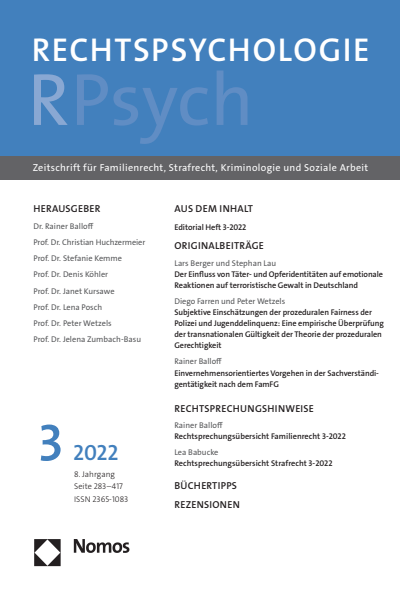
Die interdisziplinäre Zeitschrift Rechtspsychologie – RPsych bietet ein wissenschaftliches Forum für die Rechtspsychologie in Forschung und Praxis und bezieht dabei auch die Nachbardisziplinen ein. Besondere Schwerpunkte liegen im Familienrecht, im Strafrecht und der Kriminologie sowie in der Sozialen Arbeit – also in den Bereichen des Rechts, in denen psychologische Gutachten und Methoden eine besonders große Rolle spielen. In der Zeitschrift finden empirische und theoretische Abhandlungen ebenso Raum, wie Darstellungen aus der Praxis. Damit spiegelt die RPsych den state of the art der Rechtspsychologie wider und trägt maßgeblich zur Qualitätssicherung bei. Ergänzt werden die Abhandlungen durch Rezensionen, Tagungsberichte und Übersichten zur Entwicklung der Rechtsprechung. Die Qualität der Beiträge wird durch ein doppelt-blindes Peer-Review-Verfahren abgesichert. Die Zeitschrift richtet sich gleichermaßen an diejenigen, die psychologische Gutachten zu erstatten haben, wie an diejenigen, die in Justiz, Verwaltung, Anwaltschaft oder Beratung mit diesen Gutachten umgehen.
Als politische Strategie ist terroristische Gewalt abhängig von den emotionalen Reaktionen, die sie beim Zielpublikum auslöst. Die Verbreitung von Angst und Wut soll helfen, gesellschaftliche und politische Veränderungen im Sinne des...
Die Theorie der prozeduralen Gerechtigkeit nimmt an, dass die Art und Weise, wie Repräsentanten des Strafrechtssystems ihre Kontakte mit Bürger*innen gestalten, erheblichen Einfluss auf deren Bereitschaft zur Normkonformität hat. Dazu vorliegende...
Nach der gesetzlichen Vorgabe des § 163 Abs. 2 FamFG sollen psychologische Sachverständige in Familienrechtsverfahren immer dann auf Einvernehmen hinwirken, wenn dies Bestandteil des richterlichen Beschlusses ist und der/die Sachverständige...
Es wurden keine Treffer gefunden. Versuchen Sie einen anderen Begriff.
Asbrock, F. & Albrecht, M. (2020). „Die trägt ja als Deutsche ein Kopftuch“ – Der Einfluss autoritärer Einstellungen auf die Wahrnehmung der Verletzung kultureller Normen. Zeitschrift für Religion, Gesellschaft, Politik, 4(1), 105–126. Google Scholar öffnen doi.org/10.5771/2365-1083-2022-3-288
Backhaus, S., Gross, M., Waismel-Manor, I., Cohen, H. & Canetti, D. (2020). A Cyberterrorism Effect? Emotional Reactions to Lethal Attacks on Critical Infrastructure. Cyberpsychology, Behavior, and Social Networking, 23(9), 595–603. Google Scholar öffnen doi.org/10.5771/2365-1083-2022-3-288
Beierlein, C., Asbrock, F., Kauff, M. & Schmidt, P. (2014). Die Kurzskala Autoritarismus (KSA-3). Ein ökonomisches Messinstrument zur Erfassung dreier Subdimensionen autoritärer Einstellungen. Verfügbar unter: https://www.gesis.org/fileadmin/kurzskalen/working_papers/KSA3_WorkingPapers_2014-35.pdf [Zugriff am 15.02.2022] Institution: GESIS – Leibniz-Institut für Sozialwissenschaften. Google Scholar öffnen doi.org/10.5771/2365-1083-2022-3-288
Berntzen, L. & Sandberg, S. (2014). The Collective Nature of Lone Wolf Terrorism: Anders Behring Breivik and the Anti-Islamic Social Movement. Terrorism and Political Violence, 26(5), 759–779. Google Scholar öffnen doi.org/10.5771/2365-1083-2022-3-288
Bodenhausen, G. V., Kang, S. K. & Peery, D. (2012). Social categorization and the perception of social groups. In S. T. Fiske & C. N. Macrae (Hrsg.), The SAGE Handbook of Social Cognition (S. 318–336). Sage. Google Scholar öffnen doi.org/10.5771/2365-1083-2022-3-288
Bove, V., Efthyvoulou, G. & Pickard, H. (2021). Did Terrorism Affect Voting in the Brexit Referendum? British Journal of Political Science, 1–18. https://doi.org/10.1017/S0007123420000927 Google Scholar öffnen doi.org/10.5771/2365-1083-2022-3-288
Breyer, B. (2015). Left-Right Self-Placement (ALLBUS). Zusammenstellung sozialwissenschaftlicher Items und Skalen. doi:10.6102/zis83 Verfügbar unter: https://zis.gesis.org/skala/Breyer-Left-Right-Self-Placement-(ALLBUS) [Zugriff am 15.02.2022]. Google Scholar öffnen doi.org/10.5771/2365-1083-2022-3-288
Büttner, F., Lang, J., & Sigl, J. (2012). Mediale Klischeereproduktion: Zur Berichterstattung über die Neonazistin Zschäpe. Femina Politica–Zeitschrift für feministische Politikwissenschaft, 21(1), 123–127. Google Scholar öffnen doi.org/10.5771/2365-1083-2022-3-288
Cohrs, J.S. & Asbrock, F. (2009). Right-wing authoritarianism, social dominance orientation and prejudice against threatening and competitive ethnic groups. European Journal of Social Psychology, 39(2), 270–289. Google Scholar öffnen doi.org/10.5771/2365-1083-2022-3-288
Dumont, M., Yzerbyt, V., Wigboldus, D. & Gordijn, E. H. (2003). Social Categorization and Fear Reactions to the September 11th Terrorist Attacks. Personality and Social Psychology Bulletin, 29(12), 1509–1520. Google Scholar öffnen doi.org/10.5771/2365-1083-2022-3-288
Gaissmaier, W. & Gigerenzer, G. (2012). 9/11, Act II: A Fine-Grained Analysis of Regional Variations in Traffic Fatalities in the Aftermath of the Terrorist Attacks. Psychological Science, 23(12), 1449–1454. Google Scholar öffnen doi.org/10.5771/2365-1083-2022-3-288
Godefroidt, A. (2022). How Terrorism Does (and Does Not) Affect Citizens’ Political Attitudes: A Meta-Analysis. American Journal of Political Science. https://doi.org/10.1111/ajps.12692 Google Scholar öffnen doi.org/10.5771/2365-1083-2022-3-288
Hirsch-Hoefler, S., Canetti, D., Rapaport C. & Hobfoll, S. E. (2016). Conflict will harden your heart: Exposure to violence, psychological distress, and peace barriers in Israel and Palestine. British Journal of Political Science, 46(4), 845–859. Google Scholar öffnen doi.org/10.5771/2365-1083-2022-3-288
Hoffman, A. & Shelby, W. (2017). When the “Laws of Fear” Do Not Apply: Effective Counterterrorism and the Sense of Security from Terrorism. Political Research Quarterly, 70(3), 618–631. Google Scholar öffnen doi.org/10.5771/2365-1083-2022-3-288
Jones, S., Doxsee, C. & Harrington, N. (2020). The Right-wing Terrorism Threat in Europe. Verfügbar unter http://csis-website-prod.s3.amazonaws.com/s3fs-public/publication/Jones_EuropeTerrorism_WEB%20FINAL. [Zugriff am 14.02.2022] Institution: Center for Strategic and International Studies. Google Scholar öffnen doi.org/10.5771/2365-1083-2022-3-288
Manekin, D. & Wood R. M. (2020). Framing the Narrative: Female Fighters, External Audience Attitudes, and Transnational Support for Armed Rebellions. Journal of Conflict Resolution, 64(9), 1638–1665. Google Scholar öffnen doi.org/10.5771/2365-1083-2022-3-288
Matthes, J., Schmuck, D. & von Sikorski, C. (2019). Terror, Terror Everywhere? How Terrorism News Shape Support for Anti-Muslim Policies as a Function of Perceived Threat Severity and Controllability. Political Psychology, 40(5), 935–951. Google Scholar öffnen doi.org/10.5771/2365-1083-2022-3-288
Nägel, C. & Lutter, M. (2020). The Christmas Market Attack in Berlin and Attitudes toward Refugees: A Natural Experiment with Data from the European Social Survey. European Journal for Security Research, 5(2), 199–221. Google Scholar öffnen doi.org/10.5771/2365-1083-2022-3-288
Shanaah, S., Yogeeswaran, K., Greaves, L., Bulbulia, J., Osborne, D., Afzali, M. & Sibley, C. (2021). Hate Begets Warmth? The Impact of an Anti-Muslim Terrorist Attack on Public Attitudes toward Muslims. Terrorism and Political Violence, 1–19. Google Scholar öffnen doi.org/10.5771/2365-1083-2022-3-288
Skitka, L.J., Bauman, C.W., Aramovich, N.P. & Morgan, G.S. (2006). Confrontational and Preventative Policy Responses to Terrorism: Anger Wants a Fight and Fear Wants ‘Them’ to Go Away. Basic and Applied Social Psychology, 28, 375–384. Google Scholar öffnen doi.org/10.5771/2365-1083-2022-3-288
Solheim, Ø. & Jupskås, A. R. (2021). Consensus or Conflict? A Survey Analysis of How Norwegians Interpret the July 22, 2011 Attacks a Decade Later. Perspectives on Terrorism, 15(3), 109–131. Google Scholar öffnen doi.org/10.5771/2365-1083-2022-3-288
Steinbrecher, M., Biehl, H. & Graf, T. (2019). Sicherheits- und verteidigungspolitisches Meinungsbild in der Bundesrepublik Deutschland Ergebnisse und Analysen der Bevölkerungsbefragung 2019. Potsdam: Zentrum für Militärgeschichte und Sozialwissenschaften der Bundeswehr. Google Scholar öffnen doi.org/10.5771/2365-1083-2022-3-288
Tajfel, H. & Turner, J. C. (1986). The social identity theory of intergroup behavior. In S. Worchel & W. G. Austin (Hrsg.), Psychology of intergroup relations (S. 7–24). Chicago: Nelson-Hall. Google Scholar öffnen doi.org/10.5771/2365-1083-2022-3-288
Weiss, D. J. & John, R. (2009). Analyzing Projected Behavioral and Emotional Responses to Terrorism Threat. Create Research Archives. Verfügbar unter: http://research.create.usc.edu/project_summaries/27 Google Scholar öffnen doi.org/10.5771/2365-1083-2022-3-288
Adorjan, M., Ricciardelli, R. & Spencer, D. C. (2017). Youth perceptions of police in rural Atlantic Canada. Police Practice and Research, 18(6), 556–569. https://doi.org/10.1080/15614263.2017.1363961 Google Scholar öffnen doi.org/10.5771/2365-1083-2022-3-308
Boers, K. (2019). Delinquenz im Altersverlauf: Befunde der kriminologische Verlaufsforschung. In K. Boers & J. Reinecke (Hrsg.), Delinquenz im Altersverlauf: Erkenntnisse der Langzeitstudie Kriminalität in der modernen Stadt (S. 3–76). Münster: Waxmann. Google Scholar öffnen doi.org/10.5771/2365-1083-2022-3-308
Boers, K. & Reinecke, J. (2007). Verbreitung und Entwicklung delinquenten und abweichenden Verhaltens unter Jugendlichen. In K. Boers & J. Reinecke (Hrsg.), Delinquenz im Jugendalter: Erkenntnisse einer Münsteraner Längsschnittstudie (S. 79–95). Münster: Waxmann. Google Scholar öffnen doi.org/10.5771/2365-1083-2022-3-308
Brondies, M. & Pöge, A. (2007). Zusatzerhebungen. In K. Boers & J. Reinecke (Hrsg.), Delinquenz im Jugendalter: Erkenntnisse einer Münsteraner Längsschnittstudie (S. 75–77). Münster: Waxmann. Google Scholar öffnen doi.org/10.5771/2365-1083-2022-3-308
Cohen, P., Cohen, J., Aiken, L. S. & West, S. G. (1999). The Problem of Units and the Circumstance for POMP. Multivariate Behavioral Research, 34(3), 315–346. https://doi.org/10.1207/S15327906MBR3403_2 Google Scholar öffnen doi.org/10.5771/2365-1083-2022-3-308
Devlin, D. N. & Rennó Santos, M. (2022). The association between police officers in schools and students’ longer term perceptions of police as procedurally just. Criminology & Public Policy, 21(2), 273–301. https://doi.org/10.1111/1745-9133.12583 Google Scholar öffnen doi.org/10.5771/2365-1083-2022-3-308
Enzmann, D. (2018). Die Verbreitung von körperlicher Elterngewalt und Misshandlung im internationalen Vergleich: Ergebnisse der dritten International Self-Report Delinquency (ISRD‑3) Studie. Rechtspsychologie, 4(4), 456–476. https://doi.org/10.5771/2365-1083-2018-4-456 Google Scholar öffnen doi.org/10.5771/2365-1083-2022-3-308
Enzmann, D., Kivivuori, J., Marshall, I. H., Steketee, M., Hough, M. & Killias, M. (2018). A Global Perspective on Young People as Offenders and Victims. Cham: Springer International Publishing. https://doi.org/10.1007/978-3-319-63233-9 Google Scholar öffnen doi.org/10.5771/2365-1083-2022-3-308
Farren, D. & Hough, M. (2018). Teenagers’ Perceptions of Legitimacy and Preparedness to Break the Law: The Impact of Migrant and Ethnic Minority Status. In S. Roché & M. Hough (Hrsg.), Minority Youth and Social Integration: The ISRD-3 Study in Europe and the US (S. 219–243). Cham: Springer International Publishing. Google Scholar öffnen doi.org/10.5771/2365-1083-2022-3-308
Farren, D., Hough, M., Murray, K. & McVie, S. (2018). Trust in the Police and Police Legitimacy Through the Eyes of Teenagers. In S. Roché & M. Hough (Hrsg.), Minority Youth and Social Integration: The ISRD-3 Study in Europe and the US (S. 167–192). Cham: Springer International Publishing. Google Scholar öffnen doi.org/10.5771/2365-1083-2022-3-308
Farren, D. & Wetzels, P. (2022). Der Einfluss der Qualität polizeilichen Handelns bei Polizeikontrollen auf die Delinquenzbereitschaft junger Menschen: Eine empirische Prüfung der Theorie der prozeduralen Gerechtigkeit. KrimOJ (under review). Google Scholar öffnen doi.org/10.5771/2365-1083-2022-3-308
Heinz, W. (2019). Sekundäranalyse empirischer Untersuchungen zu jugendkriminalrechtlichen Maßnahmen, deren Anwendungspraxis, Ausgestaltung und Erfolg: Gutachten im Auftrag des Bundesministeriums für Justiz und Verbraucherschutz. Konstanz: Universität Konstanz. https://www.jura.uni-konstanz.de/typo3temp/secure_downloads/109923/0/ebd8a9f3f3260387bb308a49fb2b691acf59e5e2/Gutachten_JGG_Heinz_insg_01.pdf Google Scholar öffnen doi.org/10.5771/2365-1083-2022-3-308
Hough, M., Jackson, J. & Bradford, B. (2013). Legitimacy, Trust, and Compliance: An Empirical Test of Procedural Justice Theory Using the European Social Survey. In J. Tankebe & A. Liebling (Hrsg.), Legitimacy and Criminal Justice: An International Exploration (S. 326–352). Oxford: Oxford University Press. Google Scholar öffnen doi.org/10.5771/2365-1083-2022-3-308
Hough, M., Jackson, J. & Bradford, B. (2017). Policing, procedural justice and prevention. In N. Tilley & A. Sidebottom (Hrsg.), Handbook of crime prevention and community safety (S. 274–293). London: Routledge. Google Scholar öffnen doi.org/10.5771/2365-1083-2022-3-308
Hunold, D., Oberwittler, D. & Lukas, T. (2016). ‘I’d like to see your identity cards please’ – Negotiating authority in police–adolescent encounters: Findings from a mixed-method study of proactive police practices towards adolescents in two German cities. European Journal of Criminology, 13(5), 590–609. https://doi.org/10.1177/1477370816633724 Google Scholar öffnen doi.org/10.5771/2365-1083-2022-3-308
Lee, J. M., Steinberg, L. & Piquero, A. R. (2010). Ethnic identity and attitudes toward the police among African American juvenile offenders. Journal of Criminal Justice, 38(4), 781–789. https://doi.org/10.1016/j.jcrimjus.2010.05.005 Google Scholar öffnen doi.org/10.5771/2365-1083-2022-3-308
Mazerolle, L., Sargeant, E., Cherney, A., Bennett, S., Murphy, K., Antrobus, E. & Martin, P. (2014). Procedural Justice and Legitimacy in Policing. Cham: Springer International Publishing. https://doi.org/10.1007/978-3-319-04543-6 Google Scholar öffnen doi.org/10.5771/2365-1083-2022-3-308
Murphy, K. (2015). Does procedural justice matter to youth? Comparing adults' and youths' willingness to collaborate with police. Policing and Society, 25(1), 53–76. https://doi.org/10.1080/10439463.2013.802786 Google Scholar öffnen doi.org/10.5771/2365-1083-2022-3-308
Murray, K., McVie, S., Farren, D., Herlitz, L., Hough, M. & Norris, P. (2021). Procedural justice, compliance with the law and police stop-and-search: a study of young people in England and Scotland. Policing and Society, 31(3), 263–282. https://doi.org/10.1080/10439463.2020.1711756 Google Scholar öffnen doi.org/10.5771/2365-1083-2022-3-308
Nagin, D. S. & Telep, C. W. (2017). Procedural Justice and Legal Compliance. Annual Review of Law and Social Science, 13(1), 5–28. https://doi.org/10.1146/annurev-lawsocsci-110316-113310 Google Scholar öffnen doi.org/10.5771/2365-1083-2022-3-308
Oberwittler, D., Schwarzenbach, A. & Gerstner, D. (2014). Polizei und Jugendliche in multiethnischen Gesellschaften: Ergebnisse der Schulbefragung 2011 "Lebenslagen und Risiken von Jugendlichen" in Köln und Mannheim. Forschung aktuell: Bd. 47. Freiburg: Max-Planck-Institut für Ausländisches und Internationales Strafrecht. http://www.mpicc.de/shared/data/pdf/rib_47_oberwittler_ua.pdf Google Scholar öffnen doi.org/10.5771/2365-1083-2022-3-308
Reinecke, J. (2019). Entwicklungsverläufe von deviantem und delinquentem Verhalten im Jugendalter. In K. Boers & J. Reinecke (Hrsg.), Delinquenz im Altersverlauf: Erkenntnisse der Langzeitstudie Kriminalität in der modernen Stadt, (S. 145–181). Münster: Waxmann. Google Scholar öffnen doi.org/10.5771/2365-1083-2022-3-308
Roché, S. & Hough, M. (2018). Introduction: How Relations to Institutions Shape Youth Integration: Ethno-Religious Minorities, National Contexts and Social Cohesion. In S. Roché & M. Hough (Hrsg.), Minority Youth and Social Integration: The ISRD-3 Study in Europe and the US (S. 1–26). Cham: Springer International Publishing. Google Scholar öffnen doi.org/10.5771/2365-1083-2022-3-308
Solomon, S. J. (2019). How Do the Components of Procedural Justice and Driver Race Influence Encounter-Specific Perceptions of Police Legitimacy During Traffic Stops? Criminal Justice and Behavior, 46(8), 1200–1216. https://doi.org/10.1177/0093854819859606 Google Scholar öffnen doi.org/10.5771/2365-1083-2022-3-308
Steinberg, L. (2012). Should the Science of Adolescent Brain Development Inform Public Policy? Issues in Science and Technology, 28, No 3. https://issues.org/steinberg-science-adolescent-teenage-brain-policy Google Scholar öffnen doi.org/10.5771/2365-1083-2022-3-308
Testa, A., Turney, K., Jackson, D. B. & Jaynes, C. M. (2022). Police contact and future orientation from adolescence to young adulthood: Findings from the Pathways to Desistance Study. Criminology, 60 (2), 263–290. https://doi.org/10.1111/1745-9125.12297 Google Scholar öffnen doi.org/10.5771/2365-1083-2022-3-308
Trinkner, R., Mays, R. D., Cohn, E. S., Van Gundy, K. T., & Rebellon, C. J. (2019). Turning the corner on procedural justice theory: Exploring reverse causality with an experimental vignette in a longitudinal survey. Journal of Experimental Criminology, 15(4), 661–671. https://doi.org/10.1007/s11292-019-09358- Google Scholar öffnen doi.org/10.5771/2365-1083-2022-3-308
Tyler, T. R., Goff, P. A., & MacCoun, R. J. (2015). The Impact of Psychological Science on Policing in the United States: Procedural Justice, Legitimacy, and Effective Law Enforcement. Psychological Science in the Public Interest 16(3), 75-109. DOI: 10.1177/1529100615617791 Google Scholar öffnen doi.org/10.5771/2365-1083-2022-3-308
Tyler, T. R. & Trinker, R. (2017). Why children follow rules: Legal socialization and the development of legitimacy. Oxford: Oxford University Press. https://doi.org/10.1093/acprof:oso/9780190644147.001.0001 Google Scholar öffnen doi.org/10.5771/2365-1083-2022-3-308
Walburg, C. & Verneuer, L. M. (2019). Verbreitung von Delinquenz im Altersverlauf. In K. Boers & J. Reinecke (Hrsg.), Delinquenz im Altersverlauf: Erkenntnisse der Langzeitstudie Kriminalität in der modernen Stadt (S. 121–144). Münster: Waxmann. Google Scholar öffnen doi.org/10.5771/2365-1083-2022-3-308
Walters, G. D. & Bolger, P. C. (2019). Procedural justice perceptions, legitimacy beliefs, and compliance with the law: a meta-analysis. Journal of Experimental Criminology, 15(3), 341–372. https://doi.org/10.1007/s11292-018-9338-2 Google Scholar öffnen doi.org/10.5771/2365-1083-2022-3-308
Wolfe, S. E., Nix, J., Kaminski, R. & Rojek, J. (2016). Is the Effect of Procedural Justice on Police Legitimacy Invariant? Testing the Generality of Procedural Justice and Competing Antecedents of Legitimacy. Journal of Quantitative Criminology, 32(2), 253–282. https://doi.org/10.1007/s10940-015-9263-8 Google Scholar öffnen doi.org/10.5771/2365-1083-2022-3-308
Arbeitsgruppe Familienrechtliche Gutachten (2019). Mindestanforderungen an die Qualität von Sachverständigengutachten im Kindschaftsrecht. 2. Auflage. Berlin: Deutscher Psychologen Ver-lag. Google Scholar öffnen doi.org/10.5771/2365-1083-2022-3-345
Balloff, R. (2016a). Grundlagen des Hinwirkens auf Einvernehmen durch den Sachverständigen. In: R. Balloff & P. Wetzels (Hrsg.). Prinzipien, Grundlagen, Methodik und Qualität psychologischer Begutachtung in familiengerichtlichen Verfahren, (S. 48–59). Baden-Baden: Nomos,. Google Scholar öffnen doi.org/10.5771/2365-1083-2022-3-345
Balloff, R. (2016b). Replik zu den Ausführungen von Klemmert: Wie entsteht und woran erkennt man ein qualitativ gutes Sachverständigengutachten? – ZKJ 2015, 415–417 (Teil 1) u. 453–457 (Teil 2). Zeitschrift für Kindschaftsrecht und Jugendhilfe, 11(1), 15–16. Google Scholar öffnen doi.org/10.5771/2365-1083-2022-3-345
Bergau, B. & Cornelia, U. (2015). Empirische Befunde zur lösungsorientierten Begutachtung als In-tervention bei hochstrittiger Trennung und Scheidung. Neue Zeitschrift für Familienrecht, 2(17), S. 785–788. Google Scholar öffnen doi.org/10.5771/2365-1083-2022-3-345
Salzgeber, J., Bergau, B. & Fichtner, J. (2011). Lösungsorientierte Begutachtung bei Hochkonfliktfa-milien. In: S. Walper, J. Fichtner & K. Normann (Hrsg.), Hochkonflikthafte Trennungsfamilien, (S173–187). Weinheim München: Juventa. Google Scholar öffnen doi.org/10.5771/2365-1083-2022-3-345