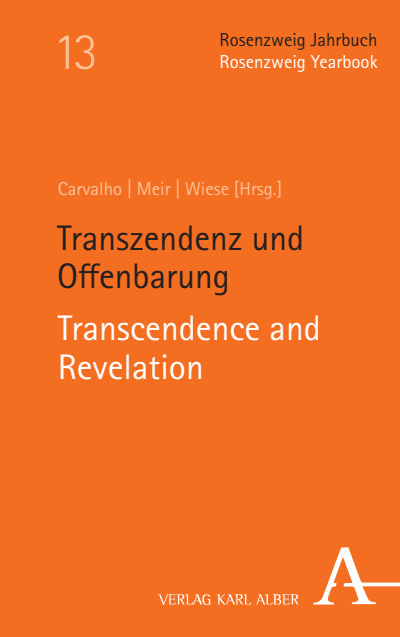
Rosenzweig Jahrbuch / Rosenzweig Yearbook
Transzendenz und Offenbarung / Transcendence and Revelation- Herausgeber:innen:
- | |
- Reihe:
- Rosenzweig-Jahrbuch, Band 13
- Verlag:
- 2023
Zusammenfassung
Die vorliegende Ausgabe des Rosenzweig-Jahrbuchs geht auf einen Kongress im Dezember 2021 in Coimbra zurück, der die weltweit angesehensten Rosenzweig-Interpreten versammelte. Der Kongress stand unter dem Titel "´Wir wissen auch jetzt noch nichts von Gott.` Transzendenz und Offenbarung zum hundertsten Jubiläum von Franz Rosenzweigs Stern der Erlösung". Die verschiedenen Beiträge in diesem Band behandeln Themen wie dialogische Ethik, den interreligiösen Dialog, Phänomenologie der Liebe und Interpretationen der Geschichte und der Transzendenz. Sie zeigen den immensen Einfluss von Rosenzweigs Leben und Werk auf Philosophie und jüdisches Denken auf und widmen sich auch bisher weniger beachteten Ansätzen des großen Denkers wie beispielsweise der Rolle der Algebra und seine Perspektiven auf pädagogische und therapeutische Aufgaben. Der Band enthält zudem eine neue Übersetzung von Rosenzweigs "Globus" durch Malcolm Goldman, die die Sensibilität des Philosophen für die historischen Dynamiken der Weltgeopolitik offenbart. Der lebhafte Bericht des Rosenzweig-Kongresses in Frankfurt im Juli 2022 von Frank Hahn schließt den Band ab und ist ein weiteres Zeichen für die Vitalität von Rosenzweigs Denken.Mit Beiträgen vonWith contributions byEdmundo Balsemão Pires | Myriam Bienenstock | Cláudio Alexandre S. Carvalho | Francesco Paolo Ciglia | Emeline Durand | Pierfrancesco Fiorato | Frank Hahn | Ido Ben Harush | Monika D. Kaminska | Stanisław Krajewski | Jacob Levi | Gesine Palmer | Eugenio Muinelo Paz | Franz Rosenzweig | Leopoldo Sandonà | Naomi Tanaka | Karl S. Sen Gupta
Schlagworte
Publikation durchsuchen
Bibliographische Angaben
- Copyrightjahr
- 2023
- ISBN-Print
- 978-3-495-99552-5
- ISBN-Online
- 978-3-495-99553-2
- Verlag
- Karl Alber, Baden-Baden
- Reihe
- Rosenzweig-Jahrbuch
- Band
- 13
- Sprache
- Deutsch
- Seiten
- 381
- Produkttyp
- Sammelband
Inhaltsverzeichnis
- Titelei/Inhaltsverzeichnis Kein Zugriff Seiten 1 - 16
- Autor:innen:
- I – From pagan separation to Revelation – the religious schema and its binary code Kein Zugriff
- 1. Alone in Prayer Kein Zugriff
- 2. The Hour and the Communal prayer Kein Zugriff
- 3. Two social modes enacting the religious code – Judaism and Christianity Kein Zugriff
- III – Transcendence as Sociability – the social setting of the religious schema Kein Zugriff
- IV – Concluding Remarks Kein Zugriff
- Autor:innen:
- I Kein Zugriff
- II Kein Zugriff
- III Kein Zugriff
- Levinas, Rosenzweig, and Antitheodicy: Kenotic Resonances in Levinas and Rosenzweig Kein Zugriff Seiten 57 - 72Autor:innen:
- Autor:innen:
- I. Introduction Kein Zugriff
- II. Rosenzweig, Allheit, and »Absolute Empiricism« Kein Zugriff
- III. Levinas’ Critique of Totality and the »Excendence« of Being Kein Zugriff
- IV. Transcendence and Immanence in the Myth of Gyges’ Ring Kein Zugriff
- V. Conclusion Kein Zugriff
- On Miracles and Experience: Franz Rosenzweig and Isaac Breuer Kein Zugriff Seiten 95 - 118Autor:innen:
- Autor:innen:
- 1. Der Diskussionsbeitrag zur Rosenzweig-Feier Kein Zugriff
- 2. Die Notizen über Messianismus und Gerechtigkeit aus den Jahren 1918/19 Kein Zugriff
- 3. Maimonides, Cohen und Rosenzweig Kein Zugriff
- 4. Neutralisierungsstrategien Kein Zugriff
- Autor:innen:
- Introduction Kein Zugriff
- Cohen’s part of the story Kein Zugriff
- A. Reality in motion Kein Zugriff
- B. Expressing the inexpressible Kein Zugriff
- C. Finite agents of revelation Kein Zugriff
- D. Messianic theory of knowledge Kein Zugriff
- E. Judaism associated with irrational and Christianity with rational numbers Kein Zugriff
- F. Mathematics over mathematics Kein Zugriff
- Overcoming the contradiction Kein Zugriff
- Additional remark Kein Zugriff
- Additional remark Kein Zugriff
- Additional remark Kein Zugriff
- D. Messianic theory of knowledge – see below. Kein Zugriff
- Additional remark Kein Zugriff
- F. More sophisticated mathematics Kein Zugriff
- D. again: the »messianic theory of knowledge« Kein Zugriff
- Autor:innen:
- 0. Kein Zugriff
- 1. Revelation and its therapeutic dimension. Kein Zugriff
- 2. The transient dual in the workings of redemption. Kein Zugriff
- 3. Destiny and therapy. Kein Zugriff
- Autor:innen:
- Premise Kein Zugriff
- Star, redemption and eschatology Kein Zugriff
- The heart of the Star: between redemption and revelation Kein Zugriff
- Perspectives for politics Kein Zugriff
- Autor:innen:
- 1. Éros and agápe: an ill-considered problem Kein Zugriff
- 2. Revelation as »grammar of Éros« Kein Zugriff
- 3. Éros without allegory Kein Zugriff
- Autor:innen:
- Preliminary Remarks Kein Zugriff
- 1. The Subtraction Passage Kein Zugriff
- 2. The Skipped Part of the Subtraction Passage Kein Zugriff
- 3. Ethics and the Right to be Right Kein Zugriff
- Epilogue on Anti-Zionist Perusal of the Subtraction Passage Kein Zugriff
- Autor:innen:
- 1. « Sentiment de Dieu » versus « religion » Kein Zugriff
- 2. « Paganisme », ontologie intuitive de la différence Kein Zugriff
- 3. « Révélation », intuition narrative des évènements relationnels Kein Zugriff
- 4. Judaïsme et Christianisme Kein Zugriff
- 5. Au-delà de la « religion » Kein Zugriff
- 6. Une pensée « rythmique » à deux phases Kein Zugriff
- 7. « Religatio » Kein Zugriff
- 8. Pour une laïcité des différences en relation Kein Zugriff
- Autor:innen:
- I. Le concept rosenzweigien de l’expérience. Kein Zugriff
- II. La philosophie au risque de l’expérience. Kein Zugriff
- III. L’expérience de la langue. Kein Zugriff
- Autor:innen:
- A basic category in Rosenzweig’s educational thoughts; Openness or the State of Readiness Kein Zugriff
- Teachings (Lehre) and hermeneutical tradition in Judaism by Eliezer Berkovits Kein Zugriff
- What could the significance of dialogical teaching and learning for Western European philosophy of dialog after the Second World War be? Kein Zugriff
- Difference and Trans-difference by Ephraim Meir Kein Zugriff
- Final remarks Kein Zugriff
- Autor:innen:
- Introduction Kein Zugriff
- 1.1. The God who promised the eternal life to Jewish people Kein Zugriff
- 1.2. The God who initiates the Dialogue Kein Zugriff
- 2.1. The God who needs to be the renewal of existence Kein Zugriff
- 2.2. The God who is an absent Other causing time Kein Zugriff
- 3.1. The God who will come in the future Kein Zugriff
- 3.2. The God who sojourns in this world Kein Zugriff
- 4 Conclusion Kein Zugriff
- Autor:innen:
- Introduction Kein Zugriff
- ECUMENEWORLD-STATE AND WORLD OF STATES Kein Zugriff
- THALATTANAVAL DOMINANCE AND MARITIME FREEDOM Kein Zugriff
- Autor:innen:
- Geschichte des eigenen Lebens Kein Zugriff
- Weltgeschichte Kein Zugriff
- Bliebe oder ginge er? Rosenzweig hier und heute Kein Zugriff
- Der Rest Kein Zugriff
- Jüdisch-christlicher Dialog Kein Zugriff
- Was bleibt? Kein Zugriff
Literaturverzeichnis (53 Einträge)
Es wurden keine Treffer gefunden. Versuchen Sie einen anderen Begriff.
- Stanisław Krajewski, »Can a Robot Be Grateful? Beyond Logic, Towards Religion«, in: Eidos. A Journal for Philosophy of Culture 4 (6)/2018, 4–13. Google Scholar öffnen doi.org/10.5771/9783495995532-139
- John Horton Conway, On numbers and games, 2nd ed., A K Peters, Ltd, Natick, MA 2001. Google Scholar öffnen doi.org/10.5771/9783495995532-139
- Scott Edgar, »Principle of the Infinitesimal Method: A Rationalist Interpretation«, DRAFT of April, 2014. Google Scholar öffnen doi.org/10.5771/9783495995532-139
- Scott Edgar, »Hermann Cohen’s Principle of the Infinitesimal Method: A Defense«, in: HOPOS: The Journal of the International Society for the History of Philosophy of Science 10 (2), 2020. Google Scholar öffnen doi.org/10.5771/9783495995532-139
- Ilya Dvorkin, »A Mathematical Road to Liturgy. Religion and Mathematics in Franz Rosenzweig’s Philosophy«, in: Judaica Petropolitana № 7 (2017), 70–80. Google Scholar öffnen doi.org/10.5771/9783495995532-139
- Amos Funkenstein, Perceptions of Jewish history, University of California Press, Berkeley 1993. Google Scholar öffnen doi.org/10.5771/9783495995532-139
- Marco Giovanelli, »Hermann Cohen’s Das Princip der Infinitesimal-Methode: The History of an Unsuccessful Book«, long draft of Giovanelli, 2016. Google Scholar öffnen doi.org/10.5771/9783495995532-139
- Marco Giovanelli, »Hermann Cohen’s Das Princip der Infinitesimal-Methode: The History of an Unsuccessful Book«, in: Studies in History and Philosophy of Science Part A 58:9–23 (2016). Doi: 10.1016/j.shpsa.2016.02.002 Google Scholar öffnen doi.org/10.5771/9783495995532-139
- Nahum Glatzer, Franz Rosenzweig, His Life and Thought, 2nd ed., Schocken Books, New York 1961. Google Scholar öffnen doi.org/10.5771/9783495995532-139
- Harry Gonshor, An Introduction to the Theory of Surreal Numbers, London Mathematical Society, 1986. Google Scholar öffnen doi.org/10.5771/9783495995532-139
- Peter Eli Gordon, Rosenzweig and Heidegger Between Judaism and German Philosophy, University of California Press, Berkeley 2003. Google Scholar öffnen doi.org/10.5771/9783495995532-139
- Matthew Handelman, »Franz Rosenzweig’s Modern Mathematics«, in: Leo Baeck Institute Year Book Vol. 57, 2012, 145–161. Google Scholar öffnen doi.org/10.5771/9783495995532-139
- Matthew Handelman, The Mathematical Imagination: On the Origins and Promise of Critical Theory, Fordham University Press, New York 2019. Google Scholar öffnen doi.org/10.5771/9783495995532-139
- Donald Knuth, Surreal Numbers, Pearson Education, 1974. Google Scholar öffnen doi.org/10.5771/9783495995532-139
- Hermann Cohen, System der Philosophie, Erster Teil: Logik der reinen Erkenntnis, Bruno Cassirer, Berlin 1902. Google Scholar öffnen doi.org/10.5771/9783495995532-139
- Stanisław Krajewski, »On Suprasubjective Existence in Mathematics«, in: Studia Semiotyczne XXXII, No 2, 2018b, 75–86. Google Scholar öffnen doi.org/10.5771/9783495995532-139
- Stanislaw Krajewski, »Is Mathematics Connected to Religion?«, in: B. Sriraman (Ed.) Handbook of the History and Philosophy of Mathematical Practice. Springer, Cham 2022. https://doi.org/10.1007/978-3-030-19071-2_77-2 Google Scholar öffnen doi.org/10.5771/9783495995532-139
- George Lakoff and Mark Johnson, Metaphors We Live By, University of Chicago Press, Chicago 1980. Google Scholar öffnen doi.org/10.5771/9783495995532-139
- George Lakoff and Rafael E. Núñez, Where Mathematics Comes From: How the Embodied Mmind Brings Mathematics into Being, Basic Books, New York 2000.Hans Reichenbach, Experience and Prediction. An Analysis of the Foundations and the Structure of Knowledge, The University of Chicago Press, Chicago 1938. Google Scholar öffnen doi.org/10.5771/9783495995532-139
- Abraham Robinson, Non-standard Analysis, Princeton University Press, Princeton 1974. Google Scholar öffnen doi.org/10.5771/9783495995532-139
- Rosenzweig, Franz. The Star of Redemption, transl. by William W. Hallo, Holt, Reinehart and Winston, Inc., New York 1970. Google Scholar öffnen doi.org/10.5771/9783495995532-139
- Franz Rosenzweig, Star of Redemption, transl. by Barbara E. Galli, Madison 2005. Google Scholar öffnen doi.org/10.5771/9783495995532-139
- Norbert Samuelson, A User’s Guide to FR’s Star of Redemption, Curzon Press, Richmond, Va. 1999. Google Scholar öffnen doi.org/10.5771/9783495995532-139
- Norbert Samuelson, Judaism and the Doctrine of Creation, Cambridge University Press, Cambridge 2007. Google Scholar öffnen doi.org/10.5771/9783495995532-139
- Norbert Samuelson, »Review of Pollock’s 2009 Franz Rosenzweig and the Systematic Task of Philosophy«, in: Journal of the American Academy of Religion 2010, 573–576, doi: 10.1093/jaarel/lfq015 Google Scholar öffnen doi.org/10.5771/9783495995532-139
- John H. Smith, »The Infinitesimal as Theological Principle: Representing the Paradoxes of God and Nothing in Cohen, Rosenzweig, Scholem, and Barth«, in: MLN 127, No. 3, 2012, 562–588. Google Scholar öffnen doi.org/10.5771/9783495995532-139
- Sebastian Wogenstein, »Alterity and Liminality in Hermann Cohen’s Writings«, in: Naharaim: Zeitschrift für deutsch-jüdische Literatur und Kulturgeschichte 2, 2008, 159–173. Google Scholar öffnen doi.org/10.5771/9783495995532-139
- Emmanuel Levinas, »Loving the Torah More Than God« Afterword, in: Yosl Rakover Talks to God, Zvi Kollitz (Ed.), trans Carol Brown Janeway, Pantheon Books, New York 1999 (79–87). Google Scholar öffnen doi.org/10.5771/9783495995532-57
- Maurice Blanchot, The Writing of the Disaster, trans. Ann Smock, University of Nebraska Press, Lincoln 1995. Google Scholar öffnen doi.org/10.5771/9783495995532-57
- Gregory A. Boyd, God at War: The Bible and Spiritual Conflict. InterVaristy Press, Downers Grove, IL 1997. Google Scholar öffnen doi.org/10.5771/9783495995532-57
- Ruth Coates, Christianity in Bakhtin: God and the Exiled Author, Cambridge University Press, Cambridge 1998. Google Scholar öffnen doi.org/10.5771/9783495995532-57
- Richard A. Cohen, Ethics, Exegesis and Philosophy: Interpretation After Levinas, Cambridge University Press, Cambridge 2001. Google Scholar öffnen doi.org/10.5771/9783495995532-57
- Fyodor Dostoevsky, The Brothers Karamazov, trans. Richard Pevear and Larissa Volokhonsky, Farar, Straus and Giroux, New York 1990. Google Scholar öffnen doi.org/10.5771/9783495995532-57
- Viktor E. Frankl, The Doctor and the Soul: From Psychotherapy to Logotherapy, trans. Richard and Clara Winston. Vintage Books, 1986. Google Scholar öffnen doi.org/10.5771/9783495995532-57
- Joseph Franks, Dostoevsky: The Writer in His Time, Princeton University Press, Princeton 2010. Google Scholar öffnen doi.org/10.5771/9783495995532-57
- David Ray Griffin, God, Power, and Evil: A Process Theodicy, Westminster John Knox, Philadelphia 2004. Google Scholar öffnen doi.org/10.5771/9783495995532-57
- Abraham Joshua Heschel, Man’s Quest for God: Studies in Prayer and Symbolism, Aurora Press, Sante Fe 1998. Google Scholar öffnen doi.org/10.5771/9783495995532-57
- Primo Levi, Survival in Auschwitz, trans. Stuart Woolf. Touchstone, New York 1993. Google Scholar öffnen doi.org/10.5771/9783495995532-57
- Emmanuel Levinas, Totality and Infinity, trans. Alphonso Lingis, Duquesne University Press, Pittsburgh 1969. Google Scholar öffnen doi.org/10.5771/9783495995532-57
- Emmanuel Levinas, »The Temptation of Temptation«, in: Nine Talmudic Readings, trans. Annette Aronowicz, Indiana University Press, Bloomington 1994. Google Scholar öffnen doi.org/10.5771/9783495995532-57
- Lorenzo Albacete, God at the Ritz: Attraction to Infinity, Crossroad Publishing Company, New York 2002. Google Scholar öffnen doi.org/10.5771/9783495995532-57
- Emmanuel Levinas, Is It Righteous to Be? Interviews with Emmanuel Levinas, Jill Robbins (Ed.), Stanford University Press, Stanford 2001. Google Scholar öffnen doi.org/10.5771/9783495995532-57
- Emmanuel Levinas, »Judaism and Kenosis«, in: In the Time of the Nations, trans. Michael B. Smith, Continuum, London 2007. Google Scholar öffnen doi.org/10.5771/9783495995532-57
- Irwin Lutzer, Hitler’s Cross, Moody Press, Chicago 1995. Google Scholar öffnen doi.org/10.5771/9783495995532-57
- Nancy Murphy and George F. R. Ellis, On the Moral Nature of the Universe: Theology, Cosmology, and Ethics, Fortress Press, Minneapolis 1996. Google Scholar öffnen doi.org/10.5771/9783495995532-57
- Nancy R. Pearcey and Charles B. Thaxton, The Soul of Science: Christian Faith and Natural Philosophy, Crossway Books, Wheaton, Illinois 1994. Google Scholar öffnen doi.org/10.5771/9783495995532-57
- John Polkinghorne (Ed.), The Work of Love: Creation as Kenosis. Eerdman’s, Grand Rapids, MI 2001. Google Scholar öffnen doi.org/10.5771/9783495995532-57
- Franz Rosenzweig, The Star of Redemption, trans. William W. Hallo, University of Notre Dame Press, Notre Dame 1985. Google Scholar öffnen doi.org/10.5771/9783495995532-57
- Franz Rosenzweig, Understanding the Sick and the Healthy: A View of World, Man, and God, trans. Nahum Glazer, Harvard University Press, Cambridge, MA 1999. Google Scholar öffnen doi.org/10.5771/9783495995532-57
- John Sanders, The God Who Risks: A Theology of Providence, InterVarsity Press, Downers Grove 1998. Google Scholar öffnen doi.org/10.5771/9783495995532-57
- Nosson Scherman (Ed.), The Chumash: The Stone Edition, Mesorah Publications, Brooklyn 2001. Google Scholar öffnen doi.org/10.5771/9783495995532-57
- Samuel J. Youngs, The Way of the Kenotic Christ: The Christology of Jürgen Moltmann, Cascade Books, Eugene, OR 2019. Google Scholar öffnen doi.org/10.5771/9783495995532-57
- Hermann Cohen, Das Prinzip der Infinitesimal-Methode und seine Geschichte: Ein Kapitel zur Grundlegung der Erkenntniskritik, Dümmler, Berlin 1883. Google Scholar öffnen doi.org/10.5771/9783495995532-139