, um zu prüfen, ob Sie einen Vollzugriff auf diese Publikation haben.
Sammelband Kein Zugriff

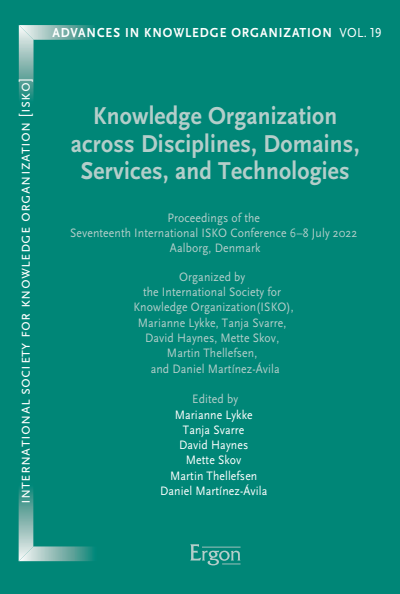
Knowledge Organization across Disciplines, Domains, Services and Technologies

Proceedings of the Seventeenth International ISKO Conference 6–8 July 2022 Aalborg, Denmark
Herausgeber:innen:
Verlag:
 2022

Schlagworte


Publikation durchsuchen


Bibliographische Angaben

Copyrightjahr
2022
ISBN-Print
978-3-95650-955-1
ISBN-Online
978-3-95650-956-8
Verlag
Ergon, Baden-Baden
Reihe
Advances in Knowledge Organization
Band
19
Sprache
Englisch
Seiten
364
Produkttyp
Sammelband

Inhaltsverzeichnis

KapitelSeiten
  1. Titelei/Inhaltsverzeichnis Kein Zugriff Seiten 1 - 10
  2. Revisiting Domain: Phases of Evolution, Typology, Classification Kein Zugriff Seiten 11 - 22
    Autor:innen:
  3. Archival Classification as Knowledge Organization Kein Zugriff Seiten 23 - 36
    Autor:innen:
  4. The Indexical Bibliography: A Historic-Bibliographic Paradigm for Knowledge Organization Kein Zugriff Seiten 37 - 48
    Autor:innen:
  5. Eliminating Racism in Education for Knowledge Organization and Library and Information Science: An Intercontinental Position Statement Kein Zugriff Seiten 49 - 62
    Autor:innen:
  6. Bias as a Means to Identify Cultural Warrant: An Approach from Cultural Representation Kein Zugriff Seiten 63 - 72
    Autor:innen:
  7. Interoperability and Standardization of Web Navigation Taxonomies: Clarifying some Operational Concepts and Developing a Tentative Basic Vocabulary Kein Zugriff Seiten 73 - 86
    Autor:innen:
  8. Object Recognition as Classification via Visual Properties Kein Zugriff Seiten 87 - 100
    Autor:innen:
  9. Taiga Penguins: Expressing Existence and Fictionality in a Phenomenon-Based Classification Kein Zugriff Seiten 101 - 110
    Autor:innen:
  10. TAXChe: An Online Taxonomy for Che’s Marginalias: A Proposal from the Digital Humanities Kein Zugriff Seiten 111 - 120
    Autor:innen:
  11. The Categorisation of Public Library Materials: Mental Models of the Bibliographic Universe Revisited Kein Zugriff Seiten 121 - 132
    Autor:innen:
  12. Analyzing the Structure and Dynamics of Control Relationships in the Case of “Illegal Aliens” in the Library of Congress Subject Headings Kein Zugriff Seiten 133 - 146
    Autor:innen:
  13. “Taxonomic Impediment” Impacts on Biodiversity Research: Contributions Based on Knowledge Organization Kein Zugriff Seiten 147 - 158
    Autor:innen:
  14. Monothetic Classification and Polythetic Classification: A Cognitive-Developmental Perspective Kein Zugriff Seiten 159 - 172
    Autor:innen:
  15. Developing a Digital Forensics Terminology Using Natural Language Processing Kein Zugriff Seiten 173 - 186
    Autor:innen:
  16. Knowledge Organisation Across Aural and Visual Domains: Connecting the Facets of Music and Art Kein Zugriff Seiten 187 - 200
    Autor:innen:
  17. Knowledge Organization Through the Shaping of Documents: The Case of Medieval Books Kein Zugriff Seiten 201 - 210
    Autor:innen:
  18. Semantic Mapping for Domain Analysis: Identification of Discursive Practice in the Mining Arena in Southeastern Pará Kein Zugriff Seiten 211 - 218
    Autor:innen:
  19. Library and Information Science: Analysis of the New Tterms Kein Zugriff Seiten 219 - 232
    Autor:innen:
  20. Knowledge Organization and the UN 2030 Agenda Through the Lens of Interoperability Kein Zugriff Seiten 233 - 248
    Autor:innen:
  21. Comparing UDC and BCC for Works of Music Kein Zugriff Seiten 249 - 260
    Autor:innen:
  22. Toward a General Theory of Knowledge Organization Kein Zugriff Seiten 261 - 272
    Autor:innen:
  23. Context as a Core Concept in Archival Knowledge Organization Kein Zugriff Seiten 273 - 284
    Autor:innen:
  24. Archival Knowledge Organization: A Terminological Review of Impartiality from the Epistemological Approach Kein Zugriff Seiten 285 - 296
    Autor:innen:
  25. Academic Warrant and Knowledge Representation: Consensus, Dissension and Expert Opinion Kein Zugriff Seiten 297 - 302
    Autor:innen:
  26. Plain Language + Machine Translation as a Form of Cultural Hospitality for Knowledge Representation Kein Zugriff Seiten 303 - 310
    Autor:innen:
  27. Confusing, Inaccurate, and Just Goofy: Author Assessments of ‘Indians of North America’ Cataloguing Kein Zugriff Seiten 311 - 320
    Autor:innen:
  28. Challenges for Subject Categorization of Fake News about COVID-19 in Brazil: Knowledge Organization against Disinformation Kein Zugriff Seiten 321 - 330
    Autor:innen:
  29. Emerging Cadastral and Related Geospatial Ontologies: A Review in Making Kein Zugriff Seiten 331 - 338
    Autor:innen:
  30. Designing an RDA Application Profile for Academic Libraries: An In-Progress Iranian Experience Kein Zugriff Seiten 339 - 348
    Autor:innen:
  31. Examining Existing Approaches Toward Semantic Disambiguation Kein Zugriff Seiten 349 - 352
    Autor:innen:
  32. Identification of the Actors Involved in COVID-19 Discussions on Twitter at the Beginning of the Epidemic: A Study of Rumors and Tweets Posted Kein Zugriff Seiten 353 - 356
    Autor:innen:
  33. Research Methods and Techniques on the Knowledge Organization in Institutional Repositories Kein Zugriff Seiten 357 - 360
    Autor:innen:
  34. Author Index Kein Zugriff Seiten 361 - 362
  35. International Scientific Committee Kein Zugriff Seiten 363 - 364

Ähnliche Veröffentlichungen

aus der Reihe "Advances in Knowledge Organization"
Cover des Buchs: Knowledge Organization for Resilience in Times of Crisis: Challenges and Opportunities
Sammelband Kein Zugriff
Wei Lu, Thiago Henrique Bragato Barros, Lu An, Daniel Martínez-Ávila
Knowledge Organization for Resilience in Times of Crisis: Challenges and Opportunities
Cover des Buchs: Knowledge Organization at the Interface
Sammelband Kein Zugriff
International Society for Knowledge Organziation (ISKO), Marianne Lykke, Tanja Svarre, Mette Skov, Daniel Martínez-Ávila
Knowledge Organization at the Interface
Cover des Buchs: Challenges and Opportunities for Knowledge Organization in the Digital Age
Sammelband Kein Zugriff
Fernanda Ribeiro, Maria Elisa Cerveira
Challenges and Opportunities for Knowledge Organization in the Digital Age