, um zu prüfen, ob Sie einen Vollzugriff auf diese Publikation haben.
Zeitschrift Teilzugriff
integration
Vierteljahreszeitschrift des Instituts für Europäische Politik in Zusammenarbeit mit dem Arbeitskreis Europäische Integration
Herausgeber:innen:
Prof. Dr. Frank Schimmelfennig (Vorsitz), Zürich | Prof. Dr. Thomas Christiansen, Rom | Prof. Dr. Friedrich Heinemann, Mannheim | Prof. Dr. Mathias Jopp, Berlin | Prof. Dr. Friedemann Kainer, Mannheim | Prof. Dr. Michèle Knodt, Darmstadt | Dr. Barbara Lippert, Berlin | Prof. Dr. Hartmut Marhold, Berlin | Prof. Dr. Franz Mayer, Bielefeld | Prof. Dr. Peter-Christian Müller-Graff, Heidelberg | Prof. Dr. Martin Nettesheim, Tübingen | Prof. Dr. Joachim Schild, Trier | Prof. Dr. Wolfgang Wessels, Köln
Relations between the European Union (EU) and Turkey have been highly topical in recent years. Growing hostilities, political turmoil and verbal skirmishes have kept this partnership in the limelight and aroused heated discussions in academic,...
There is currently momentum to put the European Union's (EU) enlargement policy as a whole to the test and, where necessary, to fundamentally reform it. This article aims to identify, contextualise and analyse the relevant points of reference in...
The United Kingdom’s exit from the European Union (EU) in January 2020 marks a historic milestone in the European integration process. For the first time since its foundation the EU faces the existential question if the specific domestic political...
The principle of “degressive proportionality” in European elections ensures that even the smallest member states are adequately represented in the European Parliament. However, it is detrimental to transnational electoral equality: votes cast in...
After having played a minor role in European politics for a long time, national parliaments were empowered to “guardians of subsidiarity” under the Lisbon Treaty. This article scrutinizes whether they have succeeded in influencing European Union...
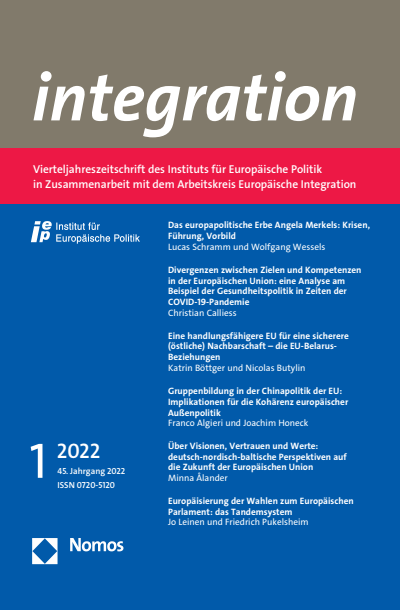
In view of numerous contributions, and especially on the occasion of Angela Merkel’s last participation in a meeting of the European Council in October 2021, this contribution analyzes the work and effects of the former Chancellor on European...
The European treaties assign goals and tasks to the European Union that sometimes do correspond to the conferral of a very limited competence by the member states. Using the corona crisis as an example, the text highlights the problematic nature of...
Since the fraudulent presidential elections in Belarus in August 2020, the country has been in the midpoint of a geopolitical stand-off. Unprecedented violence against peaceful protesters, economic and political sanctions against the regime in Minsk...
The tandem system provides a frame for the election of the European Parliament paying due tribute to the European level of the event. It invites Europarties to contest the election with power, visibility and influence. The system proceeds in three...
Relations with China are of high priority in the context of the European Union’s (EU) foreign policy. They reflect strengths and weaknesses of the EU as an actor in international relations. Regarding the issue of coherence in European foreign...
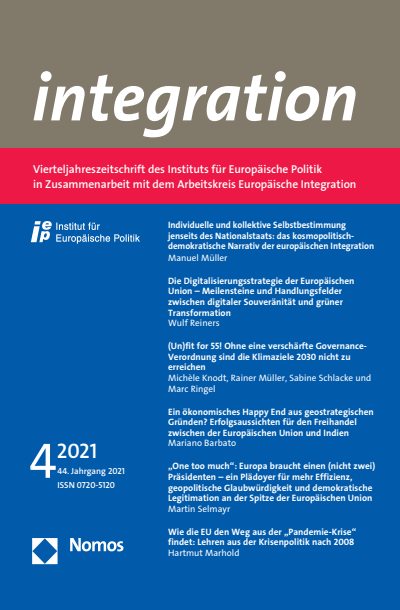
Since the 2010s, severe crises have hit the European Union (EU) approximately every five years: first the financial and euro crisis, then the migration crisis and Brexit, and last (but certainly not least) the COVID-19 pandemic. The crises have left...
Digital transformation has been accelerated by the COVID-19 pandemic. Today, it affects almost all areas of social and economic life. As a cross-cutting issue and solution to specific challenges, it is also increasingly the subject of initiatives at...
The talks that have been resumed for reaching a free trade agreement between the European Union and India have a good chance for success. Both partners, especially India, have to achieve new economic dynamics in order to be able to face the...